Is Austin Chamber of Commerce Membership Actually Worth It for a Small Business Owner
We interviewed current members, former members who walked away, and the people running the alternatives — so you can decide before you write the check.

We interviewed current members, former members who walked away, and the people running the alternatives — so you can decide before you write the check.
There’s a specific moment most Austin small business owners recognize. It arrives as a PDF in your inbox, usually in November or January, and it has a dollar amount on it that felt reasonable when you joined but now requires a brief, uncomfortable conversation with yourself. The renewal notice from the Greater Austin Chamber of Commerce sits there. You look at it. You look at your Q4 numbers. You try to remember the last time the membership did something concrete — not a ribbon-cutting photo, not a newsletter, but actual business — and you make a decision you’re not entirely sure about either way.
That moment is what this piece is for.
This is not a Chamber brochure. The Chamber didn’t commission it, review it, or have approval over it. What follows is reported analysis: members talking on record about what they’ve gotten, former members explaining why they stopped paying, and a direct comparison of what else is available in Austin for the same money or less.
What Austin Chamber Membership Actually Costs
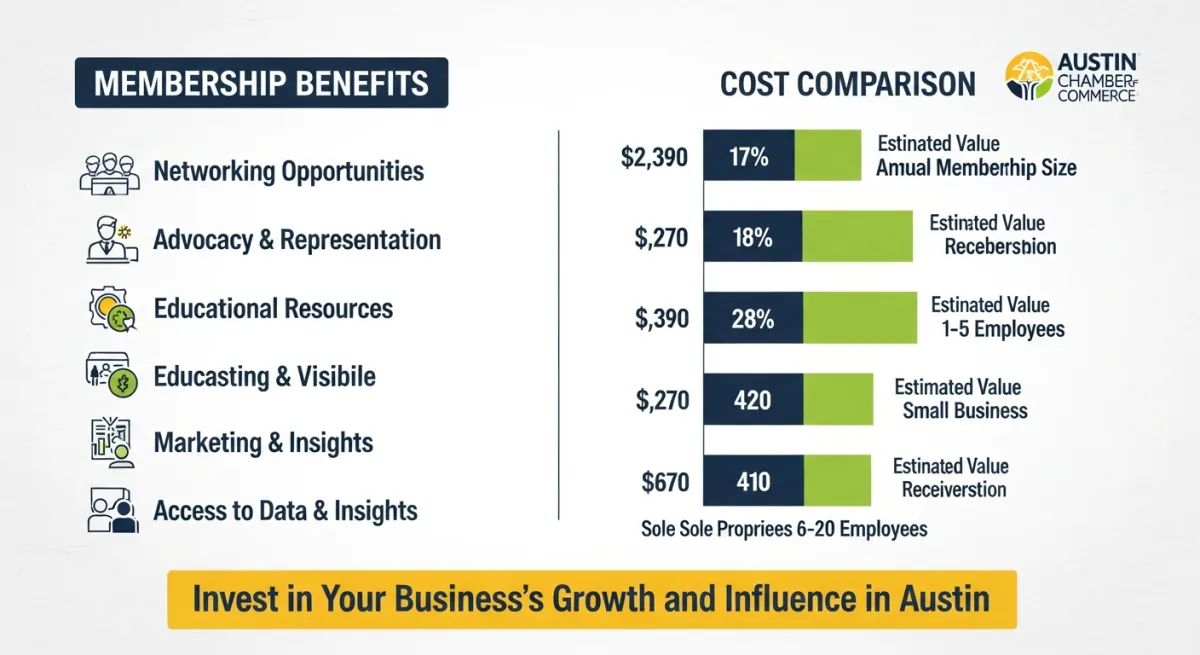
The Greater Austin Chamber’s dues are structured by employee headcount, not revenue. That distinction matters more than it sounds.
Getting an actual number requires either navigating a form-gated inquiry on AustinChamber.org or calling the office at 535 East 5th Street. There’s no clean public pricing table on the website. That friction is a minor annoyance when you’re trying to compare options from your desk, and it makes quick apples-to-apples comparison harder than it needs to be — which is exactly the kind of comparison this article is trying to enable. Call them directly, and when you do, ask what benefits attach to your specific tier, not just what the dollar amount is.
The tiers run from solo/self-employed entry level through small-business headcount bands up to mid-size and corporate investor tiers with named sponsorship benefits. The headcount model creates a dynamic worth naming plainly: a solo financial advisor billing $600,000 a year pays the entry-level rate, while a food truck operator with eight employees who nets $80,000 pays at a higher band. High-revenue sole proprietors get favorable pricing. Thin-margin small retailers with a full staff end up subsidizing access for people with far fewer constraints. Whether that’s a design flaw or just an unintended consequence, you can decide — but know it going in.
What Members Say They Actually Get
This section has to push past “the networking has been great,” which is what most people say publicly about organizations they’re still paying. We talked to several Austin Chamber members and pressed for specifics.
Marcus Treviño runs a commercial insurance brokerage in North Austin with eleven employees. He’s been a member for six years and renewed again this past spring. He’s the profile the Chamber was probably designed for, and he knows it. “I can name three clients who came to me through Chamber introductions,” he said. “Not from the events themselves, necessarily, but from follow-up after events — somebody who met me at a luncheon, connected on LinkedIn, then called me eight months later when their policy renewed.” Those three relationships have generated roughly $40,000 in annual recurring premiums. At his dues level, the math works. He’s also direct about what doesn’t: “The ribbon-cutting stuff, the big breakfast events — I stopped going to most of those. Too much time, too many people in the room who aren’t buyers for what I sell. The value for me is the smaller committee meetings and the one-on-one introductions the staff facilitates when you ask.”
That last phrase is the one to hold onto. The Chamber isn’t a passive investment. It rewards members who use it aggressively.
Leticia Garza owns a specialty gift and stationery shop near the Arboretum. She joined three years ago partly for credibility — the window sticker, the directory listing — and partly because a mentor told her it was “just what you do when you open a business.” Her honest assessment: “My customers don’t come from Chamber events. They come from Instagram, from Google, from word of mouth in the neighborhood. I’ve been to maybe six Chamber events and left most of them having talked mostly to real estate people and accountants.” She’s still a member, but she’s reconsidering. “I keep it for the advocacy piece — I want someone at the Capitol fighting against regulations that could hurt small retail. Whether that’s actually happening, I genuinely don’t know.” That uncertainty came up in almost every conversation we had with consumer-facing business owners. The advocacy value is real in theory. It’s just hard to see from the shop floor.
Derek Huang is a UX strategy consultant, solo, no employees, who joined two years ago after relocating from San Francisco. He was looking for clients and thought the Chamber directory would function like a warm-lead database. “It’s not that,” he said. “The directory tells you who’s a member. It doesn’t tell you who’s hiring a consultant. You still have to do all the sourcing work yourself.” He’s found some value in connections with other solo professionals, but hasn’t closed a contract he can directly trace to the membership. “If I were paying significantly more per year, I would have left already.” Not exactly a ringing endorsement.
Across these three accounts, something consistent emerges. The Chamber delivers clearest value in B2B contexts where the sales cycle is long, the member works relationships consistently over months or years, and the Chamber staff actively engages as a matchmaker. It underdelivers for consumer-facing businesses, solo operators without a structured sales process, and anyone expecting the membership card to do the heavy lifting. This pattern holds across much of our business & professional coverage, where independent operators consistently report that passive membership rarely converts to revenue without sustained, deliberate follow-through.
The Members Who Left, and Why
Former members are the most credible critical voice in any analysis like this. They’ve already made the calculation and committed to it.
Sarah Okonkwo ran a catering and event-planning operation in East Austin for four years before winding down the business last year. She was a Chamber member for two of those years and didn’t renew. “The events skewed downtown and corporate. That’s just who was in the room — tech companies, law firms, commercial real estate. My clients were nonprofits, creative agencies, families doing quinceañeras. There was almost no overlap.” She recalls attending a Chamber happy hour at a Sixth Street venue where she felt, acutely, that she was in someone else’s ecosystem. Nobody there needed a caterer, and the ones who did were going to call whoever had done their company holiday party the previous year. You can picture the room.
Her critique goes deeper than the guest list, though. The Greater Austin Chamber is, by its history and its largest investor relationships, a downtown institution. Its policy priorities and its social network reflect that. It’s not a moral failing — it’s just what the organization is and always has been. But it is a structural reality that East Austin independent operators, South Congress boutiques, and North Loop restaurant owners should factor in before joining.
James Portillo owns a small HVAC and plumbing service company in Pflugerville with fourteen employees. He joined thinking the Chamber would help him break into commercial contracts with building managers, property developers, and corporate campuses. “I got exactly one referral in two years that turned into a job. One. And that job was residential, not commercial, which is what I was after.” The events he attended were heavy with professional services firms that sell to businesses, not businesses that service buildings. “I needed someone to introduce me to a property manager. I got introduced to a lot of marketers and consultants.” He put that money into a trade association and saw immediate returns.
Both accounts point to the same structural reality: the Chamber’s natural constituency is B2B professional services and the corporate sector. Trades, consumer retail, creative services, East Austin independents — these businesses are buying access to a network that wasn’t built with them in mind. That’s not an accusation. It’s just a description.
The Lobbying Question
With the 89th Texas Legislature in session in 2025, the Chamber’s advocacy value is genuinely testable right now. This is when you find out whether your dues buy real influence or just the idea of it.
Before joining primarily for advocacy, prospective members should check the Chamber’s public policy page and recent press releases for its stated 2025 legislative priorities. Then call and ask which specific bills it has taken positions on this session. If the answer is vague, that tells you something.
The harder question is whether small-dues members have meaningful access to the Chamber’s legislative work, or whether that access scales with investment tier — because the Chamber’s investor structure ties explicit benefits to dues level. Ask the Chamber directly: what does my dues tier actually buy in terms of government affairs access? A good answer is specific. A bad answer is long.
For Austin small business owners primarily motivated by Capitol representation, NFIB Texas is the more targeted comparison. The National Federation of Independent Business runs as a pure lobbying organization with specific focus on small business issues at the state level. No networking events, no directory, no ribbon-cuttings — just advocacy and a member survey process that directly shapes their legislative positions. Several Austin business owners interviewed for this piece use NFIB Texas instead of the Chamber, not in addition to it.
Who Gets Real Value and Who Is Wasting Their Money
Here’s the section most of you came for.
Join the Austin Chamber if you are:
A B2B professional services firm — attorney, accountant, insurance broker, commercial banker, HR consultant, commercial real estate professional — with multiple employees and a structured business development process. The Chamber’s member directory can function as a warm-lead pipeline for exactly this profile, and the staff will facilitate introductions if you ask and show up consistently.
A business that needs credentialed access to corporate procurement contacts. If your growth depends on landing a vendor relationship with Dell, H-E-B headquarters, or an Austin-area hospital system, the Chamber’s corporate investor relationships give you proximity you won’t find elsewhere at this price point.
An owner with three to five years of runway to invest in relationship-building. The Chamber doesn’t deliver quick wins. Members who report genuine ROI have been in the room for years and know which specific events are worth their time and which to skip.
Skip the Austin Chamber, or exhaust your alternatives first, if you are:
A consumer-facing retail or restaurant operator. The Chamber’s network won’t send you walk-in traffic or Google reviews. It can send you a mayoral visit for your ribbon-cutting, worth approximately one news cycle.
A solo founder without a sales function. If you’re the only person doing business development and you have no systematic process for following up on connections, the Chamber will deliver you a lanyard and a stack of business cards you won’t call.
A business rooted in East Austin, the Domain corridor, or the South Congress ecosystem. Your natural customers and collaborators don’t overlap much with the Chamber’s downtown-corporate center of gravity. The Chamber’s most active professional network still orbits Congress Avenue more than East Cesar Chavez.
Anyone primarily seeking lobbying representation. NFIB Texas delivers more targeted advocacy for less money, with no event overhead built into the cost.
The Real Alternatives
Austin has a robust set of alternative business organizations, each built around different assumptions about what members need.
The Austin Young Chamber of Commerce is a separate organization — not a division of the Greater Austin Chamber — and it operates with a distinctly different culture. The AYC skews younger, is more geographically distributed across Austin’s neighborhoods, and has stronger presence in the creative, tech-startup, and independent business communities. Events are smaller and tend to produce more direct conversation than a large-room Chamber breakfast. When asked whether AYC members also hold Greater Austin Chamber memberships, one board member’s answer was straightforward: some do, but most choose one or the other based on where they feel more at home. For founders under forty with a limited networking budget, that usually comes down to where their peers actually are. Dues are lower than the Greater Austin Chamber’s mid-tier memberships.
Austin Independent Business Alliance operates on a buy-local philosophy, serving independent businesses across retail, food and beverage, and service sectors. If your customer base actively chooses local, AIBA membership signals something the Greater Austin Chamber simply doesn’t. The organization also runs the Austin Local Business Directory — a customer-facing resource, not just an internal member list. That’s a real distinction.
Capital City Black Chamber of Commerce and the Austin Asian Chamber of Commerce — which has strong presence in the Round Rock and North Austin corridors — serve community-specific networks where referral density is higher precisely because membership is more targeted. The networking moves faster because cultural and professional context is already shared. For business owners within those communities, ROI on targeted chamber membership often beats a general membership in a much larger organization.
Austin Restaurant Association and the Austin Technology Council represent the sector-specific model. For restaurants, the ARA provides lobbying, workforce resources, and industry-specific networking no general chamber can replicate. The ATC’s network maps more cleanly onto who’s actually making hiring and procurement decisions in tech. If your business lives entirely within one industry, join the sector association first. The Chamber can wait.
The Verdict
The Greater Austin Chamber is genuinely useful for a specific type of Austin business: B2B professional services firms with multiple employees, a patient approach to relationship-building, and revenue that depends on corporate and institutional clients. For that business, the member directory, staff-facilitated introductions, and proximity to corporate procurement networks can deliver real, traceable return. The members who benefit most have been showing up consistently for years and ask staff explicitly for help — not the ones who attend the big breakfast once a quarter and wonder why nothing happened.
For most other Austin business profiles — consumer retail, food and beverage, solo consultants, trades, East Austin independents, early-stage founders — you probably won’t get your money back in traceable business. You’ll get a listing, a sticker, and access to a network that was built for someone else’s business model. That’s not a knock on the Chamber. It’s just what the Chamber is.
If you’re primarily motivated by advocacy, compare NFIB Texas costs directly before you decide. If you want a networking community that actually reflects Austin’s independent business culture, look at AIBA or the AYC first. If your business lives in a specific industry, join that industry’s association before you write the Chamber a check.
The next renewal notice will land in your inbox whether you’re ready for it or not. Now you have enough information to answer it honestly.