Which Austin Co-Working Spaces Are Actually Still Open in 2026
We called every location showing up in search results. Several are closed. Here's the ground-truth guide.

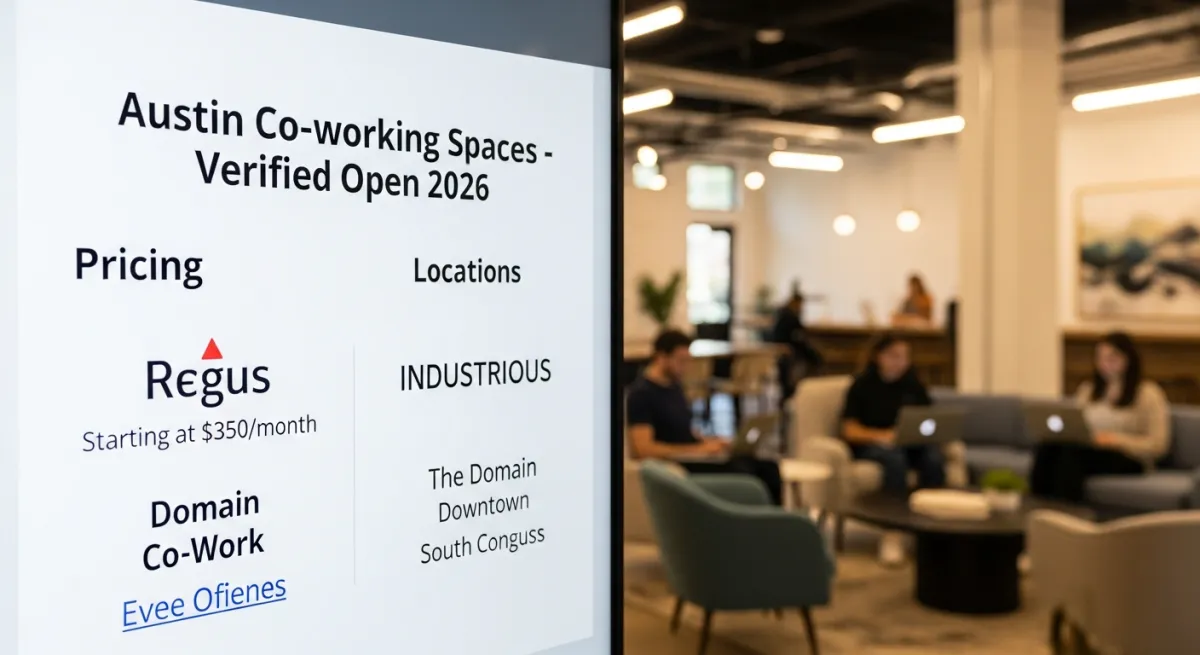
We called every location showing up in search results. Several are closed. Here’s the ground-truth guide.
Search Google for co-working space in Austin and you’ll find a tidy list of results — complete with addresses, hours, and reviews — for at least a half-dozen locations that no longer exist. The WeWork bankruptcy, Galvanize’s absorption, and a quieter wave of post-pandemic closures left a graveyard of zombie listings that live on in Yelp, Coworker.com, and Google Maps long after the last member badge stopped working. If you’ve ever driven to an address only to find a dark lobby and a removal notice, you know the problem.
This guide is the result of direct reporting: phone calls and in-person visits to every major operator appearing in Austin co-working search results, current rate cards pulled firsthand, and a pricing table built from scratch using 2026 numbers. Not recycled from 2022 content farms. What closed, what’s open, what each open space actually charges, and whether co-working is genuinely cheaper than leasing direct for a small team in today’s Austin market.
The short answer: yes, for teams of five or fewer, once you factor in Austin’s current build-out costs, lease-term risk, and elevated Class B office vacancy. But only at negotiated rates, not rack rates, and only at certain operators. The full calculation is in Section 6.
What Closed and What’s Gone for Good
These locations appear in active search results as of early 2026. None of them are operating.
WeWork Downtown (600 Congress Ave.)
WeWork occupied a flagship multi-floor location at 600 Congress. It didn’t survive the company’s Chapter 11 reorganization, filed in November 2023. The Google listing still shows “Temporarily closed.” It is not temporarily closed. Don’t trust that language to update anytime soon — Google has no incentive to be your real estate researcher.
WeWork at 221 W. 6th Street
A second downtown WeWork footprint, closed during the bankruptcy wind-down. Confirmed gone.
Galvanize Austin
Galvanize ran a tech education and co-working hybrid near the Seaholm District. WeWork acquired it in 2021 — which, in hindsight, tells you everything about how that was going to go. When WeWork entered bankruptcy, Galvanize’s co-working operations went with it. The brand no longer operates in Austin in any form.
Common Desk (Austin locations)
Common Desk, the Dallas-based operator that WeWork acquired in 2019, had Austin expansion in its plans. Those plans didn’t survive. Common Desk operates in Dallas and Houston. Its Austin presence, if any listing suggests one, requires a direct phone call before you make the trip.
If a location you’ve found isn’t on the verified-open list below, call before you go. Listings die slowly. The internet has no mechanism for grief.
The Operators Still Running
Verified open as of reporting in early 2026. Published rates are rack rates unless noted; see Section 5 for the pricing table and negotiation context.
Industrious Austin (Domain Area)
Industrious relocated its primary Austin presence to the Domain, which tracks with where the demand has moved. CBRE acquired the company in 2022 and kept the brand running. The product is genuinely higher-end than most competitors — actual acoustic separation between offices, not just a glass panel and some hope, consistent front-desk staffing, and coffee that isn’t the bad kind. Membership tiers run from part-time hot desk up through team suites.
Published rack rates: dedicated desk around $700/month; a four-to-six person private office somewhere between $3,200 and $4,800 depending on configuration. Month-to-month terms are available, with modest discounts for three- or six-month commitments. Parking at the Domain is surface or structured and meaningfully cheaper than downtown — factor that into any price comparison.
Who it’s for: remote employees of larger companies with a travel stipend, small tech teams that want a professional address without a five-year lease, founders who need reliable video-call infrastructure and don’t want to manage an office.
Of the general-market operators currently running in Austin, Industrious is the most polished. You pay for it.
Regus and Spaces (Multiple Locations)
Both are IWG brands, and IWG survived the co-working shakeout better than any large operator — partly through scale, partly because its business model was never as dependent on Silicon Valley hype as WeWork’s. Austin locations include One American Center at 600 Congress, a south Austin presence off the MoPac corridor, and multiple footprints near the Domain. Verify current suite addresses directly with IWG, since configurations shift.
Regus at One American Center, 600 Congress Ave. — Verified open. Regus, south Austin MoPac corridor — Confirm current address before visiting. Regus, Domain area — IWG operates multiple locations here.
Rack rates start around $280/month for a hot desk; dedicated desk runs $400–$600; a four-to-six person private office lists at $1,800–$3,200, with real variation by building and floor. These numbers are negotiable. With Austin office vacancy running above 20 percent, Regus has been discounting quietly — 10 to 25 percent off rack is achievable on longer commitments if you push. The operator draws professional-services workers: lawyers, consultants, accountants who need a credible address and conference room access. Teams needing multiple city locations benefit from IWG’s global network. It is not a particularly exciting place to work. That is sometimes exactly what you need.
Capital Factory (701 Brazos St., Downtown Austin)
Covered in depth in Section 7. Verified open and operating.
VUKA (Multiple Austin Locations)
VUKA is an Austin-born independent and, honestly, the most interesting survivor in this market. The company operates in the Mueller district and in south and east Austin. Rates for hot desk and dedicated desk memberships run below the national chains; private offices are available in smaller configurations, month-to-month as standard. The space skews toward Austin-based freelancers, small creative shops, nonprofits, and early-stage founders not yet in the Capital Factory orbit. Confirm current addresses and rates directly — VUKA doesn’t plaster its numbers everywhere online the way the nationals do.
Austin Technology Incubator (ATI) / UT-Adjacent Options
ATI provides workspace for tech and cleantech startups with UT affiliations at the J.J. Pickle Research Campus in North Austin. Membership is competitive and tied to program participation — not open-market co-working. Worth knowing exists; not relevant to most searches.
Independent Operators
A handful of smaller independents persist in East Austin. These tend to run on thinner margins and shorter track records. Churn among independents is meaningfully higher than among national operators. Worth knowing before you get attached to a place.
Austin by Neighborhood
In a city where I-35 can add 40 minutes to a five-mile trip, neighborhood matters more than almost anything else in this decision. Don’t treat it as something you’ll sort out after you pick an operator.
Downtown / Congress Corridor
Once the densest cluster of co-working in Austin, downtown absorbed the worst of the WeWork collapse. What remains is Regus at One American Center and Capital Factory on Brazos. The advantages are real — proximity to city, county, and state government clients, walkable lunch options, easy client access from the hotel corridor. But downtown parking runs $150–$250/month for a monthly garage pass, which needs to be added to any membership cost comparison. And a five-mile commute from north or east Austin can genuinely eat 45 minutes in peak traffic. Be honest with yourself about how many days a week you’d actually make that drive before signing anything.
The Domain / North Austin
Currently the best-supplied non-downtown submarket and, for most tech workers, the more practical choice. Industrious anchors the Domain; IWG has multiple nearby footprints. The corridor has absorbed a significant share of Austin’s tech workforce — both employees of the campuses in the area (Apple, Amazon, Indeed, Oracle) and remote workers who live north of the river and in Pflugerville. Parking is cheaper. Client meetings are easier against the Domain’s hotel and restaurant infrastructure. If you work in tech and live north of the river, the supply is here.
East Austin
VUKA anchors this area. The east side is reasonably served for solo freelancers and small creative shops but genuinely undersupplied for teams that need a private office above two people. The co-working infrastructure hasn’t kept pace with how much the neighborhood has grown. There’s a real gap here for an operator willing to put a quality space in Mueller or Cherrywood. Someone will eventually figure this out.
South Congress / South Lamar
Undersupplied. SoCo and SoLa are among the most underserved corridors relative to their population and daytime economic activity. Workers here drive to downtown, work from coffee shops, or commute north. An operator that planted something on South Lamar would likely have little trouble filling it. If you run a co-working company and you’re reading this: South Lamar. Seriously.
Cedar Park, Round Rock, and the Suburban Ring
Regus operates in Round Rock, though these are smaller business centers rather than full-service co-working environments. The suburban ring is structurally underserved. Remote-worker populations in these communities are substantial. No operator has built a flagship-quality space outside the core. For now, residents out here are largely on their own.
What It Actually Costs
Built from verified 2026 published rate cards. “Published” means what operators quote on their website or in initial inquiry — not what you’ll pay if you push back, which is covered in the note below the table. VUKA rates omitted pending direct operator verification.
| Operator / Location | Hot Desk (monthly) | Dedicated Desk | Private Office (4–6 person) |
|---|---|---|---|
| Industrious (Domain) | ~$400 (part-time) | ~$700 | ~$3,200–$4,800 |
| Regus (Congress/Austin locations) | ~$280 | ~$400–$600 | ~$1,800–$3,200 |
| Capital Factory (Brazos) | Membership-based; see Section 7 | — | — |
| VUKA (Mueller/East Austin) | Verify directly | Verify directly | Verify directly |
On negotiation: Austin’s overall office vacancy rate is above 20 percent. That’s leverage. Regus has a documented pattern of discounting off rack — 10 to 25 percent below published rate is achievable on a six-month commitment if you come in with a competing quote. Industrious is less flexible but will discount on longer terms. VUKA, as an independent, has less cushion but more willingness to structure non-standard arrangements. At any operator, asking for a free first month or a waived setup fee costs nothing. The worst they say is no.
At downtown locations, add $150–$250/month for parking. That’s not a footnote; it changes the math.
The 5-Person Team Calculation
Most co-working content skips this math because it makes the answer more complicated than a headline. Here it is anyway.
A five-person team in 2026 has two primary paths: co-working private office, or a direct lease on Class B space. As part of our business & professional coverage, we’ve tracked how Austin’s elevated office vacancy has shifted leverage toward tenants in both categories.
Direct lease, all-in monthly cost:
A 750–1,000 sq. ft. Class B office in central Austin is currently asking $30–$40 per sq. ft. per year on a full-service gross lease — roughly $1,875–$3,333/month in base rent. Add build-out and tenant improvement costs, furniture, internet, utilities if not covered, parking for five people, and cleaning. Then add the part that kills flexibility: the minimum lease term is typically three to five years. If your company has ever changed headcount by 40 percent in a single quarter, you know exactly what that commitment risk costs.
Co-working private office for 5 people:
A four-to-six person private office at Industrious runs $3,200–$4,800/month, fully furnished, with internet, utilities, cleaning, and front-desk service included. Regus lists $1,800–$3,200 at rack, with negotiated rates typically 10–25 percent below that. Add $150–$250/month for team parking at Domain locations. Month-to-month or short-commitment structures carry real value when headcount is uncertain — and in 2025–2026, with tech layoffs and funding cycles that can turn a ten-person team into four people overnight, the ability to exit in 30 days is worth something you can actually price.
The verdict: for a team with material uncertainty in its three-year headcount forecast, co-working wins the math unless the direct-lease option comes with a substantial tenant improvement allowance and a landlord willing to accept a shorter term. Both are available in today’s high-vacancy market, but they require a tenant’s broker and real negotiating effort.
Capital Factory
Capital Factory is not a co-working space in the sense that Industrious or Regus is. Comparing it on price per desk misunderstands what it sells.
Located at 701 Brazos Street downtown, Capital Factory is an accelerator, venture fund, and startup community that happens to include workspace. The co-working component is the least important thing it offers. What it actually sells is access — to investors, to corporate partners, to state and federal government contracting programs through its defense tech work, and to the connective tissue of the Austin startup community. That’s either worth a lot to you or it isn’t, depending entirely on what you’re building.
Community memberships providing workspace access have historically run $300–$500/month for individuals; startup teams in formal accelerator programs operate under different structures tied to equity or program cohort participation. Capital Factory is for founders in the early stages of building a venture-backed or defense-tech startup who want investor proximity more than a quiet place to work. It is not for consultants, remote employees of large companies, or five-person service businesses. If you’re comparing Capital Factory against Regus on a price-per-desk basis, you’re asking the wrong question about at least one of them.
What Members Say They Actually Pay
A software engineer who works remotely for a Bay Area company holds a dedicated desk at Industrious in the Domain. He pays $620/month — about 10 percent below published rack rate — after negotiating a six-month commitment. “I tried to work from home for two years and I couldn’t do it,” he said. “The commute into downtown from Pflugerville was the other option, and that’s 45 minutes each way. This is 20 minutes, there’s parking, and I can take calls without my kids in the background.” He’s renewed twice and has never seriously priced a direct lease. “I don’t want to sign three years of anything right now.”
A four-person product design consultancy holds a private office at a Regus location in Austin. The principal pays $2,100/month on a six-month rolling term, against a published rate of approximately $2,800 for the same configuration. “They wanted us badly enough to deal,” she said. “The office market here has vacancy and they know it.” One thing she didn’t anticipate: conference room overages. “That’s what they don’t tell you upfront. If you have client meetings, you will go over the monthly allotment. It caught us in the first month.”
A solo attorney at VUKA’s Mueller location bikes to the office. He pays a dedicated desk rate and doesn’t pretend to need more. “It’s not fancy. But it’s in my neighborhood, the internet is solid, and the people around me are interesting. I didn’t need the Industrious experience. I needed a place that wasn’t my kitchen table.” He adds that VUKA’s community events — happy hours, speaker nights — turned out to matter in ways he didn’t expect. “At a big national chain, nobody knows your name. Here they do.”
How to Verify Before You Sign
Given how persistently dead listings survive online, a practical checklist before you commit time or money to any Austin co-working space:
Call the direct location number — not a national reservation line — and ask someone at the physical address to confirm it. This sounds obvious. It will save you a trip to a space that closed eight months ago.
Get a written breakdown before you tour: base membership, conference room allotment and overage rate, printing fees, parking options and cost, and any one-time setup or key deposit. The conference room overage question especially — as the design firm above found out, that line item can bite.
Understand the minimum term precisely. “Month-to-month” sometimes means “month-to-month after a mandatory three-month initial period.” Ask: what is the minimum commitment from day one, and what is the notice period to cancel?
Ask about the guest policy separately. Can you bring clients in without paying a per-guest fee? For a practice that meets clients on-site, guest charges above a monthly threshold add up fast.
Use the free trial day before signing anything. A space that feels calm at 10 a.m. Tuesday is sometimes loud and chaotic at 2 p.m. Thursday. Sit there during hours when you’d actually be working.
Get a competing quote. Austin’s vacancy gives you leverage and operators know it. A second quote is often enough to unlock a meaningful discount at the first. Don’t pay rack rate without asking once.
For independent or suburban locations, check for recent Google reviews — within the last 90 days — with specific, credible detail. A location whose last review is 18 months old is a yellow flag. Three reviews all posted the same week is a red one.
Remote employees on longer-term Austin office decisions face a similar lease-versus-flexibility calculation when it comes to housing — the same logic about committing to fixed costs in a volatile market applies in both directions.
CityDesk Austin reporting reflects direct operator contact and in-person visits conducted in early 2026. Pricing is subject to change; confirm current rates with operators directly. If you have a tip about a closure or opening we missed, contact the newsroom.