What Austin's New Zoning Code Actually Changes for Your Commercial Lease and Build-Out
The city's HOME initiative amendments and Land Development Code revisions drew extensive coverage — almost all of it about housing. Here's what it means if you run a business on East Sixth, South C…

The city’s HOME initiative amendments and Land Development Code revisions drew extensive coverage — almost all of it about housing. Here’s what it means if you run a business on East Sixth, South Congress, or North Loop.
The Coverage Gap
When Austin City Council passed the HOME initiative amendments and the Land Development Code revisions, the coverage was immediate. Almost all of it focused on housing: how many triplexes could now go on a single-family lot, whether the missing middle was finally getting built, what the density bonuses would do to Austin’s affordability problem.
That coverage was warranted. But it left an entire category of Austin business owners — restaurateurs, vintage shop operators, bar owners — without answers to the questions that actually affect their businesses. Did my parcel’s zoning change? Can my landlord use a rezoning to push me out or rewrite my lease? What does the parking minimum elimination do to my build-out cost? If the building I lease gets redeveloped as a mixed-use tower, do I have any protected interest in the ground floor?
This piece is a business-desk corrective. It doesn’t relitigate the housing debate or summarize LDC policy at 30,000 feet. It works corridor by corridor, lease clause by lease clause, and addresses what has gone essentially unreported: the commercial implications of changes already in effect.
A Map of Exposure on Three Corridors
Not every commercial tenant in Austin faces equal pressure from the new code. The exposure is concentrated where base zoning, overlay activity, and land value combine to create genuine near-term risk.
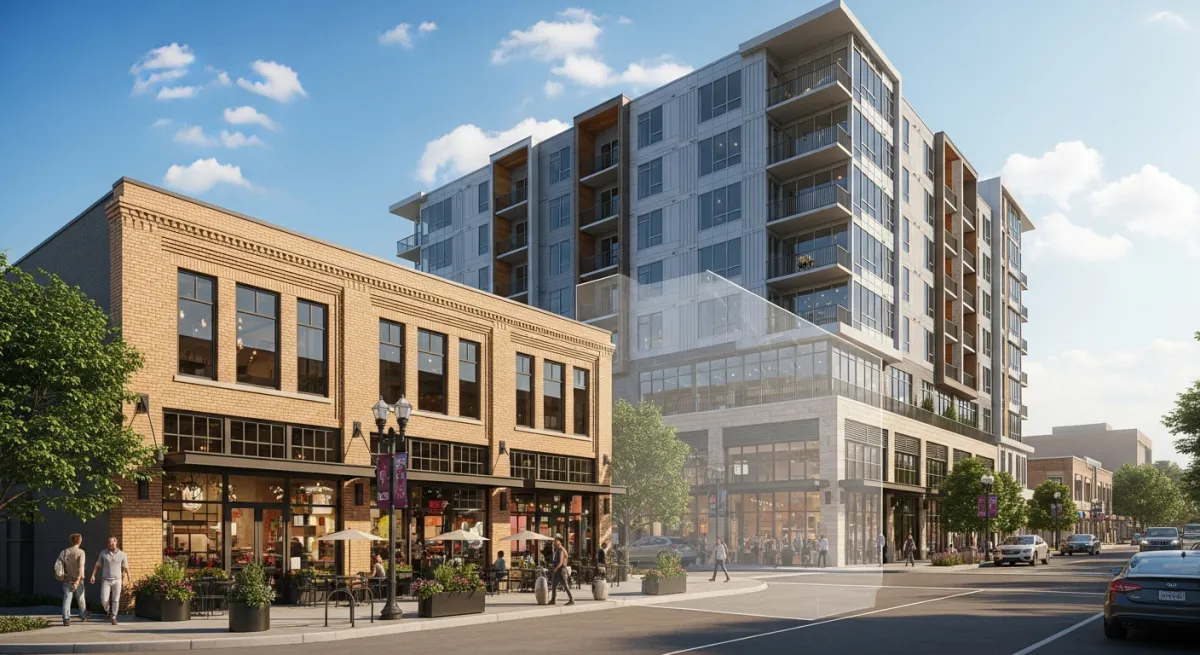
East Sixth Street (roughly Airport Boulevard to Springdale Road) is largely zoned CS — Commercial Services — and CS-MU, the mixed-use variant. This is one of Austin’s most active zoning corridors right now. VMU2 overlay applications are piling up around established anchors like Lazarus Brewing (1902 E. 6th St.) and Nickel City. The CS base zone already permitted a wide range of commercial uses before the LDC amendments. What changed is the scale of what can happen next door. VMU2 overlay applications in the CS-MU zone unlock buildings up to roughly 60 feet in exchange for affordability and commercial frontage commitments. That height bonus makes previously marginal redevelopment projects financially attractive. For tenants in one- and two-story buildings between Airport and Springdale, the realistic question is no longer whether their block gets redeveloped but when.
South Congress Avenue (between Oltorf Street and Ben White) carries a mix of CS, GR (Community Commercial), and active VMU2 overlay designations on parcels where commercial zoning and freeway proximity have made land speculation acute. The one-story retail strips in this stretch — including parcels near Güero’s (1412 S. Congress) and Uncommon Objects (1512 S. Congress) — sit on land that appraises well above its current improvement value. Before the code changes, a landlord’s ability to realize that land value through redevelopment was constrained by parking minimums, height limits, and the original VMU overlay’s less generous bonus structure. VMU2 changes the calculus. A 60-foot building with ground-floor commercial requirements now pencils on parcels that previously didn’t support the construction cost.
North Loop operates under different pressure. The corridor’s dominant base zone is LR — Neighborhood Commercial — a category with more restricted uses than CS or GR and lower-density assumptions built in. Vintage shops, Epoch Coffee (221 W. North Loop Blvd.), and the independent businesses that give the corridor its character are not in the immediate line of fire from VMU2 activity the way East Sixth is. But HOME Phase 1 and Phase 2 have enabled significantly greater residential density on the side streets feeding the corridor. As those lots fill with duplexes, triplexes, and ADUs, the commercial land along North Loop becomes more valuable to developers — more households within walking distance means more demand for ground-floor retail. That shift will register in lease renewal conversations. Maybe not this year. But it’s coming, and landlords know it before tenants do.
The Zoning Glossary Nobody Published
Austin’s zoning terminology is not self-explanatory, and the city’s official documentation was written for planners. Here’s a working translation — the version you’d want before sitting across from a landlord.
CS (Commercial Services) is the workhorse commercial designation on East Sixth and parts of South Congress. It permits a wide range of retail, restaurant, bar, and service uses by right.
CS-MU adds a mixed-use modifier, allowing residential uses on upper floors by right — no separate zoning approval needed. This makes CS-MU parcels more attractive to developers planning residential-over-retail projects, which is why they’re also the ones getting VMU2 applications filed on them first.
GR (Community Commercial) is similar in scope to CS but slightly more restrictive on automotive and industrial-adjacent uses. You’ll find it on South Congress alongside CS.
LR (Neighborhood Commercial) is the lowest-intensity commercial base zone on these corridors. North Loop runs on LR. It permits retail and personal service uses but restricts drive-throughs, larger-format retail, and some restaurant categories that would be by-right in CS.
VMU (Vertical Mixed-Use Overlay) sits on top of a base zone and allows increased height in exchange for ground-floor commercial use and affordability commitments. The original VMU was the first version.
VMU2 is the more permissive successor — up to roughly 60 feet in most applications, depending on base zone — and it’s generating active applications on East Sixth and South Congress right now. The ground-floor commercial mandate is a core requirement. A VMU2 building cannot put a parking deck or residential lobby at street level.
GO (General Office) appears on transitional parcels and restricts retail uses more than CS or GR. It matters if you’re considering a use change from office to food service or retail.
Here’s the distinction that actually matters for tenants: your base zone governs what uses are permitted in your space today. An overlay like VMU2 governs what a developer can build on your parcel. It changes the lease environment you’ll eventually inhabit, not the lease you’re currently in. Those are different problems on very different timelines, and conflating them is how tenants get caught off guard.
To check your parcel: go to austintexas.gov, search “Austin Zoning Map,” enter your address, click the parcel, and look at both the base zone and any overlay designations. Pending applications show up in the city’s Development Activity Map, also on the Planning Department’s site. If the GIS result is unclear, Austin’s Development Services Department at 6310 Wilhelmina Delco Drive accepts zoning verification requests — a formal written confirmation of a parcel’s current designation. Takes about 48 hours and costs nothing.
Can Your Landlord Raise Your Rent Because of a Rezoning?
This is the question commercial tenants ask most and get answered least.
Short answer: a rezoning alone does not void your existing lease or let your landlord unilaterally change its terms mid-term. The longer answer has enough nuance to matter.
Texas law is strongly landlord-favorable in commercial lease contexts. There’s no commercial rent control, no statutory right of first refusal for tenants upon sale, and no required relocation assistance for displaced commercial tenants. Your protections exist only to the extent your lease creates them. That’s not a complaint — it’s just the legal environment you’re operating in, and pretending otherwise before a renewal negotiation is a mistake.
The operative clause is the permitted-use clause, which defines what your space can legally be used for under the lease. If a rezoning changes what the code allows on your parcel but your permitted-use clause remains broad enough to cover your operations, you’re generally not at legal risk mid-term. The rezoning does not automatically trigger a lease amendment or give your landlord a new right to raise your rent.
Where it gets complicated is at renewal, or when a landlord pursues an entitlement that changes the physical character of the property. Say your landlord files for a VMU2 overlay while you’re two years into a five-year lease. The entitlement itself doesn’t end your lease. But it signals intent to redevelop, and it may trigger demolition or construction activity that your lease may or may not address. If your lease lacks a demolition clause or a relocation provision, your main recourse is holding the landlord to the lease term while the entitlement process moves forward. That’s not nothing — but it’s not a comfortable position.
There’s also the nonconforming-use trap. If a rezoning makes your current use no longer permitted by right in your zone, your operation becomes a “lawful nonconforming use” — you can continue, but you lose certain rights. Austin’s code has historically imposed a roughly six-month closure rule: if a nonconforming use closes for six months or more, it loses its protected status and cannot reopen as that use. The LDC amendments did not change this framework. Any extended closure — for renovation, for a lease gap, for whatever reason — can eliminate nonconforming-use protection that took years to establish. This is a quiet trap that doesn’t get enough attention. A business that shuts for a substantial remodel and comes back to discover its use is no longer protected has almost no good options.
What Parking Minimum Elimination Actually Changes
In 2023, Austin City Council eliminated most off-street parking minimums citywide. This standalone ordinance has received almost no substantive coverage in the business and professional coverage of Austin’s land-use changes. For commercial tenants, the change cuts two ways.
The upside is real. If you’re planning a build-out and your use would previously have triggered a parking minimum, you no longer carry that cost burden. A restaurant that would have had to provide one space per 150 square feet of dining area faces no code-mandated parking obligation at all. That’s not a trivial savings on a tight build-out budget.
But landlords are also no longer code-obligated to include parking. The minimum was, for tenants, a negotiating backstop — it meant a landlord couldn’t strip the property of parking and still meet code. That floor is gone. A landlord with a surface lot adjacent to your leased building can now convert it to buildable area without any obligation to replace what you lose. The change was justified as removing unnecessary regulation and enabling more efficient land use — and that’s largely true. But the efficiency gains accrue to landlords and developers. Not to tenants who lose parking they’d been relying on. Worth sitting with.
The practical instruction is simple: address parking explicitly in your lease. Specify the number of spaces allocated to your tenancy, whether those spaces can be relocated or reduced without your consent, and whether the landlord has rights to develop any associated surface lots. This isn’t a standard clause in most boilerplate commercial leases, so you’ll need to propose it — and some landlords will push back. Push back harder. On South Congress, where several commercial properties sit on oversized lots originally configured to meet parking minimums, this isn’t theoretical. It’s the difference between parking you control and parking that disappears one afternoon during your lunch rush.
VMU2 and Ground-Floor Retail: Displacement and Opportunity on the Same Block
The VMU2 overlay has been misreported — when it’s been reported at all — as a pure risk story for existing tenants. It’s more complicated than that, and tenants considering both sides of it will make better decisions.
The displacement side is real. When a landlord successfully applies for VMU2 and redevelops, the existing structure comes down. Even if the new building carries a ground-floor commercial mandate, the square footage, lease terms, and economics of the new space will likely be unrecognizable. A bar paying $22 per square foot NNN in a 1970s strip building should not assume it will re-lease anything similar in a newly constructed 60-foot mixed-use building. The ground floor of a new VMU2 project is designed for higher-income tenants or uses that support vertical density — high-end retail, full-service restaurants, coffee shops that pull foot traffic from upper-floor residents. A vintage shop that spent fifteen years at $18 NNN isn’t moving back into ground-floor space configured for $38 NNN. That’s just the math.
The mandate does matter for the long-term commercial character of these corridors, though. A landlord on South Congress who takes the VMU2 height bonus cannot finish the ground floor as residential units or a parking structure. Street level must remain retail, restaurant, or active service use. That creates a structural floor against the slow residential creep that has hollowed out ground-floor commercial space in other Texas cities where no such requirement exists. New commercial square footage is being created on corridors where height limits previously foreclosed it, and that supply is coming online whether or not the rents make sense for the tenants currently there.
For tenants not locked into an existing location — people actively looking for space — newly completed VMU2 ground-floor retail is worth evaluating. That supply is coming on East Sixth and will expand on South Congress over the next several years. A coffee roaster or small restaurant currently cramped in an older building might find ground-floor space in a new VMU2 project that works economically, even at higher per-square-foot rates, because the build-out is configured for the uses developers know perform in mixed-use environments. The space isn’t always better. But it exists in a way it didn’t before.
Build-Out and Permitting Under the Current Code
For tenants planning a build-out, renovation, or use change, several trigger points can extend your timeline significantly.
Permits run through DSD at 6310 Wilhelmina Delco Drive. Review timelines for commercial interior build-outs have run eight to fourteen weeks over the past two years — a chronic friction point that predates the LDC amendments and has not been materially improved by the new code. Budget that time into your project schedule, and don’t assume the optimistic end of that range applies to you. Any use-category change or exterior work adds time on top.
Changing your use category — retail to restaurant, general office to medical, personal service to food preparation — may require a zoning verification letter confirming that your intended use is permitted in your base zone before DSD will issue a building permit. A use change requiring a conditional use permit adds another layer, potentially including a Board of Adjustment hearing. That’s months, not weeks.
On South Congress and South Lamar, there’s a separate constraint that catches tenants off guard regularly: impervious cover limits for parcels in or near the Barton Springs recharge and contributing zones. If your build-out involves expanding your physical footprint — adding a covered patio, extending a slab, building out a previously unimproved area — you may hit an impervious cover cap that has nothing to do with your zoning designation and everything to do with the city’s water quality ordinance. The LDC amendments did nothing to relax this. It’s not a new constraint, but it’s a nasty surprise when you find it mid-project.
On current market rates: brokers active on these corridors are quoting roughly $28–$42 NNN per square foot on South Congress, $22–$32 NNN on the East Sixth creative corridor, and $18–$26 NNN on North Loop. Those figures represent meaningful softening from the 2022 peak, which gives tenants more leverage in build-out allowance negotiations than they had two years ago. A landlord who would have offered a dollar-per-foot tenant improvement allowance in 2022 may offer three to five dollars now, given the inventory of available space across all three corridors. That window won’t stay open indefinitely.
HOME’s Indirect Commercial Effect
HOME Phase 1 (effective December 2023) and HOME Phase 2 (passed August 2024) were residential amendments. They did not directly alter commercial base zones on East Sixth, South Congress, or North Loop. Tenants on corridor-edge parcels should request a zoning verification letter from DSD to confirm their specific parcel’s status — the interaction between HOME amendments and commercial overlay zones hasn’t been fully documented in public-facing coverage, and the GIS viewer doesn’t always tell the complete story.
The effects on adjacent commercial parcels are real, though indirect. By enabling significantly greater residential density on previously single-family lots within walking distance of these corridors, HOME increases the premium that developers will pay for adjacent commercial land. More households within a quarter-mile radius means more foot traffic and more willingness among mixed-use developers to underwrite commercial space in projects that would previously have needed suburban-scale parking to pencil. A parcel on the corner of South Congress and a newly dense residential side street is worth more to a developer in 2024 than it was in 2022, and that value difference works its way into lease renewal terms whether or not the landlord says so out loud.
For existing tenants on corridor edges — where commercial zoning meets the residential side streets — this accelerates land speculation pressure in ways that won’t be visible until renewal. A landlord who owns a CS-MU parcel at the intersection of a commercial corridor and a newly dense residential block is getting materially different calls from developers than they were in 2022. That changes the landlord’s leverage in renewal negotiations. It changes the likelihood they pursue entitlements during your lease term. You may not see it coming until you get the renewal offer.
There’s also an open verification question any commercial tenant on a corridor edge should raise: whether any commercial base zones were incidentally touched by the HOME amendments in the process of reclassifying residential adjacencies. DSD can answer this through a zoning verification letter. Ask before you sign a renewal. This takes 48 hours and costs nothing.
What to Do Before Your Next Lease Renewal
Look up your parcel’s current zoning and any pending applications. Use Austin’s GIS zoning viewer at austintexas.gov and the Development Activity Map. Confirm both your base zone and any overlays, and check for pending rezoning or VMU2 overlay applications. If the GIS result is unclear, get a zoning verification letter from DSD. Free, 48 hours. No excuse not to.
Read your permitted-use clause. Confirm it covers not just your current operations but any expansions or modifications you’re likely to want during the renewal term. “Retail use” may not cover a cafe addition or private event component you’re planning. Negotiate the clause language before you sign. If your landlord resists broadening it, take that seriously. Resistance on a permitted-use clause is a signal, not just a negotiating posture.
Ask your landlord in writing whether any entitlement or rezoning applications are pending on the property. Ask for a written commitment that they’ll notify you of any applications filed during your lease term. Texas doesn’t require this disclosure. Some landlords will refuse. If yours won’t commit to notifying you of rezoning filings on property you’re paying to occupy, decide whether that’s acceptable before you sign. Some tenants will sign anyway. Go in knowing what you’re accepting.
Address parking explicitly. Specify the spaces allocated to your tenancy, whether they can be relocated or reduced without your consent, and whether the landlord has development rights on any associated surface lots. This is not standard boilerplate. You’ll need to propose it. Some landlords will push back. Push harder.
Confirm impervious cover availability before you budget for any outdoor build-out on South Congress or South Lamar. Ask your landlord and verify with DSD whether your parcel has remaining capacity. A patio expansion you assumed was a contractor conversation can run into a code ceiling that requires a variance you didn’t plan for.
Before signing any renewal on a corridor with active VMU2 potential, consult a land-use attorney — not a general commercial real estate attorney. The distinction matters more than most tenants realize. A land-use attorney will read your permitted-use clause against the current code, review the parcel’s zoning and overlay history, and flag entitlement risk that a transactional real estate attorney may not catch. Firms with Austin land-use practices relevant to tenant-side work include Armbrust & Brown and the Drenner Group. A pre-signature land-use review costs substantially less than discovering mid-lease that your landlord has filed a VMU2 application and your lease has no demolition clause.
Finally: Austin’s LDC amendment effective dates are tracked on the Planning Department’s website under the Development Services Department section. If you’re mid-build-out or mid-negotiation, the effective date of a specific amendment determines which version of the code governs your project. That’s not an abstract policy question. Know which rules you’re playing under.
CityDesk Austin will continue to track VMU2 overlay applications on East Sixth and South Congress as they move through the entitlement process. If you’re a commercial tenant with a specific zoning question arising from a lease renewal or a pending build-out, Austin Development Services at 6310 Wilhelmina Delco Drive is the first stop for parcel-specific verification.