What Austin's Office Market Numbers Actually Mean for Small Business Tenants Right Now
A neighborhood-by-neighborhood breakdown of vacancy rates, asking rents, and concession packages — translated from broker reports into terms that matter if you're signing a lease in 2026.

A neighborhood-by-neighborhood breakdown of vacancy rates, asking rents, and concession packages — translated from broker reports into terms that matter if you’re signing a lease in 2026.
Austin’s overall office vacancy rate is expected to land in the 22–26 percent range for Q2 2026, based on trajectory data from CBRE, JLL, and Cushman & Wakefield Austin. That’s the number that shows up in financial press as a headline about struggling landlords and gets filed away by most readers. But if you’re a 10-person accounting firm looking for 3,500 square feet near the Arboretum, or a creative agency deciding between East 6th Street and SoCo, the metro-wide number doesn’t tell you what you actually need to know.
It doesn’t tell you what you’ll pay. It doesn’t tell you what you can negotiate. It doesn’t tell you whether this summer is a genuinely good moment to sign.
This piece does. What follows is a translation of Q2 2026 broker data — drawn from CBRE, JLL, and Cushman & Wakefield Austin market reports — into plain language for a business owner making a real leasing decision. The numbers are real. The framework is practical. The goal is to get you to the right questions before you ever walk into a building.
How Much Space Is Actually Available and Why That Number Is Bigger Than It Looks
There is an enormous amount of space sitting empty across Austin right now. CoStar puts active sublease availability in the range of 4 to 6 million square feet metro-wide, depending on how you count spaces that have been listed but not yet formally marketed. That’s not a rounding error — that’s a second market running parallel to the one most tenants think they’re shopping in.
Sublease space means different prices, different negotiating position, and different trade-offs entirely. Together, those two figures mean Austin has a tenant’s market of unusual depth. Whether that depth is useful to you depends almost entirely on your size, your submarket, and your term requirements.
If you’re shopping 3,000 to 6,000 square feet on a 3-to-5-year term, the Q2 2026 Austin market offers better negotiating position than this city has seen in at least a decade. Under 2,000 square feet and still building your team? The picture is more complicated. The answer may not be a traditional lease at all.
The Map — Five Submarkets Compared Side by Side
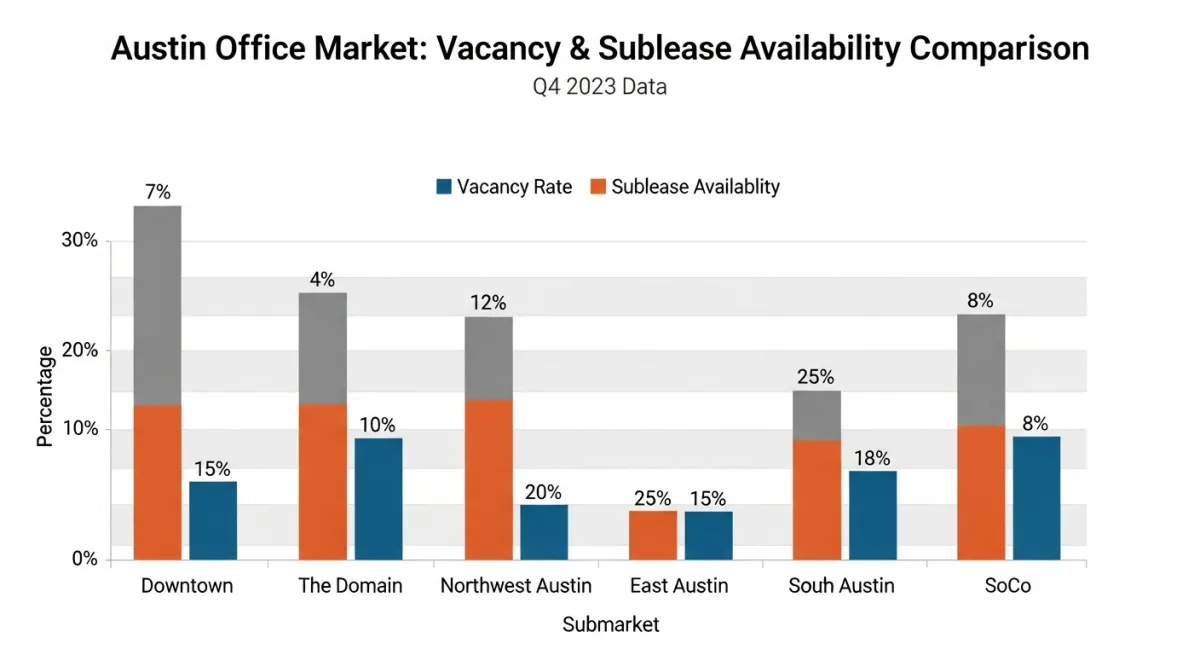
The following figures are expected ranges based on late-2025 trajectory data from CBRE, JLL, and Cushman & Wakefield. Confirm Q2 2026 figures against current broker reports before any lease decision. Sublease pricing typically runs 15 to 30 percent below direct asking rents. NNN charges, where applicable, are not included in base rent figures.
| Submarket | Vacancy (Expected Range) | Direct Asking Rent (per SF/yr) | Tenant Leverage Assessment |
|---|---|---|---|
| Downtown Austin | 23–28% | $48–$58 (Class A) | Strong leverage — large blocks of sublease from tech exits, but parking costs erode the discount |
| The Domain | 18–23% | $46–$55 (Class A) | Moderate leverage — landlords prefer larger tenants; sub-5,000 SF gets less attention |
| Northwest / Arboretum | 20–25% | $28–$38 (Class B dominant) | Strongest leverage for small professional tenants — free surface parking is a real financial advantage |
| East Austin | 15–20% | $32–$42 (creative/flex, wide range) | Moderate leverage — tighter supply but more zoning risk on longer terms |
| South Congress / SoCo | Confirm against current broker reports | $30–$44 (flex and mixed-use dominant) | Moderate leverage — tighter supply than distressed submarkets, still competitive for tenants |
Downtown’s vacancy looks severe on paper. It is. The empty space concentrates in large blocks in towers like Indeed Tower — where Indeed vacated significant space following workforce reductions — and in several Congress Avenue buildings that absorbed tech tenants during the 2020–2022 boom. Those large blocks are largely irrelevant to a 4,000-square-foot user. What matters is that the same conditions that drove those vacancies also produce landlords willing to deal aggressively on smaller suites. Negotiating with someone sitting on empty floors is a different conversation than negotiating in a tight market.
East Austin’s comparatively lower vacancy reflects a different supply profile: most of its inventory is warehouse-flex and adaptive reuse rather than purpose-built office, which caps total available square footage. SoCo’s numbers reflect genuine demand from creative and small-professional tenants who want the neighborhood — not pricing driven by distress.
What Sublease Space Actually Is and Why the Distinction Puts Money in Your Pocket
When a company like Indeed, Apple, or any of the dozens of smaller SaaS firms that expanded aggressively between 2019 and 2022 finds itself with more office space than it needs, it has a problem. It’s still on the hook for the rent. The solution is to sublease: put the space back on the market and find a subtenant to take over the payments, typically at a discount to the original lease rate.
That discount is currently running 15 to 30 percent below direct asking rents in Austin. In practical terms, a suite in a Class A downtown building with a direct asking rent of $50 per square foot per year might sublease for $38 to $42. On a 3,500-square-foot space over three years, you’re talking about real money — not rounding-error savings.
Sublease space comes with real constraints. The fixed term is the first: you can’t negotiate a term longer than what remains on the original lease. If the sublandlord has two years left, you get two years. That can work in your favor as a shorter commitment and lower risk. It can also work against you if you don’t have enough runway to justify a buildout investment. The space comes largely as-is. Walls are where they are. Tech infrastructure reflects the prior tenant’s needs. You can negotiate a tenant improvement allowance from the sublandlord, but it’ll be smaller than what a direct landlord would offer.
Your lease counterpart is the sublandlord — the company holding the original lease — not the building owner. The building owner must typically consent to the sublease, but they’re not at the negotiating table in the same way. This can complicate things if the owner has concerns about creditworthiness or proposed changes to the space. The sublandlord, however, is motivated in a way a traditional landlord is not. They are paying rent on empty space every month. A credible offer with clean credit and a reasonable ask will move faster than almost anything in the direct market.
The Austin sublease inventory this summer is real and negotiable. The best-conditioned spaces with the most flexible terms are already moving.
The Concessions Landlords Are Actually Offering and How to Ask for Them
In a market with 20-plus percent vacancy, landlords are negotiating in ways they haven’t in years.
For a five-year direct lease on Class A space downtown or at the Domain, tenants are securing free-rent periods of 6 to 12 months. On Class B suburban product in Northwest Austin, that drops to 3 to 6 months. Shorter terms see proportionally smaller packages — landlords use the free-rent carrot to secure longer commitments, and they’re not shy about it.
Tenant improvement allowances on Class A direct deals are running $60 to $100 per square foot for five-year leases. Class B suburban deals are running $25 to $50. Creative and flex deals in East Austin and SoCo vary widely depending on the building and the landlord’s capitalization — some adaptive reuse operators simply cannot afford large TI packages regardless of market conditions.
Parking is an Austin-specific point that gets overlooked more often than it should. Downtown parking in structured garages runs $200 to $350 per month per space. For a 10-person office needing eight reserved spots, that’s significant money before you pay a dollar in base rent. Landlords are offering parking as part of concession negotiations, but you have to ask. It is almost never offered in the first term sheet.
Small tenants — those under 5,000 square feet — receive smaller concession packages by default. The math of landlord economics makes large TI buildouts harder to justify on a per-SF basis for shorter lease terms. The way around this is a tenant-rep broker. Tenant-rep brokers are compensated by the landlord, typically 3 to 5 percent of total lease value, so their services cost you nothing directly. What they bring to a small-tenant negotiation is market intelligence on what comparable tenants actually closed — and the credibility to push back on term sheets that a first-time negotiator would accept as standard. In a market where every line item is negotiable, that knowledge moves money. For context on how lease structures interact with your broader occupancy budget, our business and professional coverage tracks related cost topics throughout the year.
Class A vs. Class B vs. Creative Flex — Which Market Are You Actually Shopping In?
Metro vacancy figures reported in Austin business coverage are largely a Class A story. The towers downtown and at the Domain absorbed enormous spec suites during the tech expansion of 2020 to 2022 and haven’t filled back up. Most small business tenants in Austin aren’t shopping Class A towers — which means most of the hand-wringing headlines don’t describe the market you’re actually in.
Class A (downtown, Domain core) means large floorplates, building amenities like conference centers and fitness facilities, structured parking, premium finishes. It’s relevant for professional services firms, larger tech tenants, financial services, any company for whom office quality signals credentials to clients. The minimum practical commitment is usually 3,000 square feet, but the sweet spot for building owners is 8,000 and up. Under 5,000 square feet and not in a high-margin professional services business? You may struggle to get a Class A landlord’s attention even in this market.
Class B suburban (Northwest Austin, Arboretum corridor, portions of North Lamar) is two- and three-story suburban product with free surface parking and functional amenities. It’s the natural home for CPAs, insurance agencies, regional law firms, medical billing offices, HR consultancies, and client-facing businesses where parking ease matters more than address prestige. This is where the best value-per-dollar deals in Austin’s current market are closing. If I were running a 10-person professional services firm right now, this is where I’d start the search — not downtown.
Creative and flex (East Austin, SoCo, South Lamar) means adaptive reuse warehouse space, high ceilings, exposed structure, minimal common areas. Landlords range from sophisticated operators to individuals managing a single building. It’s the market for agencies, design firms, tech startups, and any tenant for whom “the space feels right” is a legitimate business consideration. Vacancy is lower here than elsewhere, so negotiating position is more moderate. Absolute rent levels are still reasonable and buildout flexibility is often higher than in conventional office product.
Applying metro-level Class A data to a Class B or flex search leads to bad decisions. No exceptions.
Submarket Ground Truth — What Each Neighborhood Is Actually Like to Operate In
Numbers tell you price. They don’t tell you what it costs to run a business in a given building.
Downtown Austin has a theoretical case that sounds strong: proximity to the courthouse and city hall matters for law firms and lobbyists; the address carries weight in certain industries; the pedestrian environment supports lunch meetings and walkable errands. The operational reality is messier.
Parking for clients is genuine friction. Surface lots near the 2nd Street District run $150 to $250 per month. Structured garages at premium towers run $200 to $350. For any business with regular client foot traffic, parking subsidy isn’t a perk — it’s a cost of doing business. Factor those figures into your total occupancy cost before comparing downtown asking rents to Northwest asking rents. The gap closes faster than the headline numbers suggest.
Austin’s summer heat reshapes the walkability promise in ways that don’t come up in broker tours. In July and August, the walk from a parking garage to your building is punishing in 100-degree heat. For office culture that depends on staff being comfortable and client interactions being smooth, this is not a minor point.
The Domain has matured into a legitimate mixed-use district with walkable retail and restaurants. For Class A office users, it competes with downtown on amenities and usually wins on parking ease. The structural problem for small tenants is block size. The Domain’s large-format office buildings were designed for large-format tenants. A 3,500-square-foot user in a 400,000-square-foot building is not who the leasing team is optimizing for. You can get space here, and some of it is genuinely good — but expect a slower leasing process and less landlord attention than you’d receive in a building where your deal actually moves the needle.
Northwest Austin and the Arboretum corridor present an underappreciated operating cost case. Free surface parking is not a suburban compromise — it is real dollar value for any business with regular client visits and a staff that drives to work. Northwest’s Class B product is aging but functional. The Arboretum’s restaurant and retail density makes it serviceable for client entertainment. And the submarket’s high vacancy gives tenants genuine negotiating power. It’s not glamorous. It’s also where the math often works best.
East Austin involves two operational realities that brokers don’t always raise: noise and zoning. The creative warehouse product that makes East 6th and Springdale Road appealing to agencies and creative firms is frequently adjacent to mixed industrial uses, live music venues, and construction. If your business requires quiet focus environments or frequent phone calls, touring a space at 10 a.m. on a Tuesday does not tell you what the building sounds like on a Thursday evening when your team is working late. Walk the neighborhood at different times before you commit. Literally.
On zoning: East Austin’s rapid development has produced a patchwork of overlapping land uses. Some flex-office buildings sit in corridors where long-term lease commitments carry more uncertainty about neighboring land use than comparable buildings in Northwest or the Domain. Austin’s ongoing land-use changes are worth factoring into any lease longer than three years in this submarket.
SoCo shows the tightest vacancy of the five submarkets, which means the least landlord urgency. This is still a reasonable market — rents are competitive, the neighborhood works well for creative and professional tenants, and the South Congress corridor supports client-facing businesses. You’re not shopping here for aggressive pricing. Tenants are paying for a neighborhood that other tenants want, and that’s a legitimate reason to be there — as long as you go in clear-eyed about it. Note also that SoCo and East Austin flex product is often quoted NNN, while other submarkets may quote gross or modified gross. Always build out your total occupancy cost model before comparing options across submarkets.
Sign Now or Wait — An Honest Framework
The honest answer is more calibrated than “now is a great time to act.”
The case for signing now rests on three concrete things. Sublease inventory appears to be at or near its cycle peak — the companies that needed to shed space following post-pandemic rightsizing have largely listed what they’re going to list. Concession packages, particularly TI allowances and free-rent periods, reflect landlord negotiating position at a moment when absorption has been slower than projected; those packages tend to compress before vacancy rates visibly improve, because landlords reduce incentives when inquiry volume starts to recover. And locking in current effective rents provides real protection against the scenario where Austin’s employment base stabilizes and demand recovers faster than supply clears.
The case for waiting is also real. There’s no clear vacancy floor yet. Austin still has office supply in the pipeline. A macro recession would push vacancy higher, sublease inventory larger, and concessions more generous. If your business isn’t operationally constrained by its current space situation, waiting six to nine months costs you relatively little and preserves the option to negotiate into a softer market.
Here’s where I land: if you’re shopping 3,000 to 8,000 square feet on a 3-to-5-year term, Q2 2026 is a credible entry point. The concession packages are generous, the sublease inventory is real and actionable, and there’s no strong reason to believe meaningfully better conditions are 12 months away. Don’t wait for perfect. This is close enough to workable that the cost of waiting likely exceeds the benefit.
Under 2,000 square feet and still figuring out your headcount? That calculus changes. Flex office and quality coworking — WeWork’s Austin locations, Industrious at Indeed Tower, Common Desk — are pricing competitively right now, some with month-to-month or quarterly commitments. The premium for that flexibility is much lower than it was three years ago. Taking a traditional lease under 2,000 square feet specifically to capture market softness is a tradeoff that often doesn’t close.
Three Things to Do This Week If You’re Shopping Office Space in Austin
Run the sublease search yourself, but understand its limits. CoStar and LoopNet both allow filtered searches by submarket, square footage, and lease type. A sublease filter in your target neighborhood will surface publicly listed options. A meaningful portion of Austin’s sublease inventory — particularly in the early stages of marketing — circulates through broker networks before it hits public portals. Some sublandlords keep listings quiet to avoid signaling distress to their own clients. A broker relationship closes this gap. Running the public search first gives you a baseline and makes your first broker conversation more productive.
Engage a tenant-rep broker before you tour. Tenant-rep brokers in Texas are paid by the landlord side out of the transaction, typically 3 to 5 percent of total lease value, so you’re not writing a check. What you are doing is putting representation on your side of a negotiation where the other side has been doing this professionally for years. Ask the broker directly what buildings they represent (a potential conflict of interest), what comparable deals they’ve closed in your target submarket in the last 90 days, and what they believe the realistic concession floor is for your size and term. A broker who can answer all three questions specifically is worth working with. Vague answers are a signal.
Calculate total occupancy cost before you compare any two options. Some landlords quote base rent gross or modified gross; others quote triple-net, which means base rent plus your pro-rata share of property taxes, insurance, and common area maintenance. SoCo and East Austin flex product varies by landlord. A gross deal and an NNN deal at the same raw per-SF number are not the same cost. Confirm the lease structure for every option, then build out total cost before comparing anything.
Add parking to the same model. A four-person downtown office where everyone drives needs four reserved spaces at $200 to $350 per month — a material annual cost before you pay rent. The same four people at a Northwest Class B building with free surface parking pay nothing. That gap represents significant effective cost per square foot per year that never appears in a per-SF asking-rent comparison.
Build the model first. Then compare buildings.
Austin’s office market in Q2 2026 is genuinely favorable for small tenants right now — more so than at any point in recent memory. That’s not a conclusion designed to get you to sign something. The sublease inventory is real, the concessions are real, and landlords who were untouchable three years ago are returning calls. Whether those conditions match your specific situation is a business decision, not a market-timing bet. But the conditions won’t stay this good indefinitely, and pretending otherwise wouldn’t do you any favors.