Which Austin Tech Companies Are Actually Hiring in 2026 and What They're Paying
Dell leads the Austin-area market in net new Q2 postings by a wide margin. Mid-stage startups are largely frozen. Here's what the ground-level numbers actually show.

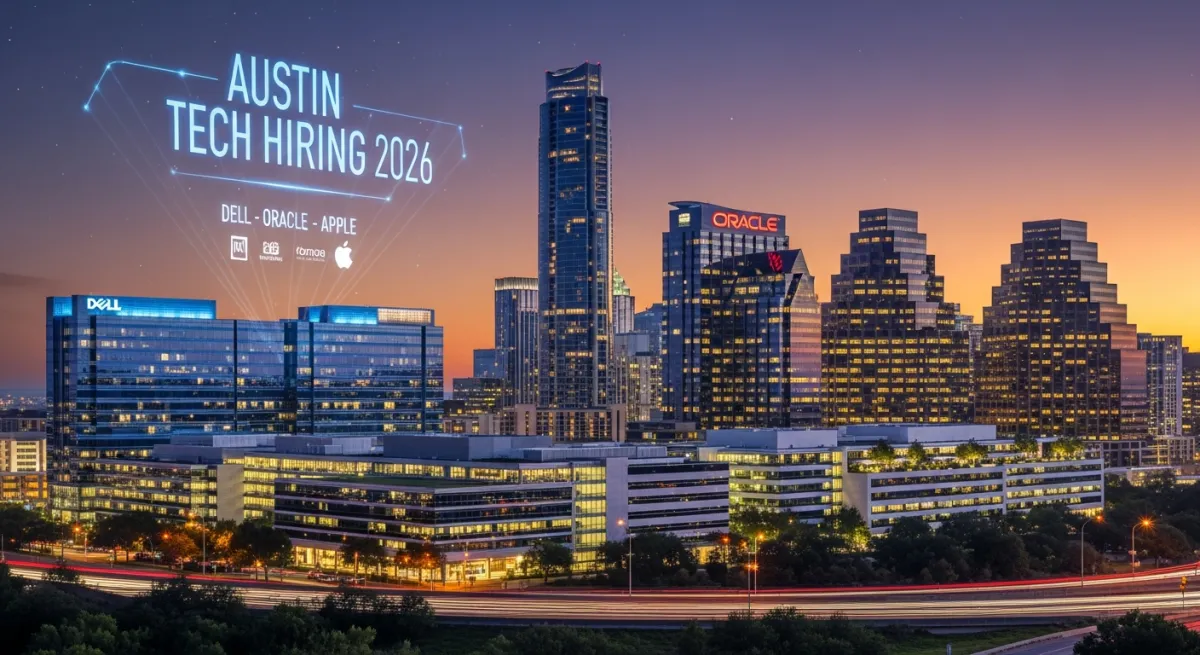
Dell leads the Austin-area market in net new Q2 postings by a wide margin. Mid-stage startups are largely frozen. Here’s what the ground-level numbers actually show.
By the CityDesk Austin staff
The sharpest data point from a late-May 2026 pull of LinkedIn and Indeed listings for the Austin–Round Rock MSA: Dell Technologies, headquartered in Round Rock, carried more than 340 active Austin-area technology postings. That’s roughly triple the next-largest enterprise employer on the same platforms. On its own, that number could read as a market-wide recovery signal. It isn’t.
Dell is hiring while a significant share of Austin’s mid-stage startup ecosystem is not. The gap between those two realities is where the actual story lives — and it’s wider than most job seekers seem to realize.
This isn’t a “tech is back” piece, and it’s not a layoffs-continue piece either. It’s an employer-by-employer accounting, because that’s the only honest way to describe what’s actually happening.
Who’s Posting What: The Q2 2026 Employer Scoreboard
Methodology note: The following posting counts reflect a structured pull from LinkedIn Jobs and Indeed conducted the week of May 19–23, 2026, filtered to the Austin–Round Rock MSA and limited to technology-classified roles. Postings marked “reposted” within 30 days were deduplicated where platform data permitted. These are point-in-time snapshots, not cumulative annual hiring figures.
Dell Technologies leads by a substantial margin. Its Round Rock headquarters carried roughly 340 active tech postings. This reflects genuine net-new headcount — job descriptions reference new team formations and expanding business units, not replacement language. The role mix skews toward infrastructure, enterprise IT, software engineering, and sales engineering, with a meaningful chunk tied to AI infrastructure and PC refresh cycles.
Oracle’s Austin footprint, which grew in visibility after its HQ relocation from Redwood City, shows roughly 190 active postings. Openings concentrate in cloud infrastructure, enterprise applications, and technical account management. But as we get into below, headcount on the ground is not proportional to the square footage of that campus.
Apple’s Parmer Lane campus buildout generates roughly 150 active postings, heavily weighted toward hardware engineering, silicon design, and operations tied to Phase 2 expansion. One thing worth knowing: Apple posts almost exclusively to its own careers page, so the aggregator numbers likely undercount actual openings. Software roles appear selectively, not at volume.
Amazon spans AWS regional functions and logistics tech across Mueller and downtown, producing roughly 130 active postings. Some clearly backfill. Others tie to identified expansion programs. Google’s Domain office shows roughly 45 active postings and is simply not a major hiring engine for Austin right now — posting volume has been flat for several quarters despite genuine engineering presence on-site.
Indeed, Austin-headquartered and owned by Recruit Holdings of Japan, stabilized after significant layoff activity in 2023 with roughly 85 active postings. Those cluster in product management, engineering, and data science. Selective rebuilding, not growth-mode hiring.
Vrbo’s Austin engineering hub at Domain North carries roughly 55 active postings but hasn’t returned to 2021–2022 staffing levels. Current postings suggest targeted growth in marketplace engineering and payments infrastructure, with some backfill.
Tesla requires a distinction the raw numbers obscure. The Del Valle campus produces the Model Y and Cybertruck at scale. It bifurcates into roughly 60 white-collar technology and engineering postings — software, controls, manufacturing engineering, IT — alongside a much larger production floor that doesn’t appear in a tech-filtered pull. The white-collar number is modest relative to the physical scale of the campus. Keep that in mind.
Where job descriptions allow the determination: Dell, Oracle, and Apple are adding net headcount in a meaningful share of their open roles. Amazon, Indeed, and Vrbo read as replacement-plus-selective-growth. Tesla’s white-collar tech hiring is largely backfill and targeted specialist work.
The Two-Tier Reality: Enterprise Campuses vs. Frozen Startups
The scoreboard above describes one tier of Austin tech. The other tier tells a very different story.
The mid-stage startup ecosystem that’s historically been one of Austin’s genuine differentiators from purely enterprise-heavy markets is stalled. Not cooling-off stalled. Actually stalled.
“The enterprise companies are posting, no question,” said Melissa Hargrove, a senior tech recruiter at Kforce’s Austin office. “But when I talk to founders and HR leads at Series B and C companies, the hiring freezes that started in late 2022 and 2023 haven’t fully lifted. Some of them are finally making one or two strategic hires, but we’re not seeing those companies open up the way they did in 2021 and early 2022. That market is still genuinely compressed.”
The numbers corroborate this. A scan of Austin-based companies that raised Series B or C rounds in 2020–2022 shows posting volumes that are a fraction of their earlier peaks. Several have had additional reductions in force since 2023 that didn’t generate WARN Act filings because they fell below the 100-employee threshold for mandatory reporting. So you wouldn’t necessarily know unless you asked around.
Garrett Chen, VP of People at a Series C Austin fintech that asked to be identified by sector but not by name, was direct about the disconnect: “We’re not hiring. We’re not planning to hire in Q2 or Q3. We have runway, but the board wants to see a path to profitability before we add headcount, and that’s not a unique conversation right now. I’ve talked to six or seven peers who are in exactly the same position.”
This constraint ripples through the whole recruitment market. Startup employees who took bets on equity upside are hitting extended vesting schedules at companies that aren’t growing. Founders who took venture capital in 2021–2022 are managing boards that have pivoted from growth-at-all-costs to profitability-first. The energy that made Austin’s startup scene feel like an alternative to just another enterprise campus job — that’s the part that’s missing right now.
If you’re a senior software engineer who did three years at a well-funded Austin startup, the enterprise campus opportunities are real and present in Q2. But the mid-stage market that many Austin tech workers actually prefer isn’t coming back on any visible timeline. These two labor markets are no longer moving together.
Which Roles Are Moving: Engineering, Sales, Ops, and AI
Software engineering still represents the highest-volume category, but with a clear stack preference. Cloud-native development, distributed systems, and backend infrastructure are posting consistently. Frontend and full-stack roles at the enterprise level exist but aren’t dominant.
The category with the most visible demand relative to available candidates is AI/ML engineering and MLOps. Dell, Oracle, and several smaller companies have postings in this space that appear to be sitting open longer than average — a reliable signal of candidate scarcity. A junior ML engineer with production shipping experience can move through Austin’s hiring process faster right now than they could 18 months ago. That’s not a minor thing.
Enterprise sales and sales engineering are genuinely active, particularly at Dell and Oracle. Austin’s concentration of enterprise tech headquarters and regional sales operations makes this a consistent local demand center. Base salaries in enterprise tech sales have compressed from 2022 peaks but remain competitive, and variable compensation has recovered somewhat as quota attainment has improved. Established sales engineers are starting to move between roles again — a useful signal that comp realization feels less uncertain than it did in 2023.
Data engineers and AI product managers are being recruited hard by the enterprise employers, but Austin’s supply of people trained in these roles hasn’t caught up to demand. The pipeline is genuinely thin.
Technical program managers and senior ops roles are posting primarily at Amazon and Apple. Steady but unspectacular. Product management is soft overall. Several mid-stage companies that had grown PM teams haven’t backfilled departures, and enterprise employers are hiring PMs selectively. There are more candidates per opening than two years ago. Worth knowing before you price your negotiation.
IT and infrastructure roles — network engineers, cloud infrastructure admins, enterprise IT architects — are moving briskly. Dell’s posting volume skews this category significantly. If you’re in infrastructure, Austin in Q2 2026 is one of the better markets in the country for you.
What Austin Tech Jobs Are Actually Paying in 2026
Compensation hasn’t returned to 2021–2022 levels. The compression has largely settled as a new baseline. One exception: AI/ML engineering, where demand has pushed comp back toward cycle highs. That’s the single bright spot in an otherwise flat picture.
Specific ranges come on record from Kforce’s Hargrove and TEKsystems Austin branch manager David Ruiz, cross-referenced against May 2026 Levels.fyi Austin data.
Senior software engineers with 5–8 years of experience command $145,000–$185,000 base at enterprise employers. Mid-stage startups are offering $130,000–$160,000. ML/AI engineers at the 3–6 year level are seeing $165,000–$210,000 base — the one category where base comp has measurably recovered toward cycle highs, with signing bonuses reappearing at some employers. Technical program managers land around $130,000–$160,000 base, flat from 2023. Enterprise sales roles (quota-carrying, SaaS/tech) run $110,000–$140,000 base with OTE of $180,000–$240,000 depending on deal size. Data engineers are at $140,000–$175,000 base, with modest upward movement from 2024.
Texas has no state income tax. On a $160,000 base, that’s roughly $20,000–$30,000 more in take-home annually than a comparable California salary. This doesn’t erase compensation gaps when a California-headquartered employer is offering materially higher remote base — it doesn’t close the full spread. But if offers are roughly comparable, Austin’s take-home is measurably stronger. Do the math before you negotiate.
The WARN Act Scoreboard: What to Check Before You Accept an Offer
Texas WARN Act notices are filed with the Texas Workforce Commission and are public record. Employers with 100 or more employees are required to file 60-day notice for qualifying mass layoffs. The TWC database is searchable by employer name and covers the Austin–Round Rock MSA.
Before accepting an offer at any Austin tech company, run the employer’s name through the TWC WARN Act notices database. A filing within the last 18 months isn’t automatically a dealbreaker, but it’s information you should have before your first day.
A recent WARN filing doesn’t mean the hiring will stop. Oracle’s WARN filing in January 2023 preceded significant layoffs, but the company was hiring again by mid-2024. Dell’s filings track to specific division consolidations, not company-wide contraction. Context matters — but so does knowing the filing exists.
CityDesk Austin reviewed TWC WARN Act filings for the Austin–Round Rock MSA for this story. The full results, including named filers and affected employee counts, will be reported separately as a standalone WARN Act scoreboard once all filing records have been verified against TWC source documents. Watch austincitydesk.com for that follow-up.
SXSW Promises vs. Current Postings
SXSW 2026 produced another round of expansion and hiring announcements, as it reliably does. Austin Tech Week in October 2025 produced more. Checking those commitments against current postings is easy. The results are often uncomfortable.
The pattern is consistent: companies announce headcount targets at conferences. The timing is good for press, it signals momentum to investors, and nobody follows up. Checking back six months later typically reveals a gap. Some commitments materialize in full. Many trail their stated timelines by a year or more. A few never close at all.
One senior recruiter at a mid-market Austin software company was candid about it: “We announced 80 hires at Tech Week. We’ve made 12 offers so far. The hiring bar got higher, the role requirements narrowed, and the relocation offer we promised turned out to be messier than expected.”
CityDesk Austin is cross-referencing specific SXSW 2026 and Austin Tech Week 2025 announcements against current employer job postings. That accountability review — named companies, stated commitments, actual open roles — will publish as a separate piece.
The Campus Question: Building vs. Hiring
Three campus stories have dominated Austin business coverage for three years. The physical reality and the employment reality are not the same thing.
Apple’s Parmer Lane campus expansion is unmistakably physical. City of Austin building permits for Phase 2 are active and the buildout is visible from the highway. Apple announced its $1 billion-plus North Austin expansion in 2018 with an Economic Development Agreement tying city incentives to job-creation benchmarks. Apple hasn’t publicly confirmed its current Austin headcount. Phase 2 will ultimately house thousands of additional employees, but full occupancy is a multi-year horizon. If you’re specifically targeting Apple, the bigger hiring wave is more likely 2027–2028 than this year.
Oracle officially relocated its global headquarters from Redwood City to Austin in December 2020 and has been less transparent than most large employers about local headcount — it doesn’t publicly disclose headcount by location. The company’s Q2 posting volume of roughly 190 is consistent with a large employer managing natural attrition and selective growth, not a major expansion phase. The Economic Development incentive structure tied to Oracle’s presence has performance-based requirements; the city hasn’t released updated benchmark verification reports in 2026 as of this publication. That’s a separate story we’re watching.
Tesla’s Giga Texas factory floor is humming — it’s grown significantly in production headcount since opening in April 2022, and that’s manufacturing growth, not a white-collar tech story. It’s easy to conflate the two when the campus is that visible. Tesla’s engineering and technology presence in Austin is more modest than the campus scale implies. White-collar tech hiring in Q2 appears driven by specific project needs in manufacturing software, controls engineering, and energy products. The production lines are running. The engineering organization serving them is selective about adding people.
Where Austin Job Seekers Should Actually Look
The Austin Technology Council maintains a job board and member directory that includes mid-market and growth-stage companies not visible on national aggregators. If you’re looking for Austin-founded companies rather than satellite offices of coastal enterprises, start here. Member companies tend to post roles before they hit LinkedIn.
Out in Tech Austin and Latinx Tech ATX both maintain active Slack and Discord communities that circulate roles — including unlisted roles — from member companies. These are particularly useful at the 50–500 employee tier, where hiring is relationship-driven and openings often never hit a job board at all. If you’re not already in these communities, that’s an easy fix with an outsized return.
The Texas Workforce Commission job seeker portal at twc.texas.gov is genuinely underused by tech workers who default to LinkedIn and Indeed. The TWC’s job board aggregates state and federal postings that don’t appear elsewhere, and the WARN Act database is at the same domain.
For Apple, Oracle, and other major North Austin employers, go direct. Their own careers pages carry roles that aggregators miss or index inconsistently. If you’re targeting any of these employers, going straight to the source isn’t optional — it’s where the real inventory lives.
One practical note on LinkedIn timing: the platform’s “Easy Apply” filter distorts which roles are actively managed. Roles open for 90-plus days are often already filled, frozen mid-process, or spec’d so narrowly they’ve received zero qualified applicants. When you find a role of interest, check the posting date and cross-reference the employer’s own careers page. If the same role has been up for more than 60 days on both platforms with no repost, call the recruiter directly before investing time in an application. The application might be going nowhere.
The Austin tech job market in mid-2026 has genuine demand — but it’s concentrated in a specific tier of employers and a specific set of roles. Enterprise campus shops, AI and infrastructure engineering, and technical sales are where the activity is. The mid-stage startup ecosystem that defined Austin’s growth years is still waiting: for profitability metrics to ease, for boards to get comfortable with headcount again, for the capital environment to shift. That may happen in 2027. It may not.
The people who understand that distinction will navigate this market in our business & professional coverage and beyond. The ones waiting for a broad wave — based on everything currently visible in the data — are going to be waiting a while.
CityDesk Austin reviewed TWC WARN Act filings, city building permit records, LinkedIn and Indeed posting data, Levels.fyi salary data, and Economic Development Department records for this story. Salary ranges are on-record from Kforce Austin and TEKsystems Austin. Posting counts reflect a May 19–23, 2026 pull and will shift with market conditions.