How the Domain Became Its Own Business District and What Leasing There Looks Like Now
The pitch has always been seductive: a walkable mixed-use district in North Austin, anchored by major tech employers, ringed by retail and restaurants, offering companies a genuine alternative to t…

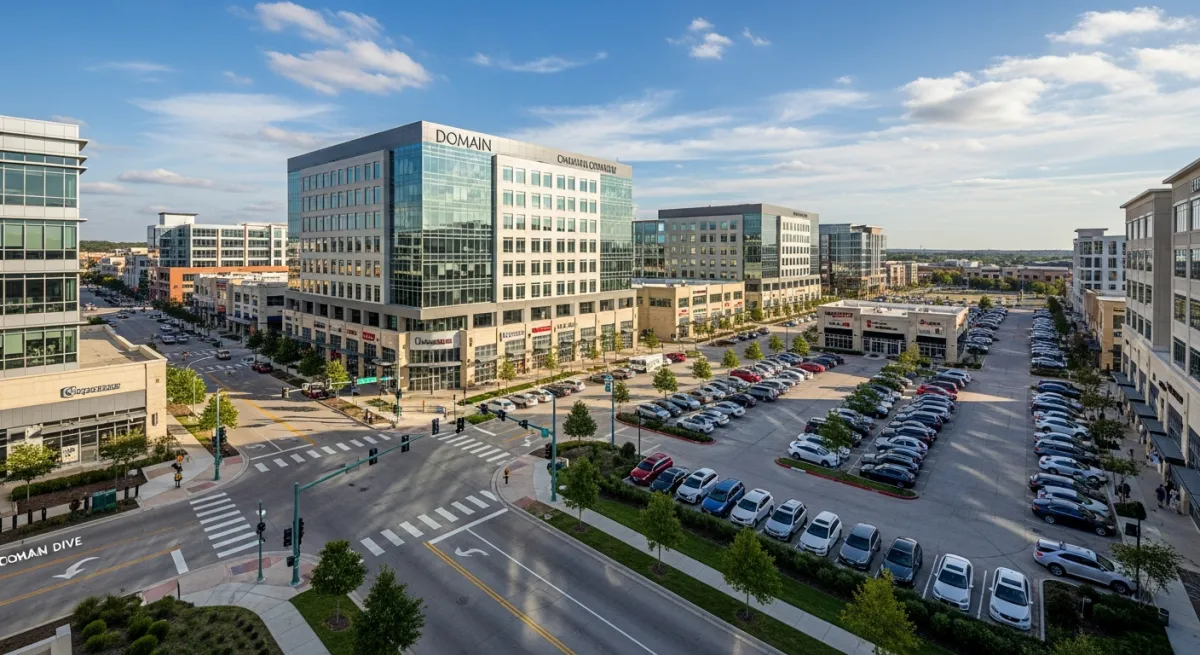
The pitch has always been seductive: a walkable mixed-use district in North Austin, anchored by major tech employers, ringed by retail and restaurants, offering companies a genuine alternative to the congestion and cost of Downtown. For a while, roughly 2015 through 2021, the Domain largely delivered on it. Vacancy was tight, rents climbed, and the district’s boosters weren’t wrong to call it Austin’s second downtown.
That story has gotten considerably more complicated.
Austin’s office market entered 2025 carrying some of the highest vacancy rates of any major Sun Belt city, and the Domain hasn’t been insulated from that reckoning. The tech companies that defined the district’s boom are either consolidating space, quietly marketing sublease inventory, or physically departing floors they’re still paying rent on. Landlords who couldn’t give a prospective tenant the time of day in 2019 are now offering concession packages not seen in more than a decade.
None of this makes the Domain a bad leasing decision in 2025. It may actually make it a better one for the right company. But you’ll need to cut through a layer of boosterism that still clings to how the district markets itself, and look squarely at what the numbers and the tenant moves actually say.
What You Will Pay: Domain Rents Compared to Downtown and East Austin
Class A office space at the Domain is currently quoting around $42 to $52 per square foot on a full-service gross basis, meaning the landlord covers operating expenses, according to CoStar and LoopNet listings as of mid-2025. That range covers the district’s premium buildings: the glass-and-steel towers along Domain Drive and Century of Progress Boulevard that Endeavor Real Estate Group developed and manages as the core of the office campus.
Downtown Class A commands $50 to $65 per square foot FSG, with the top reserved for trophy product. Creative and flex inventory on the East Austin corridor — buildings along East 6th, Airport Boulevard, and the Mueller area where smaller tech firms and agencies have settled — typically quotes $28 to $40 per square foot, often on a modified gross or NNN basis, meaning operating expenses hit the tenant’s line items separately.
The math: a 10,000-square-foot tenant on a five-year lease at the Domain’s midpoint asking rent of $47 per square foot is looking at roughly $470,000 annually, or $2.35 million over the lease term before concessions. The same deal at Downtown’s midpoint — $57 per square foot — runs $570,000 a year, $2.85 million over five years. That’s a $500,000 difference. Not nothing.
Here’s the problem. The suburban discount that once made the Domain an obvious play relative to Downtown has compressed materially. The district was built, in part, on the proposition that companies could get near-downtown amenities at a significant suburban discount. When you run the numbers today, that equation doesn’t resolve the way it once did. Any leasing analysis that doesn’t start there is working from an outdated model.
The Concession Story: What Landlords Are Actually Putting on the Table
In a market where Domain Class A vacancy has climbed into the high teens and low twenties, the more important number for a tenant signing today is what comes off the asking rent.
Tenant improvement allowances are reportedly running $80 to $120 per square foot on longer-term deals — at or near the high end of what the Austin market has historically offered. Free-rent abatement of six to twelve months is now common on five-to-seven-year leases, meaning a company can take occupancy and not write a rent check for the better part of a year while buildout is completed. Prospective tenants should get direct broker confirmation on those figures, since concession packages vary by building, by landlord appetite, and by deal timing. But the direction is clear: landlords are prioritizing occupancy over face-rate integrity.
Endeavor Real Estate Group, the Austin-based developer that built and manages the dominant share of Domain office inventory, is the landlord any serious prospect will ultimately negotiate with. Endeavor has been largely quiet in public coverage of the Domain’s office market. Their willingness to structure deals creatively in the current environment is the practical question that shapes every leasing conversation in the district. Endeavor did not respond to a request for comment for this article.
For a tenant with reasonable credit and a five-year-plus commitment, this is a genuine window. Whether it stays open through 2026 depends substantially on whether the broader Austin market begins to tighten. There are few signals that it will do so quickly.
Who Is There and Who Has Pulled Back
The Domain’s office story is largely a story about tech, and tech’s retrenchment since 2022 has landed here with force.
Meta occupies the former IBM Broadmoor Campus on Burnet Road, just west of the Domain retail core — a sprawling campus IBM developed as its Austin headquarters and Meta took on as it was scaling aggressively in 2021 and 2022. Indeed maintains its principal Austin presence in the district. Amazon has a substantial footprint. Vrbo, formerly HomeAway and now under Expedia Group ownership, has long been headquartered in the area. These anchors remain significant.
The post-2022 picture has shifted. Meta’s broader real estate pullback — part of the company’s restructuring that began in 2023 — has touched its Austin footprint. The precise current square footage under lease and any active sublease listings at Broadmoor require direct confirmation from CoStar sublease data and broker sources, but the company is understood to be carrying space it isn’t fully using.
Shadow inventory of this kind — space that remains technically leased but is available for sublease at below-market rates — is the most disruptive force in any office submarket. It suppresses effective rents and extends the vacancy cycle without showing up cleanly in headline vacancy figures. It’s also the hardest thing to track from the outside, which is part of what makes it so consequential.
The IBM-to-Meta arc at Broadmoor illustrates how the Domain has always been shaped by anchor decisions that originate far outside Austin. IBM’s national consolidation hollowed out the Broadmoor Campus and created the leasing opportunity Meta eventually took. If Meta keeps contracting, what comes next at Broadmoor — and how long it takes to answer that — will define the Domain’s north end for years.
Indeed has gone through its own turbulence. The company conducted multiple rounds of layoffs in 2023 and 2024 that affected its Austin headcount significantly. Whether those reductions translated into formal footprint changes or sublease activity is a question tenant-rep brokers are tracking closely.
Vacancy and Pipeline: How Much Space Is Actually Available
The Domain submarket’s vacancy rate has been estimated in the 18 to 24 percent range through the first half of 2025. That puts it squarely within a broader Austin office market that JLL and CBRE have identified as carrying some of the highest vacancy of any major Sun Belt market. The Domain is not the safe harbor it was once understood to be relative to Downtown’s older, harder-to-reposition inventory.
No significant new speculative office construction is underway at the Domain as of mid-2025. Endeavor’s development pipeline, which drove the district’s physical expansion through the late 2010s, hasn’t produced a major new office announcement since the market softened. That’s a mildly favorable signal — additional supply isn’t imminent, which puts a floor under conditions that might otherwise worsen.
The more relevant supply question is Uptown ATX. The Brandywine Realty-backed mixed-use project immediately adjacent to the Domain — on the former Metcalfe Park site along MoPac between Braker Lane and Burnet Road — will include a substantial commercial component alongside residential and retail, targeting the same tenant pool: tech-adjacent companies, professional services firms, corporate users who want well-designed suburban product. Its phased buildout adds inventory to an already well-supplied corridor. Any company evaluating the Domain should understand that Uptown ATX is both a competitive option and a potential source of near-term supply pressure. Worth tracking closely.
Where Domain Employees Actually Come From
The Domain’s workforce doesn’t primarily come from Central Austin. It comes from the northern suburbs: Cedar Park, Round Rock, Pflugerville, Leander, and Georgetown, moving south along the 183/MoPac/I-35 North corridor. That geographic reality isn’t incidental. For many companies that have chosen the Domain over Downtown, it’s the central reason for the choice.
A tech company recruiting experienced engineering and operations talent from those communities is drawing from a deep residential pool — households that would face genuinely difficult commutes into Downtown and would likely resist any role routed through I-35’s central corridor. Brokers on the tenant-rep side hear this constantly. If you’ve ever tried to hire someone from Cedar Park into a Downtown role, you know exactly what that conversation looks like.
Capital Metro’s Red Line does serve the Domain — Domain Station exists on the commuter rail route — but let’s be honest about what that means in practice. Service runs roughly hourly on weekdays with limited weekend coverage. It functions as a backstop for a small subset of riders, not a genuine alternative to driving. The Domain is, functionally, a car-commute destination, and that reality isn’t changing within the life of any lease a company signs today.
Most Domain office buildings offer three to four parking spaces per 1,000 square feet, typically included in the lease or priced at a modest incremental cost. Downtown parking is expensive and constrained, with ratios that are considerably tighter. For a company of meaningful size, the fully-loaded parking cost differential is the kind of line item that looks abstract in year one and very real in year four.
The Domain also sits in close proximity to Apple’s Parmer Lane campus — one of Austin’s largest private employers, roughly five miles away — and to Dell’s Round Rock headquarters. That density of tech employment along the North Austin corridor has built a residential workforce in the northern suburbs that any Domain tenant draws on. The location is well-suited to it. For a fuller picture of what those employees are paying to live in the communities feeding the Domain’s labor pool, our coverage of Austin’s suburban housing market tracks the conditions shaping where that workforce settles.
The Live-Work-Play Argument: Does the Amenity Base Actually Matter
What the Domain offers in retail and dining is genuine by Austin suburban standards. Domain NORTHSIDE’s mix of restaurants, the Archer Hotel, a concentration of national retail, and an entertainment strip that draws evening traffic create a differentiated environment. On weekdays at lunch, the outdoor corridors between offices and retail can feel genuinely mixed-use — which is more than you can say for most suburban office parks in this city.
But here’s the honest assessment: the amenity base functions best as a recruitment talking point for companies trying to attract employees who would otherwise prefer a downtown address. It is not a substitute for one. Employees who live in Cedar Park and drive to the Domain aren’t choosing it over Downtown Austin. They’re choosing it over a commute they didn’t want to make. For them, the retail corridor is a convenience — a nice one, but a convenience.
The live-work-play argument holds genuine weight for certain profiles: firms trying to recruit from a candidate pool that includes downtown-preferring candidates, companies hosting frequent clients who benefit from a presentable environment, organizations whose culture depends on in-office activity. For a back-office or engineering-heavy company whose employees are coming from Round Rock and whose clients visit infrequently, the amenity premium built into Domain rents is harder to justify.
The best research here isn’t reading a marketing deck. Visit the campus at noon on a Wednesday. Come back at 6 p.m. on a Thursday. Draw your own conclusions.
Should Your Company Lease at the Domain
The case is real. For companies drawing from the northern suburbs — and a substantial share of Austin’s tech and professional workforce lives there — the Domain is the most logistically rational office location in the metro. Parking is effectively free and plentiful. Rents are meaningfully below Downtown even if the discount has narrowed. The concession environment right now is favorable. A company signing a five-to-seven-year lease in the second half of 2025 can negotiate improvement allowances and free-rent periods that substantially reduce the effective cost below the asking rate.
The counterarguments are also real, and I’d push back on any broker who glosses over them. The rent gap with Downtown has compressed enough that the “obvious suburban value” argument requires more careful math than it once did. Vacancy in the high teens to low twenties raises legitimate questions about long-term submarket health — when a significant portion of a district’s inventory sits dark, it affects everything from building maintenance quality to the vibrancy of common areas to the landlord’s long-term financial position. The transit situation isn’t improving materially in the near term, which means the Domain’s workforce will remain car-dependent. And the shadow inventory from major tech tenants paying rent on space they aren’t fully using creates a soft ceiling on any recovery.
A few things worth watching more than anything else: whether Brandywine brings Uptown ATX product to market that competes directly on amenities and asking rents; and whether Meta, Indeed, and the other large tech anchors stabilize their Austin footprints or keep shedding space. The former signals a floor under Domain vacancy. The latter deepens the sublease shadow and extends the favorable-to-tenant concession window longer than anyone currently expects.
For the right company — North Austin labor draw, multi-year commitment, willingness to negotiate aggressively — the Domain in mid-2025 is a buyer’s market in a way it hasn’t been in more than a decade. The window is open. How long it stays that way depends on forces that have, as the IBM-to-Meta arc at Broadmoor illustrates, a habit of originating somewhere other than Austin.
CityDesk Austin will update this report as Q2 2025 CoStar vacancy figures are released and as Endeavor Real Estate Group responds to our request for comment. Reporters seeking to verify specific lease terms, sublease listings, or development permits should contact CBRE Austin’s tenant advisory group or JLL’s Austin office research team as primary sources.