How to Get a Business License in Austin in 2026 Without Getting Lost in the Process
Austin issues no general business license. What it issues are specific-use permits tied to what you do and where you do it. The city's own website won't walk you through all of them.

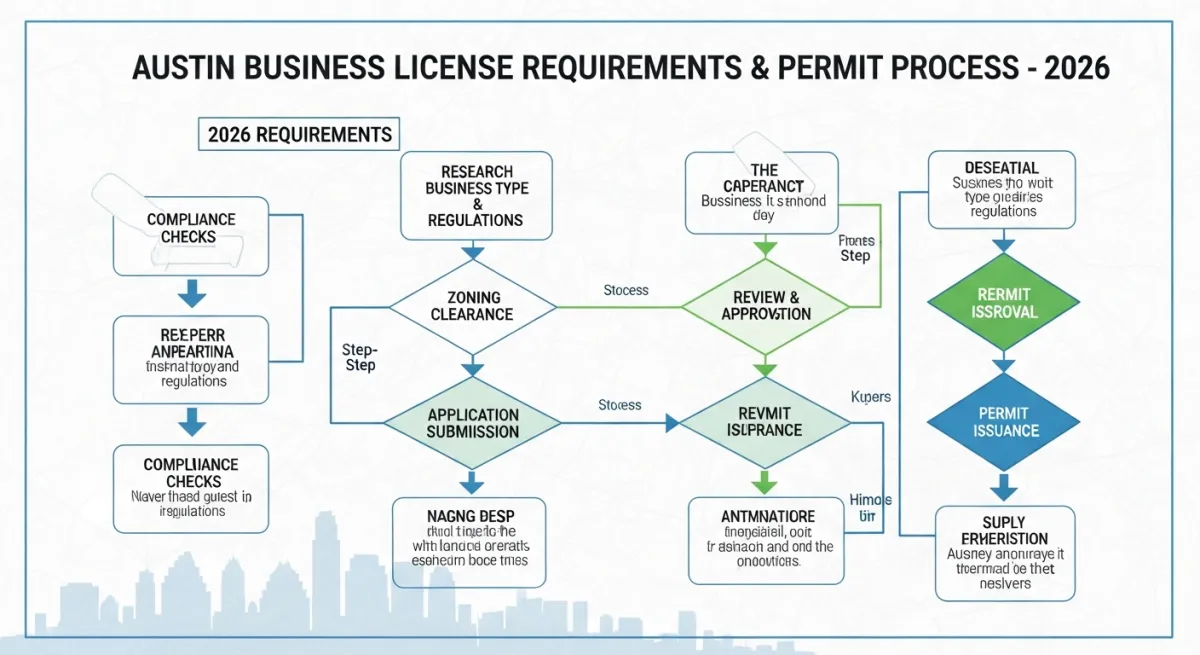
Austin issues no general business license. What it issues are specific-use permits tied to what you do and where you do it. The city’s own website won’t walk you through all of them.
Starting a business in Austin in 2026 means working through a permit system that confuses people not because it’s unusually complex, but because it’s genuinely fragmented. The Development Services Department handles occupancy. Austin Public Health handles food. TABC is a state agency with its own calendar. The Texas Secretary of State handles your LLC. None of these talk to each other — and none of them will tell you what the other ones require.
This guide walks through the full stack in the order you need to work through it, with real local addresses and a specific section on the June and July renewal deadlines that are catching established Austin businesses off guard right now.
Austin Has No General Business License — Start Here
The most clarifying thing to understand before you do anything else: there is no Austin business license. The city does not issue one. This is not a technicality. It means you cannot file an application for a “business license” anywhere on the city’s website, because that form doesn’t exist.
What Austin issues instead are specific-use permits tied to what you actually do and where you physically do it. A software consultant working from a properly permitted office may need nothing from the city beyond state-level registration. A restaurant operator on East 6th Street will need a Certificate of Occupancy, an Austin Public Health establishment permit, a TABC license, and potentially more depending on the specific space.
Naming this upfront saves weeks of confusion. I’ve heard from enough Austin business owners who spent a month looking for the wrong document that it’s clearly not a fringe experience. The real question isn’t “where do I get my Austin business license?” It’s “which permits does my specific operation, at my specific address, actually require?”
The Three Separate Filings Most People Conflate
Before touching any city-level permit, understand that three entirely separate legal questions need answers from three entirely separate agencies. Mixing these up — thinking your LLC application doubles as city permission to operate, or that a DBA filing makes your business a legal entity — is the most common structural mistake new Austin business owners make. Untangling it later is expensive.
The LLC is filed with the Texas Secretary of State through the SOS Direct portal. This answers the question: who is legally responsible? An LLC separates your personal assets from business liability and is required before you can do most other things in a legally sound way. Standard processing runs three to five business days; expedited one-day service is available. Confirm the current filing fee at sos.state.tx.us before you submit. Once approved, the SOS issues a Certificate of Formation. You will need that document number for later filings. Don’t let it get buried in your inbox.
The DBA, or Assumed Name Certificate, answers a different question: what name are you trading under? If your LLC is “Delco Holdings LLC” but you’re running a shop called “Thread,” you need a DBA. For a Texas LLC, that filing goes to the Texas Secretary of State — not exclusively to Travis County, as many guides incorrectly state. The Travis County Clerk filing applies to sole proprietors and general partnerships operating under a name that isn’t their legal name. Filing the wrong one, or filing only one when you need both, creates gaps in your legal name protection. Travis County DBA filings can be completed same-day in person; confirm the current fee with the Travis County Clerk before you go.
City permits answer the third question: are you allowed to operate this specific business at this specific Austin address? This is where DSD, Austin Public Health, and other agencies come in. It’s also where most of the timeline risk lives.
Work these in sequence, not parallel. Form your entity first. Register your name. Then approach city permits — you’ll need your entity information for those applications, and many require proof of legal formation. Showing up at DSD without your Certificate of Formation is a wasted trip.
The Austin Permit Stack — Which Layers Apply to You
Austin businesses encounter up to five regulatory layers, and the place to start isn’t the city at all.
Nearly every business that isn’t a sole proprietor operating under their own legal name needs to register with the Texas Secretary of State. If you’re selling taxable goods or services, register with the Texas Comptroller for a Sales Tax Permit — free, same-day, at comptroller.texas.gov. If you have employees, you need a federal Employer Identification Number from the IRS. Also free, also same-day. Get these out of the way early. They’re not complicated, and you’ll need them for everything else.
A Certificate of Occupancy from Austin’s Development Services Department is required for any business occupying a commercial space, and for any change of use in an existing space. Converting a former retail storefront into a food-service operation? You need a CO for the new use even if the previous tenant had one. This is where Austin’s permitting process most reliably surprises people — and where landlords who should know better sometimes give you a dangerously optimistic picture of what you’re walking into.
Austin Public Health food establishment permits are required for any operation preparing or serving food to the public. Fees are tiered by risk category and seating capacity. Verify the current FY2026 APH fee schedule at austintexas.gov/health before you budget — the city updates these at the start of each fiscal year, and the difference between tiers is real money. The APH permit also can’t be applied for until you have your CO. It’s not a parallel track. It’s a queue you enter after the first queue.
TABC licensing is required when selling or serving alcohol in Texas. Fees vary significantly by license type; confirm current schedules at tabc.texas.gov. Certain license categories in certain Austin locations require Austin City Council approval, which adds two to three months or more. This is the longest single element in the entire timeline. Start it first, not last. I’ll say it again in the food and alcohol section.
Specialty licensing applies to childcare facilities, cosmetology salons, massage therapy establishments, and short-term rental operators. Each carries additional state or city-level permits layered on top of everything above. STR operators in Austin need a city-issued STR permit, and the city has moved from passive administration to active enforcement. Given Austin’s extended litigation history around short-term rental ordinances, the current status of those rules should be confirmed directly with the city before any STR-related investment decision. Don’t buy the property, then check the rules.
Austin’s geography matters more than most people expect. East Austin zoning classifications — CS and MU are common along East Cesar Chavez and Manor Road — permit a wide range of uses but often trigger DSD review for change-of-use even in established commercial buildings. South Congress has parking and pedestrian-zone requirements that can surface during CO review. Converted residential buildings in North Loop, particularly the Craftsman bungalows increasingly used for boutiques and studios, may carry nonconforming-use complications that require a zoning review before you commit to a lease. If your target address is in any of these neighborhoods, call DSD’s zoning team for a pre-application conference before signing anything. That call is free. Breaking a lease over a zoning problem is not.
The Certificate of Occupancy — Where Austin Deals Actually Stall
The CO is where Austin business timelines blow up most reliably, and the permit that lease negotiations most frequently fail to account for. If you’ve watched a promising opening get pushed back by months while a space sits dark and ready, this is usually why.
A Certificate of Occupancy is required when a business first occupies a commercial space, and when any existing space changes its use classification. You cannot legally operate in a commercial space without one. Austin Code Department enforces it. Operating without a CO means fines and forced closure.
Austin’s primary permitting portal is Austin Build + Connect at abc.austintexas.gov. In-person service is available at DSD’s permit center — but verify the current address and hours directly at austintexas.gov before making the trip. The old One Texas Center address at 505 Barton Springs Rd. still circulates in outdated guides and is no longer correct. Showing up at the wrong place is a genuinely demoralizing way to lose a morning.
For an existing commercial structure with no construction required, recent applicants have reported CO processing running roughly four to twelve weeks. When inspections are involved — fire marshal, electrical, structural — you’re looking at the longer end of that window or beyond. If your space requires a tenant improvement buildout, a separate building permit has to clear first, which can add months. Confirm current processing times directly with DSD before you build your business timeline. Backlogs shift with application volume, and the difference between a slow month and a busy one is significant.
Sign a contingency lease that makes occupancy conditional on CO approval. This is standard practice for experienced Austin commercial brokers and protects you if the CO is delayed or denied. What you cannot do is begin operating before the CO is issued. The Code Department does inspect and cite businesses in unpermitted spaces, particularly in high-traffic corridors where complaints are common.
If you’re running a business from a home in Austin, the city’s Home Occupation Permit rules govern what’s allowed. A solo consultant taking client calls from a home office generally doesn’t need one. These activities trigger the requirement: external signage, non-family employees working on-site, regular customer traffic to your residence, or commercial delivery volume above what’s typical for a household. The permit goes through DSD. If your home is subject to an HOA or deed restrictions, check those too — they may impose independent limitations that have nothing to do with what the city permits.
Food, Alcohol, and the Permits That Add Weeks to Your Timeline
For restaurants, bars, coffee shops, food trucks, and any operation involving food or alcohol, the permitting timeline isn’t the CO timeline. It’s the CO timeline plus additional layers that run sequentially. This is where optimistic opening-date estimates go to die.
Food operations require three distinct items: individual food handler certification for every employee involved in food prep; at least one Certified Food Manager per establishment (ServSafe is the exam most widely used in Austin); and the Austin Public Health food establishment permit itself. The APH permit requires an on-site inspection before it’s issued, and the inspection queue adds time after the CO clears. You can’t compress it by calling APH more frequently. The queue is the queue.
Alcohol permits are the longest variable in the Austin permitting stack. Start your TABC application as early as possible — ideally concurrent with your lease negotiation, not after your CO is in hand. The process involves submitting an application, posting notice at the business location for a public comment period, and for certain license categories, going before Austin City Council for local approval. That council process alone can run two to three months. If your concept requires alcohol revenue to be financially viable from opening day, your TABC application is your critical path item — not an afterthought, not a box to check after everything else is done.
Here’s the part that genuinely bothers me to report, because it’s so common: serving alcohol without a TABC license isn’t a fine. It’s a state criminal violation. Soft-opening events where alcohol is served before the license arrives are routine in Austin. They’re also illegal. The fact that many places have done it without consequence doesn’t make it a calculated risk. It makes it a gamble on not getting caught.
Short-term rentals require a separate city permit. Given Austin’s ongoing litigation history around STR ordinances, anyone investing in short-term rental property in 2026 should verify current ordinance status and permitting requirements directly with the city before acquisition. For a broader look at what Austin’s short-term rental permit requirements entail in 2026, the rules in effect today may not be the rules in effect when you open.
A Realistic Timeline From LLC to Open Door
For a standard retail boutique with no food or alcohol — the simplest common case — here’s what a realistic Austin permitting timeline looks like starting from scratch.
Day one: Federal EIN from the IRS website, free, same-day confirmation. Texas Sales Tax Permit registration through the Comptroller, free, same-day. Travis County DBA if you’re a sole proprietor — in-person at the Travis County Clerk’s office, confirm the current fee before you go.
Days one through five: Texas LLC formation via SOS Direct. Standard processing is three to five business days; one-day expedited service exists. Do not sign a lease or open a business bank account before this clears.
Week one or two: Submit your CO application through Austin Build + Connect once you have entity formation and a lease address. This starts the clock.
Weeks four through twelve, realistically more: CO review and inspection. Four weeks is the optimistic end for an existing commercial space with no construction. Twelve is more realistic when inspections are involved. Plan for the longer end.
If food: Add additional weeks for the APH inspection and permit after the CO clears. Ask APH directly about current queue times when you apply.
If alcohol: Start your TABC application before your CO is issued. Budget at least 60 days for simpler license categories. A full mixed beverage permit with city council involvement can run significantly longer.
You can accomplish a lot while waiting on permits. Form your entity, negotiate and sign a contingency lease, open a business bank account, order equipment, apply for your EIN, register for sales tax, build out your space under a building permit if required. What remains prohibited during the waiting period is operating from the commercial space without a CO, serving food without an APH permit, or serving alcohol without a TABC license.
The consequences aren’t symmetric. A Code Department citation for operating without a CO can mean forced closure. An APH violation carries real health-code enforcement teeth. A TABC violation is a criminal matter under Texas law. These aren’t bureaucratic inconveniences.
The June and July Renewal Window — A Real Alert for Businesses Already Open
This section is for readers who already have permits.
Austin’s post-COVID business surge in 2021 and 2022 produced a large cohort of businesses permitted during Q3 of those years. Those businesses are now hitting first and second renewal cycles simultaneously. The concentration of renewals landing in a short window creates real risk for operators who don’t track renewal dates closely. If you opened in summer 2022 and haven’t thought about this yet, keep reading.
Food establishment permits from Austin Public Health renew annually. If your establishment was permitted in June or July of 2022 or 2023, your renewal window is now. APH renewal notices typically go out 30 to 60 days in advance — but if you haven’t seen a notice for a summer-issued permit, call APH proactively. Don’t wait.
TABC permits vary by license type. Mixed beverage permits and wine-and-beer retailer permits issued on two-year cycles with mid-year issuance dates cluster in June and July. Check your specific renewal date at tabc.texas.gov. If your license expires June 30 and you haven’t filed for renewal, you have no legal authority to serve alcohol on July 1. No grace period, no administrative extension.
Austin STR permits issued during the 2021 surge are in their second and third renewal cycles and hitting the same window. Operating a food establishment on an expired APH permit is a health code violation. Operating with an expired TABC license means no alcohol service and risks a formal complaint that can affect future licensing. Operating an STR without a current city permit puts you in the category the enforcement team is actively targeting.
If you’re operating a food-service business, a licensed alcohol establishment, or a short-term rental in Austin and you’re not certain of your renewal date, look it up this week.
Free Local Help Before You File Anything
The most useful free resource for Austin business owners working through this system is the Austin Small Business Development Center, affiliated with UT Austin and funded through the SBA. The SBDC offers free one-on-one consulting with advisors who will walk through your specific permit requirements based on your business type and address. This is substantially more useful than calling DSD’s general information line — not a knock on DSD staff, just the reality of a general line versus sitting across from someone who has seen your exact situation before. The advising request form is at austinsbdc.org.
The City of Austin runs its own Small Business Program at austintexas.gov/smallbusiness. This is a separate resource and worth a direct call. The program connects business owners with city staff who know the permit system from the inside. SCORE Austin provides follow-up mentoring from experienced business owners and is particularly useful once you’ve done the SBDC walkthrough and have more specific questions. All of this falls squarely within our business and professional coverage of how Austin entrepreneurs navigate local systems.
One practical note: phone numbers and office locations for all three of these resources change more often than their websites reflect. Before calling or visiting, confirm the current contact information directly. The DSD permit center address, the APH fee schedule for FY2026, and current CO processing times should all be verified by a direct call before you build your timeline around them. Agencies update fee schedules at the start of each fiscal year. Processing times shift with application volume. The figures that govern your actual situation are the ones the city gives you when you ask.
CityDesk Austin covers local business, development, and policy for Austin residents who need real information. If your business has navigated Austin’s permit system recently — successfully or not — we want to hear about it.