Austin Food Halls in 2026 Which Ones Are Still Open
Between 2017 and 2022, Austin opened a wave of food halls. Office construction was booming. Restaurants were pivoting fast. People wanted communal eating spaces. At peak, Austin had a substantial n…

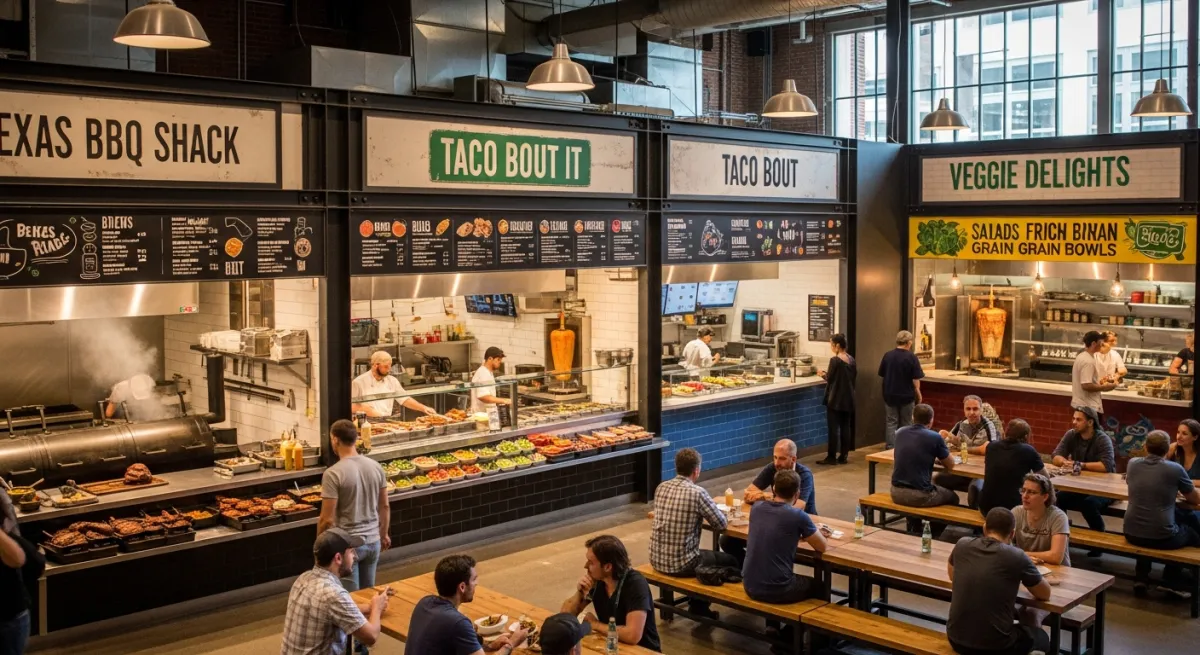
Between 2017 and 2022, Austin opened a wave of food halls. Office construction was booming. Restaurants were pivoting fast. People wanted communal eating spaces. At peak, Austin had a substantial number of food hall and hall-adjacent operations—depending on how you define the format, and that definition got pretty elastic during the pandemic years—from polished, investor-backed downtown anchors to scrappier incubator collectives on the East Side.
In 2026, a fraction of those are operating.
This is a status audit, not a dining guide. The goal is verified ground-truth answers: which halls closed, which survived, what’s in those spaces now, and why the math worked in some neighborhoods and collapsed in others. If you’re planning lunch, some of this is useful. If you’re tracking Austin real estate or evaluating a food concept, most of it is essential.
Fareground Is Closed
Start with the most-searched question in Austin food coverage: Fareground, the hall at 140 W. 6th Street in the AMLI block downtown, closed in 2023. It opened in 2018 as the city’s first purpose-built downtown food hall, with a curated vendor mix and a location that made sense on paper. The Indeed Tower and the Congress Avenue office corridor were right there. That was the whole theory of the thing.
The vendor roster during Fareground’s peak years included Henbit, Contigo’s Stix, TLV, and Tumble 22 Hot Chicken. That last one matters. Tumble 22 used the Fareground stall as a proving ground before expanding to brick-and-mortar locations of its own. Several of Fareground’s strongest vendors survived the closure precisely because they had outgrown the stall model before the lights went out. The hall’s failure didn’t kill them. It accelerated their next chapter—which is a more interesting story than the closure itself, and one that gets buried whenever Fareground comes up.
What currently occupies the ground-floor space at 140 W. 6th requires a site visit to confirm. Travis Central Appraisal District records and a direct walkthrough are the only reliable sources for current tenant status.
The Other Closures
Fareground gets the most Google searches, but it wasn’t the only casualty.
The Linc, which operated on the 183/McNeil corridor in North Austin, was positioned as a suburban alternative to downtown halls. Its current status requires direct verification. Anything more than a year old on this location cannot be trusted—and I’d extend that skepticism to most of what you’ll find in general Austin food coverage about it.
The pop-up collective wave of 2020–2022 deserves separate accounting. Several informal multi-vendor spaces operated during the pandemic under various licensing structures—some as shared commissaries, some as ghost-kitchen collectives with a walk-up window. Most dissolved between 2021 and 2022 as the economics of their moment passed. They were never true food halls in the fixed-infrastructure sense, but they occupied the same market niche and drew the same vendor pool. Their disappearance reduced the stall-format opportunities available to small operators, which is part of why the surviving halls now have waiting lists. The ghost kitchen model worked because it was cheap and flexible. When the pandemic conditions ended, so did the economics. Worth noting: some of those operators are now running the most interesting independent restaurants in the city. Different story, but a good one.
What Is Actually Open Right Now
This is the section where most coverage fails. Reporters rely on press releases, outdated Yelp listings, or hall websites that haven’t been touched since 2023. Verification is tedious. But showing up for a vendor that closed eight months ago is worse.
On methodology: vendor turnover in Austin food halls runs 30–50 percent annually even at healthy operations. A website listing vendors from eighteen months ago is fiction. The Austin Public Health food establishment database—searchable by address—is the only reliable real-time source for who holds a current permit at a given location. If you’re planning a visit around a specific vendor, call the hall directly the day before.
The Domain area in North Austin near MoPac and 183 contains the closest thing Austin has to a conventional food hall success story. Any hall concept operating here benefits from captive foot traffic, hotel and residential adjacency, and full climate control. Those structural advantages over downtown matter more than most people realize. Verify current vendor rosters through Austin Public Health permit records before visiting.
Smaller vendor collections have operated under Fareground East branding in the East Austin corridor, though operational status requires verification against current permits. The name has created genuine confusion in online searches—you’ll find contradictory claims on the same results page—making it harder to track than the original downtown location.
The East 6th Street corridor hosts several vendor operations running a different model altogether. Smaller footprint. Evening-weighted. Bar-adjacent. This format has proven more durable than the downtown lunch-anchor version, and honestly, it probably fits Austin better to begin with. Several of these operations don’t use the “food hall” label at all, which may partly explain why they’ve avoided the closure narrative while functionally serving the same role. Confirm operating status for any specific venue through Austin Public Health permit records.
The consistent check is the same regardless of location: pull the address in Austin Public Health’s food establishment database to see which vendor stalls hold active permits. That record is public, current, and more reliable than any published list.
Why Downtown Failed and the East Side Didn’t
Austin’s downtown Class A office vacancy ran between 25 and 27 percent through 2024 and into 2025, according to Downtown Austin Alliance data. The towers that Fareground was built to serve never returned to pre-pandemic occupancy levels. What that means in practice: a food hall built around lunch-rush volume from a worker population that never materialized isn’t a food hall. It’s an expensive subsidized amenity for the building. The lease structure might have worked if foot traffic matched the pro forma. It didn’t, and at some point the gap became unbridgeable.
The East Side’s survival isn’t primarily a cultural story, though culture gets the credit in most write-ups. It’s a traffic-composition story. East 6th, the Springdale Road corridor, and South Congress attract evening and weekend visitors, tourists, residents who live within walking or biking distance, and a younger demographic that treats dinner-out as a primary social activity. That mix protects a hall from the weekday-lunch single point of failure. When remote work hollowed out downtown foot traffic, East Side halls barely noticed.
There’s another factor that competing coverage has consistently ignored, and I find this genuinely baffling given that everyone here lives it: heat. As explored in our food & hospitality coverage, the physical realities of Central Texas shape restaurant economics in ways that national trend pieces rarely account for. June through September, outdoor temperatures routinely exceed 95°F and the heat index makes open-air stall dining functionally untenable for four months of the year. Halls that rely on outdoor seating face a seasonal revenue cliff specific to Central Texas. Full climate control is not an amenity here. It is an operating requirement. Most financial projections apparently did not model this accurately. We are in Austin, Texas. That is a remarkable oversight.
The Lease Structure That Determines Who Survives
Most food coverage ignores the lease mechanics. That’s a mistake, because the structure explains why two halls in similar locations with similar vendor quality can have opposite outcomes.
The basic split is fixed rent versus revenue share. Operators on fixed-rent structures face a binary: revenue covers the monthly obligation, or it doesn’t. When it doesn’t, there’s no cushion. Fixed-rent stall operators in downtown halls during the 2022–2023 foot-traffic slump were paying full occupancy cost on a fraction of their expected volume. The economics don’t reward persistence or adaptation. They only reward the hall operator—which, if you’re evaluating a stall opportunity, should give you pause.
Revenue-share arrangements function as a partial shock absorber. When sales drop, the hall’s take drops with it. The operator still loses money, but not off a cliff. This structure also aligns the hall operator’s incentives with vendor success in a way fixed rent never does. A hall on revenue share has a direct financial reason to drive traffic, program events, and support underperforming vendors through slow seasons. The operators are rooting for the same outcome. That alignment is worth something—probably more than most stall operators realize before they sign.
Any vendor evaluating a stall should ask for specific lease structure terms in writing. Treat any figures cited in general coverage—including this article—as a starting-point reference, not a verified market rate. The Austin Independent Business Alliance and the Downtown Austin Alliance can point vendors toward current market comparisons.
The Regulatory Burden That Doesn’t Scale
Austin Development Services Department oversees food establishment permits. Each vendor stall in a food hall must carry its own Food Manager Certificate and Food Establishment Permit—Class C or higher depending on food prep level. Austin/Travis County Health and Human Services inspects per stall, not per hall, which means a compliance issue at one vendor doesn’t automatically close the hall but does create independent exposure for each operator. Small comfort if you’re the one with the exposure.
On alcohol: food halls with alcohol service require each vendor serving alcohol to hold its own TABC permit, or the hall operator holds a single permit covering all stalls. The latter is more common in Austin halls, but it concentrates liability at the hall-operator level. Vendors sharing space under a single TABC permit should understand this before signing. It’s the kind of detail that gets glossed over during lease negotiations and matters a lot later.
Managing permitting across eight to fifteen vendor stalls simultaneously is a friction point that smaller hall operators consistently cite. Inspection scheduling, permit renewals, compliance documentation—that overhead doesn’t scale with revenue. A struggling hall in a slow month pays the same administrative cost as a thriving one. Nobody’s solved this elegantly.
What’s Coming
The pipeline is thinner than the hype suggests. Confidence on all of the following is low—which matters, because Austin food media tends to treat announced concepts as though opening day is a given.
The Red River Cultural District is genuinely underserved for daytime food. The live music venues that anchor the street don’t generate significant lunch traffic, and there’s a gap between the morning crowd and the evening concert-goer that a well-positioned hall could fill. Whether any specific announced concept will reach opening requires verification through Austin Development Services Department permit filings, which are public record.
The South Congress and Ben White corridor has been discussed as a potential food hall location by at least one mixed-use developer. No food establishment permits had been filed with Austin Public Health as of this writing. “In discussions” and “under development” have a long history of going nowhere in this city.
The Domain remains among the higher-confidence locations for any new concept, for the same structural reasons the existing hall there has worked. Whether any specific expansion is in active development requires confirmation from Domain management directly.
What the Surviving Halls Have in Common
The pattern is clear enough to state plainly. Every Austin food hall operating in 2026 has evening and weekend foot traffic that doesn’t depend on weekday office workers; either full climate control or a programming calendar that pulls people indoors during summer; a lease structure that provides some revenue-volatility protection rather than punishing it; and a location with durable residential or tourist traffic rather than a monoculture of corporate office demand.
The halls that closed share the inverse. Lunch-dependent economics. Fixed-rent structures. Locations whose foot traffic evaporated when office return stalled.
For vendors evaluating a stall: ask what the lease structure is. Ask what July looks like. Ask what happened to the last two vendors who left. That last question tends to get the most honest answers.
For diners: East Side and Domain corridors are where Austin’s food hall activity has consolidated. The downtown experiment, in its original form, is over. If you haven’t visited a hall in the past six months, check Austin Public Health’s permit database or call ahead. In this market, a year-old recommendation is a coin flip.
The food hall format isn’t dead in Austin. But the version that assumed downtown office workers would return, that Austin summers are compatible with open-air dining, and that fixed-rent operators could absorb sustained revenue downturns—that version is gone. What replaced it is smaller, more neighborhood-specific, and considerably less likely to appear in a national trend piece. Which may be exactly why it’s still here.