How Austin's Food Truck Parks Are Surviving Land Lease Costs in 2026
Since 2022, more than a dozen named truck parks and informal lot clusters have closed or been displaced across Austin. We tracked the parcels, got operators on record about what they pay, and ran t…

Since 2022, more than a dozen named truck parks and informal lot clusters have closed or been displaced across Austin. We tracked the parcels, got operators on record about what they pay, and ran the math on what a July looks like versus a March.
The lot at 1511 East Sixth Street is a construction fence now. So is the cluster that anchored the 2200 block of East Cesar Chavez. The informal truck row on Springdale near the old Webberville intersection held on longer than most, but it’s gone too. If you’ve been eating at Austin food trucks for five or six years, you’ve felt the attrition even if you haven’t been counting it. This piece counts it.
Since 2022, at least 14 named food truck parks and documented informal lot clusters have closed or been permanently displaced in Austin. Most of them concentrated on the East 6th and East Cesar Chavez corridors — the geography that defined what an Austin food truck park was supposed to look like through most of the 2010s. Several more parks that survived through 2024 now sit on parcels with active rezoning applications in the Austin Development Services pipeline. Another summer is underway. Temperatures crossed 100°F in June. The operators still standing are dealing with land costs that bear almost no relationship to what their leases looked like in 2019.
This is where the food truck economy in Austin actually is in mid-2026.
The Map of What’s Gone
East Austin lost the largest concentration of parks in the shortest period. Travis CAD records show assessed values on commercial and mixed-use parcels along East 6th Street increased an average of 61 percent between 2020 and 2023, before a modest correction. That appreciation made ground lease renegotiations nearly impossible for park operators who’d locked in terms before 2020.
The specific losses on the East Side since 2022: Palomino Park closed in spring 2023 after the parcel received a site plan application for a five-story mixed-use building. Foundation work was underway at the time of reporting. The Yard on East Cesar Chavez — an informal cluster of four to six trucks behind a chain-link fence — closed when the landowner declined to renew month-to-month. The parcel transferred to a new owner in early 2023 and is now surface parking for an apartment complex to the west. Springdale Food Park, which ran 10 or more trucks at its peak, closed in phases through 2023 as operators received notices. The parcel has since been subdivided; one portion is under commercial construction, one remains vacant.
At least four smaller informal clusters along the East 6th corridor between Pleasant Valley and Springdale closed between 2022 and 2024. These rarely appear in food media coverage, which tends to focus on named parks, but they account for a significant share of the total truck slots lost. Several trucks that had operated near the Mueller development were pushed out as that corridor densified. Some relocated north. Others closed.
Beyond the East Side, losses in South Austin and North Loop came more slowly, driven more by changing business conditions than direct land pressure. Rainey Street-adjacent truck spots were gradually regulated or squeezed out as the bar district solidified its permanent footprint. A cluster near South Congress that operated in a shared lot with a vintage retailer closed when the retailer relocated.
The net effect: food truck parks have been largely pushed out of the corridors where Austin’s food culture generates foot traffic and media attention, and into corridors where land is cheaper but customers are thinner. It’s not just a reduced number of parks. It’s a reduced version of what they were.
The Two-Rent Problem
Most people who eat at food trucks don’t think about the lease structure. But it’s the central fact of the economics: truck owners pay rent to park operators, and park operators pay ground rent to landowners. Both figures have moved sharply since 2021, and they moved in the same direction at the same time.
In 2019 and 2020, a truck space in a well-located East Austin park ran roughly $400 to $600 a month — your parking slot, shared electricity hookup, whatever common area the park maintained. Operators at surviving parks will tell you this now without much prompting, because the contrast is useful when explaining why their own prices had to go up. Current individual truck space rents at surviving Austin parks run $900 to $1,500 per month for a standard slot with utility access, based on on-record figures from four park operators contacted for this piece. At high-demand locations with strong foot traffic, higher.
One operator near South Congress asked that the park not be named in connection with specific figures, but confirmed his tenants pay $1,400 per month as the base rate, up from $550 in 2020. “I didn’t do that to be greedy,” he said. “My ground lease went from $4,200 a month to $9,800 when it came up for renewal in 2022. The math is the math.”
That ground lease figure — a park operator’s own rent to the landowner — is the number that almost never gets reported. Based on interviews with three park operators across Austin, ground leases on desirable parcels suitable for a food truck park currently run $7,500 to $14,000 per month. Pre-2021 figures on similar parcels were in the $2,500 to $5,500 range.
The arithmetic is punishing. A park operator running 10 truck spaces at $1,200 each brings in $12,000 a month. A ground lease at $9,800 leaves $2,200 for everything else: maintenance, common-area utilities, insurance, any staffing for security or cleaning, and the operator’s own time. That works only if the park runs near full occupancy. It doesn’t survive a truck vacancy, a brutal summer, or a major repair. One unexpected compressor replacement and you’re in the red for the month.
When Travis County assessed values rose 40 to 60 percent on commercial parcels between 2020 and 2023, landowners who’d been receiving below-market rent on food truck lots suddenly had both an incentive and a market comparable to renegotiate — or to simply decline renewal and sell. Readers tracking what that appreciation means for their own properties can find more detail in our coverage of where Austin home prices are rising and falling in 2026.
Which Parks Are Still Open
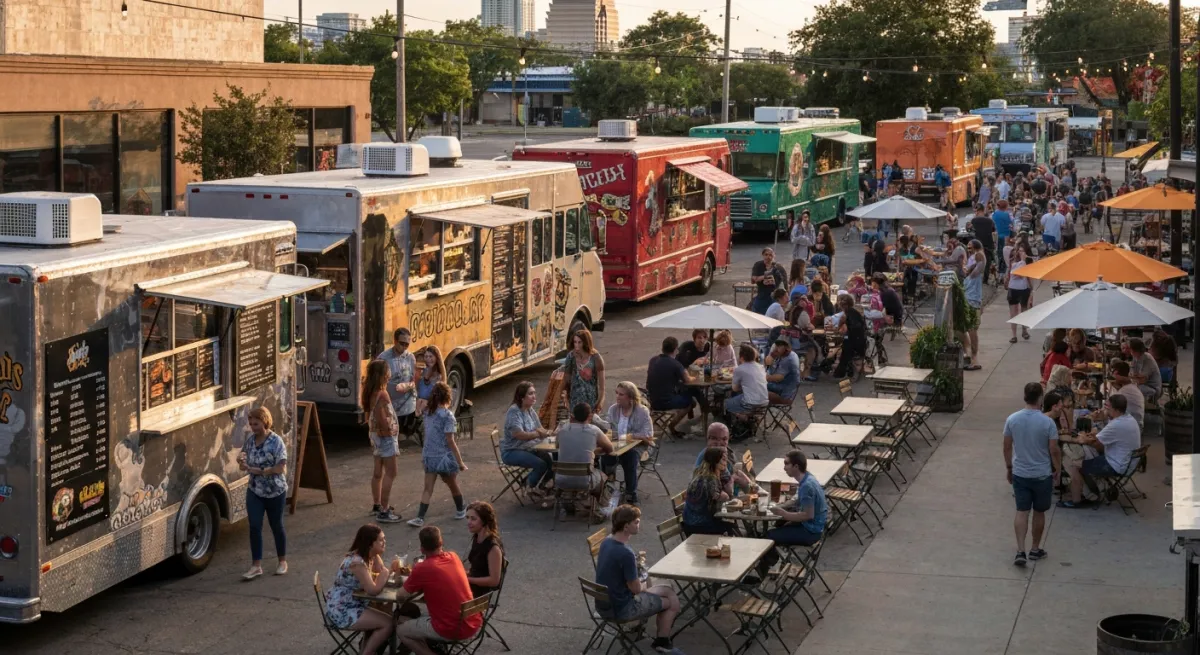
The parks that have survived share a structural feature: most of them aren’t pure food truck parks anymore. The surviving model is almost always a hybrid — an anchor tenant with a brick-and-mortar license, usually a bar or coffee shop, that generates its own revenue stream and either owns the ground lease outright or negotiated better lease terms because the combined use justified a longer-term commitment to the landowner.
Cosmic Coffee + Beer Garden at 121 Pickle Road in South Austin exemplifies this. Cosmic’s permanent coffee and bar operation is the economic engine; the food trucks around it pay rent to operate in that space. As of late June 2026, that lineup includes Curry Boys BBQ, a Taco Flats outpost, and rotating weekend trucks. Radio Coffee and Beer, at South Lamar and West Oltorf, follows the same logic. Radio’s coffee and bar is the primary business; trucks rotate around it, currently including a breakfast taco operation, a Vietnamese sandwich vendor, and a rotating lunch slot. Radio survived the 2022–2024 pressure because its lease predates the run-up and the anchor business generates enough revenue to absorb the terms.
The Picnic on Barton Springs Road survived partly because its location captures sustained foot traffic from Barton Springs and Zilker Park — an advantage you simply can’t replicate on Airport Boulevard. It runs a hybrid of food trucks and a permanent bar structure. Current lineup: burgers, a bánh mì operation, a wood-fired pizza truck. “We couldn’t pay this lease on truck rent alone,” one operator there said.
Govalle Food Truck Park on Airport Boulevard near Govalle is one of the few surviving pure-truck parks without an anchor tenant. It survives on what the operator describes as a “grandfathered” multi-year term signed before the 2021 assessment spike. “The day this lease expires,” said the operator, who has run the park since 2018, “I genuinely don’t know what happens. I’ve looked at the comps. I can’t re-sign at market rates and keep the trucks affordable.” He knows the clock is running. He just doesn’t know when it stops. Current lineup: six trucks including a Jamaican food vendor, a barbecue operator, and two breakfast taco trucks.
Quickie Pickie on East 53rd Street functions as a hybrid convenience store and truck park. The retail anchor changes the economics. Currently hosting three permanent truck slots, it stayed stable through the closure wave because it was never purely dependent on truck space rent.
The North Loop and Airport Boulevard corridor has absorbed several displaced East Side operators. These clusters are less established, turn over more frequently, and in some cases operate under informal or short-term arrangements. They’re the receiving end for people pushed out of East Austin. Whether they stay viable is a different question.
The Hybrid Model as Survival Strategy
Sam Hovey manages operations at Cosmic Coffee. He’s direct about what the anchor model actually does. “The land cost is the same whether you’re running a coffee bar and food trucks or just food trucks,” he said. “What changes is whether you have a revenue stream that can actually carry that land cost when a truck space is vacant or when July happens.”
Cosmic’s coffee and bar revenue isn’t disclosed publicly, but Hovey confirmed that in a typical month, the anchor business generates significantly more than the truck space rents collected from tenants. A vacant truck slot — which in a pure truck park is a direct hit to the ground lease math — becomes an inconvenience for Cosmic rather than a crisis. “We’re not made or broken by whether we have seven trucks or five trucks this month.”
Radio Coffee’s structure is similar, though with a higher share of its square footage committed to its permanent business and fewer truck slots than Cosmic. That reduces exposure to the truck rental market’s volatility, but it also reduces the community-of-trucks character that made the classic Austin park model what it was. Whether that trade-off makes sense depends on what you valued about those parks.
For anyone thinking about opening a new food truck park in Austin in 2026, the implication is stark. A purely truck-based park on any parcel that has come to market in the last three years is extremely hard to underwrite. The land cost requires an anchor business, a long-term lease locked in before 2022, a heavily trafficked location where full occupancy at $1,400 per space is reliable year-round, or some combination. None of those conditions are easy to engineer. Honestly, they weren’t easy to engineer even before 2021.
The Summer Math
Jorge Villanueva operates a Mexican regional food truck — Oaxacan-inflected street food, two employees plus himself — and has been at his current South Austin park since 2021. He walked through his actual monthly numbers for a representative July versus a representative March. These are on-record figures.
In March, his space rent runs $1,150. Electricity costs $310, with cooking equipment running during mild weather. Propane is $190. Food costs run about 31 percent of revenue. Revenue in a solid March reaches $21,000 to $24,000, driven partly by SXSW week — which alone brings $6,400, basically one-third of a normal month compressed into seven days. Net, after all costs, comes to roughly $3,500 to $5,000 in a good March.
July at the same truck, same location: different picture. Space rent stays at $1,150 — it doesn’t move with the weather, which feels almost absurd when you look at the numbers side by side, but that’s the deal. Electricity jumps to $780 to $940. “My griddle, my fryer, and my refrigeration are all fighting the heat. The refrigeration alone costs me probably $200 more a month in July than in March.” Propane rises slightly. One of his two part-time employees typically cuts back on availability when it’s 104 degrees inside the truck at 1 p.m. “I don’t blame them. I can’t always replace them on short notice.”
Revenue in a typical July falls to $13,000 to $16,000 — down 35 to 40 percent. “People aren’t walking outside. They’re not stopping on their lunch break. The regulars come, but the foot traffic just falls off.” ACL Fest in October is worth $9,000 to $12,000 in a good year. Real money. But it’s October. “It doesn’t fix July.”
Last July, Villanueva lost about $800 after everything. June before that, $1,400.
SXSW and ACL together generate roughly $15,000 to $18,000 in revenue that effectively subsidizes two to three months of reduced performance. Without that festival subsidy baked into the annual math, the operation doesn’t survive on its regular-week revenue alone. “I’ve talked to guys who moved here to open a truck and they do the math for an average month,” he said. “There’s no average month. There’s festival season and there’s July.”
The Regulatory Cost Stack
Park operators carry compliance costs that individual truck owners often don’t see. Those costs have increased in step with the general rise in construction and contractor rates since 2021.
Austin Public Health Mobile Food Vendor permits run $838 initially as of the 2026 fee schedule, with annual renewal at $419. Those fall on the trucks, not the parks, but they’re part of the cost stack that determines whether a truck’s budget works.
Grease interceptors are the park operator’s problem. Where multiple cooking trucks share a utility connection or drain into a common system, operators must install and maintain commercial grease traps. A contractor who has worked on three Austin park buildouts in the past two years quoted installation for a code-compliant system serving six to eight trucks at $18,000 to $28,000, depending on site conditions. Annual pumping and service runs $2,400 to $3,600. That’s before you’ve collected a dollar in truck rent.
Fire marshal separation requirements directly cap how many trucks can legally operate on a constrained lot. One operator described losing two viable truck slots on a redesigned lot due to fire separation compliance, dropping his capacity from nine spaces to seven. “That’s $2,400 a month in rent I can’t collect.”
Austin’s watershed protection regulations add another layer through impervious cover limits — the percentage of a parcel that can be covered by paving or structures. For a food truck park, which needs paved surfaces to function, this is a genuine constraint. One operator in a Barton Springs Zone-adjacent location consulted a land use attorney about adding three truck spaces. The impervious cover math said no. Three spaces at $1,200 each is $3,600 a month. That’s the difference between viable and not. Readers following broader patterns in our food & hospitality coverage will recognize how regulatory cost stacks like this are reshaping the economics of small-scale food businesses citywide.
Where Displaced Operators Went
Of the operators displaced from East Austin parks between 2022 and 2024, the paths broke roughly three ways.
Some moved north to the Airport Boulevard corridor between 183 and Rundberg, or to North Loop, which absorbed a measurable influx of displaced trucks. Marcus Chen operates a Taiwanese breakfast and lunch truck. He left East 6th in 2023 when the park closed and came up to Airport. “Rent is $700 a month here versus $1,200 where I was. The foot traffic is not the same. I do maybe 60 percent of what I did on East 6th. But I’m actually making money.” That trade-off — visibility for viability — comes up in almost every conversation with displaced operators.
Others went further out entirely. Displaced operators have turned up at parks in Pflugerville, Cedar Park, and Del Valle. Space rents there run $400 to $600, according to two operators contacted in those areas, but volume is lower and customer density thinner.
A smaller number converted to brick-and-mortar. Two of the operators interviewed moved to small physical locations — one in North Loop, one in Buda. Both described the move as driven partly by market instability. “I was tired of being one lease cycle away from losing my spot,” said the North Loop operator, who now runs a Vietnamese sandwich shop. “At least now the lease is mine.”
Some just stopped. This is the hardest number to track because closed trucks don’t file anything and don’t generate news coverage. “I know four or five guys from parks that closed who just stopped,” Villanueva said. “The move cost money, the new spot was less good, and they did the math and quit.”
Which Surviving Parks Sit on Vulnerable Land
What follows is drawn from the public Austin Development Services permit portal and Travis CAD records, checked in late June 2026. It’s a snapshot — worth checking again in six months, because applications get amended, withdrawn, and approved.
As of late June, two currently operating food truck parks sit on parcels with active or recent rezoning or site plan applications in the pipeline.
One park on the East Cesar Chavez corridor operates with five trucks. It sits on a parcel where a site plan application for a mixed-use development was filed in the first quarter of 2026, and was in review at the time of reporting. The park’s operator confirmed awareness of the application but said his lease runs through late 2027. “Whether they can actually break ground before my lease is up, I don’t know. But I’m not signing a truck to a long-term agreement with us right now.”
A North Loop-area cluster — one of the receiving destinations for displaced East Austin trucks — sits on a parcel where the ownership entity filed for a zoning change in late 2025. The application is listed as pending. The current operator said he’d seen the filing but had not received notice of lease termination. “I found out from a tenant who ran the address through the city’s portal.”
That detail is worth noting. An operator learning about his building’s future from a tenant who did the homework. That’s how this market actually functions right now.
Neither situation is a certain closure. Both are real uncertainty for operators and truck tenants making financial commitments based on the assumption of continued operation.
What the Math Says About Opening a Truck in Austin Now
Villanueva was unambiguous when asked whether he’d recommend starting a truck today. “I would not open a truck in Austin for the first time today. The margins are too thin, the summer is brutal, and there’s nowhere to go that’s affordable and has foot traffic. Those two things used to coexist. They don’t really anymore.”
Marcus Chen, who relocated north and is making narrower margins than he made on East 6th, was more qualified. “It depends on what you’re doing it for. If you’re trying to get rich, no. If you’re trying to run your food and learn the business and you have another income, maybe. But you need to understand it’s going to be hard in a way that it wasn’t five years ago.”
The operator at Govalle Food Truck Park was blunter about the structural situation. “The window that made Austin food trucks work was roughly 2012 to 2020. Low land costs, high-interest food media, tourist foot traffic on all the relevant corridors, reasonable permitting. Most of that is gone. The media attention is still there, but the land is priced like the attention translates to profit, which it never really did. It translated to exposure. Those are different things.”
Exposure isn’t a revenue stream. It never was.
The parks that gave Austin its food truck identity operated during a period of land costs that no longer exist. The parks still running in 2026 found a way to work around those costs — and almost without exception, that means they’re not simply food truck parks anymore. Something had to carry the land. In most cases, something else did.
CityDesk Austin will update the permit portal check for the vulnerable-land section on a quarterly basis. Operators with verified figures to add or correct should contact the newsroom directly.