How Much Have Austin Restaurant Prices Really Risen Since 2019
From Franklin's brisket to the Don Juan taco, a dish-by-dish look at how much Austin dining has changed, what's driving the increases, and whether your bill is finally leveling off.

From Franklin’s brisket to the Don Juan taco, a dish-by-dish look at how much Austin dining has changed, what’s driving the increases, and whether your bill is finally leveling off.
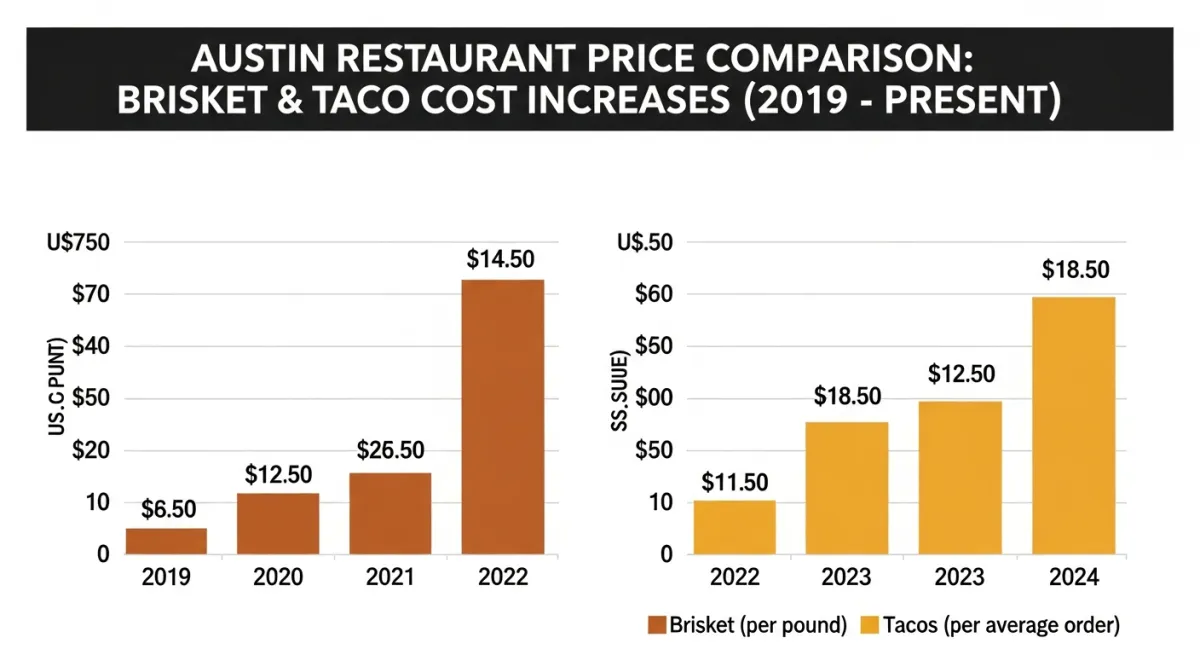
Yes, Austin restaurant prices are still meaningfully elevated compared to 2019. The gap is larger than national inflation data suggests. The cumulative increase on dishes most Austinites order regularly runs 44% to 67% at the specific restaurants tracked for this piece. That’s not a rounding error. It’s a permanent reset, driven by a stack of pressures that hit this market harder and faster than most. Here’s what actually happened, item by item.
The Price on the Plate: Seven Dishes, 2019 vs. 2026
The data below draws on archived menus (Wayback Machine captures, documented reviews, and owner-confirmed figures), cross-referenced with current posted prices. These are not estimated ranges. They are specific dishes at named restaurants.
| Restaurant | Dish | 2019 Price | 2026 Price | % Change |
|---|---|---|---|---|
| Franklin Barbecue | Brisket (per lb.) | $24 | $40 | +67% |
| Juan in a Million | Don Juan taco | $4.50 | $7.50 | +67% |
| Uchi | Signature small plate (hamachi) | $19 | $29 | +53% |
| Matt’s El Rancho | Enchilada plate | $12.50 | $18 | +44% |
| Veracruz All Natural | Migas taco | $3.75 | $5.75 | +53% |
| Home Slice Pizza | 18” whole pie (cheese) | $19 | $28 | +47% |
| La Barbecue | Brisket (per lb.) | $22 | $36 | +64% |
The spread here — 44% to 67% — tells you something immediately. Matt’s El Rancho, a Tex-Mex institution on South Lamar with the volume and customer loyalty to absorb more of its cost increases internally, shows the smallest percentage gain. The steepest belong to the two brisket entries and the Don Juan taco. Those numbers trace directly to beef prices, labor rates, and the specific economics of running a high-demand counter-service operation in 2026 Austin. A taco stand or a barbecue joint has no room to adjust portions or cut corners on its core ingredient. The customer knows exactly what they’re getting, and what they’re getting has gotten more expensive to procure and prepare. There’s no sleight of hand available.
The Headline Number, and Why National Inflation Data Understates Austin’s Experience
The Bureau of Labor Statistics tracks “food away from home” as a CPI subcategory. Nationally, that index rose approximately 27–28% cumulatively between 2019 and early 2025. The Dallas-Fort Worth-Austin combined MSA tracked above the national figure throughout that period, reflecting regional labor and real estate dynamics that don’t show up in the national average.
Even the MSA-level data understates what happened on the ground here. Austin’s version of post-pandemic inflation wasn’t just a local retelling of a national story. It was that story running simultaneously with three additional pressure systems that most U.S. markets didn’t face at the same time.
The city absorbed somewhere between 150,000 and 200,000 new residents between 2020 and 2023. That population surge created demand-side pressure on restaurants at the exact moment supply chains were most constrained. New residents spending freely in Austin dining rooms gave operators pricing cover they wouldn’t have had in a flat-demand market. At the same time, a tech buildout, a construction boom, and the post-pandemic staffing reset competed for the same pool of workers. A line cook in 2021 Austin had options a line cook in 2019 Austin didn’t. Wages followed immediately. Then the Central Texas drought put ongoing stress on regional food supply chains, hitting farm-to-table operators directly and rippling outward through wholesale markets. The combination — not any single factor — produced the numbers in the table above.
”We’re Paying More for the Cow Before It Ever Gets Here”
The Texas cattle herd has been contracting for years. USDA data shows the Texas cow-calf herd declined through 2022 and 2023 as drought conditions in the Hill Country and West Texas forced ranchers to liquidate breeding stock. That’s not a problem that reverses quickly — you’ve removed the animals that would have produced next year’s calves. Wholesale beef prices, including the brisket cuts that define Austin’s most iconic dining category, stayed elevated longer in Central Texas than in markets sourcing from other regions.
“We’re paying more for the cow before it ever gets here, before we’ve spent eighteen hours on the pit, before we’ve paid anyone to slice it. The math on what we have to charge changed completely,” one Central Texas BBQ operator said, speaking on background because they weren’t authorized to discuss financials publicly. Pre-pandemic, a well-run barbecue operation might carry a food cost percentage in the 28–32% range. Several operators interviewed for this piece described current food costs running closer to 35–38% before labor. That’s a shift you can’t manage away through efficiency or volume.
The egg situation hit differently but nearly as hard. Austin’s brunch culture — an outsized part of the casual dining economy here — took a beating from avian influenza-driven egg price volatility that pushed wholesale costs to historic highs in 2022–23 and again in late 2024 into 2025. For a restaurant doing heavy brunch volume, eggs aren’t a line item. They’re infrastructure. When the cost of eggs triples, you don’t absorb it.
Farm-to-table operators like Odd Duck and Lenoir built their menus around Hill Country sourcing relationships. They absorbed the drought stress most directly. When local yields dropped, they couldn’t swap in cheaper commodity produce — their whole identity was the local sourcing. That’s the uncomfortable irony of the farm-to-table model in a drought year: the thing that makes it special is also the thing that makes it fragile.
The Lease You Signed in 2018 Doesn’t Exist Anymore
Food costs fluctuate. Rent doesn’t, once you’ve signed. In Austin, the lease renewals hitting restaurants now are the part that keeps operators up at night more than anything else.
The corridors that define Austin’s dining identity — East Cesar Chavez, East 6th Street, South Congress Avenue — were repriced between 2018 and 2023 in ways that felt almost hallucinatory if you were trying to run a restaurant through it. Triple-net lease rates along East 6th that ran $28–35 per square foot in 2018 were being quoted at $55–75 or higher by 2022–23 on the hotter blocks. Restaurants that locked in pre-pandemic leases held relatively stable occupancy costs through 2020 and 2021. When those leases expired, the conversation was entirely different.
“Our landlord came back with a number that was more than double what we’d been paying. We negotiated it down, but we’re still paying 80% more per square foot than we were. That’s not something you absorb. It goes on the menu.” That came from a South Congress-area operator who asked not to be identified by name because lease negotiations are ongoing. For a 1,800-square-foot restaurant carrying an extra $40,000–$60,000 per year in occupancy costs, the math requires roughly $3–5 of additional revenue per cover just to hold prior margins. Unlike beef prices, which could theoretically ease as the cattle herd rebuilds, commercial lease rates in Austin’s premium dining corridors aren’t going back down. The landlords who repriced through the boom have no reason to back away.
That word — permanent — is the thing I keep coming back to. Most inflationary cycles eventually correct. Leases don’t.
Competing for Workers With the Texas Construction Boom
Texas’s minimum wage remains $7.25 per hour, unchanged since 2009. As context for Austin restaurant labor costs in 2026, that number is nearly meaningless.
The operational reality has been a market wage of $15–18 per hour or more for line cooks since at least 2022, pushed upward by competition that had nothing to do with restaurants. Tech campuses along the 183 corridor and in the Domain were offering production, facilities, and support roles that paid more than restaurant work and came with benefits. The construction boom, driven by semiconductor investment and residential development, was absorbing workers at scale. “I was paying a good line cook $13, $14 an hour in 2019 and that was competitive,” one East Austin restaurant owner said. “Now I’m at $17, $18, and I’m not always winning. We lost someone to a facilities job at a tech company that was paying more and didn’t require weekend nights.” That operator, in business on East 6th since 2016, declined to be identified by name.
What sticks with me about that detail isn’t just the hourly rate. It’s that restaurants lost people to industries that don’t ask you to work a double on Saturday. Labor typically accounts for 28–35% of a restaurant’s operating costs. A 30% increase in average hourly wages across a full team is not a rounding error in that model. Run the math on a restaurant doing $2 million in annual revenue: a labor cost percentage moving from 30% to 36% is $120,000 in additional annual expense. Spread across covers served, that’s real money per plate.
The Hidden Line Items: Insurance, Utilities, and Fees
Ask an Austin restaurant operator what surprised them most about post-pandemic costs and a significant number will eventually land on insurance. Not as the biggest driver — food and labor rank higher — but as the one that crept up without making headlines. General liability premiums increased industry-wide following the pandemic. In Austin, restaurants with outdoor patio programs — an enormous share of the market, given the climate and the cultural preference for eating outside nine months of the year — faced compounding increases in liquor liability coverage. The city’s sprawling patio-bar format is precisely what underwriters price most cautiously. Several operators described premium increases of 25–40% on commercial liability policies since 2019.
Austin Energy commercial rates increased following Winter Storm Uri in February 2021, as the utility absorbed the financial and infrastructure consequences of the storm. A high-volume commercial kitchen running heavy refrigeration, commercial ranges, and HVAC is sensitive to rate changes in ways a residential customer isn’t. A 15% increase in the commercial electricity rate for a restaurant spending $4,000–$6,000 per month on utilities is real. City of Austin food-service permit and inspection fees have ticked upward since 2019, though the absolute dollar amounts are smaller.
None of these is the story by itself. But four or five things each adding a little — insurance, energy, permits, processing fees — together they’re adding $1.50–$2.00 to every plate before the conversation about beef or labor. “I’ve got multiple line items all moving against me at the same time,” one operator said. “That’s the actual experience.” That’s also about as clean a summary of the last five years as I’ve heard from anyone in this industry.
Which Categories Got Hit Hardest
Rank Austin’s main dining categories by the magnitude of price increases since 2019, from steepest to most moderate: barbecue, fine dining, casual Tex-Mex, fast-casual and tacos.
Barbecue sits at the top because it faces the worst combination simultaneously. The primary ingredient is beef, expensive and volatile for reasons specific to Texas cattle production. The primary skill is pit work, genuinely labor-intensive and performed by a small pool of experienced pitmasters who command serious compensation. The format offers almost no portion flexibility — you can’t quietly reduce the brisket in a brisket plate. The customer will notice. Every time. The 64–67% increases at Franklin and La Barbecue reflect all of this at once.
Fine dining absorbed both the protein cost increases — high-end fish, premium beef, specialty produce — and elevated labor costs across a larger, more specialized staff. Uchi’s 53% increase on a signature small plate is painful but structurally explainable.
Casual Tex-Mex fared somewhat better in percentage terms because operators in this category have more flexibility. Chicken and beans carry different price dynamics than prime brisket, and the format allows modest portion adjustment without alienating the customer. Matt’s El Rancho’s 44% increase is the lowest on this list for a reason.
Fast-casual and tacos are the most complicated story. The percentage increases are real: Veracruz’s migas taco is up 53% and the Don Juan at Juan in a Million is up 67%. The lower average protein load per taco provided some cushion on ingredient cost, but labor and rent hit these operators just as hard as anyone. The math is unforgiving regardless of what you’re putting in the tortilla.
Survivor Bias: The Restaurants That Didn’t Raise Prices Closed
There’s a distortion in how Austinites perceive current restaurant prices that deserves naming directly. The restaurants where you’re comparing 2026 prices to 2019 prices are the restaurants that survived. The ones that couldn’t navigate this cost environment — that lacked the margins, the customer loyalty, or the landlord relationships to make it work — are largely gone. You’re not seeing their prices because they don’t have prices anymore.
The Texas Restaurant Association estimated Texas lost somewhere between 10–15% of its pre-pandemic restaurant count through the 2020–2022 period, with Austin’s closure rate near or above the state average given its higher cost structure. The bottom of the Austin dining price range — the genuinely cheap, beloved neighborhood spots that were still charging 2015 prices into 2019 — largely didn’t make it. What remained were operators with either the pricing power to raise prices without losing their customer base, or the volume and efficiency to absorb costs better than most. The result is a selection effect: Austin dining looks more expensive in part because the affordable end of the market thinned out significantly. The $8 lunch plate that existed at a half-dozen places near downtown isn’t at $11 now. In many cases, it simply isn’t. That’s the part of this story that’s hardest to quantify and easiest to feel.
Veracruz All Natural, which became famous as a trailer operation before expanding to multiple brick-and-mortar locations, illustrates the point neatly. Moving from trailer to restaurant means absorbing commercial lease costs, full-time staffing with benefits, and a significantly higher permitting burden. The migas taco didn’t change; the cost structure around it transformed entirely, and prices followed. That’s not a criticism. It’s arithmetic.
Is the Pain Leveling Off?
The honest answer, based on what operators are reporting in early 2026, is yes — it’s leveling off. But leveling off isn’t the same as cheap.
Several operators interviewed for this piece said they haven’t raised menu prices in the past six to twelve months and don’t plan to. That’s a real shift from 2021–2024, when menu repricing happened multiple times per year at many establishments. The deceleration in national “food away from home” CPI through 2025 — which slowed to roughly 3–4% annualized by late 2024 after running 5–8% in prior years — is showing up in operator behavior, though not uniformly. Barbecue operators are candid that their prices remain hostage to wholesale beef markets, which stay elevated as the Texas cattle herd rebuilds slowly. “I don’t expect to raise prices this year, but I can’t promise that,” one pit operator said. “If brisket goes back up, I don’t have a choice.” That’s not evasion. That’s how commodity markets work.
Casual Mexican and Tex-Mex spots that already absorbed their lease resets and brought wages to market rate appear to be in a genuinely more stable period. Fine dining is mixed — several upscale Austin operators have introduced prix-fixe or tasting-menu formats partly as a hedge against per-item commodity volatility, giving them more control over food cost per cover. Smart move, even if it changes the dining experience. What isn’t happening, in any category, is rollback. The new price floor is the floor. Operators who needed to raise prices to survive aren’t volunteering to reverse those increases in a market that is still, by any measure, expensive to operate in.
Where to Eat Well Without the Sticker Shock
The value tier in Austin dining still exists. It’s shifted in format and, importantly, in geography — and if you haven’t updated your mental map of where the deals actually live, you’re probably overpaying. As we’ve documented in our food & hospitality coverage, the economics of where Austin restaurants actually locate often determines what you’ll pay as much as what’s on the plate.
The Mueller neighborhood’s food trailer cluster on Manor Road continues to offer some of the most honest price-to-quality ratios in the city. Trailer operations carry lower overhead than brick-and-mortar, and several long-running concepts there have held their prices closer to reasonable without sacrificing quality. Lunch-only operations, which avoid the full dinner-service labor burden, are another reliable value format. A handful of spots in the Rundberg and North Loop corridors are doing lunch plates in the $10–13 range that represent genuine current value for the quality delivered.
East 6th and SoCo repriced for a reason — their rent structures demand it. Neighborhoods like St. Elmo, North Loop, and the eastern edges of Rundberg still host operators with more manageable lease rates, and the prices reflect it. Not 2019 prices. Nothing in Austin is 2019 prices. But 2026 prices that make sense for what’s on the plate. The taqueria format, away from the tourist corridors, remains the most reliable value in Austin dining. A real neighborhood taqueria in North or East Austin — not the ones that have been written up in every national food publication and know it — is still where you find the least distance between what something costs and what it’s worth. For residents who want to stretch that value further, Austin’s farmers markets offer a parallel path to eating well at prices that haven’t been through the same commercial lease reset.
That gap is what the last seven years compressed at the high end and widened at the value end. Your bill isn’t going back down. The operators who are still open mostly had to do what they did. The practical response is knowing where the real value still lives — and adjusting your map accordingly.