What Are Austin Restaurant Service Charges and Do You Still Need to Tip
A CityDesk Austin receipt audit of 13 local restaurants documents the specific fees, the labels, the percentages, and what Texas law actually requires operators to tell you.

A CityDesk Austin receipt audit of 13 local restaurants documents the specific fees, the labels, the percentages, and what Texas law actually requires operators to tell you.
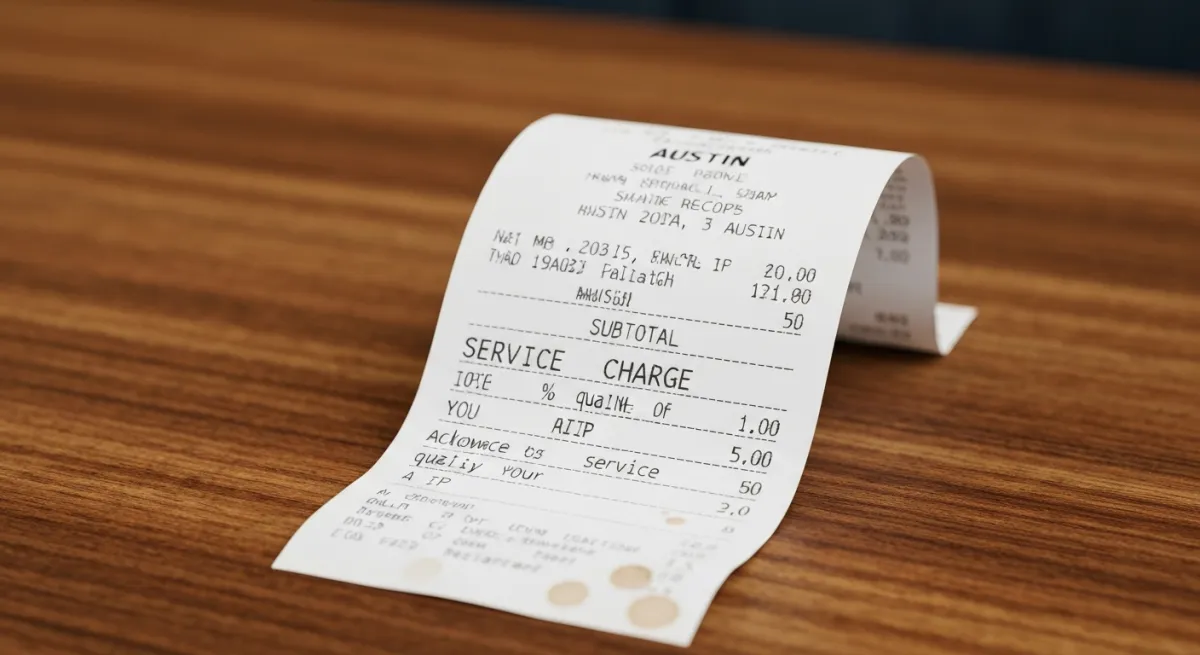
The bill came to $94 before tax at a South Congress wine bar this past April. Food was $68. Then came a 20% “Hospitality Charge” — $13.60 — which brought the subtotal to $81.60. A tip line appeared at the bottom with suggested amounts calculated on the pre-charge total. The couple at the next table tipped 18% on top, apparently without realizing they might have been doubling up. When asked privately, the server wasn’t entirely sure herself what guests were expected to do.
That last part is what I keep coming back to. If the server doesn’t know, the diner never had a chance.
This confusion is now a documented pattern across Austin’s dining neighborhoods. Several restaurants on East Sixth Street and South Congress added or modified their fee structures in late 2025 and early 2026. Summer brings the highest dining traffic of the year, and with it the highest real-dollar cost of billing that nobody explains. A $90 dinner with an unremarked 20% service charge plus an instinctive 20% tip becomes a $126 transaction — $18 more than most diners intended to spend, for reasons they never consciously agreed to — a gap that fits squarely into how much Austin restaurant prices have really risen since 2019.
CityDesk Austin spent six weeks collecting actual receipts and fee disclosure language from 13 Austin restaurants. We interviewed operators on record, reviewed Texas consumer protection statutes, and spoke with a Texas employment attorney.
The Fees on Austin Bills Right Now, Named and Documented
Five distinct fee labels appeared across our receipt audit. The percentages vary. The stated rationales differ. Most crucially, the distribution structures underneath them are not the same.
Loro (South Lamar, upscale-casual) applies a 20% “Hospitality Charge” to all dine-in checks. The restaurant’s posted menu language states the charge is distributed to all hourly employees — front of house and back of house — and that no additional gratuity is expected or required. No tip line appears on dine-in receipts. This is the clearest disclosure model we found, and it’s not complicated: one line on the menu, no tip line, done.
Olamaie (Bouldin Creek, fine dining) adds a 22% “Service Charge” automatically. Co-owner Michael Fojtasek confirmed on record that the fee is split between front- and back-of-house staff in a structured pool. “We wanted a model where the kitchen crew earned a living wage without diners having to know which side of the house to reward,” Fojtasek told us. A tip line does appear on Olamaie receipts, with a menu note that it’s optional and the service charge is the primary compensation mechanism.
Nixta Taqueria (East Sixth, neighborhood Mexican) collects a 5% “Back of House Fee” on all checks. Owner Edgar Rico has been public about the fee going entirely to kitchen staff — line cooks and prep cooks — without offsetting the restaurant’s labor costs elsewhere. A standard tip line remains on receipts. This is where the layering concern is most acute. A diner who tips 20% on an $80 check and misses the 5% BOH fee has spent $25 in fees on an $80 meal: $4 reaching kitchen workers, $16 going to front-of-house. Neither of those things is wrong. But you should know you’re doing both.
Lenoir (South Congress, farm-to-table) charges a 4% “Wellness Surcharge” disclosed on the menu as covering employee health insurance contributions and sick leave. Unlike worker-targeted fees, this money doesn’t go to individual workers directly — it offsets an operating cost the restaurant covers for staff. Owner Todd Duplechan: “We were raising prices to cover benefits anyway. At least this way guests can see where it goes.” A standard tip line remains on Lenoir’s receipts.
Uchi (South Lamar, Japanese fine dining), part of the Hai Hospitality group, applies an 18% “Service Charge” to dine-in checks, distributed to front- and back-of-house staff. A tip line appears on receipts with a note that the service charge is inclusive of gratuity. The phrasing is subtle enough that servers at two separate visits reported still receiving additional tips from guests who miss the notation. I’d wager most guests miss it.
Contigo (Mueller, neighborhood American) has no service charge as of spring 2026. A standard tip line remains, suggested at 18/20/22%. Owner Andrew Wiseheart: “I’ve watched the fee conversation carefully and I’m not convinced the model serves our guests or our staff better than a well-run tip system with real wages. That could change, but we haven’t gone there.” Wiseheart’s been operating in this city long enough that measured skepticism from him means something.
Suerte (East Sixth, upscale Mexican) carries a 3% “Kitchen Appreciation Fee” disclosed at the bottom of menus as going directly to kitchen staff. Owner Fermín Núñez confirmed the amount is distributed to non-tipped kitchen employees on a per-hour-worked basis each pay period, tracked separately in the POS system and reconciled against payroll before each disbursement. Among every operator we interviewed, Núñez was most specific about how the money actually moves. If every restaurant were that specific, this piece probably wouldn’t need to exist.
Bufalina (East Seventh, Neapolitan pizza) carries no service charge. Owner Steven Dilley said the restaurant had considered a BOH fee model in 2024 and decided against it after talking with staff. “Our kitchen team actually preferred we raise menu prices rather than add a line item. Fewer questions, same result.”
Fresa’s (South Congress and North Loop, Mexican grill) adds a 3% “Operations Fee” to all checks. When asked on record what the fee covers and who receives it, management described it as going toward “increased operating costs including labor” rather than directly to individual employees. Here’s the problem: “Operations Fee” implies overhead absorption rather than worker support, yet it looks identical on a receipt to the BOH fees at Nixta and Suerte. A guest reading both receipts side by side would have no way of knowing one goes to kitchen workers and the other goes to the business.
Ramen Tatsu-ya (South Lamar and The Domain) operates without a service charge at either location and runs a standard tip line.
Arlo Grey (downtown, fine dining) applies an automatic 20% gratuity to parties of six or more. Smaller parties face no mandatory charge. This is the long-standing large-party automatic gratuity model — standard industry practice, legally treated as a tip rather than a service charge when distributed directly to servers.
La Matta (Rainey Street, Italian) applies a 20% “Hospitality Charge” to all dine-in checks. When asked about distribution, a manager said the charge is pooled and distributed to all staff. When pressed on the specific split and whether back-of-house workers receive a defined share, the manager said he’d need to check with ownership. Two follow-up calls went unanswered before publication. That non-answer is itself information.
June’s All Day (South Congress, all-day café) carries no mandatory service charge. General manager Alysa Gabbard confirmed the restaurant reviewed the fee model in 2025 and decided staff income stability was better served by wage increases and menu price adjustments.
A Service Charge Is Not a Tip, and the Difference Is Real Money
Most receipts don’t explain this. They should.
A tip is a voluntary payment made by a customer directly to an employee. Under IRS Revenue Ruling 2012-18, tips are the property of the employee, reported as employee income, and subject to FICA withholding on the employee’s side. The employer has no legal claim to a tip.
A mandatory service charge — like the 18–22% hospitality charges in our audit — is classified as employer revenue by the IRS. The employer receives the money, owes payroll taxes on whatever portion it distributes to employees, and retains full discretion over allocation unless it has made a specific, binding promise to workers about distribution. A service charge distributed by the employer arrives on a worker’s pay stub as taxable wage income, not tip income. Different tax treatment. Different legal protections.
On an $80 check with a 20% service charge, your bill is $96 before tax. That $16 is restaurant revenue until distributed. If you then tip 20% on top — because the tip line invited you to, or because you didn’t notice the service charge — you’ve added another $16, for $32 in non-food, non-tax additions to an $80 meal. Whether any of that reaches the cook who made your food depends entirely on the restaurant’s internal policy, which may or may not appear on your receipt.
Four restaurants in our audit carry a mandatory service charge and present a tip line without prominent language explaining the relationship between the two. Two of those four had servers who gave inconsistent answers when asked directly whether an additional tip was expected. That’s not a knock on the servers. They’re operating inside a system the restaurant designed and, in some cases, apparently didn’t brief them on.
What Texas Law Requires Restaurants to Tell You
Short answer: not much.
There is no Austin city ordinance requiring restaurants to disclose service charge distribution in plain language. No Texas statute mandates that a menu or receipt explain where a fee goes. We reviewed Austin City Council agenda archives through early 2026 and confirmed no disclosure ordinance has been passed or is currently in active committee consideration.
What Texas law does cover is narrower but not entirely toothless.
Texas Payday Law, administered by the Texas Workforce Commission, requires employers to deliver compensation they have promised workers. If a restaurant tells employees — in writing, verbally, or in a handbook — that a service charge will be shared with them in a specific way, and then doesn’t deliver it, that’s a wage claim. “The Payday Law gives workers a real mechanism, but only if there was a promise in the first place,” said Austin employment attorney Claire Reisman of Reisman Employment Law. “If the restaurant’s policy simply says the fee goes into the business, workers have no claim under Payday Law, even if the fee label on the menu says ‘kitchen appreciation.’”
That’s an uncomfortable gap. A restaurant can print “Kitchen Appreciation Fee” on its menu, distribute nothing to the kitchen, and face no Payday Law liability — as long as it never promised otherwise.
The Texas Deceptive Trade Practices Act is the sharper instrument for diners. If a restaurant labels a fee as benefiting workers and the money doesn’t reach those workers in the manner the label implies, that labeling could constitute a false, misleading, or deceptive act under the DTPA. “The labeling creates a representation,” Reisman said. “If the representation is false and a consumer is misled by it, there is DTPA exposure.”
Texas sales tax adds one more wrinkle. The Texas Comptroller’s guidance holds that mandatory service charges retained by the restaurant as income — rather than paid directly and entirely to employees as wages — may be subject to state sales tax as part of the taxable sales price. A guest paying a 20% hospitality charge at a restaurant that retains a portion may, in some structures, be paying sales tax on that charge without knowing it.
The law protects workers from broken promises and diners from fraudulent labeling. It does not require restaurants to tell you upfront what their fee covers. That part, you have to ask.
Does the Money Reach Kitchen Workers?
Edgar Rico at Nixta and Fermín Núñez at Suerte both described mechanisms specific enough to be verifiable: POS tracking, per-hour reconciliation, separate payroll line items. Both were willing to walk through the mechanics on record without hesitation. Michael Fojtasek at Olamaie described a structured pool with defined percentage splits shared with staff in writing. “Our kitchen team knows exactly what to expect,” he said. “If we’re going to tell guests this is how we pay people, the people have to know that too.”
The murkier answers came from restaurants with “Operations Fee” or generic “Hospitality Charge” language. At Fresa’s, management confirmed the fee goes toward operating costs rather than directly to individual workers. La Matta provided no clear answer at all.
We also spoke with a line cook at a South Congress restaurant not in our primary audit, who asked that his employer not be named. He described receiving occasional “service charge distributions” as a line item on his pay stub but said he had no way to verify whether the amount was accurate relative to what the restaurant collected. “I have no idea what the actual percentage is or what the restaurant keeps,” he said. “I see a number on my check and I assume it’s what they said it would be.”
The whole accountability structure here depends on workers trusting that the number on the check is right — and having no practical way to confirm it. That’s not a solvable problem at the table. But it’s worth understanding when a restaurant asks you to pay a fee in the name of those workers.
The Restaurants That Dropped Fees and Why
The fee movement in Austin has not been one-directional. Several operators who tried the model reversed course, and their reasons are worth taking seriously.
Lenoir briefly ran a higher BOH fee — around 8% — before settling on its current 4% wellness surcharge. Todd Duplechan said the higher percentage triggered consistent guest confusion that pulled servers into explanations rather than service. “There’s a threshold where the explanation cost starts eating into the hospitality itself,” he said. That’s a genuine tension without a clean answer.
Bufalina’s Steven Dilley modeled a BOH fee in 2024 after kitchen staff pushed for higher wages. Staff surveys, though, surfaced a different preference. “The kitchen team didn’t want to be a line item on somebody’s receipt,” Dilley said. “They wanted to be paid. Those aren’t always the same thing.” Menu prices went up. The fee never appeared.
Barley Swine (South Lamar, tasting menu) carried a 20% service charge for roughly 18 months before reverting to a standard tip model in mid-2025. Owner Bryce Gilmore cited front-of-house resistance: servers found that guests assumed the service charge eliminated any obligation to tip, which cut total FOH compensation compared to what they’d earned before. “The math worked out better for the kitchen and worse for the dining room, and that created internal friction we didn’t anticipate,” he said. This is the piece the fee model’s proponents tend to underweight. The internal dynamics are as complicated as whatever appears on the receipt.
None of this makes the fee model wrong. It does make it a tool — one that fits some restaurant formats and staff compositions and doesn’t fit others. Austin’s market is still sorting this out.
Where in Austin You’re Most Likely to Encounter These Fees
South Congress and South Lamar fine-dining and upscale-casual restaurants are the densest fee territory in Austin. At this tier, checks run $80–$150 per person before alcohol, and an 18–22% hospitality charge is common enough that diners should assume it exists and check whether a tip line is also present before sitting down. Don’t wait for the bill.
East Sixth Street independents — particularly the newer chef-driven spots — lean toward smaller, targeted BOH fees (3–5%) alongside a standard tip line. Transparency tends to be higher here. Operators appear more willing to explain the fee structure on menus and, in our experience, to discuss it on record. This pattern is part of what we track in our food & hospitality coverage of Austin’s evolving restaurant economy.
Rainey Street bars and restaurant-bars are all over the map. Some added 18–20% hospitality charges in the past year. Others kept standard tip structures. The fee model appears more reactive there — adopted because peers adopted it, not because of a specific compensation philosophy.
The Domain and North Burnet cluster, heavy with national chains, largely doesn’t use service charges. Automatic large-party gratuities are the main mandatory-fee structure we found.
Downtown hotel-adjacent restaurants most commonly apply automatic gratuities for large parties (typically 20% for six or more) and occasional venue fees for private events. These function more like traditional banquet service charges than the restaurant-compensation models described above.
What to Do at the Table
Read the bottom of the menu before you order. Most Austin restaurants that carry service charges disclose them there, though some don’t, and the fee won’t appear until the receipt. It takes ten seconds.
If you don’t see disclosure language, ask. “Does the restaurant add a service charge or fee?” is a reasonable question. Every restaurant in our audit with a clear disclosure policy answered it without hesitation. Hedging is information.
A service charge and a tip line appearing together does not mean you owe both. The tip line doesn’t create a legal obligation to tip on top of a mandatory charge. That’s a conscious choice you get to make — not a default the receipt sets for you.
Mandatory service charges are generally non-negotiable once incurred. If you want to contest one, raise it with a manager before paying.
If a restaurant’s menu represents that a fee benefits specific workers and you believe that’s false, it’s a potential DTPA matter. Keep the receipt. Photograph the menu language. File a complaint with the Texas Attorney General’s Consumer Protection Division if you want to pursue it.
One question worth asking when the fee is unclear: “Does this go directly to kitchen staff, or is it pooled or used for operations?” A confident operator answers directly. One that hedges is telling you something, even if unintentionally.
Of the 13 restaurants in our audit, exactly three — Loro, Suerte, and Nixta Taqueria — proactively explained their fee structure without being asked, through table cards, server scripts, or menu language clear enough to stand alone. The other ten required active inquiry or a careful read of the receipt after the fact. Three out of thirteen. That’s the number Austin’s dining culture should be embarrassed by.
CityDesk Austin collected receipts and conducted on-record interviews with restaurant operators and staff between March and May 2026. Texas employment attorney Claire Reisman reviewed the legal framework sections for accuracy. The Austin Restaurant Association did not respond to a request for comment by publication time. Send receipts, operator responses, or worker accounts to tips@citydeskaustin.com.