How Gentrification Is Reshaping the East Austin Restaurant Map
From Cisco's on East 6th to displaced vendors at Plaza Saltillo, the East Side's culinary identity is being rewritten corridor by corridor. City policy isn't keeping pace.

From Cisco’s on East 6th to displaced vendors at Plaza Saltillo, the East Side’s culinary identity is being rewritten corridor by corridor. City policy isn’t keeping pace.
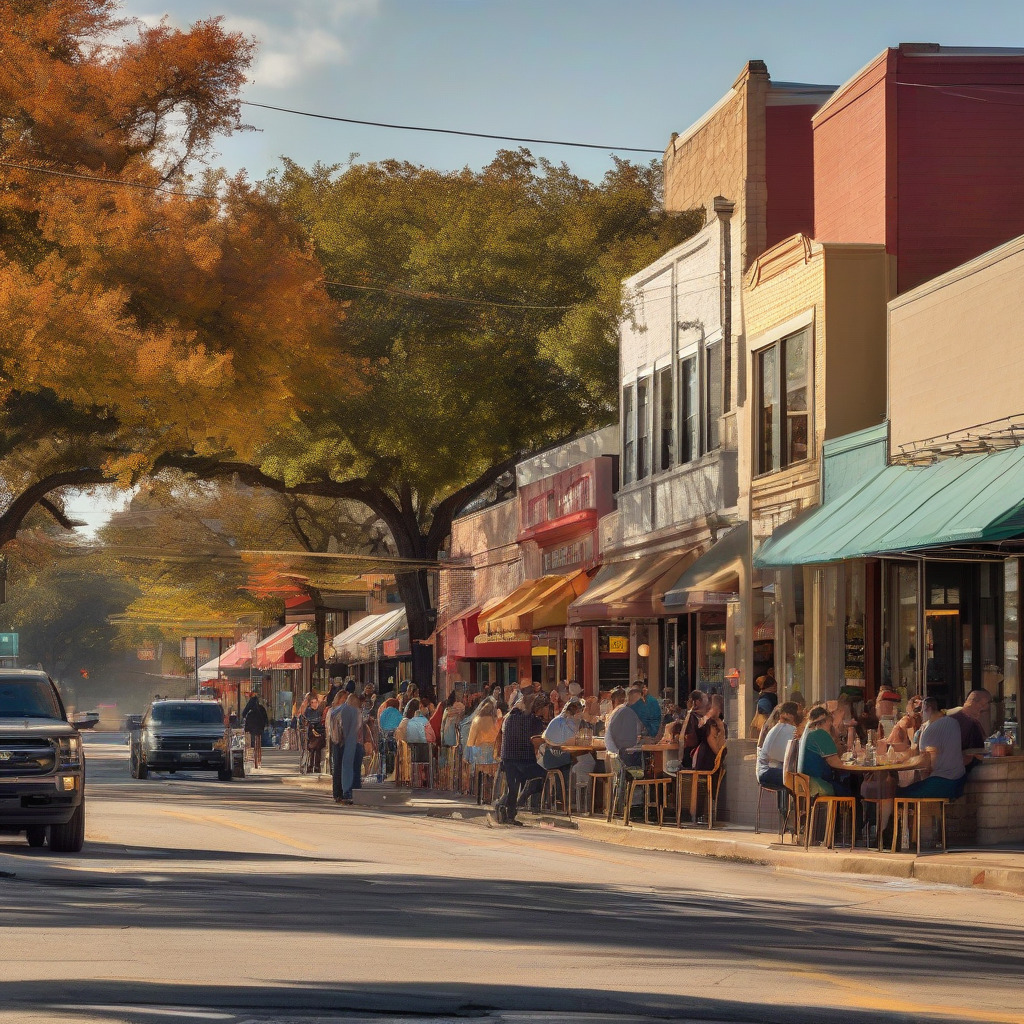
The booth where Austinites have eaten migas since Lyndon Johnson was president sat empty for the last time in 2020. Cisco’s Restaurant Bakery, at 1511 E. 6th St., ran for roughly six decades—long enough to outlast multiple waves of talk about what East Austin was becoming. It did not outlast this one. The building has been redeveloped. The address now holds commercial space consistent with the entertainment and retail profile that dominates the inner East 6th corridor. The enchiladas are gone. The rent math that made Cisco’s unviable is still very much in effect.
This isn’t a story about one restaurant closing. It’s a story about who gets to cook in a neighborhood, who gets to eat there, and who decides—told through the specific addresses, lease numbers, and operator decisions that have redrawn the East Side’s culinary map since 2020.
The Rent Math That Makes Legacy Operations Unviable
Start with the numbers. They’re doing most of the work.
In 2018 and 2019, ground-floor commercial space on East 6th Street—roughly the stretch from Chicon to Airport Boulevard—was leasing in the neighborhood of $18 to $22 per square foot annually, based on operator accounts consistent with broker activity on the inner East Side. By 2023, asking rates on the same corridor had climbed to $35 to $55 per square foot, with premium corners going higher. Austin retail market data confirms the broader East Austin submarket’s compression across this period, driven by rising land values, new mixed-use development, and speculative acquisition of older strip commercial properties.
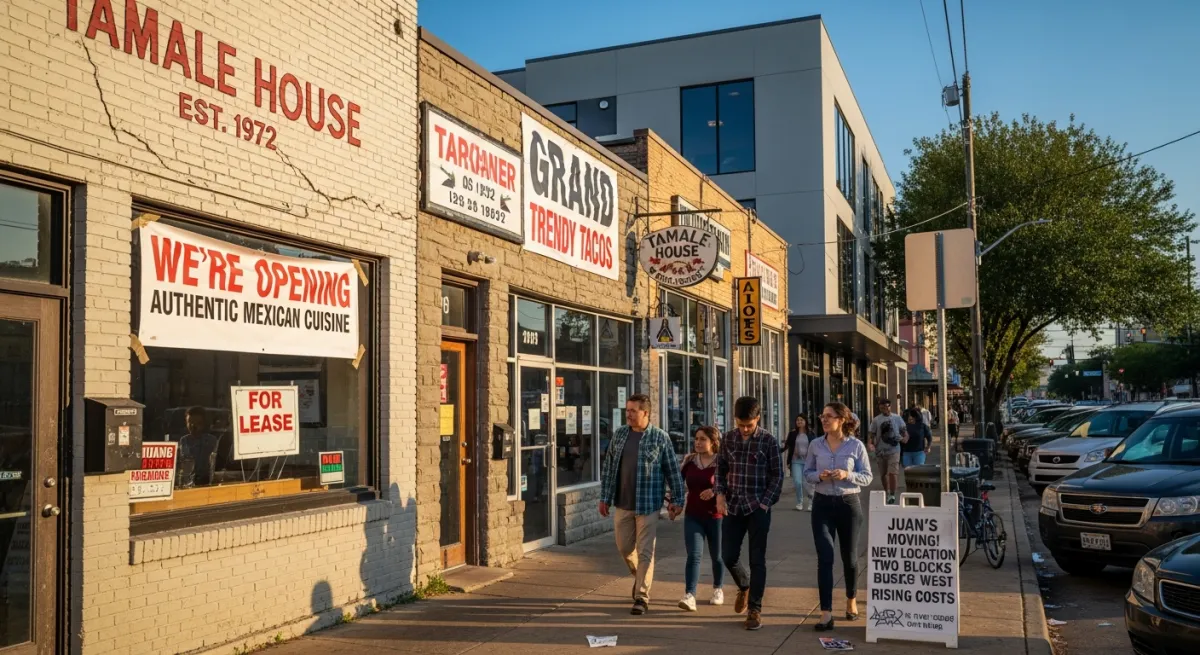
For a legacy operator running thin margins on a working-class customer base that is itself being pushed out of surrounding residential blocks, those numbers are not abstract. A taqueria that was viable at $20 per square foot—paying roughly $2,400 annually on a 1,200-square-foot space—faces an impossible lease renewal at $45 per square foot. That’s $54,000 annually on the same footprint. The operator can’t raise menu prices enough to absorb that increase without pricing out the customers the restaurant was built to serve. The rent math stopped closing several years ago.
Worth being clear about: we are not talking about marginal operations getting shaken out by competition. We are talking about businesses that were financially functional for decades, until the land under them became worth more as something else.
East 6th Corridor: Who Left and When
The closures along East 6th between Chicon and Airport Boulevard since 2020 form a specific, addressable list.
Cisco’s Restaurant Bakery, at 1511 E. 6th St., operated for approximately 60 years as one of Austin’s most recognizable institutions—famous for migas and for its role as an informal political salon where state legislators and city power brokers conducted business over breakfast. It closed in 2020. The property has since been renovated, repositioned toward the entertainment and hospitality concepts that now dominate the inner corridor’s lease roster.
Las Trancas closed during the same period. This was the kind of operation that anchored a block: high-volume, affordable, a known commodity for families in the surrounding ZIP codes. The departure shows up in the City of Austin’s Certificate of Occupancy records when tracked across the corridor. Uses that served a daily, local clientele are giving way to uses that serve a nightly, visitor-oriented one.
That CO record pattern is public and verifiable. When pulled for the East 6th corridor between Chicon and Airport, the documents show a consistent directional shift across multiple addresses since 2019. The neighborhood’s restaurant map isn’t just shrinking. It’s being replaced with a different kind of hospitality that, by design, serves a different kind of customer—one with a destination-level willingness to pay. A cocktail bar or chef-driven concept can absorb $50-per-square-foot rents because its customer base doesn’t live on East 6th and doesn’t depend on affordable neighborhood dining. The math isn’t mysterious. It’s brutal.
East César Chávez and Manor Road: The Corridors Coverage Ignores
Food media in Austin covers East 6th as though it represents the whole East Side. It doesn’t.
East César Chávez—particularly through the Holly neighborhood south of East 6th—housed some of the most durable working-class Latino dining on the inner East Side. Holly absorbed much of Austin’s Mexican American population during the mid-20th century, partly as a consequence of segregation-era policies that concentrated minority residents east of I-35. The restaurants along this corridor existed because the people who lived there needed places to eat that reflected their food culture and their budgets. Several have closed or relocated in the past four years, displaced by rising residential rents throughout Holly and the broader 78702 ZIP code. The displacement here is quieter than on East 6th. It is not less real.
The Plaza Saltillo case is the sharpest version of this story, and it involves a public entity rather than a private landlord. CapMetro’s redevelopment of the Plaza Saltillo transit-oriented development site—the mixed-use project surrounding the Red Line station at East César Chávez and 5th Street—displaced informal food vendors who had operated at or near the site for years. These weren’t permitted restaurant tenants with formal leases. They were micro-vendors: tamale sellers working weekend shifts, taco operations that set up on particular days. CapMetro’s development plans prioritized the mixed-use commercial build-out. The vendors relocated or stopped operating without formal record. The names of specific vendors are difficult to verify for publication, which is itself part of the story—informal food economies are invisible to the permit system until they’re gone. The displacement happened. The documentation did not.
Manor Road and Cherrywood are a different situation. The businesses lost on Manor Road tend to be independent, often non-Latino operators—the bohemian-independent category that settled Cherrywood’s commercial corridor in the 1990s and 2000s. The rent pressure is identical to East 6th. The cultural politics are distinct: this is not predominantly a story of Latino-owned businesses being displaced from a historically Latino corridor. Austin’s food media treats these losses as less politically significant, which reflects an implicit judgment about whose displacement matters. Both categories of business are disappearing. The reasons are economic. One is easier to narrate as a social justice story, but that doesn’t make the other losses any less real.
What’s Moving In
The incoming tenant typology on the inner East Side follows a recognizable pattern. Characterizing it doesn’t require assigning villainy—markets respond to capital, and that’s what’s happening. The capital is pointed at East Austin, and the customer base that can afford the new rents isn’t the one that used to live there.
Cocktail bars and bottle-service nightlife venues can absorb premium corner rents because they serve an evening destination crowd with high per-person spend. Chef-driven concepts with tasting menus or elaborate seasonal rotations—aimed at the Austin food-media consumer—operate at check averages that justify $50-per-square-foot leases. Fast casual priced well above the neighborhood-taqueria floor: acai bowls, pressed juice, keto-focused breakfast, all targeting the professional class that has moved into the surrounding residential blocks. Co-working cafés target the same remote-work demographic. These aren’t accidental replacements. They match incoming rent structures to the customers who can pay them. If you’ve watched the inner East Side change block by block over the past five years, you already know exactly what I’m describing.
Permit records for several addresses on the East 6th corridor confirm the pattern. Spaces that previously held food-service certificates of occupancy at the neighborhood-restaurant scale now operate under bar or limited-food-service permits, or under new CO classifications consistent with upscale hospitality buildouts.
El Naranjo is the complicated case. Chef Iliana de la Vega—a James Beard Award winner and one of the most decorated operators in Austin—relocated her Oaxacan restaurant to 85 Rainey St., a corridor that was itself substantially gentrified well before East 6th reached its current point. De la Vega has spoken publicly about cost pressure as a factor in the move. In some ways, El Naranjo is the best-case version of displacement: an award-winning operator who found a new address and kept her concept intact. But Rainey Street is a destination corridor serving an overwhelmingly non-neighborhood clientele. El Naranjo’s move is a survival story. It stopped being a neighborhood restaurant story when she crossed the bridge. That distinction matters.
The Survivor Question: How Vera Cruz All Natural Stayed
If the displacement story were total, no East Side legacy operation would still be standing on the inner corridors. Vera Cruz All Natural is standing.
The breakfast-taco operation launched near Mueller and Airport and has grown to multiple sites across Austin. That geographic spread allowed it to distribute its revenue base and lease exposure across different market conditions before the inner East Side compression became acute. The variables in Vera Cruz’s survival are clear: the brand developed citywide recognition that supports pricing power above the neighborhood-taqueria floor; it diversified its real estate footprint before the rent squeeze reached critical mass; it built a customer base well beyond the surrounding residential blocks.
Vera Cruz demonstrates that survival is possible—but it generally requires an early, favorable lease locked in before the market moved, a revenue scale sufficient to justify current rents across multiple locations, or a brand strong enough to pull destination traffic to a neighborhood location’s cost structure. The corner taqueria running thin margins for a local clientele that can’t absorb higher menu prices has none of those assets. That operator is gone.
Requests for on-record comment about lease renewal negotiations on the current East 6th corridor are met, almost universally, with operators citing active or recently concluded negotiations as a reason they can’t speak publicly. That silence is its own data point. The power imbalance between commercial tenants and landlords in this market makes candor expensive, and most of these operators know it.
Where Displaced Operators Went: The East-of-183 Story
The East Austin displacement story has a second half that almost no food coverage reaches.
When a taqueria or family Mexican restaurant closes on East 6th or César Chávez, it doesn’t always cease to exist. In a number of documented cases, it relocates—east of Airport Boulevard, east of U.S. 183, into the commercial strips of far East Austin ZIP codes like 78724 and 78725, where ground-floor retail still leases at rates closer to what the inner East Side charged five or six years ago. Operators who have made this move have generally landed in strip centers and standalone commercial buildings along Springdale Road, Bolm Road, or the corridors running through Dove Springs and Colony Park. These are majority Latino-owned commercial environments. The restaurants are real, the food is frequently very good, and the customer base is the working-class Latino community that has itself been pushed further east by residential rent pressure. Some operators report that their customer bases followed them. Others have rebuilt clientele among the surrounding communities. None of it gets documented in our food & hospitality coverage, which treats far East Austin as a culinary backwater.
If you haven’t been out there recently, you’re missing a significant chunk of the actual East Austin restaurant story.
The result is a two-tier dining geography that maps almost exactly onto income and displacement. The inner East Side gets the coverage, the social media traffic, and the tourist dollars. Far East Austin gets the actual neighborhood restaurants, in near-total obscurity. The displacement story the city keeps missing isn’t only about what closed. It’s about what relocated to a part of Austin that receives so little attention that the same cycle of rent inflation and concept replacement could begin there with almost no early warning. The vendors and operators who moved are invisible twice: once when they left the covered corridors, and again when they arrived in the uncovered ones.
Community and Institutional Response: What’s Been Tried
Austin hasn’t been entirely passive in the face of East Side commercial displacement. But the gap between what’s been produced on paper and what’s been enforced in practice is the real story.
The City of Austin’s Anti-Displacement Task Force, which produced recommendations adopted in recent years, focused primarily on residential displacement. Its commercial tenant provisions are thin. The task force recommendations didn’t establish enforceable commercial rent stabilization, didn’t create a legacy business protection mechanism, and didn’t include binding affordability requirements for commercial space in high-displacement areas. What it produced were studies, voluntary frameworks, and referrals to other city bodies. The documents are thorough. They are not binding. They are not adequate.
The Austin Revitalization Authority operates a small-business support and commercial space program within its specific mandate on the inner East Side. ARA has worked to connect minority-owned businesses with affordable commercial space in its footprint and has been involved in mixed-use development along East 11th and East 12th Streets where affordability requirements are built into the project structure. The scope of ARA’s work is real. It is also geographically limited relative to the displacement pressure on those corridors, and it moves at development-project speed in moments that demand something faster.
The Austin Independent Business Alliance tracks independent business closures broadly. No systematic, publicly available East Side commercial displacement dataset has been published by the city, which means the public record of what has been lost is assembled piecemeal through permit records, TABC filings, and local reporting. There is no official count. What you don’t measure, you don’t have to account for.
Go Austin/Vamos Austin, the community health coalition with deep roots in the Latino East Side neighborhoods most affected by displacement, has connected food access to displacement pressure as a social determinant of health. That framing hasn’t penetrated city policy in any meaningful way. The connection between where people can afford to eat and where they can afford to live remains largely outside city planning conversations—a failure of imagination as much as anything else. The downstream health consequences of this food-access contraction are documented in how Austin’s East Side food access gap is costing residents their health.
The Policy Gap and What Other Cities Have Done
Austin has no commercial equivalent to San Francisco’s Legacy Business Registry. San Francisco’s program, operating since 2007, establishes procedural rights and affordability mechanisms for small commercial tenants facing displacement. An operator in continuous operation for 30 or more years at the same location can apply for recognition. The designation doesn’t prevent rent increases but provides legal standing and community attention when a legacy business faces non-renewal. Austin has considered similar frameworks. It has not built one.
What Austin has is a zoning and land-use code that has historically enabled exactly the kind of speculative commercial acquisition and rapid use change that has defined the inner East Side’s transformation. Its historic preservation framework has focused almost entirely on residential structures, leaving East Side commercial buildings without landmark protections that might complicate their redevelopment. The code isn’t neutral. It’s structured toward fluidity of capital and rapid recapitalization of property.
The history belongs in this discussion because it isn’t decorative. East Austin’s Black and Latino communities didn’t choose to be east of I-35. They were placed there deliberately, by mid-20th century zoning policy and the informal enforcement mechanisms of a segregated city. The commercial corridors on César Chávez, East 6th, and East 11th and 12th Streets grew up as neighborhood infrastructure for communities that had been spatially excluded from the rest of the city. When those corridors are repositioned to serve an incoming professional class, the displacement isn’t economically neutral. It has a specific historical direction. The segregation that created these neighborhoods was a policy choice. The gentrification that erases them is being enabled by policy choices too.
On the Austin City Council, discussions of commercial tenant protection have surfaced repeatedly without producing binding policy. Council Member Jimmy Flannigan proposed commercial tenant protections in 2023. The proposals didn’t advance to a vote. As of 2024, no ordinance establishing a legacy business registry, commercial rent stabilization, or enforceable anti-displacement requirements for commercial tenants has made it to a council vote. What the council has done is pass resolutions, commission reports, and request staff analysis—the bureaucratic equivalent of watching a building burn while writing memos about the fire code. That’s what the record shows.
What the Map Looks Like If Current Trends Hold
Rainey Street is the predictive model.
By approximately 2016, Rainey Street’s residential bungalows had been substantially converted to bars and restaurants serving a destination crowd. The neighborhood character of that corridor—it once housed working-class and elderly residents, some of them Latino—had been almost entirely superseded. The transformation took roughly a decade from the first significant commercial investment. Brokers and commercial real estate analysts tracking the East 6th corridor have estimated it’s five to seven years behind Rainey Street’s curve, and the curve is accelerating.
The window for meaningful policy intervention on the inner East 6th corridor may be three or four years wide. Maybe less. That window requires a legacy business registry with actual legal standing; community land trust commercial components that guarantee below-market space for qualifying operators; and enforceable lease renewal rights that prevent displacement through non-renewal. Austin has none of these. On César Chávez and in Holly, the window is similarly constrained.
East of 183, it’s still open, but narrowing. The commercial strips along Springdale, along the far East corridors, along the edges of Colony Park and Dove Springs—this is where the displaced restaurant map is currently reassembling itself. It’s also where the next speculative real estate cycle will look once the inner East Side reaches full buildout. The question Austin hasn’t answered, and has barely begun to ask, is whether those corridors will receive any protection before the same arithmetic that closed Cisco’s starts closing whatever replaced it further east.
The enchiladas keep moving. The city keeps watching.
Have a tip on East Austin commercial displacement, lease data, or a business that has relocated east of 183? Contact CityDesk Austin at our secure tip line.