What Is Actually Happening on Rainey Street in 2026
On a Friday night in late April, the stretch of Rainey Street between River and Cesar Chavez looks full. The sidewalks outside Banger's carry a steady crowd. The line for Clive Bar wraps past the c…

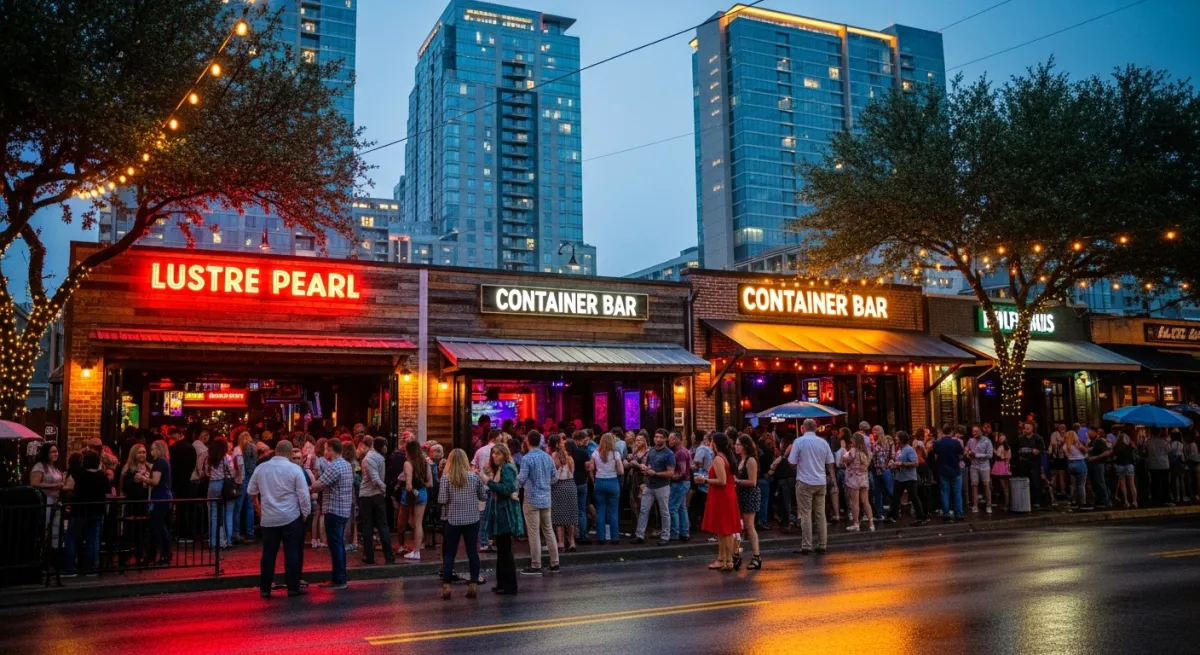
On a Friday night in late April, the stretch of Rainey Street between River and Cesar Chavez looks full. The sidewalks outside Banger’s carry a steady crowd. The line for Clive Bar wraps past the corrugated-metal planter boxes that have become, by now, as familiar as the old bungalow porches they partly replaced. A Marriott Autograph Collection hotel opened at the northern end of the street in late 2024. The Lueders throws warm light from a lobby bar that didn’t exist three years ago. The crowd is dressed up in a way Rainey crowds rarely were in 2019, carrying drinks that cost $18 before tax.
Walk another hundred feet south and you hit a locked door. The hand-lettered sign identifying one of the strip’s smaller bungalow bars has been replaced by a construction notice from the City of Austin’s Development Services Department. The bungalow behind it is staged for renovation. Permit pulls suggest a conversion to short-term rental use rather than a return to any food-and-beverage tenant. One of several such gaps visible on a Friday night in 2026, it tells you more about where Rainey Street actually is than anything you could read in a hotel press release.
This is the strip as it exists now: still active, still drawing bodies, but changed in ways that affect whether you should go, what you should expect when you get there, and who “you” even is in the first place.
What’s Gone Since Early 2024
Lustre Pearl Rainey, the open-air courtyard concept at 94 Rainey St., defined the strip’s casual, string-light era. It stopped operating in mid-2024 after its lease ended and the landlord did not renew. TABC records show the license lapsed that June. The property sat dark through the fall and is now under renovation — likely hotel-adjacent commercial space. The closure ended what had been the strip’s most recognizable Instagram destination, a loss that matters for reputation even if the actual revenue impact was smaller than the visibility suggested.
Container Bar occupied 90 Rainey St. as a shipping-container concept, one of the most photographed spots on the street. It closed in January 2025. Ownership cited rent escalation and the difficulty of running an outdoor-centric venue through consecutive summers with weeks of 105°F heat — which, if you’ve spent an Austin August anywhere near that block, sounds less like an excuse and more like an obvious inevitability. The container structures remain on site but aren’t operational. The operators had expanded to a second location in 2022 expecting the original would anchor the brand. Instead, they consolidated to one venue and reduced staff.
Icenhauer’s sat at 83 Rainey St., a mid-century bar and small event space that went dark in March 2025. A longtime Rainey regular who asked not to be identified called it “the closure that actually hit people,” because Icenhauer’s had the closest thing to a neighborhood-bar sensibility remaining on the strip. TABC filings show the license was surrendered rather than transferred, suggesting no active buyer had secured the space. The owner, who ran the bar for fourteen years, told a mutual acquaintance he couldn’t justify the rent renewal at 2025 rates against declining midweek traffic. Fourteen years. That’s not a pivot — that’s someone who genuinely believed in the place.
Craft Pride, the Texas craft beer bungalow at 61 Rainey St., closed quietly in fall 2024 without a public announcement. The space has been leased to a yet-to-open cocktail concept whose permit application was filed with the city in February 2026. One employee learned of the closure the day the landlord changed the locks.
Two smaller bungalow bars also went dark — a mezcal-focused concept and a wine bar that opened during the 2021–2022 rush of post-shutdown openings. Their TABC licenses show lapses in mid- and late-2024 respectively. These weren’t destination venues, which is why their closures attracted less attention. But they were the kind of small, specialized, operator-controlled spaces that once defined the street.
The closures share a common thread: not a single cause but a convergence. Leases written during high-demand years came due in a market where landlords had seen what hotel developers would pay for the same footprint. Outdoor formats got punished by climate. The pedestrian demographic shifted in ways that made some concepts functionally obsolete without their original audience. There’s no villain here, exactly, which somehow makes it worse.
What Has Opened in the Past 18 Months
The Lueders Hotel opened its street-level bar in November 2024 at 74 Rainey. The Long Play Lounge seats around 60 and operates as an all-day café and cocktail bar with a playlist-curated music concept. The design is clean, the cocktails are technically sound, the service is smooth. It attracts controlled traffic from hotel guests with time to kill between check-in and dinner — cocktails run $17–$21. Its presence means foot traffic on the block, but it doesn’t replace the walk-up bungalow bar it occupies, and I’m not sure it’s trying to.
Jo’s Coffee added a Rainey-adjacent kiosk at the southern end of the street in late 2024, open from 7 a.m. to 2 p.m. More morning anchor than nightlife addition. But it filled a gap the strip had always had: no casual coffee service within walking distance of the southern bungalow blocks, no clear reason to arrive before 10 p.m.
El Nido opened at 62 Rainey St. in February 2025 from an Austin restaurant group, built into a lot where a bungalow used to be. The kitchen is serious. Early reviews from the Austin Chronicle and Austin American-Statesman noted the quality of the food and the care taken in preparation. Covers run $80–$120 per person with drinks. It’s the most credible new entrant to the Rainey food scene in the past two years, and the reviews aren’t wrong.
Mañana opened in July 2025 at a Rainey address that previously held a short-lived cocktail concept. The bar emphasizes Tex-Mex snacks and frozen drinks, genuinely independent and operated by Marcus Treviño and his business partner, who also runs a place on Manor Road. Treviño is not interested in the event-rental business or high-table-turn pricing. He’s interested in people coming in, ordering a margarita and some queso, and staying long enough to know the bartender’s name. The frozen margarita is $11 — notable because $11 is now the low end of the Rainey price scale rather than a midpoint.
The net picture is clear: the openings haven’t restored what closed. The independent, mid-price, bungalow-format bar that was Rainey’s core product in 2017–2022 has not been replaced by more independent, mid-price, bungalow-format bars. It’s been replaced by hotel F&B, full-service restaurants, and a smaller number of independents operating at a higher price floor.
The Bungalow Problem
Rainey Street’s original appeal was structural as much as social. Residential bungalows from the early twentieth century — most between 800 and 1,400 square feet — converted to bar use with their front porches, backyard patios, and low ceilings intact. Conversion cost was modest. Rent was low. The format encouraged the kind of casual, linger-longer atmosphere that large venues cannot manufacture. A bar in a bungalow, by definition, could not operate like a nightclub. The space itself prevented it.
That format now occupies a sharply reduced share of the street’s active frontage. The Rainey high-rise cluster includes the 33-story Milago condominiums, the Independent tower two blocks north, and three additional residential towers completed between 2019 and 2024. These absorbed most of the surface parking that once buffered the bungalow blocks from redevelopment pressure. As parking disappeared, land values climbed. Bungalow landlords found themselves sitting on properties appraised at hospitality or multifamily development values, not residential ones. A property renting for $3,500 a month in 2014 as a bar lease was suddenly valued at $800,000 to $1.2 million. The math favors selling to a developer over a $4,500 monthly bar lease. You don’t have to love that outcome to understand it.
Several bungalows that housed bars have been converted to short-term rentals, which generate higher per-night revenue with lower operational liability. A COA permit search of the 80–100 Rainey block shows two such conversions completed in 2024. An STR doesn’t require staff, insurance, liquor licensing, or health department compliance. It requires cleaning between guests and a calendar. From a pure asset-management standpoint, the choice is obvious. From a “what made this street interesting” standpoint, it’s a slow bleed.
The bungalows that remain in bar or restaurant use now read as artifacts of a prior era rather than as the dominant format. Clive Bar at 609 Davis St. is the most prominent survivor, along with Banger’s and a handful of holdovers. One longtime property owner who asked to remain anonymous said three of his four original bungalow properties on Rainey have either been sold to developers or are listed with commercial brokers. “The economics don’t allow you to keep them as bars anymore,” he said. “If you own the building, you’d be crazy not to develop it. If you’re leasing it, you’re paying a developer’s price for a bar’s margins.”
What Operators Are Actually Saying
Marcus Treviño has co-owned Mañana since its July 2025 opening and runs it with his business partner from a space he describes as “the right size for what we’re trying to do.” Not large enough to attract the corporate-events clientele that might justify Rainey rents in theory.
“The rent math here only works if you’re busy Thursday through Sunday, and busy means a full room every shift,” Treviño said in a conversation outside the bar in early April. “There’s no slow Tuesday that you make up for. The tourists are real — they keep the weekend numbers up — but they’re not regulars. You can’t build a bar around people who are here once.”
Treviño estimates he knows the names of roughly forty people who come in more than once a month. “That’s my local base,” he said. “Forty people. On a street that’s supposed to be one of the most-visited nightlife strips in Texas.” Compare that to his Manor Road location, where he estimates fifty regulars from a neighborhood with one-fifth of Rainey’s pedestrian traffic. The street is drawing volume without depth — visitors without loyalty. That’s an operational problem, not just a vibe problem.
“East 6th still feels like it belongs to Austin,” he said. “Rainey is starting to feel like it belongs to wherever the hotel guests are from.” The distinction isn’t philosophical. It affects every operational decision: hours, pricing, whether it makes sense to run a happy hour on Tuesday.
A manager at one of the larger, established Rainey venues who spoke on background said his team had stopped trying to drive Tuesday-night volume entirely, optimizing staffing and pricing for Thursday through Saturday and writing off four days a week as loss-leader costs. That’s a significant admission for a street that used to draw crowds on random Wednesday nights. “The identity question is real,” this person said. “Are we a locals bar that happens to get a lot of visitors, or are we a visitor destination that locals still come to? The answer used to be clear. It isn’t now.”
The Crowd Shift
Hotel Van Zandt opened in 2015 at 605 Davis St. and was, for several years, a complementary presence rather than a transformative one. Its rooftop and lobby bar drew visitors but the street remained pedestrian-casual enough that hotel guests blended into the scene without defining it. You could walk Rainey on a Friday night in 2017 and still feel like you were in an Austin neighborhood that happened to have bars.
By 2026, the Lueders has added a second hotel with active F&B to the strip. A third hotel project is permitted on the northern end. The hotel-adjacent customer now constitutes a larger share of the Friday and Saturday night crowd than at any previous point in the street’s history. Fly-in, bachelorette budget, one night in Austin, Rainey Street on the itinerary because it appeared on a “best bars in Austin” list. On a Saturday in April, the proportion of visible hotel key cards, the volume of “wait, where is this place?” conversations, and the general absence of anyone who seemed to know where they’d go next all suggest the visitor share has moved above 60 percent on peak nights.
Drink prices are calibrated to someone who isn’t comparison-shopping because they don’t know the alternatives. The crowd peaks around 10 p.m. and thins fast — visitors who have a flight or a 9 a.m. checkout don’t tend to close bars down. Rainey’s 11 p.m.–close energy has thinned noticeably compared to 2019. The outdoor culture that was the strip’s signature survives at a few venues but is no longer what organizes the night. Dog-friendly patios, lawn chairs, $6 cans over two hours — this still exists somewhere on the strip. But Austin’s climate makes that culture seasonal at best. Sustained heat above 100°F in June, July, and August now effectively shuts down the outdoor experience that drew people here in the first place. Banger’s, which runs the largest outdoor area on the strip, has acknowledged internally that its outdoor capacity goes unused from mid-June through mid-August.
The “locals moved to East 6th” narrative was accurate in 2022. By 2026, that migration has partially dispersed further. Some of that cohort is on South Congress or in Bouldin Creek. Some has moved to North Loop or Far South Austin. East 6th itself has had its own turnover. The point isn’t that there’s a single alternative — it’s that Rainey is no longer the reference point from which alternatives are measured. When a local recommends a bar to another local, Rainey is no longer the default suggestion. That’s a meaningful shift for a street that spent a decade being exactly that.
Rainey vs. East 6th in 2026
These two streets are now different enough that the comparison requires specifics. A first-time visitor asking which neighborhood to hit should understand the actual differences rather than relying on either street’s reputation from 2018.
Price sets the tone immediately. On Rainey, a cocktail at any established venue costs $14–$21. Beer runs $8–$12. On East 6th — the stretch from roughly I-35 to Comal, which is the relevant comparison — cocktails run $10–$15 at independents like Whisler’s, and drinks at Nickel City land around $7–$10. The lower end of that range is genuinely available. The gap compounds across a night.
Venue format diverges just as sharply. East 6th skews toward smaller rooms, local art, bar-forward rather than experience-forward. Fewer bouncers, no velvet rope. Rainey in 2026 skews toward large-footprint venues like Banger’s, hotel bars like the Long Play Lounge and the Van Zandt rooftop, and full-service restaurants like El Nido. Fewer than six bungalows operate as bars on Rainey now, compared to eight in 2022.
Crowd timing follows visitor patterns. East 6th runs later. Rainey peaks earlier and empties faster. Walk Rainey at 11:30 p.m. on a Friday and you’ll see one-third of the traffic you saw at 10. Walk East 6th at the same time and the crowd is stable or growing.
Operator independence shapes the entire experience in ways that aren’t always visible until you’re inside. By our count of active TABC licensees and operating entities, roughly 60–65% of Rainey’s active venues are either hotel-owned F&B programs or concepts owned by multi-unit Austin restaurant groups. The majority of East 6th’s active operators are single-unit independents. A hotel bar manager is executing against a quarterly budget. An independent operator is there because this is the bet they made. The difference shows up in whether the person behind the bar can tell you what’s good or just what’s available.
Neither street is what it was five years ago, but East 6th has changed more slowly and in ways that preserved more of what drew Austin’s nightlife crowd to these blocks in the first place.
When to Go and What’s Still Worth It
If you’re coming to Rainey Street for the first time, or returning after a few years away, here’s what’s actually useful to know. As we track in our food & hospitality coverage, Austin’s bar and restaurant landscape is shifting faster than most visitors realize — and Rainey is the clearest case study.
Go between October and May. This is the only window in which the outdoor culture that made the strip known is functional. June through September, Rainey becomes an indoor bar district that could be anywhere — air-conditioned, crowded, expensive, and stripped of the thing that made it distinct. The quality remains but the character changes completely.
Banger’s Sausage House & Beer Garden at 79 Rainey St. remains the closest thing to a democratic Rainey experience. It has 104 taps, a large outdoor area, and a price point that holds the line against full gentrification — most beers run $7–$10. It’s a big venue that feels like a big venue, but it earns its spot. The sausage menu is legitimately good; the owner has been buying from the same supplier for twelve years, and it shows. On a Friday evening in April, the crowd was mixed between visitors and locals, which is about as balanced as the strip gets now.
Clive Bar at 609 Davis St. best captures what Rainey once felt like. Patio-forward, well-made drinks without theatrical production, cocktails at $13–$16. The bartenders know regulars by name. The crowd includes people who actually live nearby. That probably sounds like a low bar in 2026. On Rainey, it isn’t.
Mañana is worth the stop if you want an independent bar run by people who are genuinely invested in whether you have a good night. The frozen margarita at $11 is the best value on the strip. Treviño’s approach — simple drinks, good ingredients, consistent pricing — runs counter to everything else happening on Rainey. The bar closes at midnight on weeknights and 2 a.m. on weekends, which is also out of step with current Rainey norms.
El Nido at 62 Rainey is the right call if you want a full dinner. The kitchen is real, the room looks good, and it performs at the level you’d expect for $80–$120 per person. Walk in knowing it’s a restaurant, not a bar with food. Make a reservation.
Skip the hotel lobby bars unless you’re staying there or someone specifically recommended a bartender. They’re fine but interchangeable. Skip any venue with a cover above $10 on a night without a ticketed event — the cover-charge floor on Rainey has drifted upward, and at a certain point you’re paying for the address rather than the bar.
Budget realistically. A couple spending a Friday night with two cocktails each, one shared snack plate, no bottle service, and no cover is looking at $80–$110 before tip. That number was closer to $50–$65 in 2020. The difference reflects both price-per-drink inflation and the disappearance of lower-priced venues that once kept the average down. If you want to stretch your food budget further, Austin’s farmers markets this summer offer a useful counterweight to Rainey-level pricing for those who want to eat well without the markup.
The Verdict
Rainey Street is not dead, and it’s not in crisis. What it is, in 2026, is a different place than the one that earned its reputation.
The strip people mean when they invoke Rainey nostalgia is dog-friendly, bungalow-scaled, walkable from condo towers that didn’t yet exist — a place where Austin’s mid-twenties cohort could spend a Saturday on a patio without consulting a price list. That strip is not coming back. The physical conditions that produced it no longer exist. The buildings are gone or converted or surrounded by a built environment that makes their informality read as charming exception rather than neighborhood character. The cost basis has shifted so dramatically that the economics that once worked no longer work for new operators. Long leases, modest prices, high volume, minimal marketing — gone.
What Rainey has instead is density, hotel-supported foot traffic, a handful of genuinely good bars and restaurants, and a weekend energy that functions on its own terms even if those terms are no longer distinctively Austin. It has become a polished nightlife district rather than a scene. That distinction matters more to some people than others — I’ll admit it matters quite a bit to me — but it’s also just what cities do to streets that work. I haven’t decided whether that’s tragedy or inevitability. Probably it’s both, and which one depends on the night.
Marcus Treviño put it plainly: “I love this street. I wouldn’t be here if I didn’t. But I think people need to come to it knowing what it is now, not what they read about it five years ago. If you know what it is, you can have a great night. If you’re looking for what it was, you’re going to be confused.” He added that he’s already had conversations with other operators about whether the model works at current rent levels. One established venue owner told him privately that he’d close if his lease renewal came due at the asking rate.
Go in October. Go to Banger’s or Clive Bar. Spend what it actually costs. And don’t look too hard for that bungalow that used to be there. It’s probably an STR now.