How Austin's HOME Initiative Changed What You Can Build on a Single-Family Lot
The ordinance rewrote the rules citywide. Deed restrictions, utility tap fees, and construction financing are writing a slower story.

The ordinance rewrote the rules citywide. Deed restrictions, utility tap fees, and construction financing are writing a slower story.
Austin’s single-family zoning rules changed more in six months—December 2023 to May 2024—than they had in the previous half-century. The HOME Initiative, passed in two phases by Austin City Council, eliminated single-family-only zoning across the city and gave property owners the legal right to build up to three residential units on lots that previously permitted one. No discretionary review. No variance hearing. No neighborhood petition to survive.
That’s a genuine policy shift. It’s also not the whole story.
HOME removed the largest formal obstacle to missing-middle housing in Austin. What it didn’t remove: private deed restrictions written before most of these neighborhoods had HOAs, an Austin Water fee structure that treats your second water meter like a brand-new connection, a construction financing market that hasn’t caught up with what the city now permits, and a local building industry still grinding through project backlog accumulated since 2021.
For homeowners and small investors trying to figure out whether any of this applies to their property, here’s what the policy actually says, where the real friction lives, and what it would cost to act on it today.
What HOME Actually Did, in Two Phases
Phase 1 passed December 7, 2023, and did the structural work. It eliminated single-family-only zoning across Austin’s SF-1, SF-2, and SF-3 base districts and established a three-units-by-right rule. It also eliminated the requirement that a primary structure be owner-occupied before you could build accessory units.
That phrase—“by right”—carries real weight. It means the city cannot require a special permit, a conditional use review, or a public hearing before you add a second or third unit. If your lot meets the dimensional requirements under the code, you submit your building permit and the city reviews it against objective standards. The permitting process becomes ministerial rather than discretionary, which changes the risk profile for a developer or owner planning a project. Anyone who has sat through an Austin neighborhood zoning fight knows how much time and money the old system could absorb. That part is genuinely gone now.
Phase 2 followed in May 2024. It enabled urban lot subdivision, allowing qualifying larger lots to be split into smaller parcels, and reduced minimum lot width requirements. An owner with a larger parcel can now subdivide rather than stacking multiple units onto one structure. Depending on your financing situation, subdivision is often the cleaner path—you end up with independently titled parcels, which are easier to sell or finance separately than a three-unit property held under one deed.
One legal question has hovered over the ordinance since it passed. The Texas Attorney General’s office signaled interest in challenging Austin’s zoning reforms, part of a broader pattern of state-level authority pushing back on local land use decisions. Check the AG’s office press releases before committing to a multi-year project on the assumption that the regulatory environment stays put.
The Lot-Size Math: Does Your Property Actually Qualify?
Under current Austin city code, a lot must be at least 5,750 square feet to add a second unit. The threshold for three-unit configurations should be confirmed directly against Austin City Code Chapter 25-2 before you rely on it for project planning. This is the kind of number that sounds simple until you’re arguing with a DSD reviewer over a site plan.
Impervious cover limits create a second constraint that consistently surprises people. For SF-3 zoning, impervious cover is capped at 45 percent of the lot—every structure, every paved surface combined. Your existing house foundation, the new unit foundation, walkways, driveways, patios, all of it. On a 6,000 square-foot lot, 45 percent gives you 2,700 square feet total. If your existing house already has a two-car garage and a back patio, you may have considerably less headroom than the raw square footage suggests.
Pull your TCAD property record, confirm your lot’s square footage and dimensions, and compare them against current DSD dimensional standards before you assume you’re eligible for what you have in mind. Lots that appear to qualify on square footage alone often fail on dimensional requirements or impervious cover math once you account for what already exists.
The Deed Restriction Problem Nobody Mentions
The HOME Initiative changed Austin’s zoning code. It did not change private property law, and this distinction matters more than most people realize until it’s too late.
Deed restrictions and HOA covenants are contractual obligations that run with the land. They were written by subdivision developers, sometimes decades ago, and recorded in county property records. The city doesn’t enforce them and cannot override them. When Council passed HOME, it couldn’t reach into the deed restriction records of every affected subdivision and erase single-family-use covenants—and it didn’t try.
This is most consequential in East Austin subdivisions platted in the 1950s and 1960s, where deed restrictions limiting use to one single-family dwelling were common and frequently remain active. It surfaces in some Mueller-adjacent PUD areas, certain older North Austin neighborhoods, and Barton Hills is worth scrutinizing carefully. The deeper the restrictive covenants run in a neighborhood’s title history, the more likely HOME stays theoretical rather than actionable for those properties.
Check your deed restrictions before you talk to a contractor, before you commission a site plan, before you spend a dollar. Pull restriction records from the Travis Central Appraisal District’s online portal; they’re also embedded in your title policy if you have one. If the restriction predates the ordinance and limits the property to one unit, HOME doesn’t help you unless you can successfully challenge or negotiate a release of the restriction. That’s a real estate attorney problem, not a permit problem. Deed release negotiations with neighborhood associations or original subdivision developers can stretch across months and cost thousands in legal fees.
Skip this step and everything else in this article is premature.
What It Actually Costs to Add a Unit in Austin Right Now
National ADU cost estimates are useful as benchmarks and nearly useless for budgeting. Austin’s labor market, land costs, and infrastructure fee structure create a specific cost environment that diverges from national figures in ways that regularly kill projects that looked viable on paper. For a broader look at this topic, our moving & real estate coverage tracks how construction costs and market conditions are affecting Austin property decisions across the city.
The following ranges reflect the Austin ADU and small residential construction market as reported by builders active in the post-HOME permit pipeline. Verify current figures with a licensed Austin-area contractor before finalizing any budget.
Garage conversion to habitable space: $80,000–$130,000. This is the least expensive path because the structure already exists and no new foundation is required. Costs escalate with HVAC, plumbing additions, and finish level. A garage conversion also avoids most site work costs that ground-up construction cannot escape. If you have a detached garage, run these numbers first.
Detached ADU, 600–800 square feet, ground-up: $180,000–$280,000. Site conditions matter significantly. A flat, utility-accessible lot runs differently than a sloped parcel requiring retaining work. Utility line extensions can add $10,000–$30,000 to construction costs if the lot doesn’t have nearby service.
Ground-up attached second unit or duplex addition: $200,000–$350,000. The range reflects finish level, whether shared foundation work is required, and the extent of demo involved on the existing structure.
These are construction costs only.
Design and architectural fees for a small residential project typically run 8–15 percent of construction cost—$15,000–$40,000 on top of the construction numbers above. Permitting and engineering fees add another $3,000–$8,000.
Austin Water tap fees for a second meter—which you’ll need if you’re adding a unit with a separate kitchen that you intend to rent—run $10,000–$20,000-plus depending on meter size and existing service. If Austin Water determines your property has capacity constraints or an undersized existing line, it will require upgrades to the main service, which pushes fees significantly higher. Verify the current fee schedule at austinwater.org before budgeting. This is the line item that surprises people most, and it’s the one most project budgets undercount. Austin Energy connection costs for a second unit are more modest—typically $1,000–$3,000 for a straightforward connection—though a new transformer or service extension can increase that.
Labor availability remains constrained across the Austin metro, which has kept prices elevated even as some material costs normalized from their 2021–2022 peaks.
How to Finance It, and Why Most Lenders Make It Hard
The core problem is structural: conventional mortgage underwriting is built around properties that already exist. A unit you haven’t built yet doesn’t appraise. Rental income from a tenant you haven’t found doesn’t qualify on a standard application. That gap between what Austin now permits and what the lending market readily finances is a real source of project stall—and it doesn’t get better just because the zoning changed.
For owner-occupants, realistic options are limited. A home equity line of credit is the most accessible path for homeowners with meaningful equity, though HELOCs carry variable rates and the carrying costs during a six-to-twelve-month construction period can be significant. A cash-out refinance only makes sense if your existing mortgage rate is already well above current market rates; if you locked in a low rate in 2021, you’re almost certainly not doing this voluntarily. Construction-to-permanent loans bundle the draw period and long-term mortgage into one product with one closing—more complex underwriting, typically requiring a licensed general contractor and a detailed draw schedule, but cleaner than managing two closings. UFCU and Amplify Credit Union have both been active in Austin’s ADU and small residential construction space and are worth contacting directly. National bank products often don’t fit small residential construction well.
A critical note for owner-occupants who receive the Texas homestead exemption: adding a rental unit can create complications with your homestead status depending on how the property is legally configured. This is a Texas-specific issue and it bites people who don’t ask about it in advance. Talk to a CPA or real estate attorney who practices in Texas before you finalize your ownership structure. The difference between “owner-occupied with an ADU” and “investment property” carries real tax consequences here, and the distinction is fact-dependent in ways that matter. Understanding what the Travis County homestead exemption covers and saves you is essential groundwork before you change how your property is configured.
Investors buying properties specifically to develop under HOME face different math. They’re not protecting a homestead exemption, not rate-locked on an existing mortgage, and can underwrite a project more directly using projected rental income. The ROI calculus in ZIP codes where land is cheaper relative to the central core is more straightforward than the same math applied to a high-cost lot near downtown. An investor buying a $450,000 property in Rundberg with plans to build two additional units can underwrite rents and return on capital more reliably than someone doing the same project on a $700,000-plus lot in Hyde Park. Land cost alone changes the whole equation.
Has HOME Actually Produced New Housing?
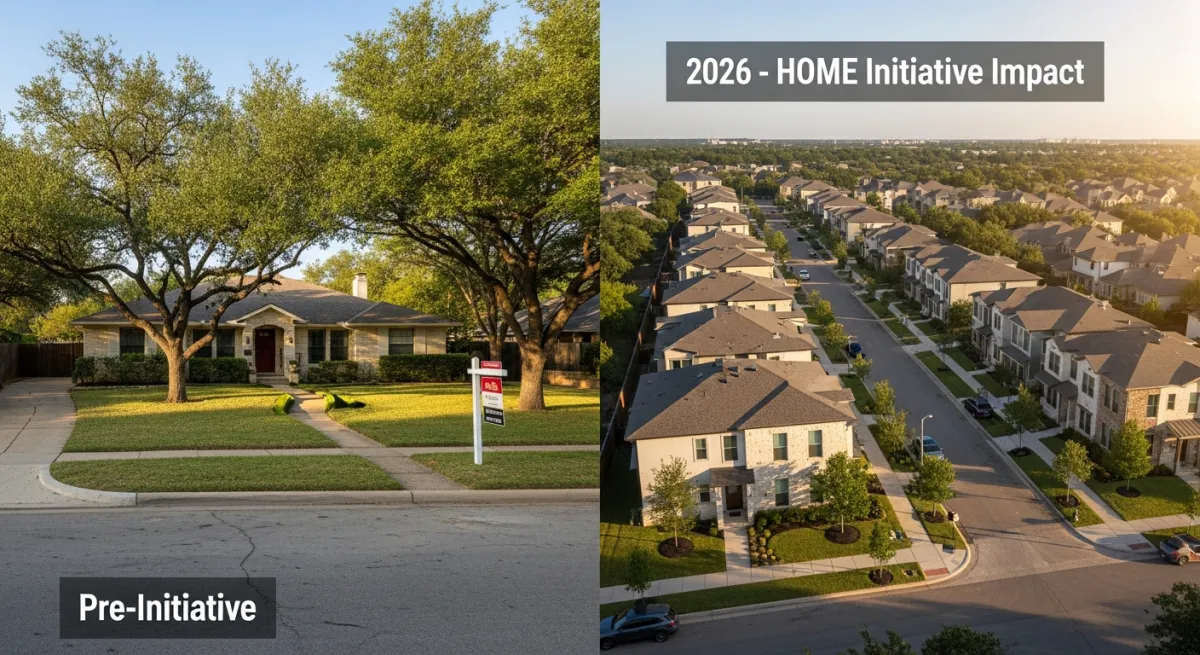
Permit filings show real but measured progress. Austin Development Services Department data for two-family and three-family residential permits shows a meaningful increase in applications following Phase 1 and Phase 2 effective dates. Three-family filings represent a category that essentially didn’t exist in Austin’s permit pipeline before HOME. That’s not nothing.
But the gap between applications and completions is larger than housing advocates projected. The reasons aren’t mysterious. Construction costs remain high enough that many projects pencil out only narrowly—or don’t pencil at all—at market rents in neighborhoods where land is already expensive. Financing gaps slow projects at the design phase. Contractor scheduling is creating delays of months on permitted projects because Austin’s construction market is still working through inventory filed before HOME passed. Some applications, particularly for three-unit configurations, bounce back for revisions as DSD works through implementation details in the new code environment. One DSD reviewer noted in late 2024 that three-family configurations are still generating interpretive questions on parking requirements and unit separation standards, which slows reviews beyond the timeline of a standard residential permit.
The pipeline is real. The pace reflects the full stack of friction this article describes.
Which Austin Neighborhoods Have the Lot Inventory to Use These Rules
Opportunity is not evenly distributed.
In East Austin (78702, 78721), lot inventory exists, but already-elevated land values, dense deed restriction history from older subdivision platting, and investor competition have compressed margins. Projects work here. They require sharper underwriting and smaller contingencies.
The Rundberg and North Lamar corridor (78753) is arguably the most favorable territory for HOME development right now—not because it’s glamorous, but because the numbers work. Lots are larger, land values are lower, deed restriction friction is less pronounced, and the area has seen sustained infrastructure and public safety investment that’s slowly improving the investment calculus. If you’re an investor and you haven’t run the per-unit cost math for this corridor against Hyde Park or Crestview, do that before you make any assumptions about where to buy.
Dove Springs and Southeast Austin (78744) present a similar profile to Rundberg on lot size, with less investor saturation to date. Rental rates still lag closer-in neighborhoods, but land costs are proportionally lower in ways that matter for feasibility. The further-from-core location affects achievable rents, but for investors with a longer horizon it’s worth the analysis.
Hyde Park (78751) has lots that qualify under HOME and strong rental demand, but it sits within a historic overlay environment that adds design review friction to projects even when they’re technically by-right on zoning. Expect longer timelines and tighter design parameters. Crestview and Brentwood were already among Austin’s most active neighborhoods for ADU development before HOME passed; they’re now seeing the next wave of triplex inquiries. Land values there are high enough that the three-unit math only works cleanly with premium rents or a basis that preceded the recent price run-up. A lot of people are going to discover that too late.
Short-Term Rentals, School Districts, and Other Fine Print
Adding a unit for Airbnb or VRBO is subject to Austin’s STR licensing framework regardless of what HOME permits on the zoning side. Type 1 permits apply to owner-occupied properties; Type 2 permits—for non-owner-occupied STRs—are subject to neighborhood caps and have faced recurring Council scrutiny. If your plan for a new rear unit involves short-term rental, check STR licensing requirements before you finalize your business model. Some neighborhoods that were open to Type 2 STR permits two years ago have seen Council discussion about restricting new permits. Current availability for your specific address matters. For a full breakdown of how Austin’s licensing system currently works, see what Austin’s short-term rental permit rules require in 2026.
Austin doesn’t currently assess school impact fees on residential development, which distinguishes it from some neighboring jurisdictions. Council has ongoing discussions about tying affordability incentives to the by-right permissions HOME created—reducing tap fees or waiving permit fees for owners who commit to income-restricted rents for a defined period. This remains a work in progress. Confirm what’s actually available with Austin’s Development Services Department or the city’s Housing Department before assuming any incentive applies to your project.
Before You Call a Contractor, Work Through This List
The homeowners and small investors who succeed in this environment do the homework before they spend money. The ones who skip steps find out why those steps exist at a point when it’s expensive to backtrack.
In sequence: Pull your TCAD property record and verify your lot’s square footage and dimensions against current code thresholds. Check them against Austin City Code Chapter 25-2 directly—don’t rely on secondhand summaries, including this one. Pull deed restriction records from TCAD’s online portal and your existing title policy. If you find restrictions limiting use to a single family, stop and consult a real estate attorney before proceeding; this step alone kills otherwise-viable projects. Calculate what’s already on the lot—structures, driveways, patios—and compare it against the 45 percent SF-3 impervious cover limit. Contact Austin Water and get a project-specific tap fee estimate; do not rely on average figures. If any unit is intended for short-term rental, check current permit availability for your property address with the city’s STR licensing office. Understand your financing ceiling before you start design—talk to a lender with experience in small residential construction, and ask specifically about construction-to-permanent products if you’re an owner-occupant. Find a builder who has pulled HOME-era permits and knows where applications get kicked back. Austin has builders—including firms such as Moontower ADU that have been active in the post-HOME DSD review environment—who understand permit review timelines and code interpretation details. Their experience is worth paying for.
Austin’s missing-middle reform is among the most aggressive upzoning actions any major Texas city has attempted. But the ordinance is a necessary condition for building more housing, not a sufficient one. The property math, the private restrictions, the infrastructure fees, the financing market—none of that changed when Council voted. Knowing which of those variables apply to your specific address before you get deep into a project is the work that separates a viable plan from an expensive lesson. Most of the people who are going to learn that the hard way haven’t started yet.