What Austin Landlords Are Legally Required to Fix and How Fast They Must Do It
When your air conditioner dies in Austin in July and the indoor thermometer reads 95°F, you're not dealing with an inconvenience. This is a documented health emergency. Austin averages roughly 111 …

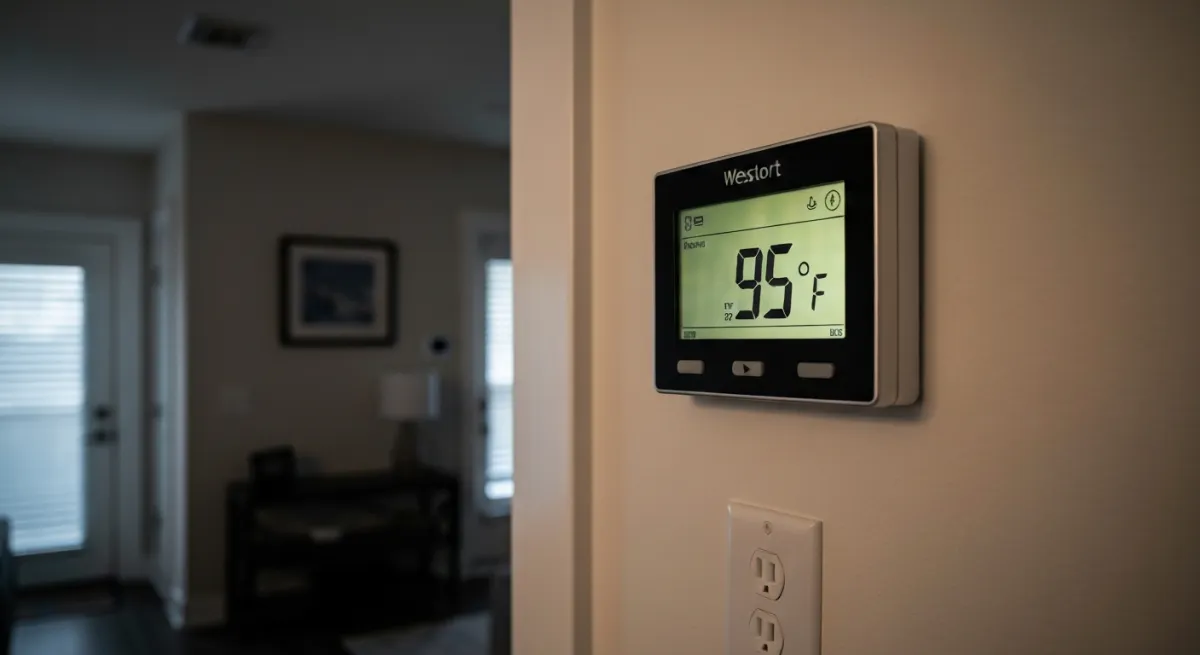
When your air conditioner dies in Austin in July and the indoor thermometer reads 95°F, you’re not dealing with an inconvenience. This is a documented health emergency. Austin averages roughly 111 days above 90°F annually, and 2023 brought 107°F in August. What you do in the next 48 hours — and how you document it — will determine whether Texas law protects you or leaves you without options.
This is a section-by-section walkthrough of your actual rights under Texas Property Code §92.056, the steps Austin renters need to take to preserve those rights, and the specific local resources that can help when a landlord goes quiet.
Why AC Failure in Austin Is a Legal Matter, Not Just a Comfort Complaint
Austin clears 100°F on roughly 15 to 20 days each summer, and extended heat stretches have become a recurring feature of Central Texas life — not a fluke. For renters in older housing stock, the problem compounds. Think early-1980s apartments and duplexes in East Austin, along the Rundberg Lane corridor, and in southeast neighborhoods like Dove Springs. Those HVAC systems fail with predictable frequency precisely when they’re under the heaviest load.
Meanwhile, Austin’s rent growth over the past decade has left many tenants with no practical exit. Moving costs money. Breaking a lease costs money. Finding a comparable unit in what looks like a softening market still takes time that a tenant sleeping in 90°F indoor heat in July simply doesn’t have.
That combination is why Texas law treats non-functional air conditioning as a condition materially affecting physical health and safety — not a comfort preference, a legal trigger. Landlords cannot simply ignore it.
What Texas Law Actually Requires Landlords to Fix
Texas Property Code §92.056 requires landlords to repair conditions that “materially affect the physical health or safety of an ordinary tenant.” The statute doesn’t list every qualifying condition, but courts and the Austin Tenants Council have applied the standard consistently over the years.
Conditions that qualify: AC failure during high heat, heating failure in cold weather, sewage backup or non-functional toilets, broken exterior doors or locks, gas leaks, active roof leaks causing water intrusion, mold from landlord-caused or landlord-ignored moisture problems, and significant rodent or pest infestation. Non-functional smoke detectors — governed under §92.251–92.262 — and unsafe electrical conditions also create landlord obligations.
Cosmetic issues don’t qualify. Peeling interior paint with no health risk, worn carpet, minor drywall scuffs — these fall outside the statute. So does damage the tenant or their guests caused, appliances the lease explicitly assigns to the tenant, and conditions the tenant accepted in writing before moving in.
The “ordinary tenant” standard matters. Courts look at whether the condition poses a real threat to a reasonable person in the unit, not whether a particularly sensitive tenant would be affected. An outdoor temperature of 105°F combined with a dead AC system clears that bar without much legal ambiguity.
If you’re unsure whether your specific situation qualifies, the Austin Tenants Council at (512) 474-1961 offers free counseling. Call before you take any formal steps.
The Written Notice Requirement Most Renters Get Wrong
This is where tenants lose cases they should win. Texas law requires written notice before any repair remedy is available — and the clock doesn’t start when you send the notice. It starts when the landlord receives it.
Under §92.056, a landlord has a “reasonable time” to make repairs after receiving written notice. Seven days is presumed reasonable for most conditions, including AC failure in August.
Your notice must identify the specific condition. Not “the AC is broken” — the symptom, the date it failed, and the fact that indoor temperatures are dangerously elevated. It must be in writing and delivered in a way you can prove.
Send it certified mail with return receipt. Yes, a text message or email may be legally sufficient in some circumstances, but the green card gives you an irrefutable record of exactly when the landlord received it. That receipt becomes your evidence if you end up in Travis County Justice Court three weeks later. Keep it somewhere you’ll actually find it.
One additional wrinkle: some readings of §92.056 require two separate written notices before certain remedies — particularly repair-and-deduct — become available. This depends on how the remedies section interacts with the notice provisions and on your specific circumstances. Before you send a second notice or take any remedial action, call the Austin Tenants Council and confirm what’s required for your situation. Getting this wrong can forfeit your legal standing.
What to Do From the Day Your AC Fails
Do not skip steps. Do not reorder them.
Day 1 — Document everything immediately. Photograph your thermostat and any wall thermometers. Include a timestamp, or photograph next to a phone showing the date and time. Screenshot any texts or emails you’ve already sent the landlord. Note outdoor temperature from a weather service and write it down. If you have a window unit, document that it’s non-functional or insufficient.
Day 1 or 2 — Send written notice by certified mail.
Your notice doesn’t need to be a legal document. It needs to be clear, dated, specific, and demonstrably received:
[Date] [Landlord Name] [Landlord Address]
Dear [Landlord Name],
I am writing to formally notify you that the air conditioning system at my residence, [Unit Address], Austin, Texas [ZIP], has been non-functional since [date]. Indoor temperatures have reached [X]°F. This condition materially affects my physical health and safety.
Pursuant to Texas Property Code §92.056, I am requesting that you repair this condition within a reasonable time. Please confirm receipt of this notice and provide a timeline for repair.
Sincerely, [Your Name] [Your Phone Number]
Send it certified mail and keep a copy. Also email it so you have a digital record — but don’t rely on email alone.
Same day — File a code complaint. Go to austintexas.gov/department/code or call 311. This creates an official city record independent of your landlord, puts an inspector in play who can document conditions you might not fully capture yourself, and produces a city-issued document that carries real weight in court.
Same week — Contact the Austin Tenants Council. Call (512) 474-1961 during intake hours (verify current hours before calling). ATC counselors can review your notice, tell you whether your situation requires a second notice before pursuing further steps, and advise on documentation.
While the clock runs — protect yourself. If indoor temperatures are genuinely unsafe, Austin Public Health has opened cooling centers during extreme heat events; the City of Austin maintains current locations at austintexas.gov. If you have to stay in a hotel, document those costs — they may be recoverable. Log every phone call to your landlord, every text or non-response, every day that passes without repair. That log is your evidence.
The Remedies Texas Law Actually Gives You
Here’s one of the most dangerous pieces of bad advice circulating in tenant forums: stopping rent because the landlord won’t fix the AC. Texas law does not permit rent withholding. If you do it, you will almost certainly be evicted. You’ll hand your landlord the legal high ground and forfeit your standing under §92.056. Don’t do it.
Repair-and-deduct is what the law actually provides. After proper written notice and the expiration of a reasonable repair window, a tenant can arrange the repair themselves and deduct the cost from rent. The statutory cap is the greater of $500 or one month’s rent — so if your monthly rent is $1,400, you can deduct up to $1,400, not just $500. This is available twice in any 12-month period. Get written estimates, hire a licensed contractor, keep every receipt, and notify your landlord before you proceed.
Lease termination is available if the landlord’s failure to repair renders the unit effectively uninhabitable. Texas law allows a tenant to exit the lease without penalty in this circumstance. This is a serious step that requires careful documentation and, ideally, a conversation with an attorney or ATC counselor before you invoke it. An improperly executed termination can leave you on the hook for remaining rent.
Suing for damages is the third option. Under §92.056(e), a tenant who wins in court can recover actual damages (hotel bills, medical costs attributable to the condition, repair costs you paid out of pocket), one month’s rent, $500 in statutory damages, and reasonable attorney’s fees. These stack — which means a well-documented case can produce real money even in small claims.
Texas also has no statutory rent escrow system for repair disputes. That option, which exists in some other states, simply isn’t available here. Any tenant who tries it is in the same position as one who stops paying rent outright.
What Your Landlord Cannot Do After You Complain
Texas Property Code §92.331 prohibits retaliation. A landlord cannot raise rent, reduce services, threaten eviction, or file an eviction proceeding within six months of a tenant’s good-faith repair request or code complaint — unless they can show the action had an independent, non-retaliatory reason.
This covers both written repair requests sent directly to the landlord and code complaints filed with Austin Code Department. If your landlord suddenly raises your rent or threatens eviction shortly after you send a certified mail demand or file a 311 complaint, document the timeline. Retaliation creates its own cause of action and can be raised as a defense in an eviction proceeding.
Tenants sometimes hesitate to complain because they fear retaliation more than they trust the law, and honestly, that fear comes from somewhere real — retaliatory landlords exist, and the power imbalance in a tenancy is not abstract. But the six-month window and the independent-reason requirement give the protection actual teeth. What makes it work is documentation of the sequence of events.
Filing With Austin Code Department and What to Expect
File online at austintexas.gov/department/code or call 311. You’ll need your address, a description of the condition, and the date it started. A case number is issued when the complaint is accepted.
An inspector is then assigned to visit the property and document what they find. If they confirm a code violation, the landlord receives a notice of violation and a compliance deadline. Continued non-compliance can result in fines. More importantly for your purposes, that violation notice is an official city document — not something you produced — establishing that the condition existed and was serious enough to constitute a violation. That matters in court.
One thing to know going in: Austin Code Department has faced real capacity constraints as the city’s rental stock has grown faster than its enforcement staffing. This isn’t a one-time backlog; it’s been an ongoing problem for years. Inspections during peak summer complaint periods can take weeks. File the complaint immediately, but don’t build your entire plan around code enforcement speed. The private legal remedies under §92.056 work independently of whether Austin Code has visited the property yet.
Taking Your Landlord to Travis County Justice Court
Texas Justice Court handles small claims up to $20,000, which covers the realistic damages in most residential repair disputes. You don’t need an attorney, though having one helps in anything complicated.
Justice Court Precinct 5 covers central Austin, but East Austin, North Austin, and South Austin addresses may fall under different precincts. Check your precinct at the Travis County website before you file — filing in the wrong precinct requires a transfer that costs time. Fees vary by claim amount and precinct; verify the current fee schedule with the clerk before filing.
Bring your certified mail receipt, your photo and temperature log, repair receipts if you used repair-and-deduct, a code violation notice if one was issued, and a written timeline of every communication with the landlord. The timeline is often more useful than people expect — courts want to see the sequence of events laid out clearly, not pieced together from a stack of screenshots.
The Austin Tenants Council offers coaching for self-represented tenants, including guidance on what documentation to present and how to organize it. For a straightforward repair dispute with good documentation, self-representation in Justice Court is realistic.
Litigation should be your last move — after written notice, after the repair window closes, after ATC counseling, after the landlord has had every opportunity to comply.
How the Austin Tenants Council Can Help You Right Now
The Austin Tenants Council at (512) 474-1961 is the primary local resource for renters in repair disputes. Their services are free.
A counselor will walk through your situation, confirm whether §92.056 applies, and tell you exactly what notices to send and in what order. They have sample demand letters calibrated to Texas law. They’ll tell you what documentation is most useful for the specific remedy you’re pursuing. For tenants who end up in Justice Court, ATC can sometimes provide support for self-represented tenants. For cases that warrant an attorney, they connect tenants to Texas RioGrande Legal Aid and other providers serving Travis County.
When you call, have your lease, copies of any communications with your landlord, your photo and temperature documentation, a written timeline, and your certified mail tracking number if you’ve already sent a notice.
Verify hours before calling. ATC’s intake schedule and service model have shifted over the years. Current hours and any appointment requirements are at austintenants.org or available by calling directly.
Common Questions
Does my landlord have to fix my AC? Yes. Under §92.056, AC failure during high heat qualifies as a condition materially affecting health and safety. Landlords are legally required to repair it after receiving written notice.
How fast? Seven days is the statutory presumption of a “reasonable time” for most conditions. The clock starts when the landlord receives the notice, not when you send it.
What if my landlord says a part is on order? That doesn’t pause your legal timeline, but it is relevant context. Document when you got that response and what was said. If the window closes and the unit is still down, call ATC before taking further steps.
Can I withhold rent? No. Texas law doesn’t allow it. Doing so will almost certainly result in eviction proceedings and forfeit your standing under §92.056.
What if I caused the damage? §92.056 doesn’t apply to tenant-caused damage. You’re responsible for damage from you or your guests.
What if I’m behind on rent? Being behind weakens your legal position and may give your landlord independent grounds for eviction. You should still document the repair failure and contact ATC — but your counselor needs to know about the arrearage up front, because it changes the strategy.
What if the landlord says the condition isn’t that serious? That’s a factual dispute your documentation resolves. Temperature photos, dated records, a code violation notice — courts apply the “ordinary tenant” standard, not the landlord’s self-assessment. If the condition is serious, document that it was serious.
Contact information and service hours for the Austin Tenants Council and Austin Code Department should be verified before acting on this information. This article does not constitute legal advice. Readers with specific legal questions should consult a licensed Texas attorney or contact Texas RioGrande Legal Aid.