A Realistic Cost Breakdown for Moving Within Austin This Summer
Between movers, deposits, pet fees, and utility hookups, your upfront cash exposure can clear $4,000 before you unpack a single box. Here's where every dollar goes.

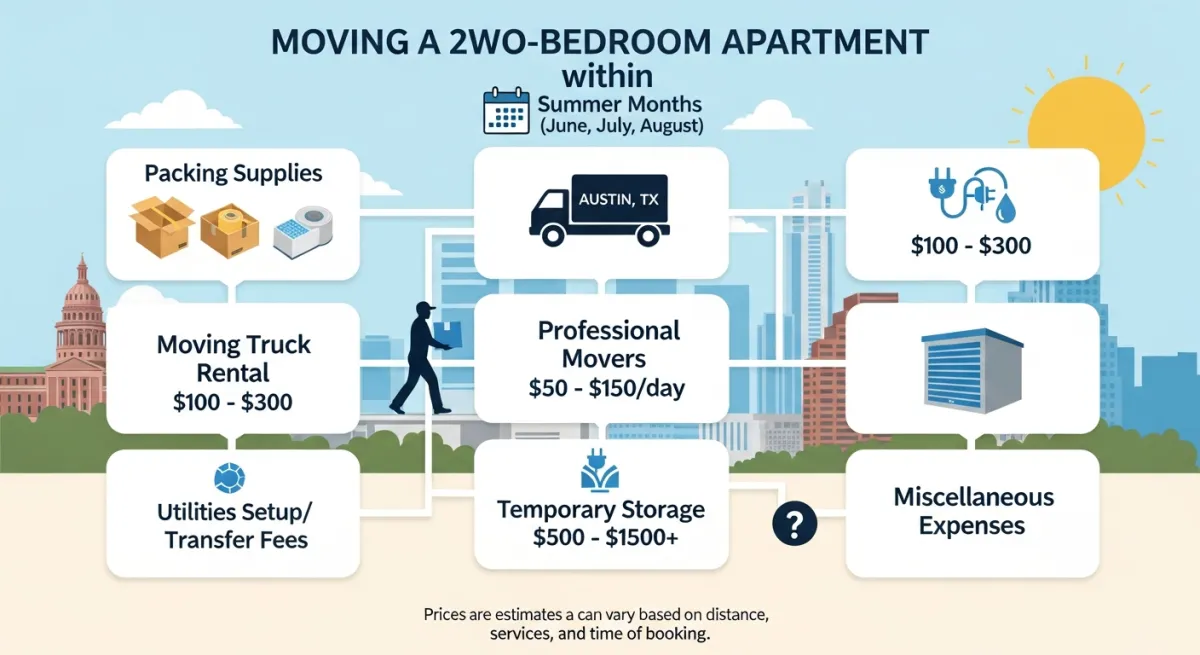
Between movers, deposits, pet fees, and utility hookups, your upfront cash exposure can clear $4,000 before you unpack a single box. Here’s where every dollar goes.
If you’re moving a two-bedroom apartment within Austin this summer, your total upfront cash exposure runs roughly $2,050 on the low end to more than $6,500 at the high end. That range is wide, and the width is the whole point. One versus two months’ security deposit, whether you have a pet, whether your new building has elevator reservation requirements, whether you’re moving on a Tuesday in May or a Saturday in late July — each of those swings the needle hard.
This isn’t a tips list. It’s a line-item accounting of where the money actually goes so you can build a real number before you sign anything.
What Austin Movers Charge for a Local Two-Bedroom Move in Summer
A standard local two-bedroom move — two-person crew, single truck, four to six hours of labor — runs $400–$900 during summer 2025. Three-person crews run $600–$1,200. The spread depends on the company, the day of the week, and whether surcharges appear in the initial quote or show up on the final invoice. That last variable is more common than it should be.
Austin-area operators worth calling for actual quotes: Square Cow Movers (Austin-founded, multiple metro locations), Einstein Moving Company (North Austin flagship), and Black Tie Moving (Austin office, higher price point, fewer complaints about invoice surprises). For budget comparison, Austin Discount Movers and Lone Star Moving are worth a call. Get written quotes from at least three companies before you book. The gap between the cheapest and most expensive credentialed operator can be several hundred dollars for the same job.
Fuel surcharges deserve a specific mention. Many Austin movers add $50–$100 that doesn’t appear in the hourly rate quote. Ask directly: “Is there a fuel or truck fee on top of the hourly rate?” Get it in writing. Not the week of the move — when you book.
What Summer Does to the Price
A Saturday move during peak summer costs 15–25% more than a Wednesday. That’s standard demand pricing, not a hidden fee, but it’s not always volunteered when you call. You have to ask.
The crunch follows the academic calendar more than the thermometer. UT Austin’s spring semester ends mid-May, when a large cohort of student renters clears out simultaneously — moving companies are fully booked across Central and North Austin by then. The tightest window on the Austin moving calendar is July 28–August 15, when the fall move-in surge for UT and Austin Community College kicks in. Crews not already booked by early July charge premium rates.
Austin’s average high hits 97–100°F from mid-June through August. Most professional crews now prefer — and some require — 7–9 a.m. start windows to front-load heavy lifting before afternoon heat peaks. If your building doesn’t allow elevator or loading dock access before 8 a.m., flag that when you book. A crew grinding through peak afternoon heat moves slower. At hourly rates, slower means more expensive. That’s not hypothetical.
For any Saturday move between June 1 and August 20, call three to four weeks out minimum. If you have a locked-in lease start date, four weeks is the floor.
DIY vs. Hiring Pros: What Truck Rental Actually Costs on a Summer Weekend
The pitch for DIY is obvious: why pay $800 for movers when you can rent a truck for $150? The honest answer is that the savings are real but smaller than advertised — and on a summer weekend they shrink further. Anyone who’s tried to maneuver a 15-foot truck through a South Lamar apartment complex at 8 a.m. already knows this.
U-Haul charges a base day rate of $39–$49 for a 15-foot truck at Austin locations including MLK Jr. Boulevard, North Lamar, and South Congress. Then the per-mile charge: $0.99–$1.19 per mile. An intra-Austin move covers 20–40 total miles (loading location to new address to return drop-off), putting mileage at $20–$48. Moving blankets run $20–$40 per set — skip them and you’re gambling with furniture. Appliance dolly adds $10–$20. Fuel: budget for roughly 10 mpg. On a summer Saturday, U-Haul’s dynamic pricing can run 20–30% above the base rate published for off-peak dates. Check the actual price for your specific pickup date, not the homepage advertised rate.
Penske is worth a separate check. Their 16-foot truck runs approximately $80–$120 per day on a local rate in Austin. Get a live quote for your date; don’t assume either company is cheaper.
Realistic DIY total for a local two-bedroom Austin move on a summer Saturday: $120–$300 for the truck, plus fuel, plus labor from whoever you’ve roped into helping you. Professional movers for the same job, with fuel surcharge, cost $450–$1,000 all-in.
The savings are real if you go DIY — roughly $200–$500 in most scenarios. But if you have a third-floor unit, a sectional, or a tight stairwell, the value of a professional crew rises fast. And if your new property manager charges for wall dings and door-frame damage, that liability shifts the math in ways the truck rental rate doesn’t capture. If the conditions are easy, DIY makes sense. If they’re not, it’s usually not worth it.
Security Deposits, Application Fees, and the Upfront Cash Your Landlord Expects
This is where budgets blow up — specifically for people who’ve only priced the move itself and not what the new landlord wants before handing over keys.
Austin’s median two-bedroom rent in 2025 runs approximately $1,600–$1,900 per month depending on neighborhood and unit age. Security deposits at most Austin apartment communities run one to two months’ rent. Texas has no statutory cap on deposit amounts, so landlords set this based on market standards and their own risk tolerance.
A landlord typically pushes toward two months instead of one if you’re signing a shorter lease, if your credit score falls below the property’s minimum (often 650–680), if your rental history has gaps, or if you have pets. That puts deposit exposure at $1,600–$3,800 for a two-bedroom. It’s the single largest line item in this entire budget for most renters.
Application fees are a separate, non-refundable cost. Standard Austin practice is $50–$100 per adult applicant. If you and a roommate are applying at three properties while you decide, you’ve already spent $300–$600 before you’ve committed to anything. Some properties will waive the fee if you’re denied; most won’t. Ask before you apply.
Get deposit terms in writing before you sign — specifically which conditions allow the landlord to withhold funds. Texas law requires landlords to return deposits within 30 days of move-out with an itemized written accounting of any deductions. Knowing that before you move in is more useful than learning it when you’re already fighting over a cleaning charge.
Pet Deposits, Non-Refundable Fees, and Monthly Pet Rent
Corporate-managed Austin apartments have largely standardized a three-layer pet cost structure that catches renters off guard, particularly anyone whose last rental experience was with a private landlord.
It works like this: a refundable pet deposit of $300–$500 per pet sits alongside your security deposit and is theoretically recoverable if your animal causes no damage. Alongside that — not instead of it — is a non-refundable pet fee of $200–$400. That money is gone no matter how well-behaved your dog is. Then comes monthly pet rent: $25–$75 per month, per pet. Over a 12-month lease, that’s $300–$900 per year per pet, on top of everything else.
This structure is standard at Roscoe Properties, one of Austin’s larger local managers, and at Greystar-managed communities, which run a significant share of newer high-rises and mid-rises across the Domain, Mueller, South Lamar, and the East Side. It is, bluntly, a revenue mechanism dressed up as a risk-management tool — the non-refundable fee in particular is hard to justify on any other basis.
Upfront pet exposure for one pet: $500–$900 before your first month of pet rent. Many communities charge the full structure per animal. For two pets, do the math yourself — it gets uncomfortable quickly.
Private landlords operate differently. A private owner renting a house or duplex in Crestview or East Austin may ask for a flat pet deposit with no non-refundable component and no monthly pet rent. If you have pets and any flexibility on property type, that distinction can be worth $600–$1,500 over the course of a year. It’s worth a targeted search on Zillow or Facebook Marketplace for privately listed rentals before defaulting to a corporate community.
Always ask your prospective landlord directly: which components are refundable? Management companies aren’t always forthcoming about this in initial leasing conversations, and the lease language can be confusing even when the terms are disclosed.
Austin Utility Connection Costs That National Moving Guides Get Wrong
Most national moving-cost articles reference generic utility deposit figures that have nothing to do with how Austin’s specific providers work. Here’s what’s actually true locally, and a topic worth tracking closely in our moving & real estate coverage.
Austin Energy, the city-owned electric utility, charges a one-time new-account connection fee for residential accounts — $36 at last confirmed rates. Verify the current amount at austinenergy.com or call 512-494-9400 before budgeting. Customers with an established Austin Energy account in good standing typically have this reduced or waived, but new-to-Austin residents should budget for it.
Austin Water charges a new-account setup fee and, in some cases, a deposit. Customers with clean Austin Water account history generally see the deposit waived. If you’re new to the city or had a previous account closed for non-payment, budget $150–$200 for the deposit. Verify your specific situation at austintexas.gov/department/austin-water before moving.
Atmos Energy provides natural gas service to portions of Austin, but a large share of newer Austin apartment construction is all-electric — particularly high-rises and newer garden-style communities built in the last decade. If you’re moving into a newer unit, confirm whether you need gas service at all before budgeting for it. If you do, Atmos residential deposits run approximately $35–$75 depending on account history.
Internet is one area where Austin renters catch a genuine break. Google Fiber covers a substantial portion of central Austin with no installation fee and no equipment deposit for standard residential plans. If Google Fiber is available at your new address, setup costs nothing. Spectrum and AT&T Fiber both offer self-install options that avoid technician-visit fees when equipment ships directly — confirm that option when you sign up, because it’s not always what they lead with.
Renter’s insurance is now a lease requirement at most corporate-managed communities, not a suggestion. Coverage runs $15–$30 per month for a standard policy. Most properties require proof uploaded to their resident portal before you get keys. Budget the first month’s premium as an upfront cost.
Elevator Reservations, Certificates of Insurance, and Parking
Newer Austin apartment buildings — particularly in the Domain, the Seaholm District, the South Lamar corridor, and downtown — have move-in requirements that aren’t buried in the lease. They’re just never mentioned unless you ask.
Most mid-rise and high-rise communities require you to reserve the service elevator for your move-in window, with access limited to specific hours and a refundable deposit of $150–$300 to hold the reservation. Not a huge amount, but it’s cash tied up during a period when you’re already stretched thin. Call your property manager before you book movers to get the specific policy. Don’t assume it’s in the lease — at many properties it isn’t.
Many Austin high-rises and Class A communities require moving companies to provide a Certificate of Insurance naming the building as an additional insured before movers can enter the property. Professional movers typically carry this and can produce it on request. Smaller operators and independents may not have the required coverage levels — which means you could arrive on moving day with a crew the building won’t let past the lobby. Ask your moving company directly, before you book: “Can you provide a COI naming the property as additional insured?” This is a five-minute question that can save a genuinely unrecoverable situation.
Travis Heights, Clarksville, Old West Austin, and parts of Hyde Park have residential parking restrictions that complicate where a moving truck can legally sit for several hours. Austin doesn’t have a formal residential moving-permit system. In practice, you’re coordinating informally — identifying loading zones, checking posted restrictions, sometimes parking a large truck on a narrow street where it barely fits. If your new address is on a restricted street, call 311 before moving day to understand what’s posted. It’s a short call.
Austin Summer Logistics: Heat, Construction, and Routing Problems
Two on-the-ground factors affect both cost and timing this summer that don’t appear in any pricing guide.
The ongoing I-35 Capital Express Central construction between Airport Boulevard and Riverside Drive is actively disrupting cross-town truck routes. For anyone moving between North Austin (Domain, Rundberg, Pflugerville corridor) and South Austin (78704, Slaughter Lane, South Congress neighborhoods), this means trucks routing around the construction zone, longer drive times between stops, and additional billable hours on an hourly contract. Ask your mover to confirm their routing plan. An experienced local crew knows the detour options; a crew new to the market often doesn’t.
A summer move starting at 10 a.m. instead of 7 a.m. is a materially different invoice. Average highs of 97–100°F in July and August mean a later start equals a slower crew equals more hours billed. A move that takes five hours starting at 7 a.m. may take six or more starting at 10 a.m. That’s not a rounding error at Austin mover rates. Isolated afternoon storms are also common from mid-July through September. Ask your moving company before you book: what’s your weather-delay policy? Knowing that in advance prevents an argument at 2 p.m. on moving day.
Your Full Budget, Line by Line
Every cost category in one place. Fill in the ranges that apply to your situation.
| Cost Category | Low Estimate | High Estimate | Notes |
|---|---|---|---|
| Professional movers (2-person crew, 4–6 hrs) | $400 | $900 | Summer weekend adds 15–25% |
| Fuel surcharge (movers) | $50 | $100 | Ask upfront; often not in the quote |
| — OR — DIY truck rental (summer weekend) | $120 | $300 | U-Haul/Penske + mileage + supplies |
| Security deposit | $1,600 | $3,800 | 1–2 months’ rent; median 2BR rent $1,600–$1,900 |
| First month’s rent | $1,600 | $1,900 | Due at lease signing |
| Application fee(s) | $50 | $200 | Per adult; non-refundable |
| Pet deposit (refundable, 1 pet) | $300 | $500 | Corporate-managed buildings |
| Pet fee (non-refundable, 1 pet) | $200 | $400 | Standard at Greystar, Roscoe properties |
| Austin Energy connection fee | $0 | $36 | Waived with established account in good standing; verify current rate |
| Austin Water deposit | $0 | $200 | Waived with established good-standing history; verify current rate |
| Atmos Energy deposit (if gas unit) | $0 | $75 | Many newer units are all-electric; verify first |
| Internet setup | $0 | $0 | Google Fiber: $0; Spectrum/AT&T self-install: $0 with self-install option |
| Elevator reservation deposit (if applicable) | $0 | $300 | Refundable; high-rises in Domain, Seaholm, S. Lamar |
| Renter’s insurance (first month) | $15 | $30 | Required by most corporate-managed communities |
| Total upfront cash exposure | ~$2,050 | ~$6,500+ |
One thing people consistently underestimate: the sequencing. Application fees are due before you’re approved. Security deposit and first month’s rent are typically due at lease signing, before keys change hands — and some landlords require first and last month’s rent simultaneously. Ask before you apply, not after you’re approved and committed. Pet fees and deposits are usually collected with the security deposit. Utility setup should be initiated one to two weeks before move-in to avoid a gap in service. Renter’s insurance must be active before your move-in date if the lease requires it — and at most corporate properties, it does.
If you’re weighing whether renting or buying makes more sense before committing to another lease, the five-year rent-vs-buy calculus for Austin in 2026 is worth working through before you sign anything.
Moving Day Execution
Book your movers three to four weeks out minimum for any Saturday between June 1 and August 20. The window is genuinely tight during UT move-out (mid-May) and UT/ACC move-in (late July through mid-August).
Call your building manager before you book movers to ask about elevator reservation requirements, COI requirements, and loading dock hours. That information is often not in the lease.
Ask every apartment community to put in writing which pet fees are refundable and which are not. A $400 refundable deposit and a $400 non-refundable fee are not the same thing. That conversation happens at lease signing — not at move-out, when the answer no longer helps you.
Verify whether your unit has gas service before budgeting an Atmos deposit. Confirm your Austin Energy and Austin Water account status before assuming connection fees are waived. They often are — but only if your account history is clean.
Add it all up before you sign anything. The total is real. It’s just spread across enough line items that most people don’t see it until the money is already out the door.