What East Austin in 2026 Is Actually Costing, What Got Lost, and Where to Look Instead
The Arabella on Cesar Chavez is a five-story, 330-unit complex that opened in phases between 2023 and 2024 at the corner of Cesar Chavez and Chicon Street. Studios were listing at $2,149 as of late…

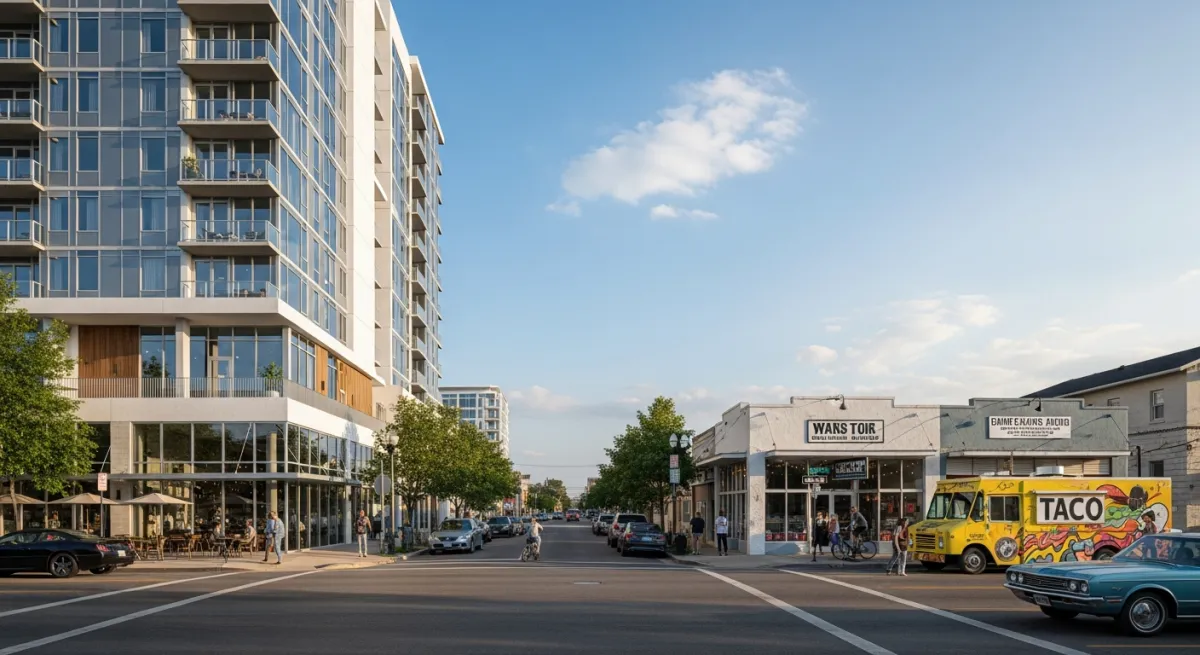
The Arabella on Cesar Chavez is a five-story, 330-unit complex that opened in phases between 2023 and 2024 at the corner of Cesar Chavez and Chicon Street. Studios were listing at $2,149 as of late April 2026. A one-bedroom runs $2,450 at the low end. The site where the Arabella now stands once held a cluster of working-class rentals: modest wood-frame duplexes and a small multiunit building that housed mostly Latino families paying rents in the $700–$900 range in 2015.
That year, the median household income in 78702 was roughly $38,000. By standard housing math, a household at that median could afford about $950 a month in rent. That number and the number on the Arabella’s leasing page are not in the same conversation. That gap is the entire story of East Austin in 2026. There’s no point in burying it.
The Rent Survey: Cesar Chavez vs. Airport Boulevard, Block by Block
The Cesar Chavez and East 6th spine runs from I-35 west to Pleasant Valley Road. It’s Austin’s most heavily covered gentrification corridor, and the coverage hasn’t been wrong. But it has tended to flatten what is actually a tiered, block-specific market. Here’s what verified asking rents looked like along that corridor and along Airport Boulevard from roughly 45th Street north toward 183, pulled from Zillow, Apartments.com, and direct property listings in late April 2026.
Cesar Chavez / East 6th Corridor (78702)
| Property | Address | Unit Type | Asking Rent | Date Pulled |
|---|---|---|---|---|
| Arabella | 1301 E Cesar Chavez | Studio | $2,149 | Apr 2026 |
| Arabella | 1301 E Cesar Chavez | 1BR | $2,450 | Apr 2026 |
| The Ruckus | 1209 E 6th St | Studio | $1,895 | Apr 2026 |
| The Ruckus | 1209 E 6th St | 1BR | $2,275 | Apr 2026 |
| East Cesar Chavez (older stock) | 1800 block E Cesar Chavez | 1BR | $1,450–$1,600 | Apr 2026 |
| Small multifamily (private landlord) | 2200 block E 6th St | 1BR | $1,350 | Apr 2026 |
The older private-landlord stock on the 2100–2400 blocks of East 6th and on the eastern stretch toward Pleasant Valley is what’s left of the pre-gentrification rental supply in 78702. Let’s be clear about what “left” means: a $1,350 one-bedroom still requires an annual household income of $54,000 to clear the 30-percent threshold. It’s in a different market category than the new Class A product, and it’s being lost steadily to sale and redevelopment.
Airport Boulevard Corridor (78752 / northern 78702 boundary)
| Property | Address | Unit Type | Asking Rent | Date Pulled |
|---|---|---|---|---|
| The Linc at Airport | 4800 block Airport Blvd | Studio | $1,375 | Apr 2026 |
| The Linc at Airport | 4800 block Airport Blvd | 1BR | $1,595 | Apr 2026 |
| Older Class B complex | 5200 block Airport Blvd | 1BR | $1,195–$1,295 | Apr 2026 |
| Class C garden-style | 6100 block Airport Blvd | 1BR | $975–$1,050 | Apr 2026 |
| Garden apartments (1970s stock) | Near 183 interchange | Studio | $895 | Apr 2026 |
Airport Boulevard is the most underreported segment of this market. The older Class B and C stock along Airport — unremarkable 1970s and 1980s garden apartments that have never appeared in any story about East Austin — represents the last mid-market rental inventory within reasonable distance of the urban core. A studio at $895 is a genuine outlier for inner Austin in 2026. That outlier status won’t hold.
Several properties along Airport Boulevard and in the 78752 pocket north of 51st Street were advertising concessions in April 2026. First-month-free offers and reduced deposits point to softening in the newer Class B product at the $1,300–$1,600 range. Effective rents at those properties run $90–$130 below listed asking price when annualized. The luxury Cesar Chavez product has no such concessions. The divergence is telling: the premium corridor holds price while the secondary market feels pressure. Neither is moving in any direction that helps the households that built this neighborhood.
The Income Gap: Who 78702 Has Actually Priced Out
The current Census ACS median household income for 78702 sits at approximately $62,000, up from $38,000 a decade ago. That itself is a displacement story, and an important one to understand correctly. The median income rose because lower-income households left the ZIP code — not because they got raises.
To afford the median asking rent for a one-bedroom in 78702 today — roughly $2,100, splitting the difference between older private stock and new construction — a household needs a gross annual income of $84,000. The Arabella and comparable new developments push that threshold to $98,000.
An Austin food service worker earning the city’s median hourly rate for that sector grosses about $34,300 annually working full time. That figure comes from Texas Workforce Commission data showing roughly $16.50 an hour in 2025. A home health aide or medical assistant earns approximately $38,000–$44,000. A retail worker at the neighborhood’s boutiques and coffee shops earns in a similar range. None of these workers can afford a market-rate one-bedroom anywhere on the Cesar Chavez corridor in 2026. Not even close.
Even paired incomes in those categories don’t solve the problem. Two food service workers sharing a unit would spend more than 40 percent of combined gross income to afford a $1,450 one-bedroom on the older end of the market. That’s not affordability. That’s subsistence.
The Austin Displacement Project’s census-tract-level analysis confirms the same story geographically. The tracts covering the core of 78702 are no longer coded on the City of Austin’s Displacement Risk Map as “at risk.” They’re coded as “already displaced.” Long-term low-income residents aren’t in danger of being pushed out; for the most part, they have been. The risk map is tracking what has already happened. It’s a historical document at this point, not a warning.
What Drove the Most Recent Pricing Pressure in 78702
The current moment in East Austin isn’t a spike. It’s a consolidation. The speculative run-up happened between 2021 and 2023, when asking rents in 78702 jumped 30–40 percent in under two years. What 2025 and 2026 look like is prices holding at those elevated levels with no meaningful reversion — even as the broader Austin multifamily market absorbed a significant supply glut.
Austin-wide multifamily vacancy rose to roughly 10–12 percent in 2024–2025, driven by mass delivery of units permitted during the pandemic-era demand surge. In most Austin submarkets, that glut produced visible concessions and modest rent reductions. In 78702, vacancy stayed below the metro average — estimated at 6–7 percent for the ZIP — because demand for the Cesar Chavez corridor specifically absorbed new supply faster than the broader market. Walkability, proximity to downtown, and rail premium all played roles. Pick your favorite.
New construction reset the neighborhood’s baseline. The Arabella (2023–2024), the Ruckus on East 6th (late 2023), and smaller infill condo and townhome projects along East 7th and East 8th between 2023 and 2025 added Class A product to a corridor where nothing comparable had previously existed. These buildings didn’t lower overall rents. They established a new luxury comparable set that private landlords with aging stock use to justify increases. A landlord holding a 1980s multiplex sees what the Arabella asks four blocks away and makes a calculation. It’s not a complicated calculation.
Type 2 STR inventory — owner-absent short-term rentals — has removed a meaningful number of units from the long-term rental market in 78702’s most desirable blocks. City of Austin permit data shows hundreds of active Type 2 licenses concentrated in East Austin ZIP codes. Every unit operating as a short-term rental is a unit not available to the household earning $45,000 looking for a twelve-month lease. The margin profile of short-term rentals makes that obvious to property owners. Ownership of multi-unit properties on Cesar Chavez has shifted substantially toward corporate and investor operators in the past five years. Those operators optimize for short-term revenue. Neighborhood stability doesn’t appear on their spreadsheets.
The Project Connect Blue Line adds a third layer. The planned light rail alignment through East Cesar Chavez and the proposed station area near Pleasant Valley has already been incorporated into land values and, in the case of newer listings, marketing copy. Proximity to a future station stop is being priced into asking rents on the eastern stretch of the corridor right now. Those stops don’t exist yet. Rents are moving for infrastructure that’s five to seven years away at minimum.
Then there’s the Rainey Street adjacency. Rainey’s hospitality corridor, pushing hard against the southern boundary of 78702, generates demand pressure that bleeds east along Cesar Chavez. Renters priced out of the immediate Rainey/downtown area treat East Cesar Chavez as the next-closest option, sustaining demand at the western end of the corridor even as softening appears in newer stock further east. The western blocks of Cesar Chavez are now functionally part of the downtown hospitality workforce market rather than a traditional residential neighborhood. That changes who lives there and what the neighborhood is for — and it’s not the kind of change that runs in reverse.
What Is Still Here: A Status Check on the Anchors
Mi Madre’s Restaurant on Manor Road opened in 1990 and is one of the few original Tejano-owned food businesses still operating on its original block in East Austin. A staff member confirmed in April that the weekday lunch crowd “has changed — we see a lot more people from the new buildings now, people who moved here recently.” The longtime regulars mostly come on weekends. Some drive in from Rundberg or Pflugerville now. That sentence contains the entire story compressed into one commute.
Tamale House East on Airport Boulevard appears stable, and its Airport location turns out to be a structural advantage — the corner that once seemed marginal is now insulated from the worst of the Cesar Chavez rent pressure. Nobody would have predicted that fifteen years ago. Its large, loyal following helps too.
El Chile Cafe and Cantina on Manor Road has adapted rather than been displaced, which is rarer than it should be. Being a full-service restaurant rather than quick-service has helped it hold margins as labor costs rose.
Nixta Taqueria on East 6th Street is open and has received national attention in recent years. Its customer base today skews heavily toward higher-income diners. The restaurant didn’t change. The neighborhood around it did, in less than a decade — which is an extraordinary speed for a place to become unrecognizable to the people who lived there first.
Eastside Café on East 38th-and-a-half Street has been operating since 1988 in a converted Victorian house. The customer base today is broadly professional and upwardly mobile. The address is the same. Everything else is different.
El Buen Samaritano Episcopal Church, near Cesar Chavez and Pleasant Valley, has remained a direct services hub for low-income Latino families — food assistance, immigration legal services, no relocation. Several informal mercados and corner tiendas that operated along East 1st and East 2nd Streets in the 2010s have closed; one relocated to Rundberg. As our coverage of East Austin’s food access gaps has documented, the loss of those neighborhood-serving businesses carries health consequences that extend well beyond convenience. They followed their customers to where rents allowed them to go. That’s how it works.
The Guadalupe Neighborhood Development Corporation operates the most documented counterexample to full displacement in 78702. Through its community land trust program, GNDC has preserved permanently affordable homeownership units concentrated near the East 11th and East 12th Street corridors. As of early 2026, its land trust portfolio holds approximately 200 units in various stages — some occupied by long-term homeowners, some in active development. The East 12th Street mixed-use project includes permanently affordable rental and ownership units and has been in phased development since 2022.
The land trust model works because it removes units from market pressure entirely. I don’t say what follows to diminish what GNDC has done — it’s genuinely hard work and it matters to the specific families it serves. But 200 units against a neighborhood of thousands is a rescue operation, not a policy outcome. The math still runs the other direction.
Where Value Has Migrated: A ZIP-by-ZIP Look
For anyone asking whether there are still deals within reasonable distance of the urban core: yes, but “reasonable distance” is doing more work with each passing year, and the deals keep moving. We track the forces driving those shifts in our Austin moving and real estate coverage, where the ZIP-level data gets updated as the market moves.
78753 — Cameron Road / Rundberg Corridor
This is now the primary working-class spillover zone from 78702, absorbing the most direct displacement. Studios along Cameron Road and on the side streets feeding into Rundberg Lane are currently listing at $850–$1,050. One-bedrooms range from $975 to $1,200 at Class C properties and reach $1,395 at newer Class B buildings near Tech Ridge further north. Specific complexes on the 6000–7000 blocks of Cameron Road and along Georgian Drive and Village Park Drive offer some of the lowest effective rents within 15 minutes of downtown Austin.
The trade-offs are real. Rundberg has historically had limited walkable retail, infrequent transit, and a stigma that has affected insurance rates and business investment. That stigma is now attracting investor attention precisely because land is still cheap. Fix-and-flip activity has accelerated. Two Class B complexes on the north end of Cameron Road completed renovations in 2025 and repriced immediately. The runway for below-$1,000 rents in 78753 is real but it’s not long — call it three to five years before the lower end of Cameron Road looks more like current Airport Boulevard than like current Rundberg. Sound familiar? It should.
78741 — East Riverside / Montopolis
East Riverside and Montopolis, south of Lady Bird Lake, tell two different stories depending on exactly where you’re standing. The stretch of East Riverside from I-35 toward Pleasant Valley is already in active transition, anchored by the Oracle campus’s western edge and newer Class A buildings along Riverside asking $1,600–$2,100 for one-bedrooms. That part of 78741 passed through a stage East Cesar Chavez cleared five years ago. The direction isn’t hard to read.
Further south and east, Montopolis proper — along Montopolis Drive and the streets approaching Bastrop Highway — is more accessible. One-bedrooms in older garden complexes are currently listing at $1,050–$1,250. The Oracle expansion effect is measurable: rents in the closest Montopolis blocks to the campus have moved $150–$200 per month higher than comparable units a mile east over the past three years. Watch how fast that distance closes.
78724 — Manor Road East / Decker Lane
This is the least-reported remaining value pocket in inner-ring East Austin. It won’t stay that way. The 78724 ZIP runs east along Manor Road from around Loyola Lane toward the Decker Lake area. One-bedroom apartments at older complexes are currently listing at $950–$1,150, with some units at smaller properties below $900. Genuinely affordable by 2026 Austin standards and genuinely inconvenient by the same standard: limited transit, minimal walkable retail, a long drive or bus ride to major employment centers.
What it has going for it is single-family stock, some of it still affordable for purchase for households qualifying for down-payment assistance programs, and distance from the Oracle/Riverside pressure that has given it more runway than 78741. It’s where families who can no longer afford Rundberg are now being directed by housing advocates. The displacement clock is running, but it’s earlier in the sequence. That doesn’t mean it’ll run slower. It just means there’s still time to do something different — if anyone’s paying attention.
Policy Levers: What the City Has Done and Whether It’s Working
The City of Austin has layered several anti-displacement tools onto 78702 over the past five years. The VMU2 (Vertical Mixed-Use 2) density bonus program, expanded through the 2023 land development code revisions, allows developers to build taller along commercial corridors in exchange for income-restricted units in the project. Several Cesar Chavez and East 6th corridor developments negotiated VMU2 provisions. In theory, a percentage of units at those properties are restricted to households earning 60–80 percent of Area Median Income.
Here’s exactly where that framework fails. Eighty percent of Austin’s Area Median Income in 2026 is approximately $74,000 for a single person. The “affordable” units in a VMU2 building can rent to households that aren’t working-class by any definition relevant to this neighborhood’s displacement story. A household earning $34,000 doesn’t qualify for the income-restricted units in most VMU2 developments because those units are priced above what a 30-percent threshold on $34,000 produces. The income band between the workers who were displaced and the floor of the affordability bonus program is where the policy fails. It’s a gap large enough to drive a neighborhood through.
The Austin Tenants Council’s caseload reflected this across 2025. ATC staff handling East Austin cases reported that the majority of displacement-related inquiries came from 78702 addresses involving households earning below $45,000 who had received non-renewal notices or faced rent increases that pushed them out. These households had no recourse under the city’s anti-displacement framework because none of it operates below the market-rate threshold. ATC declined to provide specific 2026 caseload figures by ZIP code ahead of publication, but the characterization comes from public statements by ATC staff in 2025 and from intake data the council has made selectively public. The pattern is consistent: the policy floor is above the income ceiling for the people who most need it.
The GNDC community land trust model works because it operates outside the market entirely. Permanently affordable units held by a land trust are protected from market pressure by design, not policy encouragement. But GNDC’s portfolio is operating at a scale that is, bluntly, tiny compared to the displacement volume in 78702. The city’s investment in the East 12th Street corridor through the Neighborhood Housing and Community Development department has supported GNDC’s work, but it hasn’t been replicated at a scale that would change the ZIP code’s overall affordability profile. One successful land trust is not a strategy. It’s an exception that proves the rule.
The Austin City Council passed an anti-displacement ordinance in 2024 intended to strengthen tenant protections and provide additional resources for at-risk neighborhoods. By mid-2026, the enforcement mechanisms were still being operationalized. City staff reported delays in funding allocation. Even when fully operational, the ordinance’s scope doesn’t address the core problem. It focuses on non-renewal protections and relocation assistance rather than rent stabilization. A household earning $34,000 can’t afford to stay at any price a landlord operating in a competitive market would accept. Protection from a non-renewal notice buys a few months before the same outcome becomes inevitable. It doesn’t change the direction.
Austin’s anti-displacement toolkit has not materially changed outcomes for renters earning under $50,000 a year in East Austin at any meaningful scale. It has preserved units for hundreds of households. It has not preserved a neighborhood. It has managed the speed of change without reversing it. The city should say so plainly instead of pointing to the same hundred-unit projects year after year.
The Specific Cascade
What happened in 78702 ran in sequence. Between 2018 and 2021, the City of Austin pursued land use reforms allowing greater density along commercial corridors. It was appropriate policy — the kind urbanists had been requesting for years — that might have worked had it arrived earlier. It didn’t. It arrived at the exact moment capital was looking for East Austin specifically as a development target.
The density permissions coincided with two facts: working-class residents in 78702 had been aging in place, long-term tenancies were creating downward rent pressure even as demand began rising, and a developer acquiring a properly zoned small multiplex could envision a five- or six-story mixed-use building with 200–300 units on the same footprint. The economics were irresistible. The incentives aligned perfectly against the people living there.
Between 2021 and 2023, transaction velocity in 78702 increased substantially. A property on Cesar Chavez that had been holding steady at $1,200–$1,400 per unit per month for a 1990s-era multiplex suddenly faced competition from new Class A developments asking $2,100 for studios. A landlord holding that property had a choice: keep operating at the old rent, or sell to a developer for a price that reflected the new-use potential. Most sold. Tenancies that had lasted 15, 20, sometimes 25 years were terminated — some with 60-day notice, some with less. All ended the same way: move or be moved.
Between 2023 and 2026, the new construction wave completed and stabilized. The rents didn’t revert. Occupancy stayed high enough that concessions weren’t necessary at the luxury end. The market reset. The new baseline: $2,100 for a studio on Cesar Chavez, Class A amenities, a 10-minute walk to Austin Energy offices and Rainey Street, future transit priced in. A household earning $38,000 had no position in that market. Neither did one earning $50,000.
The market wasn’t malfunctioning. It was converting land to its highest-value financial use, which is what markets do. The displacement of the people who had been using that land wasn’t an unintended consequence. It was the mechanism by which conversion operates. That’s worth sitting with.
The Bottom Line
Veronica Salinas rented a two-bedroom on East 4th Street for eleven years before receiving a non-renewal notice in early 2024. She moved with her teenage son to a complex off Cameron Road near Rundberg Lane. She now pays $1,095 for a one-bedroom — more than her old two-bedroom, less space, forty minutes by bus from her housekeeping job at a downtown hotel. “I don’t say I got priced out,” she said in an April 2026 conversation. “I say I got pushed out. Priced out sounds like it was the market. Somebody made those decisions.”
I keep coming back to that line. It’s the most precise description of this situation I’ve heard.
East Austin’s displacement isn’t a pending story. For most working-class households who made the Cesar Chavez corridor and the blocks around it what they were, it’s a completed story. The move already happened. The old address is already something else. The neighborhood they built is now being marketed to people who arrived after it was built.
The 2026 question isn’t whether 78702 will change. It has. The question is whether the Rundbergs and Montopolises absorbing its former residents will get the land acquisition, community trust infrastructure, and policy attention necessary to avoid the same decade-long arc. Or whether those neighborhoods will go through what East Austin went through, on a slightly slower timeline, with slightly less coverage, with the same ending.
The Arabella’s studio is $2,149. Veronica Salinas is on Cameron Road. The math was never ambiguous.