First-Time Homebuyer Programs Available in Austin and Travis County in 2026
Editorial note: Income limits, purchase price caps, assistance amounts, lender lists, and funding status cited throughout this guide require direct verification with TDHCA and AHFC before publicati…

Editorial note: Income limits, purchase price caps, assistance amounts, lender lists, and funding status cited throughout this guide require direct verification with TDHCA and AHFC before publication. TDHCA rate sheets update weekly; pull figures the week of filing. AHFC HAP funding status must be confirmed for June 2026 — do not assume open enrollment. Flag all bracketed figures for reporter verification.
For the past two years, Austin’s housing market has been doing something the 2022 boom made look impossible: becoming, in patches, accessible again.
Travis County’s median home price peaked somewhere north of $550,000 in spring 2022. It’s since corrected enough that, depending on the neighborhood and property type, a meaningful number of listings now fall within striking distance of state and local down payment assistance program caps. That shift matters because several of the programs covered in this guide carry purchase price limits. For the first time since roughly 2020, those caps cover homes that are actually on the market in neighborhoods like Montopolis, Dove Springs, and along the east Manor Road corridor — not just theoretical inventory.
If you’ve been waiting because you assumed you couldn’t afford a down payment, or because you figured these programs were for someone else, 2026 is a reasonable year to actually run the numbers. This guide covers every major program available to Travis County buyers: real income and purchase price limits, which combinations work, what the application process looks like in sequence, and what a household earning $75,000 a year would actually bring to closing on a $390,000 home.
Who Counts as a First-Time Buyer in Texas
Here’s where a lot of people self-disqualify before they even look it up. Under the federal definition that governs most of these programs, a first-time homebuyer is anyone who has not owned a primary residence in the past three years. Not someone who has never owned property. If you owned a home six years ago, went through a divorce, and have been renting since, you qualify. Owned a condo in Dallas in 2019 and sold it that same year? You qualify. Owned investment property but not a primary residence in the past three years? You may qualify depending on the program — confirm with the administering agency.
A few programs go further. Surviving spouses of veterans and buyers purchasing in federally designated “targeted areas” are exempt from the three-year rule entirely, meaning even current homeowners can access those funds if the property is in a targeted census tract. Travis County has targeted area designations. A TDHCA-approved lender can run any address against the current list.
If you owned a home more than three years ago, the programs in this guide are worth investigating. Don’t assume otherwise.
The Three Main Programs Travis County Buyers Should Know
There’s no single “Austin first-time buyer program.” There are at least three distinct programs operating in Travis County simultaneously — each administered by different agencies at different government levels, with different income caps, different assistance structures, and different lender requirements. Understand them separately before thinking about combinations.
TDHCA My First Texas Home (MFT)
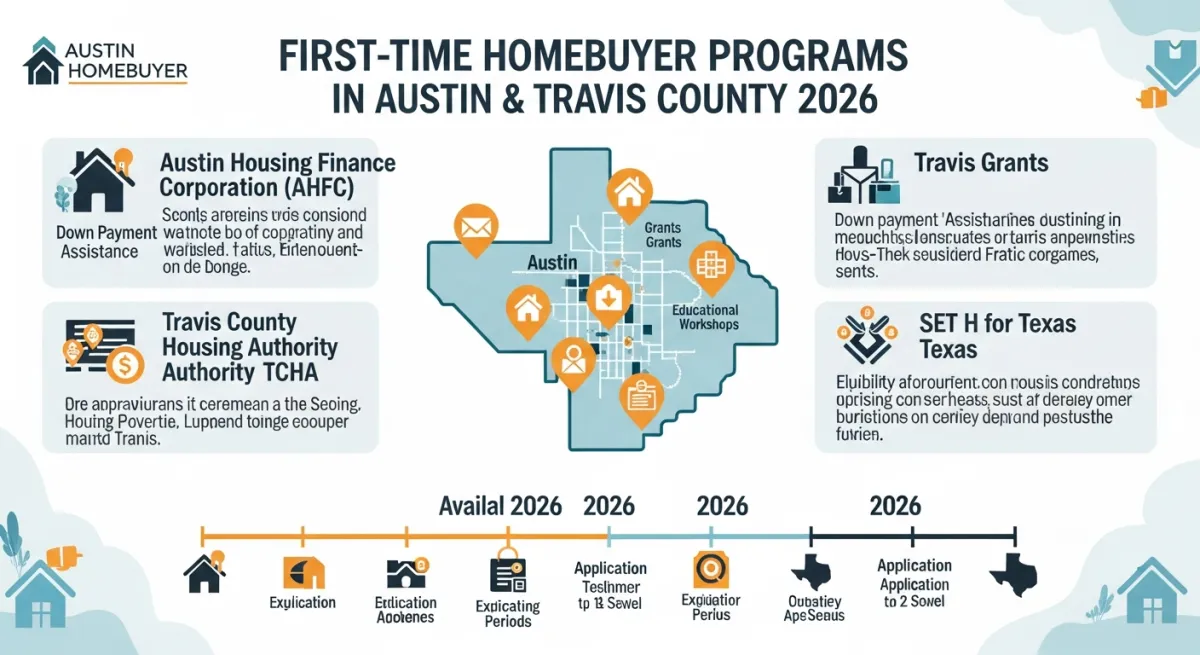
My First Texas Home is a state-level program administered by the Texas Department of Housing and Community Affairs. It packages two things: a 30-year fixed-rate mortgage at a below-market rate (TDHCA publishes rate sheets weekly — pull the current figure the week you file), and down payment and closing cost assistance of up to 5% of the loan amount, structured as a 0% interest deferred second lien. “Deferred” means no monthly payments on the assistance amount. The lien comes due when you sell the home, refinance, or pay off the first mortgage.
MFT runs on bond allocations replenished through TDHCA’s bond issuance cycle rather than annual appropriations. That makes it less prone to mid-year depletion than local programs, though volume spikes in spring and early summer can create reservation queues.
Key numbers for Travis County in 2026: ⚠️ Verify current figures directly with TDHCA before publishing.
- Income limit: Travis County falls in a higher-cost area. The MFT limit for a family of three or more has historically been set at or near the area median income for the region. [Confirm 2026 figure with TDHCA — limits adjust annually and vary by household size.]
- Purchase price limit: [Confirm 2026 acquisition cost limit with TDHCA — limits for non-targeted areas differ from targeted area limits.]
- Minimum credit score: 620 for most loan types.
- Assistance: Up to 5% of the loan amount in down payment and closing cost assistance, structured as a 0% deferred second lien.
- Loan types eligible: FHA, VA, USDA, and conventional (HFA Preferred).
Austin Housing Finance Corporation Homebuyer Assistance Program (AHFC HAP)
The Austin Housing Finance Corporation is a public instrumentality of the City of Austin, established in 1979. Its Homebuyer Assistance Program provides a forgivable loan — not a deferred lien — for qualifying buyers purchasing within city limits. The forgivable structure means the assistance converts to a grant if the buyer stays in the home for the required period, typically five to ten years depending on program terms. Leave or sell before that window closes, and a prorated portion must be repaid.
Critical timing note: AHFC HAP runs on annual allocation cycles and has exhausted its funds before the end of the fiscal year in recent years. Before taking any preparatory steps, call AHFC directly or check the program page at austintexas.gov/housing to confirm current funding status. Skipping this call has burned a lot of buyers. ⚠️
Key numbers for 2026: ⚠️ All figures require direct AHFC verification before publishing.
- Income limit: Set as a percentage of Austin’s Area Median Income, which HUD updates annually. Historically at or below 80% AMI for some tiers, with lower assistance amounts at higher income bands. [Confirm 2026 AMI and income band structure with AHFC.]
- Purchase price limit: [Confirm 2026 cap with AHFC — this figure has historically aligned with HUD fair market value standards for the area.]
- Assistance amount: [Confirm current assistance maximum with AHFC — figures have varied by program year and income tier.]
- Geographic restriction: The home must be within Austin city limits. A significant portion of Travis County — Del Valle, Manor, and unincorporated areas — falls outside AHFC’s coverage area.
- Minimum credit score: [Confirm with AHFC.]
- Structure: Forgivable loan with a retention period of five to ten years; prorated repayment if sold or refinanced before the retention period ends.
Travis County Housing Finance Corporation
The Travis County HFC operates separately from AHFC and covers the broader county. It’s the relevant option for buyers in unincorporated Travis County, Pflugerville, Manor, or other areas outside city limits. ⚠️ Travis County HFC program specifics, current funding status, and 2026 income and purchase price limits require direct verification with the Corporation before publishing. The organization has historically offered down payment assistance through bond-backed programs similar to TDHCA’s structure — deferred second liens at low or zero interest. In some program years, Travis County HFC assistance has been layered with MFT; in others, the programs run parallel through different lenders. Confirm the current program offering and lender list directly with Travis County HFC.
Quick-Reference Table
| Program | Administrator | Assistance Type | Max Assistance | Income Cap | Purchase Price Cap | Min Credit Score |
|---|---|---|---|---|---|---|
| My First Texas Home | TDHCA (state) | 0% deferred second lien | Up to 5% of loan | ⚠️ Verify 2026 | ⚠️ Verify 2026 | 620 |
| AHFC HAP | Austin Housing Finance Corp. (city) | Forgivable loan (5–10 yr) | ⚠️ Verify 2026 | ≤80% AMI (tiered) | ⚠️ Verify 2026 | ⚠️ Verify |
| Travis County HFC | Travis County HFC | Deferred second lien | ⚠️ Verify 2026 | ⚠️ Verify 2026 | ⚠️ Verify 2026 | ⚠️ Verify |
Worked Example: A $75K Household Buying a $390,000 Home in Montopolis
Montopolis — the working-class East Austin neighborhood east of 183 and south of the Colorado — has seen prices come off their 2022 highs enough that sub-$400,000 inventory turns up. That makes it a realistic setting for this exercise, not a hypothetical one.
The baseline without assistance:
On a $390,000 purchase using an FHA loan, the required down payment is 3.5%, or $13,650. Closing costs on an FHA loan in the Austin market typically run 2.5% to 3.5% of the loan amount — call it roughly $9,400 to $13,200 on a $376,350 base loan after the down payment. All in, the buyer is looking at bringing somewhere between $23,000 and $27,000 to closing before any assistance.
That’s a lot of money for a household earning $75,000 a year. Which is exactly the problem these programs exist to solve.
With TDHCA MFT assistance:
MFT provides up to 5% of the loan amount as a 0% deferred second lien. On a $376,350 FHA loan, 5% equals roughly $18,817. That covers the entire $13,650 FHA down payment and a meaningful chunk of closing costs, leaving the buyer responsible for approximately $4,000 to $8,000 depending on the transaction.
⚠️ Monthly payment figures require the current TDHCA MFT rate, pulled the week of filing. As of late 2024 through early 2025, 30-year FHA rates were in the 6.5%–7.25% range — confirm the current TDHCA MFT rate before completing this calculation. Travis County property taxes are a significant additional line item; confirm current effective rates before publishing a monthly payment estimate.
If the property is within Austin city limits and the buyer is income-eligible, AHFC forgivable assistance can reduce remaining out-of-pocket costs further. ⚠️ Current AHFC assistance amounts must be verified before these figures can be completed. The practical effect of layering the two programs is that buyers in this income range can approach closing with substantially less cash than the $20,000-plus required without assistance — but that depends on confirmed 2026 assistance amounts.
Now, the part worth dwelling on: the TDHCA second lien costs nothing monthly. No payment. But it doesn’t disappear. When you sell the home or refinance, the full assistance amount comes due. On the $18,817 used in this example, that’s real money. The equity you build reduces the practical impact over time, but it’s a real obligation — one that should factor into long-term financial planning rather than getting buried in the relief of reaching closing. Buyers researching their full cost picture, including how closing costs on an Austin home purchase layer on top of assistance programs, should account for both before running their final numbers.
Stacking Programs: Which Combinations Work and What Makes Them Complicated
You can combine TDHCA MFT with AHFC HAP. In some cases you can add a Federal Home Loan Bank of Dallas Affordable Housing Program grant on top. Whether you can do so in practice depends almost entirely on your lender.
TDHCA and AHFC maintain separate approved lender lists. Not every lender approved by TDHCA to originate MFT loans is also on AHFC’s approved list. If you need both programs — which in many cases you do, because combined assistance can cut out-of-pocket costs dramatically — you need a lender appearing on both lists at the same time. That’s a shorter list than most buyers expect, and it’s worth confirming directly with both agencies rather than taking a lender’s word for it.
⚠️ 2026 stacking policy must be confirmed with both TDHCA and AHFC — policies can change between program years.
There’s also a ceiling. Total assistance across all sources cannot produce cash back to the buyer at closing, and combined financing cannot exceed the program’s allowable loan-to-value ratio. Stacking is powerful, but it requires a lender who understands both programs’ rules and can structure the transaction so it clears both agencies’ compliance requirements at once.
Several major Austin-area employers — UT, Austin ISD, and some healthcare systems — have run employer-assisted housing programs in recent years. These are employer-specific and vary widely; worth a five-minute conversation with HR that most people never have. ⚠️ Verify which employer-assisted housing programs are currently active in 2026 before publishing. FHLB Dallas grants, distributed through member financial institutions, add another potential layer but require the originating lender to be an FHLB Dallas member with access to current grant funding.
The buyer who successfully combines MFT, AHFC, and an employer or FHLB layer is not common. But it happens. When it does, a down payment and closing cost burden of $20,000-plus can come down to a few thousand dollars. Getting there requires a lender with genuine experience in multi-layered transactions — not one who has heard of the programs but never closed one. That’s a reasonable question to ask any lender before you discuss rates: “Have you closed a transaction that layered MFT and AHFC HAP in the same deal?” The answer tells you most of what you need to know.
The Application Process, Step by Step
Order matters here. Steps taken out of sequence can disqualify a buyer from assistance or require starting over entirely.
Step 1: Complete a HUD-approved homebuyer education course.
Both TDHCA and AHFC require a certificate of completion from a HUD-approved counseling provider before a program application can be submitted — and the certificate must be in hand before pre-approval moves forward, not after. The certificate has a validity period, typically one to two years, so don’t complete the course too far ahead of your expected closing timeline.
Three Austin-area providers with current or recent HUD approval status: Frameworks (formerly Neighborhood Services of Austin, offers online and in-person formats), Austin Habitat for Humanity’s homebuyer education program, and AVANCE Austin. ⚠️ Verify current HUD approval status for each provider before publishing. The course covers budgeting, loan terms, the purchase process, and fair housing rights. It’s genuinely useful — not just a checkbox. Do not plan to double back and complete it later. You can’t.
Step 2: Confirm which programs are currently funded.
Before getting pre-approved anywhere, call AHFC and check TDHCA’s website to confirm which programs are accepting applications and have available funds. ⚠️ This is especially critical for AHFC HAP, which has closed mid-year in recent years. There’s no value in completing a counseling course and pursuing pre-approval for a program that has already exhausted its allocation. Twenty minutes on the phone now can save weeks of wasted effort later.
Step 3: Get pre-approved with a lender on the correct approved list.
Once you’ve confirmed which programs are active, find lenders approved by the relevant agencies for those specific programs. If you’re pursuing both MFT and AHFC HAP, you need a lender on both lists. Confirm this before completing a credit application. Pre-approval with the wrong lender means starting over — there are no exceptions.
Step 4: Submit the program application through your lender.
For MFT, the application is submitted by your lender on your behalf through TDHCA’s reservation system. AHFC HAP has its own review process, also handled through the lender. If you’re stacking programs, your lender should be managing both tracks simultaneously — and if they’re not, that’s a problem worth surfacing early.
Step 5: Close.
Program funds are reserved at loan approval and disbursed at closing.
Approved Lenders: Why the List Matters More Than You Think
Using the wrong lender doesn’t just mean you miss a rate deal. It means you cannot access the program at all, regardless of income, credit score, or purchase price. Both TDHCA and AHFC require that the originating lender appear on their respective approved lists at the time of application.
TDHCA’s approved lender list is publicly available on the TDHCA website and searchable by county. AHFC’s list is available through AHFC directly. ⚠️ Confirm 2026 lender lists with both agencies before publishing — approved lender lists change as lenders add or drop program participation. Ask any lender you’re considering two specific questions before you discuss rates or fees: “Are you currently on the TDHCA approved lender list for My First Texas Home?” and “Are you currently on the AHFC approved lender list for the Homebuyer Assistance Program?” A lender who hesitates or conflates the two lists is a yellow flag. In my experience covering this space, that hesitation comes up more than it should.
The Timing and Funding Reality
The most common waste of time among Austin first-time buyers pursuing assistance is spending weeks preparing for a program that has already closed for the year. AHFC HAP has exhausted its annual allocation by mid-year in active market conditions. A buyer who finishes their HUD counseling course in March, gets pre-approved in April, and calls in May to submit can find the door already shut.
The fix takes twenty minutes. Before anything else, contact AHFC and ask whether the Homebuyer Assistance Program is currently funded and accepting applications.
AHFC contact: Austin Housing Finance Corporation, reachable through the City of Austin Housing Department. Current program status is also tracked at austintexas.gov/housing. ⚠️ Confirm the current direct program contact and URL before publishing.
TDHCA: My First Texas Home program status and rate sheets are updated weekly at tdhca.state.tx.us. The program is generally more consistently funded than local programs due to its bond-backed structure, though spring and early summer volume can create reservation queues.
If AHFC is closed when you check, ask whether they anticipate a supplemental funding round before year-end. In some program years, mid-year allocations have reopened the program after an initial depletion. Not guaranteed — but worth asking directly rather than assuming the year is over.
Where in Travis County These Price Caps Actually Stretch
Program purchase price caps mean nothing without inventory to match — and for a few years, that was effectively the situation in Austin. Sub-$400,000 homes are currently appearing with some regularity in the Rundberg/North Lamar corridor in North Austin, Montopolis and the East Riverside corridor southeast of downtown, Dove Springs in Southeast Austin, and the Del Valle and east Manor Road corridor stretching toward the city’s eastern edge. These are working-class neighborhoods with existing owner-occupied housing stock. The post-2022 correction has brought some inventory back into the range these programs are designed to reach.
The Manor area — in Travis County but outside Austin city limits — also has relevant inventory. Buyers there would access TDHCA MFT and Travis County HFC programs but would not be eligible for AHFC HAP, which applies only to properties within Austin city limits.
Central Austin — Zilker, Travis Heights, Clarksville, Hyde Park, Mueller — is largely priced above where these programs can reach for standard purchases. Travis County also encompasses Austin city limits plus Manor, Lago Vista, Rollingwood, West Lake Hills, and unincorporated areas; program eligibility varies by jurisdiction for city-specific programs. Buda and Kyle in Hays County fall outside Travis County program coverage entirely, though TDHCA MFT operates statewide.
The geographic split worth keeping straight: AHFC HAP requires the property to be within Austin city limits. TDHCA MFT works anywhere in Texas. Travis County HFC covers unincorporated Travis County and participating municipalities. A buyer looking in Manor proper should not assume AHFC eligibility — confirm the property’s jurisdictional status before selecting programs to pursue. For broader context on how neighborhood-level prices are shifting across the metro, Austin home prices by ZIP code in 2026 tracks which areas are moving in and out of reach for buyers working within program caps.
⚠️ Cross-reference against Austin Board of Realtors June 2026 median price data by zip code before publishing — neighborhood-level inventory and price ranges shift, and the corridors identified here should be verified against current listing data.
Before You Call Anyone
The first-time homebuyer assistance available in Travis County in 2026 is real, and it’s available to a larger group of buyers than most assume. A household at $75,000 in annual income is not wealthy in Austin’s cost environment — and I think the broader conversation about Austin housing sometimes treats that income level as though it’s comfortably middle class when it simply isn’t anymore. Programs that can cut a $20,000-plus cash-to-close requirement down to a few thousand dollars are worth understanding in detail before you decide the market isn’t for you. For readers still weighing whether to buy at all, our moving & real estate coverage tracks the market conditions and financial trade-offs relevant to that decision.
These programs reward preparation and punish improvisation. A buyer who calls a random lender from a rate comparison website, skips the counseling certificate, and picks a neighborhood without checking geographic eligibility will either fail to access the programs or discover mid-transaction that they’ve been working with the wrong lender. Start by checking AHFC funding status. Complete the HUD counseling course. Find a lender on the right lists. Then find the house.
Verification checklist before publication: TDHCA 2026 income limits and purchase price caps by household size for Travis County; TDHCA MFT current note rate (pull week of filing); AHFC HAP 2026 funding status, current assistance amounts, income limits, and purchase price cap; Travis County HFC 2026 program details; TDHCA and AHFC approved lender lists; HUD approval status for Frameworks, Austin Habitat for Humanity, and AVANCE Austin counseling programs; Austin Board of Realtors June 2026 median price by neighborhood. Do not publish with unverified figures.