How to Break a Lease in Austin Without Paying More Than You Have To
Texas Property Code § 91.006 requires your landlord to actively try to re-rent your unit after you leave. Most Austin renters don't know it exists. That ignorance costs them thousands.

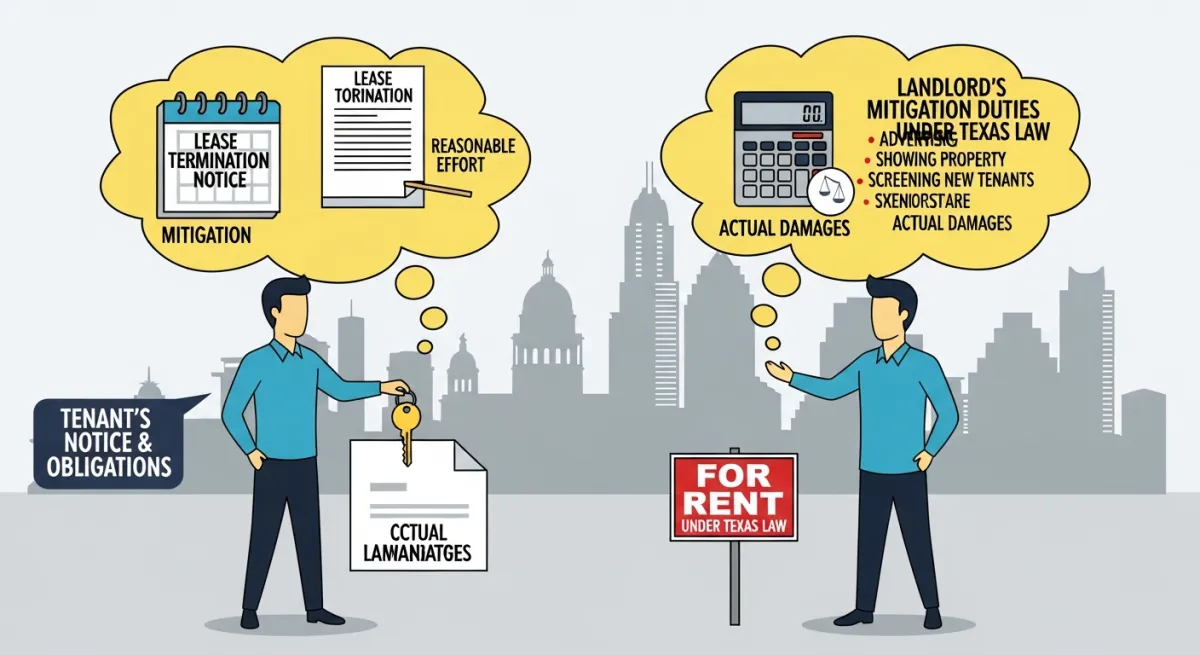
Texas Property Code § 91.006 requires your landlord to actively try to re-rent your unit after you leave. Most Austin renters don’t know it exists. That ignorance costs them thousands.
Breaking a lease in Austin can feel like stepping off a financial cliff. You’re staring down months of remaining rent, a landlord who’s suddenly hard to reach, and a lease document written to make you feel like you have no options.
What that document won’t tell you: under Texas law, your landlord cannot pocket your security deposit, stop marketing the apartment, and bill you for every month left on the contract. They have an active legal obligation to try to re-rent the unit. If they don’t, you may owe far less than they’re claiming. You might owe nothing at all.
This guide walks through that law, how to use it, and the specific steps Austin renters should take from the moment they decide to leave.
The Law Most Austin Renters Never See
Texas Property Code § 91.006 reads, in full:
(a) A landlord has a duty to mitigate damages if a tenant abandons the leased premises in violation of the lease. The landlord’s failure to mitigate damages may be raised by the tenant as a defense in an action against the tenant.
(b) A lease provision that purports to waive a right or to exempt a landlord from a liability or duty under this section is void.
Plain translation: your landlord cannot park your empty apartment and bill you for the remaining rent. They must make diligent efforts to find a new tenant. If they pull the listing, skip showing requests, or let the unit sit dark for two months while the clock runs, their damages claim against you shrinks accordingly. A court won’t award them rent for months they could reasonably have collected from someone else.
The second paragraph matters just as much. That clause you signed — the one that says something like “Tenant waives any right to require Landlord to mitigate damages upon early termination” — is void. Not voidable, not subject to negotiation: void. Texas law does not allow a landlord to contract around this duty, regardless of what the lease says. If their attorney drafted that language into the agreement, it has no legal force. Someone got paid to write something unenforceable, and you’ve probably been treating it as gospel.
Everything else in this article flows from § 91.006. Keep it in mind.
Note: CityDesk Austin is working to confirm that § 91.006 was not amended during the 88th Texas Legislative Session (2023). Readers should verify the current text at statutes.capitol.texas.gov before relying on it in any legal proceeding.
Read Your Lease Before You Do Anything Else
Before you make a single phone call, sit down with your lease. I know that sounds obvious. Do it anyway. You need to know two things: what your financial exposure looks like under your specific contract, and what procedural requirements you’re bound by. Not what your neighbor paid. Not what the internet says. Your lease.
A reletting fee compensates the landlord for the administrative and marketing cost of finding a new tenant. In Austin-area leases managed by large property management companies, it’s typically calculated as a percentage of one month’s rent. It’s owed regardless of how quickly the landlord re-rents the unit — it covers their effort, not their lost income.
An early termination fee (ETF) is a separate charge. Austin leases often call it a “lease termination fee” or “lease buyout fee.” It functions as a liquidated damages provision: pay a fixed amount, exit cleanly, no further claims for lost rent. Some leases stack both. A common structure in Austin’s larger apartment communities charges a reletting fee plus continued rent liability until a new tenant moves in. Under that structure, the ETF buyout option — if your lease has one — may actually be your cheapest exit. Run the numbers before you assume.
Greystar manages a substantial portion of Austin’s large apartment inventory, including properties across the Domain area and the South Congress corridor. Their standard lease addenda include early termination provisions, but specific fee amounts, notice requirements, and rent liability terms vary by property and haven’t been independently verified for this article. Read your specific addendum carefully. Some versions roll the reletting fee into the ETF; others treat them as additive — a distinction that can mean hundreds of dollars.
Roscoe Properties manages a significant portfolio of mid-size Austin properties in Hyde Park, South Lamar, Mueller, and the North Loop area. Their lease addenda also include early termination options, but specific terms vary by property. Roscoe is Austin-headquartered, and tenant advocates note the company is generally accessible for lease negotiation discussions, though individual outcomes vary.
If you’re not in a Greystar or Roscoe property, the principle holds: look for an addendum labeled “Early Termination,” “Lease Buyout,” or “Reletting Fee,” not just the main body of the lease. These provisions are often buried in multi-page addenda that tenants sign during a rushed move-in and never look at again.
Texas law requires only a 30-day minimum notice to terminate a month-to-month tenancy. Most fixed-term Austin leases require 60 days’ written notice for early termination. Some require notice by a specific date relative to month-end, not just 60 calendar days from whenever you notify. Missing that window by a few days can cost you an extra month’s rent. Check the exact language in the section titled something like “Notice of Termination” or “Early Lease Termination Procedures.”
The Five Situations Where You Can Walk Away Without Owing a Penalty
Several Texas statutes allow tenants to terminate a lease early without financial penalty, regardless of what the lease says. Each comes with specific documentation requirements, and none of them will protect you if you don’t follow procedure.
Under Texas Property Code § 92.056, if your landlord fails to make a repair that materially affects your health or safety after written notice and a reasonable time to repair, you may have the right to terminate and pursue other remedies. § 92.061 covers that termination right specifically. This is not a license to leave because your HVAC runs slow in August — courts take “materially affects health or safety” seriously. You need documentation: written repair requests dated and sent via email or certified mail, dated photographs, and any written responses or non-responses from the property manager.
Texas Property Code § 92.016 allows a tenant, or a household member, who is a victim of family violence, sexual assault, sexual abuse, stalking, or human trafficking to terminate a lease by giving written notice with supporting documentation. Acceptable documentation includes a protective order or magistrate’s order, a police report, a copy of a conviction, or a written statement from a licensed health care provider, family violence center advocate, sexual assault program advocate, or mental health services provider who assisted the victim. Termination is not optional for the landlord. The tenant is not liable for future rent after the termination date.
The federal Servicemembers Civil Relief Act (50 U.S.C. § 3955) allows an active-duty servicemember to terminate a lease early when receiving deployment orders to a location at least 35 miles away for 90 days or more, or permanent change-of-station orders. Deliver written notice with a copy of the orders. Termination takes effect 30 days after the next rental payment date following notice. Landlords cannot charge an early termination fee. No exceptions.
Job relocation without military orders, a breakup, purchasing a home, deciding you prefer a different neighborhood — none of these trigger statutory early termination rights. Renters who overestimate their position and stop paying rent without the required documentation put themselves at serious legal risk. An eviction judgment can follow you for years in Texas’s tenant screening databases. Use these provisions only when they genuinely apply.
How to Write Your Notice With Language That Actually Works
Your written notice is the most important document you’ll produce in this process. Courts, mediators, and landlords take written notice seriously in a way they simply don’t take texts. Doing this right costs you nothing. Doing it wrong can cost you a lot.
Your notice must include your full legal name as it appears on the lease, the full address including apartment number, the specific date you intend to vacate, and your reason for terminating. If you’re claiming a statutory right, cite the code section.
The element most Austin renters omit is an explicit invocation of your landlord’s duty under § 91.006. Here is ready-to-adapt draft language:
“Pursuant to Texas Property Code § 91.006, I hereby notify you of your legal duty to make diligent efforts to re-let the above-referenced dwelling unit following my vacating on [DATE]. I am prepared to cooperate with reasonable showing requests and will ensure the unit is accessible during the notice period. Please be advised that any failure to make diligent efforts to re-let the unit may substantially reduce or eliminate any damages claim against me for rent accruing after my vacate date. I request written confirmation of your re-marketing efforts, including any listing placements, showing activity, and applications received.”
Note: This language is provided as a starting point only and has not been reviewed by a licensed Texas attorney. Have an attorney review your notice before sending if at all possible.
Send this notice two ways. Certified mail with return receipt requested to the landlord’s address of record in your lease — not a maintenance portal, but the address in the lease. Then hand-deliver a copy to the leasing office and ask for written acknowledgment, either a signature on your copy or a confirmation email. Keep copies of everything: the letter, the certified mail receipt, and the green return card when it comes back. Keep that green card permanently. It’s a small piece of paper that can be worth real money.
If this ends up in Travis County Justice of the Peace court, the judge will ask whether you gave proper notice and whether you demanded mitigation in writing. The paper trail you build now is your defense.
How Austin’s Rental Market Affects Your Leverage Right Now
Austin’s rental market has softened considerably since the pandemic-era frenzy — and if you were apartment-hunting in 2021 or early 2022, you remember exactly how brutal it was. Vacancy rates across the metro have climbed as a wave of new multifamily supply came online faster than demand could absorb it. Most of that supply landed in the Domain area, the East Riverside corridor, and newer high-rise developments in East Austin. As we’ve noted in our moving and real estate coverage, that supply wave has meaningfully shifted leverage between landlords and tenants across much of the city.
That matters for your § 91.006 argument. If comparable units in your building have been sitting vacant for 60 or 90 days, and your landlord claims they couldn’t find a replacement tenant, a Travis County JP court will scrutinize that. High local vacancy doesn’t automatically defeat the landlord’s claim, but it gives you — or a tenant’s attorney — concrete questions to ask.
Hyde Park, Zilker, and South Congress are different. Inventory in those neighborhoods stays relatively tight, especially for smaller units. A landlord who lists quickly and prices correctly can argue they re-rented fast, which undercuts your failure-to-mitigate position. It’s not fatal, but you’ll need more documentation, not less.
The Domain area, East Riverside from I-35 to 183, and the newer East Austin high-rises are a different story. A tenant breaking a lease in a two-bedroom Domain complex in 2025 has meaningfully better leverage than someone leaving a unit on South Congress. Geography matters here more than most renters realize.
One more variable worth thinking through if you have any flexibility: Austin’s leasing cycle peaks between March and August, driven by UT’s academic calendar and corporate relocation patterns. If you vacate between October and January, you’re leaving during the quietest stretch of the year. Landlords will have a harder time demonstrating diligent re-rental efforts during those months. That’s harder on you personally, but easier to defend.
How to Contact the Austin Tenants Council
The Austin Tenants Council (ATC) is the first call most Austin renters should make before they sign, send, or agree to anything. ATC is a nonprofit tenant advocacy organization — not a city agency, not a legal services firm. They won’t appear in court with you. What they provide is free counseling from staff who understand Austin’s rental market, Texas landlord-tenant law, and the practical reality of what landlords in this city actually do. That combination is genuinely uncommon.
Their free services include lease review and explanation of specific clause language (including ETF addenda and mitigation provisions), guidance on termination notices and demand letters, habitability complaint advice, fair housing guidance, and referrals to pro bono and reduced-fee attorneys in Travis County. ATC’s main intake line is (512) 474-1961. Their office has historically been located at 1640 E. 2nd Street, Austin, TX 78702, but call ahead — the address and hours have shifted in recent years. Walk-in availability varies. Calling first will save you a trip.
Ask specifically for the Tenants’ Rights Handbook. It’s the kind of document you’ll wish you’d read before signing.
If your situation has progressed to the point where you’re facing a lawsuit, a JP court case, or a landlord who’s sent a claim to collections, you need a licensed attorney. Lone Star Legal Aid at (512) 477-6000 provides free civil legal services to income-qualified Travis County residents, including landlord-tenant cases. Texas RioGrande Legal Aid at (512) 374-2700 covers Austin and Travis County; intake is available by phone. Both screen for income eligibility. Contact them before your court date — not the morning of.
Note: Phone numbers for all three organizations are flagged for pre-publication verification. Call to confirm current intake numbers and hours before relying on them.
If It Goes to Court in Travis County
Residential lease disputes in Travis County — including landlord suits for unpaid rent after early termination — are heard in Justice of the Peace courts. Travis County has five JP precincts; your case will be assigned based on the property address. Small-claims filing fees typically run between approximately $46 and $100 depending on the amount in controversy and the precinct. Confirm current fee schedules directly with the relevant JP court before filing.
One thing most tenants miss, and it’s expensive: § 91.006 does not apply automatically in court. You must affirmatively raise failure to mitigate as a defense. Walk into JP court and simply say “I had to leave,” and the judge is not required to ask whether the landlord made diligent re-rental efforts. You raise it, and you bring documentation to support it.
Bring: your written notice with proof of delivery, your lease and all addenda, any communications with the landlord about re-rental efforts, screenshots of listing activity (or the absence of it), and documentation showing the unit was not re-rented promptly. If you’re countersuing for an unreturned security deposit — common when lease disputes escalate — bring documentation of the deposit amount, any itemized deduction list, and receipts for repairs or cleaning you did before move-out.
This section is informational, not legal advice. Anyone preparing for Travis County JP court on a landlord-tenant matter should contact Lone Star Legal Aid or Texas RioGrande Legal Aid before their hearing date.
Your Step-by-Step Action Checklist
For the reader in mid-crisis who needs to know what to do Monday morning.
Monday or Tuesday: Pull and read. Get your lease and every addendum. Find the early termination fee, reletting fee, and notice period clauses. Know the difference between what you’ll owe under the ETF buyout versus open-ended rent liability. Write down the required notice period and the delivery method the lease specifies. Do this before you talk to anyone — including your landlord.
By end of week: Call ATC. Contact the Austin Tenants Council at (512) 474-1961. Ask for a lease review. Tell them your situation and ask specifically about ETF language, your § 91.006 rights, and what to include in your notice. This call is free. Don’t skip it.
Following week: Write and send notice. Use the draft language above and customize it for your situation. Include your legal name, unit address, specific vacate date, reason for terminating, and the § 91.006 mitigation demand. Do not send a text. Do not email a maintenance portal. Send a formal written letter — printed, signed, three copies.
Same day: Deliver it properly. Take one copy to the leasing office and ask for written acknowledgment of hand delivery. Take a second copy to the post office and send it certified mail with return receipt requested to the landlord’s address of record in your lease. Keep the certified mail receipt. When the green card comes back, keep it permanently.
From now on: Document everything. Log every text, email, and call. Date and time, who you talked to, what was said. Create a folder — physical or digital — and put every piece of paper and every screenshot in it. You won’t regret having this. You will regret not having it.
Ongoing: Monitor listing activity. Starting the day after you send notice, check your property’s listing on Apartments.com, Zillow, and the property’s own website regularly. Screenshot listings with the date visible. The platforms show when listings were posted. If your unit never appears, screenshot the blank search result too. Landlords sometimes list units quietly or pull them strategically. You need to know which happened.
If you receive a demand letter or court notice. Don’t panic, don’t ignore it, and don’t pay it immediately without getting advice first. Contact Lone Star Legal Aid at (512) 477-6000 or Texas RioGrande Legal Aid at (512) 374-2700 the day you receive it.
Breaking a lease in Austin isn’t consequence-free. But the gap between what renters believe they owe and what they actually owe is real money — often thousands of dollars — leaving people’s pockets unnecessarily. Texas law gives tenants genuine leverage through the duty to mitigate. Austin has real resources to help use it. The renter who walks away owing two months’ rent instead of eight got there through documentation, timing, and knowing which statute to cite. None of that is complicated. It just requires knowing where to look.
CityDesk Austin does not provide legal advice. Readers facing active legal disputes should contact a licensed Texas attorney, Lone Star Legal Aid at (512) 477-6000, or Texas RioGrande Legal Aid at (512) 374-2700.