Best Austin Suburbs for Remote Workers Kyle Pflugerville Leander
We ran the numbers on broadband infrastructure, co-working access, housing costs, and commute options. Here's where each city wins, where it falls short, and which one fits your actual work situation.

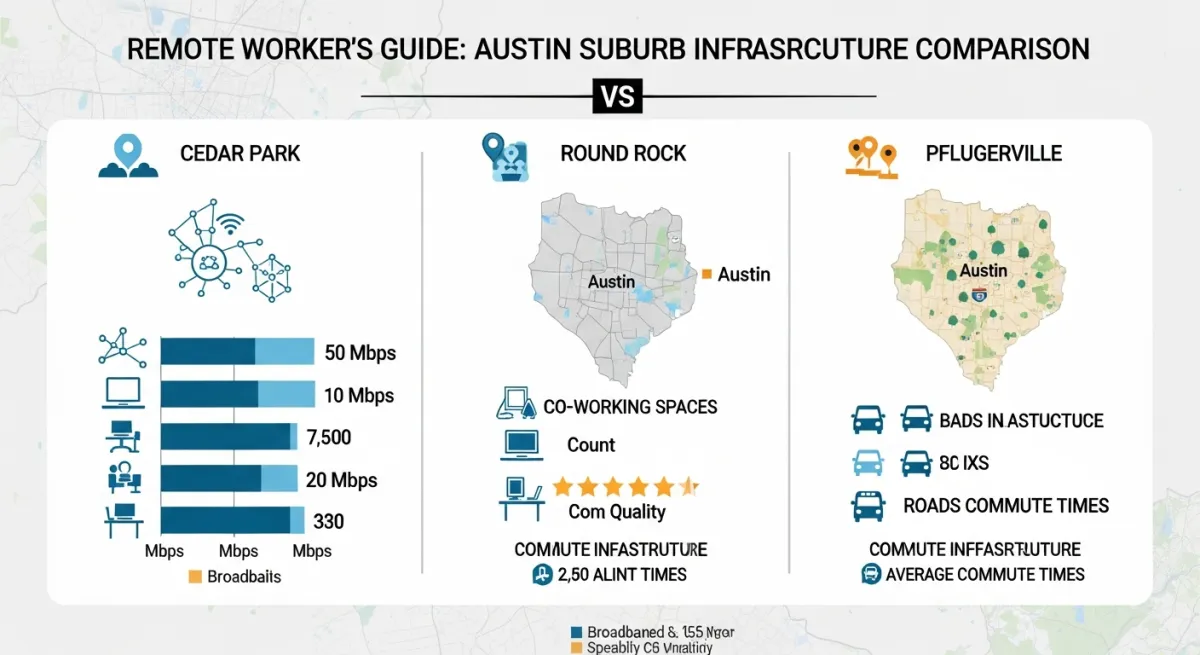
We ran the numbers on broadband infrastructure, co-working access, housing costs, and commute options. Here’s where each city wins, where it falls short, and which one fits your actual work situation.
How We Scored This (and What We Left Out)
This is not a lifestyle ranking. We’re not comparing taco restaurants, trail systems, or school district ratings. This piece evaluates three Austin suburbs on four criteria that directly affect the workday of someone who earns a living remotely: broadband infrastructure, co-working space availability, housing cost, and commute optionality for the days you do have to show up somewhere in person.
The cities are Kyle, Pflugerville, and Leander. All three are growing fast, all three are HOA-heavy and car-dependent by design — which levels the playing field on the soft factors that often inflate suburban rankings in other publications — and all three have become genuine landing spots for remote workers priced out of Austin proper or simply done with the density.
What follows is a functional evaluation. If your job depends on upload speeds, uninterrupted video calls, and a commute that doesn’t cost you two hours of productive time three times a week, this is written for you.
One note on sourcing: broadband availability data is drawn from the FCC National Broadband Map at the census-block level for each city’s primary ZIP codes. Housing figures are sourced from ACTRIS MLS and Redfin as of June 2026. Drive times are verified against Google Maps for a Tuesday 8am weekday departure. All figures carry this publication date. Check them again before you sign anything.
Broadband Infrastructure — Who Can Actually Support a Workday
For remote workers, internet service is infrastructure in the same way a commercial landlord thinks about electrical capacity. Download speed gets the headlines. Symmetrical gigabit upload is what actually determines whether your 9am Zoom call with fifteen people drops frames or holds steady.
Large file transfers, cloud backups running in the background, video uploads — these demand upload bandwidth in ways that a household streaming Netflix never would. That’s the lens here.
Kyle (ZIPs 78640, 78666)
Kyle’s primary fiber option is AT&T Fiber, available across portions of the city. That word “portions” is doing real work in that sentence. Coverage is subdivision-specific, not citywide. Newer developments like Plum Creek, Anthem, and Post Oak have better fiber penetration. Subdivisions on the southwestern edge, particularly those built in the last 18 to 24 months, may still be waiting on infrastructure buildout.
Spectrum cable is the widespread fallback. Advertised download speeds handle most remote work, but the asymmetric upload will frustrate heavy uploaders and frequent video collaborators. That’s not a knock on Spectrum specifically — it’s just how cable architecture works.
The honest picture: fiber exists in Kyle, but you can’t assume it covers your specific address. The FCC National Broadband Map, searchable by address, is the only reliable verification. Do not trust the city’s marketing materials or a real estate agent’s reassurance. No municipal broadband exists in Kyle, and none is in the near-term pipeline.
Pflugerville (ZIPs 78660, 78664)
This is where the broadband story gets interesting. Google Fiber has been expanding into parts of Pflugerville. If that expansion has reached your specific address, it’s a genuine category differentiator — symmetrical gigabit service designed for exactly the use case remote workers describe. I’d put it near the top of the checklist if you’re seriously looking at this city.
AT&T Fiber is also present in portions of Pflugerville, and Spectrum cable covers broader geography. Same caveat as Kyle: Google Fiber availability is not citywide. The FCC broadband map for ZIPs 78660 and 78664 will show current reported coverage, but fiber-to-the-home availability changes as builds complete.
A property two streets from a Google Fiber-served block may be on a cable plan for another two years. Verify at your specific address. If Google Fiber does serve your Pflugerville address, that’s the strongest residential broadband position available in any of these three cities.
Leander (ZIPs 78641, 78645)
Leander’s broadband situation is in active transition. AT&T Fiber has been extending its buildout through the city — the Hero Way corridor and adjacent developments are among the areas seeing the most recent expansion. Eastern portions of Leander, closer to US-183A and the MetroRail station, generally have better coverage than the city’s western edge.
Some addresses fall into Pedernales Electric Cooperative territory, where fiber infrastructure has lagged. Spectrum cable is the prevalent alternative where fiber hasn’t arrived.
The western coverage gap is real enough to warrant a specific check before purchasing. If you’re considering a home on the far western edge of the city, run the FCC map, confirm your utility provider (Oncor vs. PEC), and factor PEC’s historical outage frequency into your uptime calculations. PEC has made infrastructure investments in recent years, but its reliability record in severe weather remains a meaningful variable for anyone running a home office. If you were anywhere near Austin during Winter Storm Uri, you already know how that math works.
Co-Working Space — The Honest Map
The co-working inventory across these three cities is thin. Kyle has the local option. Pflugerville and Leander both point you outward. That’s the summary — the details below explain how workable each situation actually is.
Kyle
Cowork Kyle is the city’s primary dedicated co-working facility, located in the downtown area, with day passes and membership tiers. Confirm current day-pass rates directly with the space before visiting; pricing in the Austin-area co-working market has been in flux.
It’s a small operation relative to what you’d find in Austin proper. This matters on days when you need a private call room or a guaranteed quiet desk. Beyond Cowork Kyle, the Kyle Public Library on Center Street functions as a free fallback with Wi-Fi and work-friendly seating.
Kyle doesn’t have a large co-working infrastructure, and it doesn’t pretend to. If you’re fully remote and using co-working space two or three times a month for a change of scenery, Cowork Kyle handles that. If you’re planning to use co-working as a daily office substitute, the inventory will feel limiting quickly.
Pflugerville
There’s no established multi-desk co-working facility operating in Pflugerville that this publication can confirm as of June 2026.
The practical nearest option is The Yard in Round Rock, roughly ten minutes north, which offers day passes and dedicated desks in a well-maintained environment. Historically it has run in the $25–$35 range for drop-in access; confirm current pricing directly.
The absence of local co-working in Pflugerville is a genuine gap. For a hybrid remote worker who occasionally needs a professional environment outside the home, Round Rock is workable. It does add a commute leg running in the opposite direction from Austin, which is mildly annoying in practice but not a dealbreaker unless you’re making the trip frequently.
Leander
Dedicated co-working near Leander’s MetroRail station or along the East Market Street corridor is sparse. Cedar Park, immediately adjacent to Leander and functionally continuous with the city’s eastern edge, has co-working options that serve as the realistic local alternative. Confirm current availability and pricing with Cedar Park operators directly.
The more common pattern among Leander remote workers who occasionally need professional space isn’t geographic at all — it’s behavioral. They board the MetroRail Red Line at Leander Station and ride into Austin, where co-working inventory is dense. If you live within reasonable distance of the station, this is actually a functional strategy, and a more interesting one than it might sound. More on that in the commute section.
The Data Table
All figures as of June 2026. Verify current data at the sources cited before making decisions.
| Criterion | Kyle | Pflugerville | Leander |
|---|---|---|---|
| Primary broadband providers | AT&T Fiber (partial), Spectrum | Google Fiber (partial), AT&T Fiber (partial), Spectrum | AT&T Fiber (partial), Spectrum |
| Confirmed fiber availability | Subdivision-specific; verify at FCC map | Subdivision-specific; verify at FCC map | Subdivision-specific; western edge gaps |
| Local co-working options | 1 (Cowork Kyle); library fallback | 0 confirmed locally; The Yard in Round Rock (~10 min) | 0 confirmed locally; Cedar Park adjacent |
| Co-working day-pass range | Verify with Cowork Kyle | ~$25–35 at The Yard, Round Rock | Verify with Cedar Park operators |
| Median home sale price (June 2026) | ~$310,000–$340,000 | ~$360,000–$395,000 | ~$390,000–$430,000 |
| Median 2BR asking rent (June 2026) | ~$1,450–$1,650 | ~$1,500–$1,750 | ~$1,550–$1,800 |
| Peak drive time to 6th & Congress (Tue 8am) | 50–75 minutes | 30–45 minutes | 40–60 minutes |
| Rail/transit to downtown Austin | No | No | Yes — MetroRail Red Line |
Sources: ACTRIS MLS, Redfin, FCC National Broadband Map, Google Maps (Tuesday 8am benchmark). Housing figures represent reported medians and asking ranges; individual properties will vary. Verify all figures at time of search.
Housing Costs — What the Market Actually Looks Like Right Now
Kyle carries the lowest median home price of the three cities, in the $310,000–$340,000 range as of June 2026. That spread represents roughly $80,000–$90,000 below Pflugerville and Leander at the median. Not trivial — that’s real money, and on a 30-year mortgage at current rates it shows up every month.
Kyle has absorbed an enormous volume of new construction over the past several years, with builder inventory and apartment pipeline both running high. That supply pressure has kept prices lower and produced a concession-heavy rental market. Landlords in newer Kyle developments are offering free months, reduced deposits, and upgraded unit features to attract tenants. Median two-bedroom asking rents are landing in the $1,450–$1,650 range, the lowest of the three cities.
Buyers should think about this clearly though: a high-inventory market can mean slower appreciation in the near term. Many of Kyle’s outer subdivisions are still establishing their character — some of them, honestly, still have that fresh-asphalt, where-did-the-cedar-go feeling that you either make peace with or you don’t. Month three is usually when people figure out which camp they’re in.
Pflugerville sits in Travis County rather than Hays County, a placement that has historically contributed to its price premium over Kyle. Proximity to major employers along the SH-130 corridor and generally more established neighborhood infrastructure both support a higher floor. Median home prices run in the $360,000–$395,000 range, with two-bedroom rents in the $1,500–$1,750 range.
The county line matters primarily in property tax calculations. Hays County and Travis County have meaningfully different rates, and that difference compounds over years of ownership. A lower purchase price doesn’t always mean a lower monthly number. Run the full carrying cost. For a deeper look at how those tax bills are built, our moving & real estate coverage tracks the mechanics behind Austin-area ownership costs.
Leander’s pricing reflects a specific premium that buyers should understand rather than dismiss as simply expensive: proximity to the MetroRail station drives measurable price differentiation. Homes within roughly a half-mile of Leander Station command more than comparable properties on the city’s western edge. Buyers who want the commute optionality the rail line provides should target that radius and budget accordingly.
Overall, Leander median home prices run in the $390,000–$430,000 range, with two-bedroom rents between $1,550 and $1,800. The premium over Kyle is real. Whether it’s justified depends entirely on how much the MetroRail option, the established feel of the US-183A corridor, and Cedar Park adjacency are worth to you functionally — not as a vibe, but as a practical daily-life calculation.
Commute Options — Drive Times, Toll Costs, and the One Rail Line
The benchmark here is a Tuesday morning drive departing for downtown Austin — specifically 6th Street and Congress Avenue — at 8am. Tuesday was selected deliberately: it represents a standard peak-weekday commute without the anomalies of Monday or Friday hybrid-work patterns. All times are verified against Google Maps at that time and day.
Kyle’s commute to downtown Austin is the worst of the three. The I-35 corridor south of Austin has been a documented bottleneck for years — if you’ve sat at Slaughter Lane at 8:15am, you already know. From central Kyle, expect 50 to 75 minutes on a typical Tuesday morning. The upper end of that range is normal congestion, not an unusual incident.
The toll alternative: SH-45 connects to MoPac (Loop 1), bypassing the worst I-35 segments. One-way toll cost runs roughly $3–$5 using a TxTag. The time savings are real on bad I-35 days, but the route adds congestion where it meets MoPac near Parmer — you’re not escaping the backup so much as moving it. Kyle remote workers who commute to Austin twice a week should budget this as a recurring line item. It accumulates. There’s no rail option from Kyle.
Pflugerville offers the fastest car commute of the three cities. SH-130 runs north-south east of the I-35 corridor, connecting to US-183 for a path into central Austin that largely bypasses the I-35 grind. A Tuesday 8am departure from Pflugerville typically lands in the 30–45 minute range — a substantial improvement over Kyle. Budget roughly $2–$4 one-way in tolls via TxTag; the precise figure depends on which SH-130 segments you access. For a hybrid worker making that trip twice a week, the monthly toll cost is manageable but not invisible. No passenger rail from Pflugerville.
By car, Leander falls between Kyle and Pflugerville — running 40–60 minutes on the Tuesday 8am benchmark via US-183A south. Tolls are in a similar range to the Pflugerville routing. But the car commute is not really Leander’s story.
The MetroRail Red Line terminates at Leander Station, making it the only city in this comparison with a car-free path into Austin. The ride to downtown takes 55–65 minutes and costs around $3.50 one-way. I’d take 60 minutes on a train over 50 minutes on I-35 without much hesitation — you can actually work on the train, which makes the time accounting look different.
The schedule is oriented toward peak weekday commuters: trains run roughly every 30 minutes during peak windows, no weekend service. Morning in, afternoon back — that’s the pattern. The rail option doesn’t work for a midday errand or a late evening return. Worth knowing before you build your whole week around it.
One hard operational constraint: the Leander Station parking lot fills by approximately 7:30am on peak weekday mornings. Arrive after that and you’re circling for street parking or rerouting. This catches a lot of new Leander residents off guard the first time. It’s a real scheduling constraint, not a minor inconvenience. Workers who live within biking or walking distance of the station avoid it entirely. Everyone else needs to leave early.
Where Each City Wins
Profile 1: Fully remote, rarely goes downtown, prioritizes low housing costs
Kyle is the answer, with conditions. The median purchase price and rental market represent the best value in this comparison. If you’re genuinely working from home five days a week with minimal reason to enter Austin, the commute disadvantage is irrelevant.
The conditions: fiber must be confirmed at your specific address before you commit — not assumed based on the neighborhood or the city’s general coverage. You should also be clear-eyed that local co-working is thin, and that downtown Kyle’s amenity base, while growing, is not yet a substitute for urban density. Kyle is the right call if you’ve done the infrastructure homework and can live comfortably in a suburb that doesn’t pretend to be something it isn’t yet. Some people are genuinely fine with that. Some people figure out they’re not after month three.
Profile 2: Hybrid remote, drives into Austin one to three days a week, needs reliable gigabit internet
Pflugerville is the strongest fit on two grounds. The commute time advantage over Kyle is significant enough to matter week in and week out: 30–45 minutes versus 50–75 is not a rounding error when you’re making that trip 100 times a year. Do the math on cumulative hours.
If Google Fiber serves your specific Pflugerville address, you have access to the best residential broadband product available in any of these three cities. Local co-working is essentially nonexistent, so factor Round Rock’s The Yard into your routine. The housing premium over Kyle is real. But for a hybrid worker whose job depends on fast symmetrical internet and a manageable commute, Pflugerville is hard to beat when the pieces align at the address level.
Profile 3: Wants occasional car-free commuting or plans to use Austin co-working spaces on office days
Leander is the only city here with a feature none of the others can replicate: a train that goes downtown. For a remote worker who wants to board at Leander Station, work during the ride, and arrive at a downtown co-working space without touching a steering wheel, that has real operational value.
Buyers should actively target addresses near Leander Station rather than assuming any Leander address provides convenient rail access. The western edge of the city is a long drive from the station and falls into coverage gaps on both broadband and transit. Get close to the station, confirm fiber at your address, and Leander is a workable and genuinely distinctive option. The trade-offs are the highest housing costs of the three cities and a rail schedule that constrains when you can use it. Go in knowing both. If you want to stress-test whether that price premium actually pencils out versus renting, the rent-vs-buy math for Austin in 2026 is worth running before you commit.
What to Verify Before You Sign Anything
Run your address on the FCC National Broadband Map. Go to broadbandmap.fcc.gov, enter the specific property address, and look at what providers report serving that census block. The provider’s own website is not sufficient — reported coverage and actual serviceability at your address don’t always match. This takes five minutes and can save you months of frustration.
Call the co-working space and confirm it’s still operating. Co-working operators in suburban markets have had high turnover since 2022. Before budgeting a day-pass routine into your work life, verify that Cowork Kyle, The Yard in Round Rock, or your Cedar Park alternative is currently open, what the current day rate is, and whether drop-in access requires a reservation.
Pull a Tuesday 8am drive time from your specific address, not the city center. Where you live within these cities varies significantly. A Kyle address near I-35 drives differently than one near the county’s western edge. Use your actual origin in Google Maps, set departure to 8am Tuesday, and look at the range — not just the best-case estimate.
Check your HOA CC&Rs if you’re running a business from home. All three cities are HOA-heavy. Some agreements in these markets include restrictions on client visits, business vehicle parking, or signage — restrictions that matter if you’re running a client-facing operation from a home address. Read the CC&Rs before you’re bound by them. That particular surprise is unpleasant to discover after closing. If you want a fuller picture of what HOA fees across Austin communities actually look like — and what you get for them — that comparison covers the range in detail.
Confirm your utility provider if you’re looking at western Leander. Addresses there may fall in Pedernales Electric Cooperative territory rather than Oncor. PEC’s outage history in severe weather is part of the public record and a real uptime variable for a home office. PEC has invested in grid improvements, but it is not an equivalent product to Oncor service for everyone. Find out before you buy.
Watch the Leander East Market Street revitalization timeline. The city’s investment in that corridor is ongoing as of mid-2026, with commercial development and mixed-use projects in various stages of permitting and construction. If walkable amenities near the MetroRail station factor into your decision, that picture could look meaningfully different in the 2026–2027 window. Check the City of Leander’s development portal for current project status before assuming the current sparse inventory is permanent.
All housing data sourced from ACTRIS MLS and Redfin, June 2026. Broadband availability data drawn from the FCC National Broadband Map. Drive times verified via Google Maps, Tuesday 8am departure. Co-working details verified as of publication date; contact operators directly for current pricing and availability. CityDesk Austin updates market comparisons when data materially changes — check the publication date on any version you’re reading.