How Austin's Mueller Neighborhood Holds Up as a Place to Actually Live in 2026
There's a townhome on the northern edge of Aldrich Street that's been sitting on the market for 61 days. The listing copy calls the neighborhood "a walkable community with strong amenities." What i…

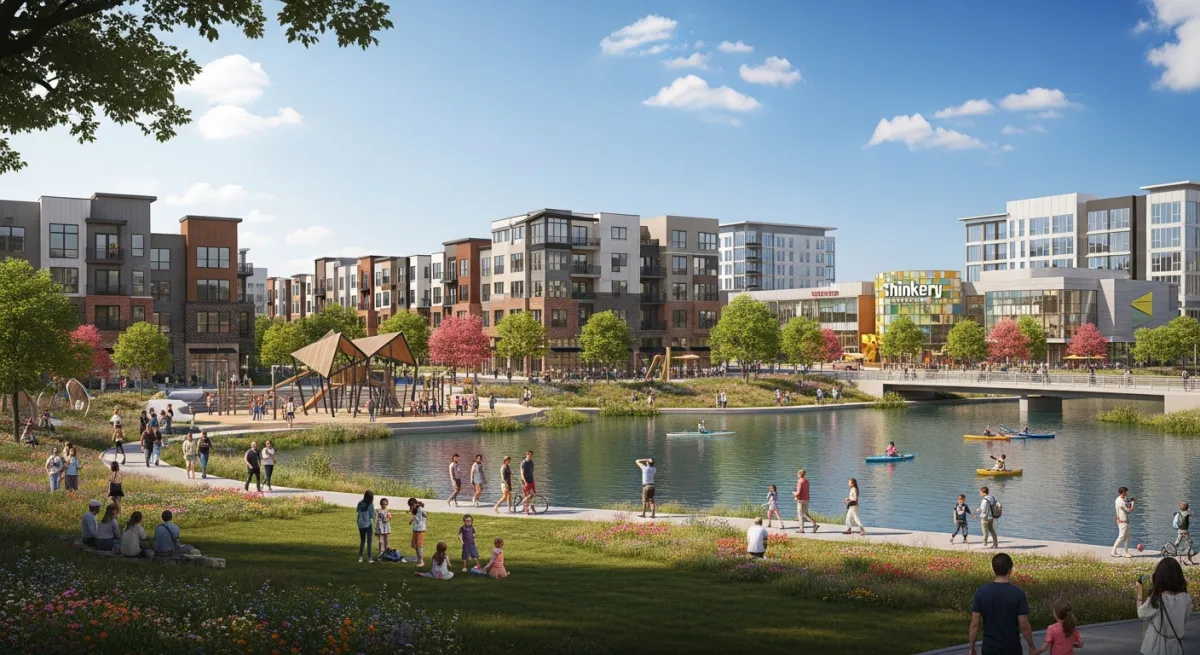
There’s a townhome on the northern edge of Aldrich Street that’s been sitting on the market for 61 days. The listing copy calls the neighborhood “a walkable community with strong amenities.” What it doesn’t mention: the unit backs toward Airport Boulevard. The building’s condo association levies a separate monthly fee on top of the Mueller Community Association charge. The Alamo Drafthouse’s Saturday-night crowd parks on the residential streets within a two-block radius. The seller has already cut the price once.
That gap between the marketing language and the lived experience is what this piece is actually about.
Mueller is a legitimate urbanist achievement — and I say that as someone who’s watched Austin produce plenty of master-planned neighborhoods that promised walkability and delivered strip malls with nice landscaping. Built on the roughly 700-acre site of the old Robert Mueller Municipal Airport, the neighborhood has moved well into a buildout that began around 2007, managed by Catellus Development Corporation under a development agreement with the City. Mixed-income housing. A 30-acre lake park. A commercial spine. A design framework that genuinely favors pedestrians over cars in ways that are unusual for Austin. It’s also a real place where real people pay real HOA bills, face real parking constraints, and sometimes lie awake listening to trucks on SH-183.
Four questions, answered directly: What does living here actually cost when you add up all the fees? Is parking workable? How much does the highway noise matter, and on which blocks? And what does the resale market look like right now?
HOA Fees: The Real Monthly Number, Line by Line
The Mueller Community Association collects fees from every residential property in the neighborhood — single-family, townhome, and condo units, each assessed at different rates. The MCA fee covers lake park maintenance and programming, trail upkeep, common area landscaping, architectural review administration, and the community events budget that funds the weekend farmers market and seasonal programming at the park pavilion.
Before making any purchase decision, confirm current figures directly with the Mueller Community Association at muelleraustin.com. Listing fields on third-party real estate sites frequently carry outdated or incomplete HOA fee data. That sounds obvious. I’ve talked to enough frustrated Mueller buyers to know it isn’t obvious enough.
Here’s the catch that trips up condo buyers specifically: there’s a two-layer fee structure. The MCA fee applies to every unit in the neighborhood, but above that sits a separate building-level condominium association fee that varies by complex. In buildings along Aldrich Street and in some East Mueller blocks, that building fee adds a substantial additional monthly charge depending on the building’s amenity package, elevator maintenance obligations, reserve fund status, and insurance allocation. The combined monthly association cost for a condo buyer in Mueller is materially higher than what any single line in a listing suggests. Request both fee schedules before calculating your carrying cost.
Residents have genuinely mixed feelings about the structure, and that tracks. Park maintenance draws consistent praise in resident forums. The architectural review process is a recurring irritant — some homeowners report extended waits for approval on modifications they describe as straightforward. The pattern is pretty consistent: residents who use the park frequently regard the fee as fair value; residents who don’t find it harder to justify. That’s not a knock on the MCA. It’s just worth knowing which kind of resident you’re going to be before you sign.
One underappreciated feature of the original development agreement: commercial properties in Mueller also pay MCA assessments, structured separately from residential fees. That commercial contribution moderates residential HOA costs as commercial buildout completes — the intent being that residential owners wouldn’t bear the full cost of common area maintenance. If you’re the kind of person who reads development agreements, it’s a clever piece of financial engineering. If you’re not, the short version is: your residential fees are lower than they would otherwise be, and that gap narrows slightly as Catellus finishes the commercial side.
For a broader look at how HOA costs stack up across Austin’s master-planned communities, our moving & real estate coverage tracks neighborhoods across the metro where these fee structures play a significant role in total cost of ownership.
What HOA Governance Actually Looks Like Day-to-Day
Architectural review decisions — fence heights, exterior paint colors, landscaping modifications, accessory structure placement — go through a formal online submittal system. The review committee is made up of community volunteers. Enforcement of deed restrictions is active. Mueller is not a neighborhood where you can leave a boat parked in the driveway indefinitely or install a fence that doesn’t meet the approved material list.
Residents who’ve come from deed-restriction-light parts of Austin sometimes find this jarring. Those who’ve dealt with neighbor disputes in unregulated neighborhoods often appreciate it. Where you land on that probably tells you something about whether Mueller’s governance style is a feature or a bug for your household — and that’s a question worth answering before you buy, not after.
Responsiveness to non-architectural complaints — maintenance issues with common areas, lighting outages on trails — gets moderate marks from residents. Not glowing. Not terrible. If you want a real voice in how the association operates, showing up to board meetings and staying consistent gives you influence over budget priorities. That’s true of every HOA. It’s especially true here, where commercial buildout is still ongoing and decisions being made now will shape the neighborhood for a long time.
Parking: Design Philosophy vs. Lived Reality
Mueller was designed to minimize surface parking. Homes are alley-loaded, with garages facing rear alleys rather than streets — which produces the attractive tree-lined streetscapes in the listing photos but also means on-street parking was never meant to carry much load. It exists as incidental overflow. In practice, this creates friction at specific pressure points.
Several blocks near Aldrich Street fall within Austin’s residential permit parking zones. Confirm current zone boundaries and enforcement hours with the City of Austin Transportation Department before buying; conditions have evolved as the neighborhood has filled in. Residents with two or more vehicles report that the alley garage typically holds one car comfortably, and that a second vehicle competes for on-street spots subject to time restrictions or permit requirements. Guests without residential permits face real limitations — not “inconvenience” limitations, actual “nowhere to park” limitations on a busy weekend.
The commercial overflow is well-documented. Alamo Drafthouse and Thinkery visitors who can’t find — or don’t want to pay for — parking in the commercial lots park on residential streets, particularly on blocks between Aldrich and the interior residential streets to the south and east. Friday and Saturday evenings are the peak conflict. If you’ve ever circled a block three times looking for a spot near a movie theater, you already know what this looks like.
One car, it lives in your garage: Mueller’s parking design works exactly as intended. Two cars, frequent guests, or any household that depends on street parking as primary storage: it’s a legitimate problem, not a minor one.
Noise from SH-183: Which Streets Are Affected and How Much
State Highway 183 runs as Airport Boulevard along Mueller’s northern edge before transitioning to the limited-access expressway further east. The Berkman Drive interchange adds elevated ramp traffic noise to the northeastern corner — this is where the elevated highway geometry compounds the surface-level boulevard noise and affects a specific cluster of East Mueller blocks between Berkman Drive and the northern residential boundary.
TxDOT’s Environmental Affairs Division maintains noise contour mapping for the SH-183 corridor. The federal threshold for residential noise impact assessment under FHWA standards is 66 dB(A) Leq for Category B land use; 70 dB(A) triggers more aggressive mitigation review. Buyers evaluating properties on the northern tier should request specific noise contour data for any address under consideration directly from TxDOT — the maps are embedded in prior highway project environmental documents and are publicly available.
A sound wall exists along portions of Airport Boulevard and does provide measurable attenuation for some residential blocks. It doesn’t run continuously along the entire northern boundary, and its effectiveness depends on whether a specific unit’s outdoor space or primary bedroom faces toward or away from the roadway.
Late-night truck traffic is the specific condition residents describe as most disruptive. Daytime traffic creates a consistent ambient hum that most people acclimate to. The intermittent heavy trucks in the early morning hours are harder to tune out and harder to assess on a daytime showing. This deserves more emphasis than it typically gets. You can visit a unit at 2 p.m. on a Tuesday, fall in love with the finishes, and not fully understand what you’ve bought until 3 a.m. on a Thursday. The streets most consistently flagged by residents are those in the northern tier of East Mueller, closest to the Berkman Drive interchange. West Mueller blocks south of the park are effectively buffered by distance and the park’s open space — a different neighborhood in this respect.
If noise sensitivity is a factor: request the contour data for the specific address. Visit on a weeknight after 10 p.m. Ask the seller which direction the primary bedroom windows face.
The Resale Market Right Now: Inventory, Days on Market, and New Construction Competition
The Austin metro broadly has seen median home prices decline from the 2021–2022 peak, with days on market stretching across most submarkets. Mueller-specific figures — active listing counts, median days on market, price-per-square-foot trends — should be pulled directly from the Austin Board of Realtors MLS; anything printed here would be stale before it’s useful.
What the data will show, regardless of the specific current numbers: Mueller resale sellers are competing against builder-incentivized new construction from active Catellus development phases. Not just against the general Austin correction. This is the dynamic that most coverage of Mueller never addresses directly, and it matters a lot. Catellus and its builder partners have been offering incentives on new construction inventory. A buyer choosing between a resale townhome and a new construction unit in the current phase may be looking at comparable net costs once builder incentives are factored in — and the new construction carries a full warranty and the buyer’s choice of finishes. That directly pressures resale pricing and days on market in a way the listing-photo version of Mueller coverage conveniently ignores.
The condo segment is under sharper pressure than townhomes. Condo resales carry the dual-fee structure discussed above, face a buyer pool that has adjusted to elevated mortgage rates, and have lost much of their investor demand as Austin’s short-term rental regulatory environment has tightened. Sellers in this segment have more room to negotiate than they have in years. If you’re shopping Mueller condos right now and you’re not asking for concessions, you’re leaving money on the table. For context on how Mueller’s per-square-foot pricing stacks up against other Austin submarkets, where Austin home prices are rising and falling in 2026 tracks current trends by ZIP code.
Aldrich Street Today: What’s Open, What’s Gone, and What That Means
Aldrich Street’s commercial spine is the functional core of Mueller’s “live-work-play” pitch, and it deserves an honest accounting of where things stand in 2026 rather than reprinting the 2019 tenant roster.
The anchors hold. Alamo Drafthouse Mueller draws consistent traffic and is the neighborhood’s genuine cultural draw — it functions as a neighborhood amenity in a way that not every Drafthouse location does, and the proximity matters for residents in a way that’s hard to fully appreciate until you’ve walked there on a Friday night. The Thinkery remains well-attended and is a real asset for families. The farmers market continues on weekend mornings and draws buyers from well outside the neighborhood.
The restaurant and retail count has contracted. Austin’s 2023–2025 food-and-beverage correction hit Aldrich Street as it hit most of the city’s mixed-use corridors. Vacancy reports from 2023–2024 indicated several storefronts were empty; current conditions should be verified by walking the street yourself and counting. Active lease negotiations can change the picture quickly in either direction, and there’s no substitute for a weekday afternoon walk.
Before buying on the strength of the walkable retail narrative, walk Aldrich on a weekday and a weekend. Here’s the honest summary: daily walkable errands are available — coffee, casual dining, a drink after work, weekend entertainment. The full retail experience some listings imply, where you handle most of your household shopping on foot, isn’t there and may not be for a while. Mueller is a neighborhood where you walk to the park and the movie theater. You drive to Target.
The Amenities That Do Deliver: Mueller Lake Park and the Trail Network
Mueller Lake Park’s roughly 30 acres at the neighborhood’s center is maintained to a consistently high standard, and this is probably the one area where the marketing copy actually undersells the reality. The lake, the pavilion, the open lawn areas, and the playground infrastructure are in good condition. Weekend mornings bring heavy usage — families, dog walkers, cyclists, people doing laps on the perimeter trail — and the park absorbs it.
Programming at the pavilion includes seasonal events, the farmers market, outdoor fitness classes, and community gatherings funded partly through the MCA fee. The hike-and-bike trail network connects through the park and links east to Bartholomew District Park, extending the available open space well beyond the neighborhood’s boundaries. That connection is usable, not theoretical — residents in the eastern sections use it as a daily bike commute route and a recreational loop.
Park maintenance quality is one of the few items on the MCA expense ledger that draws consistent positive feedback in resident forums. Consistent positive feedback in HOA forums is rare, which means something. It’s also the reason Mueller’s market holds up better than comparable fee-encumbered communities elsewhere in Austin. Buyers are paying for something they can walk to and use, and it delivers.
Schools, UT Proximity, and Who Actually Lives Here
AISD school assignments for Mueller as of 2026 include Maplewood Elementary at the elementary level. The district’s 2024 closure and consolidation decisions did affect the broader AISD feeder pattern in East Austin, and assignment boundaries have been updated from the pre-2024 maps that still appear on many real estate sites. Verify current attendance boundaries directly with AISD before buying based on specific school assignment, particularly at the elementary level. Don’t trust the Zillow school tab on this one.
Mueller’s proximity to UT’s main campus — roughly 1.5 miles to the western edge — and to UT Dell Medical School, which sits at the neighborhood’s southwestern edge, drives a meaningful share of Mueller’s owner-occupant population. Dell Med faculty, researchers, and clinical staff live here regularly. That institutional anchor sustains rental demand in the condo segment, which is part of why that segment has held value better than a pure rate-sensitivity analysis might predict.
Who Mueller Works For in 2026, and Who Should Look Elsewhere
Mueller works well for households with one car, walking habits, and a genuine appetite for park-centered daily life. It works for buyers who value architectural cohesion and don’t find deed restriction enforcement oppressive. It works for UT Dell Medical School affiliates and others with daily destinations at the campus edge. It works for buyers who understand that the HOA fee is buying them a maintained park — not a luxury amenity package — and who use the park enough to feel that’s a fair trade.
It’s a harder fit for buyers who need guest parking regularly or who have two vehicles without a plan for the second one. It’s a particularly rough resale environment for condo owners who need to move on a compressed timeline: competing against builder incentives, carrying high combined fees, facing a buyer pool that has absorbed the rate environment differently than in 2021.
The townhome sitting on the northern edge of Aldrich Street with 61 days on market isn’t a sign that Mueller has failed. It’s a sign that buyers in 2026 are doing their homework before making an offer. The neighborhood concept works. The park is real. The walkability to the commercial corridor is real. What gets overstated is the retail completeness of Aldrich Street as it exists today, the simplicity of the fee structure for condo buyers, and how easy it is to resell in a market where new construction from the same master developer is a live competitor one block away.