How Texas Security Deposit Law Works and What Austin Renters Can Do When It Goes Wrong
Texas Property Code §92.109 gives renters real protection, including up to three times their deposit back. The clock starts only when you do one thing most tenants skip.

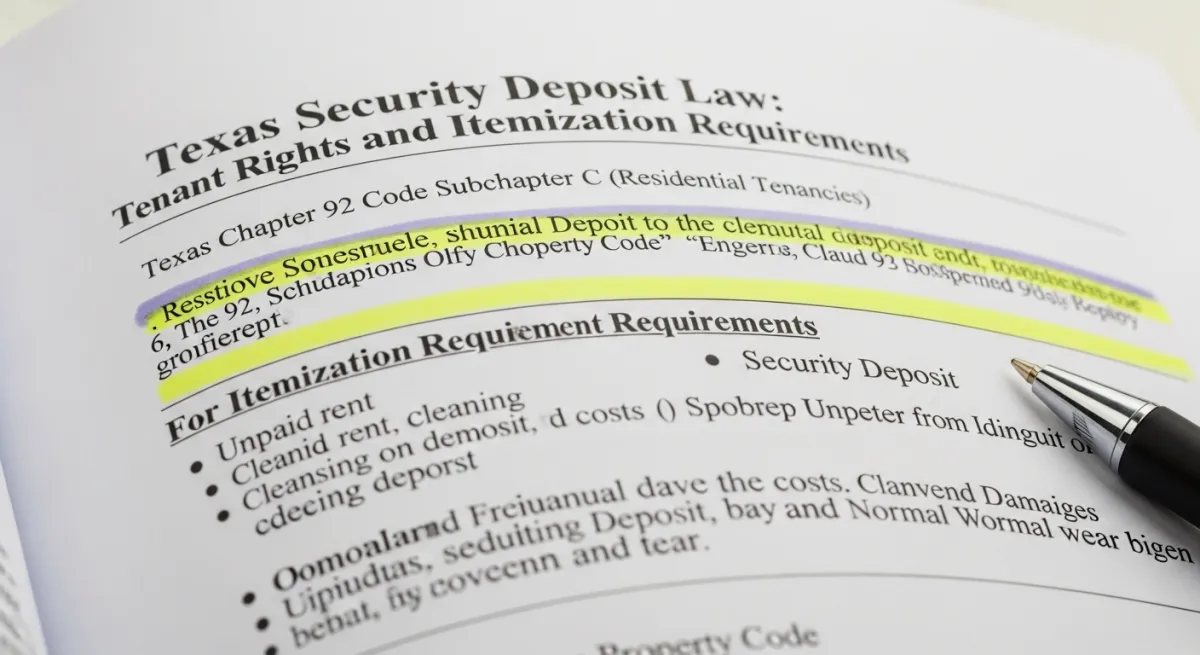
Texas Property Code §92.109 gives renters real protection, including up to three times their deposit back. The clock starts only when you do one thing most tenants skip.
Every September, the same scene plays out across Travis County. A UT student or a Riverside corridor renter ended their lease on July 31, dropped off the keys, cleaned out the apartment, and waited. Labor Day comes and goes. No deposit check. No itemized statement. Just silence — and $1,500 on the line.
Texas has a statutory framework that protects renters in exactly this situation. The catch: most tenants don’t know it exists until after they’ve forfeited the part of the law that makes it worth pursuing.
This piece covers what the law actually says, what you can actually win, and what Travis County’s Justice of the Peace court looks like when you get there.
The 30-Day Rule, and the Forwarding Address That Starts the Clock
Texas Property Code §92.103 sets the baseline: a landlord must return your security deposit within 30 days of lease surrender. If the landlord keeps any portion, they must also deliver a written, itemized accounting of every deduction within that same window. Miss either deadline and the legal exposure grows fast.
But there’s a precise, often-missed condition attached to that 30-day clock. It doesn’t begin running until the tenant has both vacated the unit and provided a written forwarding address. Verbal notice — telling your landlord at key drop-off where you’re headed — doesn’t count. A mention during a walkthrough doesn’t count. Under Texas law, the forwarding address must be in writing.
This is the single most common reason Austin renters lose access to the statute’s penalty provisions. They leave on July 31, assume their landlord knows how to reach them, and discover months later that the landlord’s attorney is citing the absence of a written forwarding address as a defense to bad-faith penalties. It works. ATC counselors report hearing this story constantly, and it never gets less frustrating.
The fix takes two minutes: on the day you hand over your keys, send your landlord a text or email stating your name, the property address, your move-out date, and your forwarding address. Screenshot it. Certified mail is stronger still if you have reason to anticipate a dispute. The forwarding address doesn’t need to be your permanent new home — a P.O. box works — but written documentation is non-negotiable.
If you’re on a UT-cycle lease ending July 31, the landlord’s deadline falls on August 31. Calendar it. No deposit and no itemized statement by then means the penalties in §92.109 come into play.
What Your Landlord Can and Cannot Legally Deduct
Texas Property Code §92.104 permits three categories of deductions: unpaid rent, actual damages beyond normal wear and tear, and charges specifically authorized in the lease. Every deduction must be itemized. A landlord can’t simply decide the apartment needs fresh paint after a two-year tenancy and bill you for it.
The phrase “normal wear and tear” does enormous legal work there, and Texas courts adjudicate it constantly. The statute doesn’t define it. Courts have consistently held that deterioration from ordinary, reasonable use — without negligence or abuse — is the landlord’s responsibility. Scuffs on baseboards, minor nail holes, carpet compression from furniture, gradual fading from sunlight: normal wear and tear. A cigarette burn in the carpet, a broken window, pet urine damage, holes punched in drywall: not.
Austin introduces complications that statewide legal summaries rarely address. The city’s extreme summer heat — routinely above 100 degrees for weeks — causes paint to crack, wood trim to warp, caulk to shrink and separate, and HVAC filters to clog faster than in milder climates. Some Austin landlords attempt to charge tenants for these conditions as tenant-caused damage. Whether a court accepts that framing depends heavily on whether the tenant can show the condition was pre-existing or climate-driven. This is why documentation matters before problems arise, not after. A photograph of a hairline paint crack above a west-facing window in July, taken at move-in, is worth more than any argument you make at a JP hearing six months later. Bring that photo and you’ve essentially won that line item.
One more thing Austin renters should scrutinize before signing: deduction clauses. In a competitive rental market, some Austin leases contain provisions that expand what landlords can charge beyond the §92.104 defaults — professional cleaning fees regardless of move-out condition, carpet replacement formulas based on age rather than actual damage, administrative processing fees. If the lease expressly authorizes a charge, the landlord can make it even if it feels unfair. Read those clauses before you sign. Most people don’t. For broader context on how Austin’s rental market shapes these lease terms, see our moving & real estate coverage.
When Silence Becomes Bad Faith
If your landlord keeps any part of your deposit and doesn’t send a written, itemized list of deductions within 30 days of your move-out and forwarding address submission, that silence has legal consequence. Under §92.107, the itemization is mandatory. Under §92.109, failing to provide it within 30 days creates a presumption of bad faith.
That presumption matters procedurally: it shifts the burden to the landlord to prove they acted in good faith. They can try to rebut it — by showing they had a reasonable belief the deductions were valid, by demonstrating a genuine dispute about the property’s condition, or by arguing the forwarding address was never properly provided. But they have to make that argument. A landlord who missed the deadline and never sent itemization walks into court already behind. Their job is to explain why silence for 30-plus days was somehow reasonable. That’s a harder position than it sounds when the statute explicitly names that silence as the penalty trigger.
The Penalty Structure Under §92.109, Including Real Numbers
This is where the statute has real teeth, and where the math determines whether hiring an attorney makes sense.
Under §92.109, a landlord who retains a deposit in bad faith — or who is presumed to have done so by missing the itemization deadline — is liable for:
- The wrongfully withheld deposit amount
- A $100 statutory penalty
- Three times the amount wrongfully withheld
- Reasonable attorney’s fees
These are cumulative, not alternatives. A number of explanations of this statute describe the penalty as “up to three times the deposit.” That’s not quite right. The structure is the actual deposit amount, plus $100, plus three times that deposit amount.
Run the math on a realistic Austin situation. Your landlord wrongfully withheld a $1,500 deposit in bad faith and failed to provide itemization within 30 days: that’s $1,500 plus $100 plus $4,500 in treble damages — $6,100 before attorney’s fees. A more modest $800 deposit wrongfully withheld yields $3,300. This is why Texas deposit cases, when the facts are clean, are worth pursuing.
One significant caveat: if you never provided a written forwarding address, you can still recover the actual deposit amount in a lawsuit, but you lose access to the statutory penalties. Without a written forwarding address, the landlord has a credible argument the 30-day clock never started. You may win the $1,500 but not the $4,600. Which is why that two-minute text message on moving day matters so much.
How to File in Travis County Justice of the Peace Court
Security deposit claims fall within Texas small claims jurisdiction — Justice of the Peace court. Travis County has five JP precincts. You file in the precinct covering the address of the rental property, not your new address. Look up the precinct on the Travis County JP court website before you file.
The sequence: submit a petition describing your claim and the amount sought, pay the filing fee, and the court issues a citation served by constable. If you can’t afford the filing fee, ask the clerk for a Statement of Inability to Afford Payment of Court Costs — the fee waiver form available at the window. Fees are waived for qualifying low-income filers.
The hearing itself is informal. No jury. The judge asks questions of both parties, reviews documents, and usually issues a decision the same day. Attorneys are permitted but not required on either side, and many renters represent themselves successfully when their documentation is solid.
If you win, the judgment is enforceable for 10 years in Texas. You can pursue collection against the landlord’s bank account through a writ of garnishment, or against their property through an abstract of judgment, if they don’t pay voluntarily. It’s not cash the day you win. But it has real, lasting legal force — and some landlords who initially ignore it discover that reality when they try to sell a property.
What to Bring to Court
Travis County JP judges decide deposit cases on documentation, not argument. Show up with paper.
Your signed move-in inspection report. If you documented the apartment’s condition at move-in on a form your landlord also signed, that record is powerful evidence against any claimed damage. Texas law doesn’t require landlords to provide a move-in checklist for most residential leases, but its absence works against you.
Timestamped move-out photos and video. Shot the day you vacate, before anything is removed. Cover every room, every wall, the stove and refrigerator interior, bathroom grout, carpet, and — given Austin’s climate — the HVAC filter. The timestamp embedded in a smartphone photo is metadata a judge can verify. Undated photos are worth far less.
Your lease. The judge needs to see what charges the lease authorized, what the deposit amount was, and what the move-out requirements stated.
Written proof that you provided your forwarding address. A screenshot of a text message showing you sent the address and the date. An email in your sent folder. A certified mail receipt. Without it, your landlord’s attorney will argue the clock never started.
All written communications about the deposit. Every text thread, every email, every letter. If the landlord said anything about why they’re withholding funds, you want that in front of the judge. If they said nothing, the silence is part of the evidence.
The itemized deduction statement — or proof the landlord never sent one. If you received an itemization, bring it and be prepared to contest each line. If you never received one, bring your move-out date, your forwarding address transmission date, and a calendar. The absence of itemization isn’t a gap in your case. It is the case.
One Austin-specific note: photograph your HVAC filter at both move-in and move-out. A clogged filter at move-out, in a city where filters need replacement every month or two during heavy cooling season, is something a landlord might characterize as tenant neglect. A filter that’s visibly appropriate for the time since move-in, or a receipt showing you replaced it, forecloses that argument.
Before You File, Start Here
Before you pay the filing fee and serve a citation, contact the Austin Tenants Council. Their office is at 1619 E. César Chávez Street (confirm current hours at austintenants.org). Phone: (512) 474-1961. ATC provides free tenant counseling specifically for deposit disputes — they’ll review the itemized deductions you received and identify which ones are legally questionable, help you draft a demand letter, and tell you whether your facts are strong enough to justify filing.
ATC doesn’t provide legal representation. For low-income renters whose deposits involve meaningful amounts — and once treble damages are in play, that’s most of them — they refer qualifying clients to Texas RioGrande Legal Aid, which covers Travis County and can represent eligible clients in JP court. When a case involves potential attorney’s fee recovery under §92.109, representation becomes financially viable for the organization as well as the renter.
The demand letter step deserves emphasis. Sending a written demand to your landlord before filing isn’t legally required, but it accomplishes two things. It gives the landlord a chance to settle without litigation, which frequently works — particularly with individual landlord-owners who aren’t eager to appear in JP court. And if they ignore it and you do file, the letter becomes evidence of their refusal to engage. Keep a copy and document when it was sent.
Move-Out Documentation Checklist
Before you sign the lease: Read every deduction clause. Note any professional cleaning fees, carpet assessment formulas, or administrative charges that apply regardless of actual damage. Ask for a move-in inspection form, complete it in detail noting every scratch and pre-existing defect, have the landlord sign it, and photograph the entire unit before you move anything in.
During the tenancy: Replace HVAC filters on a regular schedule during Austin summers and keep the receipts. If you cause damage, report it to the landlord in writing promptly — self-reporting and arranging repair is better than leaving it to be discovered at move-out.
At move-out: Deep clean before photographing. Shoot timestamped video and photos of every room, all appliances inside and out, all walls, floors, fixtures, window blinds, and the HVAC filter. Note any heat-related wear — paint cracking, wood trim separation, caulk shrinkage — particularly if it was pre-existing or appeared during summer. Request a joint walkthrough with the landlord if possible; Texas law doesn’t require one, but doing it in person eliminates a large category of later disputes. Return all keys and get a written acknowledgment of the return date. Then, that same day, send your forwarding address to the landlord in writing and keep proof of delivery.
After move-out: If your lease ended July 31, mark August 31 on your calendar — that’s your landlord’s §92.103 deadline. If it passes without a deposit return or itemized statement, contact ATC before filing. Send a written demand letter stating the deadline has passed and demanding return of the deposit plus applicable statutory penalties. If no satisfactory response arrives, file in the appropriate Travis County JP precinct.
Deposit disputes feel petty from the outside until you’re the one who gave a landlord $1,500 in good faith, left the apartment cleaner than you found it, and spent September watching a deadline expire in silence. Texas law built a real remedy for that situation. Whether you can use it comes down to a text message sent on moving day and 20 minutes of video before you handed over the keys.
For questions about a specific deposit dispute, contact the Austin Tenants Council at (512) 474-1961 or austintenants.org.