What the Student Housing Rush Around UT Austin Means for Everyone Renting Nearby This Fall
Every spring, UT Austin's tens of thousands of off-campus students start signing leases. By June, the window has effectively closed. Here's the calendar, the zip codes, and the mechanics that expla…

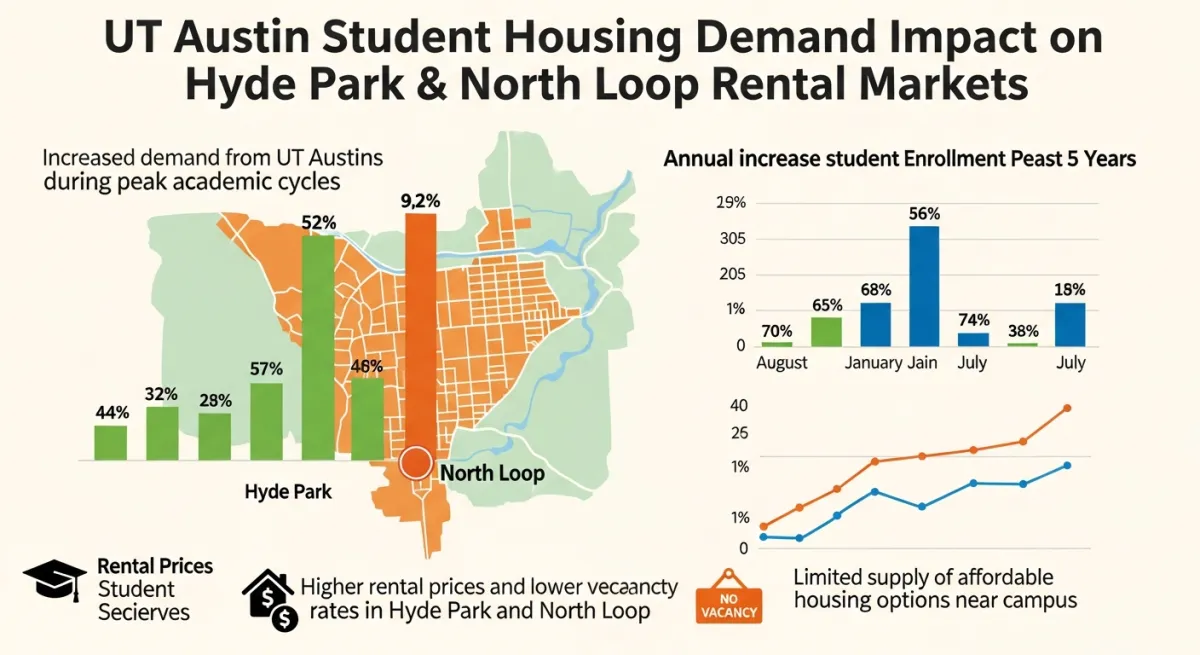
Every spring, UT Austin’s tens of thousands of off-campus students start signing leases. By June, the window has effectively closed. Here’s the calendar, the zip codes, and the mechanics that explain what’s happening to rents in Hyde Park, North Loop, and every neighborhood in between.
If you’re a non-student renter trying to find a one-bedroom in Hyde Park or North Loop for a fall move-in, you’ve probably already noticed something feels wrong about the timing. By the time “available August 1” listings start appearing on Zillow in June, the good ones are already gone. The remaining ones are priced like the landlord knows you’re desperate. The property manager at the building you actually want hasn’t called you back.
This isn’t bad luck. It’s a mechanical outcome of the most predictable event in Austin’s rental calendar, and it plays out the same way every year. Understanding how it works is the only way to stop getting run over by it.
The Structural Mismatch That Drives Everything
UT Austin enrolls more than 50,000 students. On-campus residence halls house a small fraction of that enrollment. The private rental market absorbs the rest — every single year — which means the neighborhoods surrounding campus are subject to one of the most concentrated, time-compressed housing demand events in any mid-sized American city. It happens on a fixed schedule. It has predictable losers. The losers, nearly every cycle, are non-student renters who didn’t see it coming early enough.
The core problem is lease-date clustering with no real parallel in other Austin neighborhoods. Off-campus units near campus turn over heavily on August 1 or August 15 because that’s when the academic year begins and when student leases are written. This creates a re-leasing window that feels like it opens in June but actually closes in March.
Why June and July Feel Like a Crisis When the Real Deadline Was March 1
The June–July sense of crisis is real, but it’s a lagging indicator. By the time you’re refreshing Zillow in July, the cycle that will determine your options has already played out.
In February, purpose-built student housing towers open pre-leasing for the following fall. Dobie Twenty21 on Guadalupe. The Castilian on Guadalupe. RISE on 2nd in West Campus. These towers lease the bulk of their units well before March. That activity sends a signal to the broader student rental market: the clock is running.
March is when the off-campus rush begins in earnest. Students who didn’t secure a tower unit — or couldn’t afford one, or wanted a house share in Hyde Park with their friend group — start signing leases for traditional apartment stock. Property managers who handle units along the Duval Street corridor, on the streets running between 38th and 45th, and on the blocks north of 45th toward North Loop say March is when they receive the overwhelming majority of their applications.
March 1 is the practical inflection point. By mid-March, available inventory has shrunk visibly and landlords no longer need to negotiate.
What remains after April skews heavily toward units with real problems: previous tenants who backed out, buildings with documented pest issues or deferred maintenance, properties at the outer geographic edge of what students consider walkable. July brings the truly desperate transactions — month-to-month bridging leases, sublets from departing students who need cash to break their lease early, and occasional price concessions from units that simply sat too long at an asking rent nobody would pay. By that point, you’re not shopping. You’re salvaging.
The Neighborhoods Taking the Hit
The geography of this pressure isn’t uniform. Understanding which neighborhoods bear the load, and why, matters both for finding housing and for interpreting what rent data actually means.
West Campus — roughly Guadalupe west to Lamar, MLK north to 29th Street — has been largely absorbed into the purpose-built student housing market. Traditional apartment stock here has been bought up, renovated, or replaced by towers over the past fifteen years. Non-student renters aren’t really competing in West Campus anymore. It has effectively become a student-housing campus of its own.
Hyde Park (zip code 78751, north of 38th Street, centered on the Duval/Speedway corridor up to about 45th) is where the real competition plays out. The neighborhood has older brick apartment buildings, a significant inventory of rented bungalows and duplexes, and a genuinely mixed-use character with residents across income levels and backgrounds. That’s what students unable to get into the towers are targeting when the pre-leasing wave ends in March. The Speedway protected bike lane, which runs directly from campus through Hyde Park, has intensified demand on and near that corridor specifically. It’s not unusual for landlords on Speedway to receive three applications for a two-bedroom within a week in early March.
North Loop — roughly 51st Street to Airport Boulevard, anchored by the commercial strip on North Loop Boulevard — is the most important story in this cycle right now. The neighborhood has historically been affordable relative to Hyde Park, with a distinct indie commercial character: record shops, vintage stores, taquerias along North Loop Boulevard. That character attracted artists, service workers, and non-student young residents priced out of Hyde Park proper. Student demand has been creeping north along the Speedway and Duval corridors as Hyde Park prices rise, and North Loop is now in the early stages of what Hyde Park experienced five to eight years ago. The transition shows up in lease application patterns before the rent data fully catches up — longtime residents notice it first.
Hancock, around the golf course and 41st Street, draws more graduate students, young professionals, and faculty. The pressure is real but less acute. The buyer profile skews toward higher-income renters with less calendar dependency on the academic year.
Brentwood and Crestview (78757, north of 45th between Burnet Road and Lamar) function as the overflow valve when 78751 prices spike. Every year Hyde Park median rents take a significant jump, Brentwood and Crestview see corresponding inquiry volume. The commute to campus is longer and less transit-friendly, which acts as a natural filter. But renters who actually evaluate their transit options can find genuine value here. This isn’t a consolation-prize neighborhood.
What the Rent Data Shows and What Still Needs Verification
The campus-adjacency premium is real and measurable. Hyde Park and North Loop in zip code 78751 carry a meaningful cost premium over comparable Austin zip codes that aren’t adjacent to campus — 78745 in South Austin, 78753 in Far Northeast. The spread between 78751 and 78753 runs in the range of $400 to $600 per month on a one-bedroom, based on figures tracked by ApartmentData.com and Zillow’s Observed Rent Index. Verify current 2026 figures directly against those sources; the market has moved enough in recent years that specific numbers go stale fast.
What the data shows consistently across leasing cycles: asking rents in 78751 track the academic enrollment calendar closely, spike during the March–May signing window, and have historically grown faster than the Austin metro average in years of stable or growing enrollment. The premium is sticky because the demand driving it is structural. Enrollment doesn’t decline. On-campus capacity doesn’t grow fast enough to absorb it. The August lease-start clustering means the demand hits in a short window every single year.
For current, verified figures: ApartmentData.com tracks Austin by submarket. Zillow’s Observed Rent Index, filtered to zip code, is another solid source. The Austin Board of Realtors publishes monthly market reports. The Austin Tenants Council publishes rent trend data with a tenant-advocacy lens that’s useful for understanding displacement patterns, and their research staff will answer direct questions about neighborhood-specific trends without the commercial filter apartment listing platforms bring.
The Purpose-Built Student Tower Paradox
The towers were supposed to help. The theory behind purpose-built student housing — Dobie Twenty21, The Castilian, RISE on 2nd, and the cluster along San Jacinto and Red River — was straightforward: concentrate student demand in amenity-rich towers and relieve pressure on the traditional residential neighborhoods north of campus.
There’s a version of this that works. The towers absorb a significant volume of high-income students willing to pay $1,800 to $3,000 per month for furnished units with gyms, rooftop pools, and package concierges. Without those towers, that cohort would be competing directly for Hyde Park bungalows. Credit where it’s due.
But the paradox is baked into the system. By pre-leasing in February, the towers trigger the broader off-campus panic before most non-student renters have begun thinking about their housing situation at all. A UT junior who doesn’t get a tower unit in February doesn’t wait until June to find something else. She starts calling Hyde Park property managers in March. And because PBSH towers serve primarily the upper end of the student budget, the students they push back into the traditional market are the ones with tighter budgets — the ones competing for the same lower-cost Hyde Park and North Loop stock that non-student residents need.
The towers accelerate the competition for the units non-student renters actually depend on. February pre-leasing is now a trigger for the broader rush, and that earlier trigger disadvantages renters who don’t know to move their own calendar up accordingly. Work through the full mechanics of it and you’ll find it’s a genuinely badly designed system — not maliciously, just structurally. Nobody designed it. It assembled itself.
The Austin Tenants Council tracks displacement patterns in the 78751 zip code and is a direct resource for understanding how this cycle affects existing tenants facing non-renewal or above-market rent increases.
Who’s Actually Getting Squeezed in North Loop
North Loop is the most instructive case because it’s still mid-process. The displacement dynamic that reshaped Hyde Park is arriving now, which means it’s still visible in real time — useful if you’re a researcher, depressing if you’re a renter.
The neighborhood has historically served residents in lower and moderate income brackets: artists, service industry workers, entry-level professionals who wanted urban texture without Hyde Park prices. That affordability has eroded as student demand crept north. A one-bedroom that rented for $1,100 in 2019 in the heart of North Loop now carries asking rents in the $1,650 to $1,800 range. That’s not an abstraction for the people who lived there through the change.
One dynamic property managers and longtime residents describe consistently: co-signed student applications present a more favorable financial profile than an independent renter with a shorter credit history and no guarantor. This is a rational choice for landlords. It’s also a structural disadvantage for exactly the renters who most need affordable North Loop stock. It’s not discrimination; it’s a financial calculation that consistently advantages student applicants in a competitive pool.
When a property manager in March receives fifteen applications for a two-bedroom, the undergraduate whose parents co-sign with strong credit scores moves to the top regardless of where other candidates rank on affordability or long-term tenancy potential. If you’ve ever lost a unit you were clearly a better long-term tenant for, this is probably what happened.
The Austin Tenants Council is the right resource for renters who believe they’ve faced discriminatory application practices or retaliatory non-renewal. They offer free counseling and can help renters understand their rights under Texas law — specific protections around lease termination timing and retaliation that matter in a market where your negotiating position is otherwise weak.
Why Demand Clusters Where It Does: The Transit and Bike Layer
Student housing demand isn’t spread evenly across the two miles surrounding campus. It concentrates along specific corridors, and those corridors carry rent premiums that aren’t always obvious when you’re just looking at neighborhood-level averages.
CapMetro Route 1 runs along Lamar Boulevard, connecting Hyde Park northward. For students and young renters without cars, the Lamar corridor anchors transit access on the western side of the demand zone. Units within a short walk of Lamar bus stops carry a premium in the 78756 and northern 78751 zones.
CapMetro Route 7 runs along Duval Street, connecting UT’s north campus area directly into Hyde Park and continuing toward North Loop. This is the most student-dense transit corridor in north-central Austin. A unit on Duval itself can command $200 to $300 per month above a comparable unit two blocks away on a parallel street — for what amounts to a slightly shorter walk to the bus stop. That gap is real and it shows up in asking rents.
MetroRapid 803 runs along Guadalupe and Lamar, connecting downtown and UT to North Lamar commercial areas. Frequency on the 803 is meaningfully better than local routes, and the corridor shows corresponding rent premiums. Living within a five-minute walk of the 803 versus four blocks away often translates directly into what a landlord feels they can ask.
The Speedway protected bike lane, in place since 2019, has had a disproportionate effect on demand along its specific corridor. Landlords have had time to calibrate asking rents accordingly. Blocks within easy biking distance of Speedway carry a premium relative to comparable units two or three blocks east toward Airport Boulevard.
For non-student renters willing to bike but not locked to Speedway itself: blocks in 78751 that sit just east of Airport Boulevard, or on the western side near Guadalupe but slightly south, can offer meaningfully lower asking rents for similar unit quality. They attract less attention from the student market while sitting in the same neighborhood and zip code. Not glamorous intel. But it’s real.
What a Non-Student Renter Should Actually Do, and When
This is the section most renters wish they’d read in October.
November: Start monitoring listings in 78751 and 78756. Not as an active searcher — August-move-in listings don’t exist yet — but as intelligence gathering. Contact Hyde Park property managers directly, before units hit Zillow or Apartments.com. Smaller portfolio managers along Duval, 45th Street, and the streets between them often post to their own websites or to Craigslist, and they have more flexibility in timing than large apartment communities do. Ask specifically about anticipated availability for the following August and whether they offer renewals with early notification. Some property managers notify existing tenants in October or November that their unit won’t be renewed. Others offer renewal options with sixty days’ notice. Renewal units never hit the open market.
December through January: If you’ve identified a property you want, have a real conversation with the manager about their process. Ask about their re-leasing timeline. Ask whether current tenants are not renewing. You won’t get guarantees, but you’ll get a sense of whether the property operates on the student cycle. Some property managers will tell you directly about buildings where churn is low — they use it as a selling point for the kind of renter who values stability.
February: This is your decision month. Anything you’re serious about should be under active application by the end of February — submitted, with documents, with a co-signer if you need one. PBSH pre-leasing is underway by early February, and the secondary rush into traditional stock follows within two to three weeks. A completed application with references checked in early February puts you ahead of the wave that arrives in mid-March.
March 1: Treat this as the de facto deadline for securing a unit at a fair price within the primary demand zone. If you’re still in negotiation on March 15 for an August 1 unit, the leverage balance has shifted against you. Landlords know they have options. They’ll take their time because they’re not worried about vacancy.
May onward: If you missed the window, real options exist — but enter them with clear eyes about the tradeoffs. As covered in our moving & real estate coverage, the broader Austin rental market has its own seasonal patterns worth understanding alongside the campus cycle.
Brentwood and Crestview (78757, Burnet Road corridor) deserve genuine consideration, not just as fallback. Asking rents run below comparable Hyde Park units — verify current figures against ApartmentData.com or Zillow before budgeting. CapMetro Route 1 and the 803 MetroRapid provide reasonable access to campus. The neighborhood character is genuinely good and not student-dominated. The blocks along North Loop Boulevard between Burnet and Lamar have their own commercial texture, with local coffee shops and restaurants that serve a non-student population. If you can bike or tolerate a fifteen-minute bus commute, the math works.
Cherrywood and the East 12th Street corridor (78702) aren’t traditional student overflow markets, but they have CapMetro access and direct connections to downtown. The commute to campus is longer than North Loop. The neighborhood has stronger arts and restaurant culture than Burnet Road, which matters if you want somewhere to actually live rather than just sleep near campus.
If you’ve already missed the window for Fall 2026, the options are specific. Look for sublets from departing UT students. May and June produce real inventory from students graduating or studying abroad who need someone to take over their lease through December or the following summer. These units are often priced at or below market because the departing tenant needs the deal more than the landlord does. Craigslist and UT’s off-campus housing board are where these surface. The downside is commitment length — you may be taking a December lease when you wanted August permanence — but the rent savings and availability are real.
Ask property managers about month-to-month availability. Some units that didn’t lease on the student cycle come available in July and August at month-to-month terms. Rent usually isn’t discounted — landlords know you need the occupancy — but you gain time to search for a longer lease from within the city rather than from out of state.
Contact the Austin Tenants Council if you’re currently in a unit and facing displacement pressure. They offer free counseling on lease non-renewal, rent increase timing, and retaliation protections under Texas law. Texas law prohibits local rent control, meaning landlords have full pricing latitude on new and renewing leases. That makes knowing your procedural rights especially important. Landlords can’t increase rent mid-lease. They must provide specific notice before non-renewal. They can’t retaliate for habitability complaints. For a deeper look at how the broader UT-area lease market functions and what renters can expect this season, see how Austin’s University of Texas area lease market works for renters this summer 2026. Know those rules. They’re not nothing.
The Honest Summary
The UT Austin housing cycle isn’t going to change. Enrollment isn’t going to shrink. On-campus housing isn’t going to expand fast enough to matter. The August 1 lease-date clustering is self-reinforcing. The question for non-student renters isn’t whether the market will improve — it won’t, not structurally — but whether they understand how it actually works before they start looking.
The campus-adjacency premium is real, it’s growing in Hyde Park and North Loop, and it’s driven in part by transit and bike infrastructure decisions that aren’t getting reversed. The Speedway lane exists. Route 7 on Duval exists. These neighborhoods are not moving farther from campus.
The window for securing a unit at a fair price closes every year around March 1. That window is not a secret. It’s just forgotten every year by renters who begin their housing search in June.
The renters who fare best treat November as the beginning of their housing search. Not June. November.