What a $1,500 a Month Budget Actually Rents You Across Austin Right Now
New supply has quietly shifted the math for budget renters. Here's what's real on the ground in Hyde Park, East Cesar Chavez, Rundberg, and Southeast Austin.

New supply has quietly shifted the math for budget renters. Here’s what’s real on the ground in Hyde Park, East Cesar Chavez, Rundberg, and Southeast Austin.
Austin has been among the top metros in the country for new apartment deliveries over the past two years. The supply surge has softened rents and pushed landlords toward concessions. Many newer complexes now offer four to eight weeks free on a 12-month lease. None of this shows up cleanly in advertised asking prices, and the benefits aren’t evenly distributed across the city.
So here’s the direct answer: yes, a $1,500 one-bedroom exists in Austin in 2025. But only in specific pockets. The gap in what you actually get — square footage, finishes, commute, neighborhood — between those pockets has never been wider. What follows is a zip-by-zip reality check on four of them, based on live listings pulled from Zillow and Apartments.com during the week of publication.
How to Read This Survey
All pricing is based on active listings during the week this piece was written. Individual units move fast, but the pricing bands and conditions described reflect genuine current inventory.
One number you need before reading further: net effective rent. A unit advertised at $1,700 per month with six weeks free on a 12-month lease is not a $1,700 apartment. Six weeks free means you pay for 10.5 months. Multiply $1,700 by 10.5 and divide by 12: your actual monthly cost is roughly $1,540. That spread between the listed price and what you actually pay is unusually large right now, especially in 78744. Advertised asking prices and real prices are different numbers in the current Austin market. Keep that in mind every time you open Zillow.
Commute times throughout are benchmarked to 6th and Congress in downtown Austin — off-peak by car, peak-hour by bus, unless noted.
Before signing anything, ask the landlord for average monthly utility bills across the last 12 months. This isn’t a hedge. In July and August, window-unit AC in a 1970s or 1980s apartment runs $150 to $250 per month in electricity. That adds real money to a $1,500 lease for two months of the year. A landlord who won’t provide that number is telling you something.
78702: East Cesar Chavez and Govalle — The Tightest Market on This List
This zip covers an unusually wide stretch of Austin’s east side — from the heavily gentrified East 6th Street corridor west of Airport Boulevard out to the quieter, largely working-class Govalle neighborhood anchored by Pan Am Park and the Fiesta Mart on Cesar Chavez.
The honest geography of $1,500 in 78702: west of Airport Boulevard, you’re priced out. East of Airport, in Govalle, it becomes possible.
What you get is 550 to 680 square feet, mostly in buildings from the 1970s through the 1990s. Functional, occasionally charming in the way older Texas apartment buildings are, but not modern. Laundry rooms instead of in-unit hookups. The oldest buildings have window AC — see the utility warning above. Surface parking, no gym, likely no pool.
The case for 78702 despite all that is location. The Cesar Chavez protected bike lanes connect Govalle to downtown in 25 to 40 minutes on a flat ride. Off-peak by car, 10 to 18 minutes to 6th and Congress. MetroRapid 300 or Route 17 puts you downtown in roughly 20 to 35 minutes from the eastern end of the zip. If you work downtown or spend significant time in central Austin, the time savings are worth calculating against the smaller square footage — because the math is closer than it looks.
The trade-off is this zip offers the worst space-per-dollar of the four neighborhoods here. You’re paying a location premium that is real and demonstrable, and you’re getting less of it than renters did even two years ago, when the east side still had meaningful affordable inventory. Units at this price in 78702 move the fastest of anything on this list. If something looks right, apply the same day.
78751: North Loop and Hyde Park — Best Commute, Narrowest Inventory
Geography matters here, because “Hyde Park” means different things depending on who you ask. Hyde Park proper — the historic bungalow neighborhood north of UT — is essentially unavailable at $1,500 for a one-bedroom in 2025. The sub-neighborhood where this budget actually works is North Loop, north of 51st Street. It’s a scruffier commercial corridor: vintage clothing stores, independent coffee shops, a handful of good taco spots, and the kind of walkable block-by-block infrastructure that draws UT graduate students and Ascension Seton hospital workers in roughly equal measure.
At $1,500 in North Loop, you’re in a six-to-twelve-unit complex built in the 1960s. These buildings have a certain integrity — thick walls, mature trees in the courtyard, rooms that are larger than you’d expect from the exterior. Covered parking isn’t guaranteed. In-unit laundry is uncommon. Expect 600 to 750 square feet and minimal amenities. What you get instead is walkability and a commute that no other zip on this list can match.
MetroRapid 803 runs down Burnet and Lamar to downtown in 25 to 35 minutes at peak hours, one of Austin’s more functional bus routes. By bike, it’s four miles to 6th and Congress via Speedway or Guadalupe. Off-peak by car, 15 to 22 minutes. The commute case for 78751 is the strongest here, and it’s not particularly close.
Shipe Park, a city-operated neighborhood park with a public swimming pool, is within walking distance and free for Austin residents. When your apartment probably lacks a pool and your July electricity bill is a known quantity, a walkable public pool is more useful than it sounds on paper.
The catch is inventory, and it’s a real one. UT Austin’s enrollment of more than 50,000 students generates persistent off-campus housing demand right at this price range. The cluster of Ascension Seton and medical office employment just south along Lamar adds pressure from a completely different renter demographic. When a $1,500 unit lists in this zip, it goes in hours. Have your application documents ready before you start looking — pay stubs, ID, references, credit report. If you’re waiting to get organized after you find something, you’ve already lost it.
78753: Rundberg and Georgian Acres — The Most Space for the Money, With Real Caveats
This is where the $1,500 budget stretches furthest on square footage. 750 to 950 square feet is realistic here. A pool is possible. Covered parking is possible. Some complexes carry income-restricted affordable housing designations with income caps — worth checking if you qualify.
Now for the part that matters, because writing about Rundberg without it is doing you a disservice. Rundberg Lane has a documented history of crime and disinvestment going back decades. Conditions have measurably improved in parts of the neighborhood over the past five years — the Austin Police Department has run sustained enforcement initiatives here — but calling it “transitional” or “up-and-coming” without context is a vague way of avoiding specifics that a renter actually needs. The eastern portions of 78753, particularly around Georgian Acres and the northeastern quadrant above Rundberg Lane, have meaningfully different conditions than the immediate corridor. Check current APD crime mapping data for the specific address you’re considering, not the zip code as a whole, which is large and internally varied. Do it before you tour, not after you fall in love with the floor plan. It takes twenty minutes.
I-35 southbound from Rundberg to downtown at 8 a.m. is, by any honest measure, one of the most congested freeway stretches in Texas. A 25 to 40-minute drive in peak hours isn’t a worst case — it’s Tuesday. Bus routes to downtown run 45 to 65 minutes depending on the route. If your job is in central Austin, that commute is a real daily cost. Price out what it does to your effective hourly wage before you sign.
Here’s where the math shifts: if you work at Apple, Indeed, Oracle’s North Campus, or any of the other tech employers concentrated in the Domain corridor near 183 and MoPac, 78753 makes actual sense. That route can put you at the Domain in 15 minutes off-peak. Most of Rundberg’s reputation as a commute problem is built entirely on the downtown experience. If downtown isn’t your commute, you’re renting the most apartment per dollar on this list, in a neighborhood that requires homework on the specific address — not the whole zip — before you commit.
78744: Southeast Austin Near Slaughter Lane — New Construction at a Concession Discount
The southeast zip around Slaughter Lane and I-35 has seen significant Class A apartment construction over the past several years. That inventory hasn’t absorbed as quickly as developers projected, and the concession packages running at some complexes here are the most interesting thing happening in the [Austin rental market](/ moving-real-estate/) at this price point right now. One to two months free on a 12-month lease is not unusual. Verify current offers directly with individual properties — these packages shift, and some have already changed since this was written.
Run the math on a specific example: a unit listed at $1,750 per month with six weeks free on a 12-month lease nets to approximately $1,531 per month. That effective price buys something that simply doesn’t exist anywhere else on this list — new construction finishes, in-unit washer/dryer, central HVAC (critical for those summer utility bills; this is not a small thing), stainless appliances, a real gym, a pool, covered parking. That combination of features at this effective price point doesn’t exist in 78702, 78751, or 78753.
Southeast Austin is not close to downtown. Off-peak by car via Riverside or I-35 North, budget 20 to 35 minutes. Peak hours, longer. MetroRapid 320 and Route 3 to downtown run 40 to 60 minutes. Austin-Bergstrom International Airport sits within this zip, which is a genuine advantage for anyone who travels frequently for work — or anyone who’s done the 45-minute post-midnight Uber from North Austin and quietly wondered whether there was a smarter way to live.
Flood risk is not a footnote here. Portions of the Onion Creek area within and near 78744 fall within [FEMA flood zones](/ home-property/how-to-read-fema-flood-map-austin-property/). The area flooded significantly in 2015. Before signing any lease — particularly a ground-floor unit — confirm the specific address on the current FEMA flood map at msc.fema.gov. Flood zone designations vary block by block and have been updated since 2015. If the property sits in or near a designated zone, renters insurance with appropriate flood coverage is not optional.
McKinney Falls State Park sits within 78744 and gets almost no mention in rental coverage. Swimming holes on Onion Creek, miles of hiking and biking trails, a ten-minute drive from most of the zip. For renters priced out of more expensive parts of the city, that’s real daily-life infrastructure — actual water and trails, not a rooftop deck rendering in a leasing brochure.
Four Zips, Side by Side
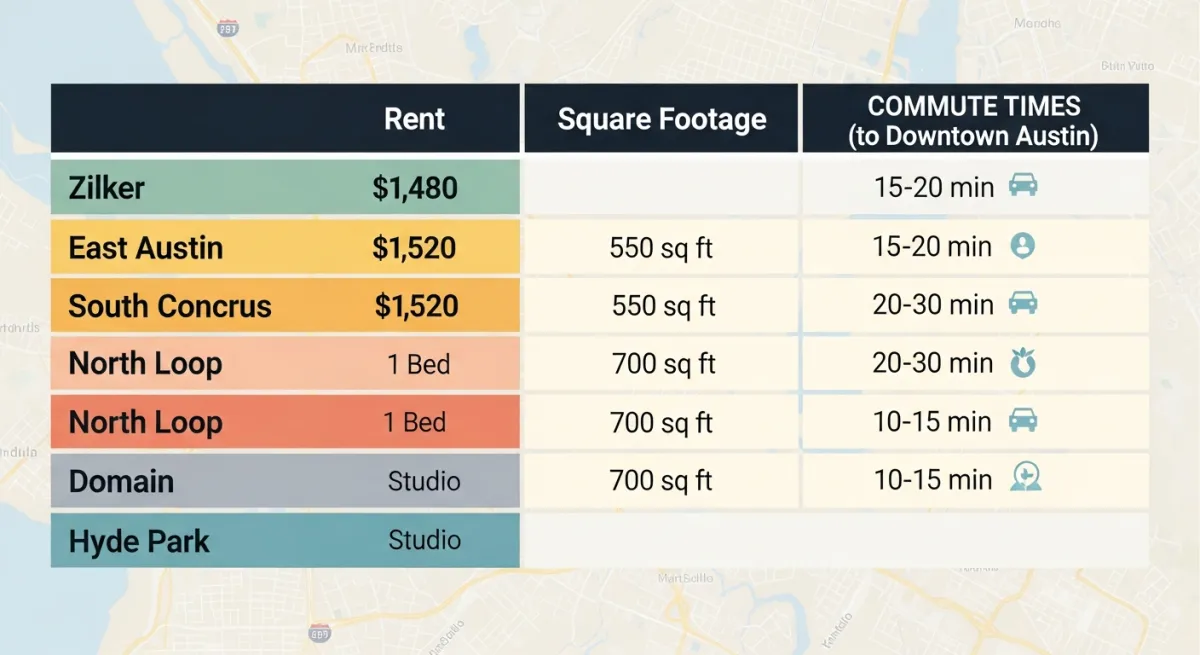
| 78702 | 78751 | 78753 | 78744 | |
|---|---|---|---|---|
| Neighborhood | East Cesar Chavez / Govalle | North Loop | Rundberg / Georgian Acres | SE Austin / Slaughter Lane |
| Sq. ft. at $1,500 | 550–680 | 600–750 | 750–950 | 800–1,000 (with concessions) |
| Typical amenities | Laundry room, surface parking | Laundry room, some pools | Pool possible, covered parking possible | Full amenity package (via concessions) |
| Drive to downtown (off-peak) | 10–18 min | 15–22 min | 25–40 min | 20–35 min |
| Bus to downtown (peak) | 20–35 min | 25–35 min | 45–65 min | 40–60 min |
| Year-over-year buying power shift | Modest (location demand buffered softening) | Modest (location demand buffered softening) | Meaningful (~15–20%) | Meaningful (~20–25%) |
| Key trade-off | Least space per dollar | Fastest-moving inventory | Commute; address-level due diligence required | Flood risk; distance from downtown |
Net effective rent note: Class A properties in 78744 are currently advertising concessions of 4–8 weeks free on 12-month leases. Always calculate net effective rent — (monthly rent × months paying) ÷ 12 — before comparing advertised prices across properties. A $1,750 unit with 6 weeks free nets to approximately $1,531/month.
The buying-power gains at $1,500 are concentrated in 78753 and 78744, where new supply and slower absorption have moved the market. In 78702 and 78751, location demand from employment centers and university enrollment has absorbed most of the softening. The result is roughly 15 to 25 percent more apartment for the same money in the outer zips — a real difference, not a rounding error.
What $1,500 Doesn’t Buy Anymore, and What’s Changed Since 2023
Austin one-bedroom rents peaked metro-wide at roughly $1,600 to $1,650 per month around mid-2022. By mid-2024, the median had softened to the $1,400 to $1,500 range. The $1,500 renter is better positioned today than at any point between spring 2021 and early 2023 — and if you were apartment hunting during that stretch, you know how bad it got.
Concessions are a market condition, not a permanent feature. When recent deliveries reach stable occupancy, landlords stop offering free months. The packages making 78744 accessible at a $1,500 effective budget exist because of a specific supply surplus. If Austin’s construction pace slows — and the data on new starts does suggest a pullback from peak pace — that window closes. A renter [locking in a 12-month lease now](/ home-property/rent-vs-buy-austin-2026/) is buying time, not a permanent shift.
Texas has no rent control, and state law prevents any city from enacting it. When market conditions change, landlords across every zip covered here can raise rents at renewal without a legal ceiling. Smaller, individually-owned properties sometimes behave differently than buildings run by institutional operators using revenue management software — not always, and it’s not a strategy, but it’s worth understanding the dynamic when you’re evaluating your options.
Here’s the bottom line: a livable, comfortable one-bedroom at $1,500 exists in Austin in 2025. You’re making real trade-offs — on commute, location, or building age — no matter which zip you choose. The most apartment per dollar is in 78753 and 78744. The best commute is in 78751. The best close-in urban location is in 78702, and you’re paying for it in square footage and competition. These are genuinely different decisions. A generic “Austin median rent” figure won’t tell you which one is right for your job, your commute, and how you actually spend your time.
Listing data sourced from Zillow and Apartments.com during the week of publication. Square footage and rent ranges reflect active listings at time of research; individual availability changes rapidly. FEMA flood zone status should be verified at msc.fema.gov for any specific address in 78744. Utility cost ranges are estimates based on landlord-reported billing data for comparable building stock and should be verified directly with property management. Commute times reflect Google Maps estimates under specified conditions and will vary. CapMetro route numbers should be confirmed at capmetro.org before travel, as schedules are subject to change.