What Austin Toll Roads Are Charging in 2026 and How the Rate System Works
From dynamic pricing to pay-by-mail penalties, here's what Leander-to-downtown drivers need to know before their next trip.

From dynamic pricing to pay-by-mail penalties, here’s what Leander-to-downtown drivers need to know before their next trip.
If you commute from Leander to downtown Austin five days a week on the full toll corridor, you’re looking at $90 to $130 a month as a TxTag user — assuming you’re selective about when you hit MoPac’s Express lanes. Run them every peak-hours trip without variation and the number climbs past $350. The route is 183A south from RM 1431, SH 45 North across to the interchange, then MoPac Express lanes the rest of the way downtown. Pay-by-mail and you can add $50 to $70 on top of whatever that base figure is, before any late fees. Two commuters in a household doing this route: you’re spending more on tolls annually than most people spend on a car payment.
That total is what surprises people. Not any single trip — $2.50 here, $4.80 there — but the monthly number when they actually add it up. I’ve talked to drivers who’d been doing this corridor for two years and had never done that math. This piece is built around that reality: which roads charge what in 2026, how to read your bill, what pay-by-mail actually costs you, and whether the free alternative routes are slow enough to make the tolls worthwhile.
Two Agencies, Two Completely Different Models
Your Austin toll experience feels inconsistent because it is. The roads covered here don’t run on the same system, and that matters more than most drivers realize.
CTRMA — the Central Texas Regional Mobility Authority — operates 183A from RM 1431 in Leander south to US-183 near Cedar Park, and SH 45 North, which connects 183A to MoPac/Loop 1 on the northwest side. CTRMA uses a fixed per-transaction model. You pass a gantry, you pay a set amount. Rates adjust periodically — CTRMA moved them in early 2026 — but on any given day the price at a specific entry/exit point is posted in advance. TxTag users pay the base rate. Pay-by-mail customers pay more.
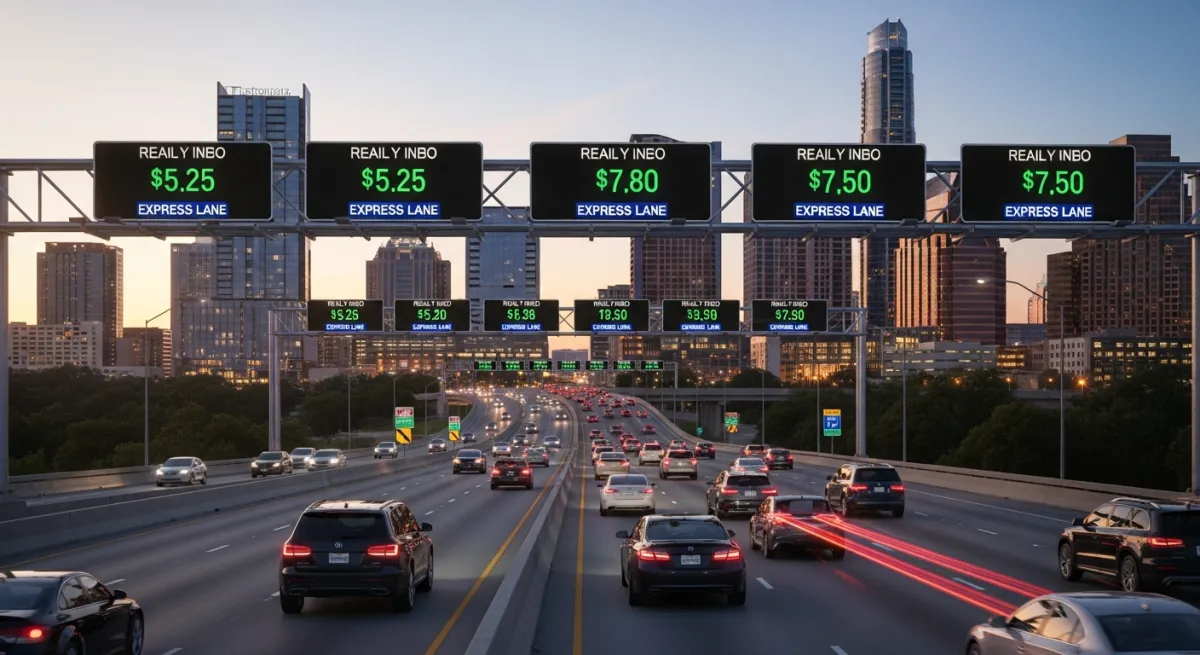
TxDOT and Cintra, a private operator under a concession agreement with TxDOT, run the MoPac Express lanes — formally Loop 1 Express — on a completely different model: dynamic congestion pricing. The rate changes every five minutes during peak hours based on real-time traffic density. There is no fixed rate to quote because there isn’t one. The price moves between a floor and a ceiling throughout the day. TxTag is required, but unlike on CTRMA roads, TxTag users don’t get a discount. Everyone pays the same dynamic price.
This is the distinction that catches people off guard, and it’s the one worth understanding before anything else. In our Austin transportation coverage, this dynamic-versus-fixed split is one of the most consistently misunderstood aspects of how toll costs add up across different roads.
What Changed in 2026
CTRMA reviews toll rates annually, and the pattern has been modest, consistent increases tied to the agency’s revenue needs and bond covenants. Both 183A and SH 45 North saw adjustments effective January 1, 2026.
On 183A, TxTag transactions at mainlane gantries run approximately $1.25 to $2.75 per transaction depending on which entry and exit points you’re using. The road has multiple gantries; longer segments cost more. The RM 1431 to SH 45 North segment — the first leg for most Leander commuters — lands toward the higher end of that range.
On SH 45 North, TxTag mainlane rates for the segment connecting 183A to the MoPac interchange run about $1.00 to $1.50.
Practical translation for a commuter entering 183A at RM 1431 and heading to the SH 45 connection: figure $3.50 to $4.25 each way in CTRMA tolls before you’ve even touched MoPac. Pay-by-mail rates on CTRMA roads run roughly 25 to 50 percent higher per transaction, plus an invoice fee.
For MoPac Express, the 2026 structure maintains a floor of $0.50 (off-peak, light traffic) and a ceiling of $8.00 (peak congestion, full corridor). The ceiling covers the full 11-mile stretch from Parmer Lane to Cesar Chavez. Shorter segments entering or exiting mid-corridor cost proportionally less. The ceiling figure is essentially unchanged from 2025; the 2026 adjustment was primarily a confirmation, not an increase.
Rate comparison table:
| Road | Segment | TxTag Rate (2026) | Pay-by-Mail Rate | Change from 2025 |
|---|---|---|---|---|
| 183A | RM 1431 → SH 45 N | ~$3.75–$4.25/trip | ~$4.75–$6.00+ | Small increase |
| SH 45 North | 183A → MoPac interchange | ~$1.00–$1.50/trip | ~$1.25–$2.00+ | Small increase |
| MoPac Express | Full corridor (Parmer–Cesar Chavez) | $0.50–$8.00 dynamic | Same dynamic rate | Ceiling confirmed |
| MoPac Express | Partial (e.g., Parmer–2222) | $0.50–$3.00 dynamic | Same dynamic rate | No change |
Individual gantry rates vary by entry/exit combination. Verify your specific numbers at CTRMA.org and LoopExpressway.com before budgeting.
How MoPac Express Pricing Actually Works
The Express lanes are where Austin’s toll system generates the most frustration — mostly from drivers who feel like they’re being charged arbitrarily. They’re not, but the system is genuinely unlike anything else on the corridor and it’s worth understanding before you commit to using it.
The MoPac Express lanes run alongside the general-purpose lanes on Loop 1 from Parmer Lane south to Cesar Chavez Street, separated by a buffer, with limited and marked entry/exit points. You must have a TxTag. There’s no cash option, and if you drive in without a transponder, your plate gets photographed and a bill arrives through a third-party enforcement process — not a designed payment method, a penalty.
Every five minutes during active pricing windows, the toll displayed on dynamic signs at entry points updates. The price you see when your transponder is read is the price you pay. There’s no averaging, no appeal on the basis of traffic being unexpectedly bad. You saw the number, you entered.
Peak pricing windows run roughly 6 to 10 AM and 4 to 8 PM on weekdays. Outside those windows, prices drop toward the floor. The algorithm is trying to keep the Express lanes moving at 50 mph or better — when too many cars enter, the price rises to push people back to the general lanes; when flow is good, it drops to draw them in. The lanes almost always move faster than the free lanes. That’s what you’re paying for.
A driver entering the Express lane southbound at Parmer at 8:15 AM on a typical Tuesday will likely see $4.50 to $6.50 for the full corridor. That same driver at 10:30 AM, after the peak has cleared, might see $0.75 to $1.50 for the identical trip. Same road. Same distance. Entirely different price.
One thing TxTag holders need to understand clearly: TxTag does not give you a discounted rate here. On 183A and SH 45, TxTag users pay less than pay-by-mail customers. On MoPac Express, TxTag is just the required entry method. You’re not saving money compared to some theoretical pay-by-mail option — there isn’t one. Everyone pays the same dynamic price.
The Stacking Problem: What the Full Commute Actually Costs
Most toll explainers skip this part. They shouldn’t. Toll stacking — passing multiple separate gantries on multiple roads operated by separate agencies, each billed as its own transaction — is exactly why this corridor costs more per month than people expect.
The Leander commute from RM 1431 to downtown touches at least four gantries:
Gantry 1 — 183A mainline north segment near RM 1431 entry: about $1.50 to $2.00 TxTag
Gantry 2 — 183A mainline south segment approaching SH 45 North: about $1.75 to $2.25 TxTag (some configurations combine these; others don’t)
Gantry 3 — SH 45 North mainline crossing to the MoPac interchange: about $1.00 to $1.50 TxTag
Gantry 4 — MoPac Express entry, varies by entry point and time: $0.50 to $8.00 dynamic
At a realistic peak-hour scenario — $4.00 total on 183A, $1.25 on SH 45, $5.00 on MoPac Express at 8:15 AM — that’s $10.25 one way, $20.50 round-trip, roughly $451 for a 22-working-day month. That’s the ceiling.
Pull the MoPac Express figure down to an average of $3.00 (mixing some peak trips with some off-peak returns) and you land around $8 per trip, $16 per day, $352 per month. Even averaging $2.00 on MoPac — catching genuinely light windows both ways — the corridor still costs over $250 a month for a TxTag user.
The $90 to $130 estimate at the top of this piece reflects commuters who use the Express lanes selectively: maybe only inbound mornings when they’re running late, and skip them entirely on remote-work days or when they leave early. The stacked gantries are why a road that feels cheap per transaction ends up expensive per month. The math just doesn’t work the way it feels at the gantry. For Leander residents already weighing the full financial picture of suburban commuting, what Kyle, Pflugerville, and Hutto actually cost after taxes, HOAs, tolls, and closing day surprises shows how toll spending fits into a broader monthly budget calculation.
TxTag Versus Pay-by-Mail
If you’re still doing pay-by-mail on this corridor, you’re paying extra for the privilege of not having set up an account. That’s a choice, but it should be a conscious one.
TxTag is a prepaid account through TxDOT. The transponder is free with an initial minimum deposit. You maintain a balance (typically $20 to $40, auto-replenished by credit card) and it covers every tolled road in Texas, including CTRMA. The base rate on CTRMA’s schedule is your rate.
Pay-by-mail means the camera at the gantry reads your plate, the agency identifies the registered owner, and a bill arrives two to three weeks later. On CTRMA roads, that rate is roughly 25 to 50 percent higher per transaction than TxTag, plus a $1.00 invoice fee per statement. On the Leander corridor across a full round-trip month, that differential runs $50 to $70 more than TxTag — for the exact same trips. That’s not a small number for something with a $0 fix.
Miss the bill and things escalate quickly. The invoice comes with a 30-day due date. Miss it — because it went to an old address, you set it aside and forgot, whatever — and CTRMA adds late fees. A $4 toll becomes a $50 or $60 statement without much drama. Unpaid balances trigger a vehicle registration hold through TxDMV. You cannot renew your registration in Texas until the debt is cleared. Eventually the account goes to collections.
For anyone who’s moved in the past two years — and Austin has no shortage of people who’ve moved recently — the path from a missed toll bill to registration trouble is short and annoying. CTRMA has a dispute process, but you have to initiate it, and you have to do it within 30 days of the invoice date. They will not assume you’re contesting.
Rental cars deserve a specific warning. Companies typically route toll charges through a third-party service like Platepass, which adds a daily administrative fee — often $4 to $7 per day, regardless of how many tolls you drove through — on top of the actual toll cost. Pick up a rental at Austin-Bergstrom and take 183A or MoPac and your final toll bill on the rental invoice will be materially higher than anything published here. It’s not fraudulent, but it’s the kind of thing that would be useful to know before you drive out of the lot.
Toll Road Versus Free Route
The right answer here depends entirely on what your time is worth to you, but here are the actual units so you can do the math yourself rather than guess.
The scenario: Leander near RM 1431 and US-183 to downtown Austin at Congress and 6th Street, leaving at 8:00 AM on a weekday.
Full toll route — 183A south, SH 45 North, MoPac Express southbound, exit at Cesar Chavez or 5th Street: 35 to 45 minutes. TxTag cost at peak MoPac pricing: $8.50 to $11.00 one way.
Free alternative — surface 183 through Cedar Park, Burnet Road or Lamar Boulevard south, surface streets downtown: 55 to 75 minutes at 8:00 AM, depending on signal timing and whatever construction is currently eating a lane somewhere on Lamar. Cost: nothing.
At the midpoints — 22 minutes saved, $9.75 in tolls — you’re paying about $26 per hour of time saved. If your time is worth more than that, the toll route makes financial sense on peak mornings. If you can shift your departure to 9:30 AM, the free route becomes considerably more competitive, because peak congestion on Burnet and Lamar clears after 9:00 and MoPac Express pricing drops toward the floor.
My read: for a driver with a fixed 8:00 AM start and real consequences for being late, the toll route pays for itself on bad-traffic mornings. For someone with any flexibility on start time, the smarter move is leaving at 9:30 and pocketing the $10. The monthly savings over a month of late-start free-route days is enough to notice.
When Normal Estimates Fall Apart
Three recurring conditions in Austin’s calendar break the standard model, and if you’re budgeting for an average week, these weeks will surprise you.
SXSW in mid-March brings tens of thousands of visitors to central Austin over 10 days, many of them in rental cars on unfamiliar routes. MoPac Express lane demand spikes, and the ceiling price — $8.00 for the full corridor — hits more frequently and stays longer than on any normal weekday, particularly Thursday through Saturday nights. Free-route alternatives are also slower than usual because everyone who bailed on the Express lanes is now on Lamar. During SXSW, budget the ceiling, not your usual average.
UT Football Saturdays produce a different pattern than weekday commutes — not a morning rush, but a midday or afternoon surge toward the Forty Acres that pushes traffic onto MoPac and adjacent surface routes. A 3:30 kickoff creates conditions that run from roughly noon to 6:00 PM. If you’re transiting that corridor on a game-day afternoon, both your toll cost and your free-route travel time will be worse than anything this article’s weekday figures suggest.
Summer construction is the third. TxDOT and CTRMA historically schedule major work during summer when school traffic drops. In practice, reduced lane capacity on MoPac or US-183 pushes displaced traffic onto SH 45 North and surface alternatives, which changes both Express lane pricing and free-route travel times for weeks at a stretch. Check TxDOT’s Austin district construction map before assuming your July commute will look anything like your March commute. July, especially, has a way of humbling people who think they’ve got this figured out.
Four Things to Do Right Now
Get a TxTag if you don’t have one. Visit TxTag.org or pick one up at HEB, Walmart, or most major retailers around Austin. You’ll need a minimum initial deposit (currently $40 for most account types), a credit card for auto-replenishment, and your vehicle information. Processing takes a few days, so do it before you’ve racked up pay-by-mail charges rather than after. If you drive toll roads more than a handful of times per month, the rate differential makes this a clear call.
Check live MoPac Express pricing before you enter. Cintra maintains a live pricing display at LoopExpressway.com showing current per-segment rates. The dynamic signs at each entry point also display the price. If you’re at the entrance and the board shows $7.00 and you’re not genuinely pressed for time, merging back to the general lanes takes 30 seconds and saves you real money.
Dispute a CTRMA pay-by-mail charge quickly if you think it’s wrong. You have 30 days from the invoice date to dispute without additional fees accruing during the process. File online at CTRMA.org or call their customer service line. Include your invoice number, document everything in writing, and if you believe the gantry should have billed your TxTag instead, pull your account transaction history and include it. Once an account goes to collections, the process slows dramatically and gets considerably less pleasant.
Verify your specific gantry rates directly. The figures in this piece are based on CTRMA’s published 2026 schedule, but individual entry/exit combinations have their own line-item rates, and some short-segment trips cost less than the through-route numbers quoted here. Visit CTRMA.org, find the current rate schedule under “Toll Rates,” and look up your actual entry and exit points. Five minutes of verification is the only way to get your real number.
CityDesk Austin covers Austin transportation and infrastructure on an ongoing basis. Rate tables in this article reflect CTRMA’s published 2026 schedule and TxDOT/Cintra’s Loop 1 Express rate structure as of publication. Verify current rates directly with CTRMA and TxDOT, as toll authorities update schedules periodically throughout the year.