Should You Buy or Lease a Car in Austin in 2026
National lease calculators won't tell you about Austin's sales tax trap, Georgetown commute mileage overages, or why a Tesla lease is a different conversation entirely.

National lease calculators won’t tell you about Austin’s sales tax trap, Georgetown commute mileage overages, or why a Tesla lease is a different conversation entirely.
The standard buy-versus-lease debate plays out in personal finance columns with a familiar script: leasing wins for low-mileage drivers who want a new car every three years; buying wins for anyone who keeps a vehicle long-term. That framing isn’t wrong. It’s just built on assumptions that don’t hold in Austin.
Texas taxes leases differently than most states. The metro’s suburban sprawl pushes annual mileage well above the caps that make leasing affordable. And the federal EV credit structure creates a genuine financial opportunity for Austin drivers willing to lease — but only if they understand what they’re actually getting.
Here’s what the math looks like when you run it with Austin-specific numbers.
The Texas Sales Tax Trap Most Lease Shoppers Don’t See Coming
In most states, sales tax on a leased vehicle is calculated monthly. You pay tax on each payment over the life of the lease, which keeps the upfront cost low and spreads the burden across 36 or 39 months.
Texas doesn’t work that way.
Under Texas Comptroller rules, a vehicle lease is treated as a taxable sale of the full vehicle price at signing. Austin’s combined rate — 6.25% state plus 2% local, totaling 8.25% — applies to the entire capitalized cost of the vehicle, not to your monthly payment. On a $35,000 Toyota Camry, that’s roughly $2,888 in sales tax due when you take delivery.
That amount is either paid out of pocket at signing or rolled into the cap cost, which increases your monthly payment and the total interest over the lease term. Neither option is great, but at least one of them won’t blindside you at the dealership.
States like California or Illinois let lessees pay tax only on each monthly payment. The tax spreads incrementally over the lease term, the total dollar amount is lower, and the deal feels cheaper — because it is cheaper. It’s one of those moments where Texas’s tax structure genuinely works against consumers in ways that don’t come up enough in these conversations.
There’s another wrinkle: in a Texas purchase transaction, a trade-in reduces the taxable purchase price. Trade in a $10,000 car toward a $35,000 purchase and you pay sales tax on $25,000. On a lease in Texas, that offset typically doesn’t apply the same way. The tax base is the capitalized cost of the leased vehicle, and dealer practices vary on how trade equity gets handled.
Ask the finance office directly: “Does my trade-in reduce my tax base on this lease?” Get the answer in writing before you sign.
The tax difference alone can add $2,500 or more to the true cost of leasing versus purchasing in Texas, depending on the vehicle price and deal structure. Most dealership finance offices don’t volunteer this comparison. They’ll quote the monthly payment. They won’t mention that a resident leasing the identical car in a monthly-tax state pays less in taxes over the same term. That’s not deceptive, exactly, but it’s not helpful either.
The Mileage Problem for Austin’s Suburban Commuters
Standard lease mileage caps — 10,000 or 12,000 miles per year — were designed for urban and inner-ring suburban drivers. Austin is neither of those things for a significant portion of its workforce.
A driver in Kyle or Buda heading to a job downtown or at the Domain covers roughly 30 miles each way. Georgetown to downtown Austin runs 25 to 30 miles one way. Pflugerville to central Austin is 18 to 22 miles. If you’ve ever sat on 183A at 7:45 a.m., none of this is surprising.
A Georgetown commuter driving 30 miles each way, five days a week, 50 weeks a year accumulates well over 15,000 miles from commuting alone — before a single grocery run, weekend trip to the Hill Country, or visit to family in San Antonio. A Kyle resident on the same pattern is looking at 15,000 to 18,000 miles annually with ordinary daily life factored in. These aren’t edge cases. They’re the actual commute patterns of a large share of Austin’s workforce, and the lease market mostly pretends otherwise.
A standard 12,000-mile cap is structurally incompatible with these patterns. Most lease contracts charge $0.25 per mile over the agreed cap. A lessee who drives 18,000 miles on a 12,000-mile cap owes $1,500 at turn-in — money due all at once, often as a genuine surprise to people who never ran the calculation at signing. I’ve heard this called a “gotcha fee” by more than a few people who found out the hard way.
The 15,000-mile option reduces that risk but it’s not free. Upgrading from a 12,000-mile to a 15,000-mile cap on a Camry lease typically adds $30 to $50 per month. Over 36 months, that’s real money. Still potentially cheaper than paying overages at turn-in — but only if you’re honest about your actual mileage going in.
Even 15,000 miles won’t save a Georgetown driver doing 19,000 miles a year. That’s a 12,000-mile total overage over three years, which at standard overage rates runs around $3,000 at turn-in. For high-mileage Austin drivers who still want to lease, the only clean solution is negotiating a custom high-mileage cap at signing — some dealers will do this, but the economics are rarely in the lessee’s favor — or accepting that leasing probably isn’t the right structure for their commute. There’s no clever workaround. The math is what it is.
What It Actually Costs to Buy Right Now
The purchase side requires looking at where Austin residents are actually financing their vehicles. UFCU (University Federal Credit Union), Amplify Credit Union, and Austin Telco Federal Credit Union are the three dominant Austin-area credit unions for auto lending. Check current published rates directly — UFCU at ufcu.org, Amplify at their Cedar Park and Round Rock branches, Austin Telco through their branch network. Rates shift with the Fed and with promotional cycles; the figure you find today is the one that matters for your deal.
Dealer-captive financing from Toyota Financial Services can run materially higher than credit union rates outside of manufacturer promotional windows. Promotional APR offers do appear on select models periodically, but these are conditional on specific model years, trim levels, and whether you’re stacking other incentives. Outside those windows, a well-qualified borrower at a local credit union has typically done better.
Get a loan pre-approval from UFCU, Amplify, or Austin Telco before visiting a dealership. Bring it as a benchmark. It also gives you negotiating leverage if the dealer wants your financing business — which they do, because they earn revenue on financing placement. A pre-approval takes about 20 minutes online. Do it before you set foot on a lot.
UFCU has expanded membership eligibility well beyond its original UT-affiliated base. Most Austin-area residents now qualify. Amplify operates branches in Cedar Park and Round Rock, which matters for Williamson County buyers who’d rather not drive into the city to close a loan. There’s no practical reason to accept dealer financing without comparing it to at least one credit union quote.
Leasing a Non-EV in Austin — What Camry Numbers Actually Look Like
When you shop Camry lease quotes from Austin-area Toyota dealers — Toyota of Cedar Park, Nyle Maxwell, Covert Toyota on Burnet Road — ask for both the 12,000-mile and 15,000-mile options in writing at the same time. The monthly payment difference between those two caps is the first number you need before any other lease math makes sense.
The money factor Toyota Financial Services is offering when you shop determines the effective interest rate built into your lease. Ask for it explicitly. Multiply any money factor by 2,400 to get an approximate APR equivalent. This lets you compare the lease’s financing cost directly against a credit union loan rate. Most people never ask. Ask.
The acquisition fee from Toyota Financial typically runs around $650 to $795, paid at signing or rolled into the cap cost. Toyota Financial also charges a disposition fee of about $350 at lease end if you return the vehicle without buying or re-leasing a Toyota. It’s standard, non-negotiable, and frequently omitted from the payment comparison the finance office shows you. Notice that omission.
On a $34,000 effective cap cost, the 8.25% Austin combined rate adds around $2,800 in tax due at or near signing. Add that to your signing costs, your monthly payments over 36 months, and the disposition fee. The true 36-month total is substantially higher than the advertised monthly payment implies. Run that calculation yourself, with your actual numbers, before comparing the lease against a purchase. The dealership won’t do it for you.
For Williamson County buyers weighing whether the suburb premium is worth it, our automotive coverage tracks how Austin-area commute distances interact with vehicle financing decisions across the metro.
The EV Exception — Where Leasing Can Actually Win in Austin
Leasing an EV is a categorically different financial calculation. For Austin buyers interested in electric vehicles, it may be the most consequential section in this article.
The Inflation Reduction Act created a $7,500 federal tax credit for new EV purchases, but the retail purchase credit comes loaded with restrictions: income caps, North American final assembly requirements, battery component sourcing thresholds that have continued to tighten. Several popular vehicles have faced eligibility problems under the battery sourcing rules in recent model years.
The lease structure sidesteps most of this. Under the IRA’s commercial vehicle provision, a leased EV is treated as a commercial transaction in which the lessor — the financing company — is the buyer. The lessor can claim the $7,500 credit without the income limits or assembly restrictions that apply to retail purchasers. Whether you as the lessee actually see that benefit depends entirely on whether the manufacturer passes it through as a cap cost reduction.
That’s the variable. Verify it directly with any EV manufacturer’s sales advisor: is the $7,500 credit being applied as a cap cost reduction on your specific deal? Request a deal sheet showing the adjusted capitalized cost after the credit is applied. If the credit is being fully passed through, great. If it isn’t appearing as a line item, ask why and push for a real answer. The difference in your total outlay over 36 months is $7,500. That’s worth being annoying about.
For a buyer who wouldn’t qualify for the retail credit — whether due to income, vehicle eligibility, or insufficient tax liability — leasing becomes the primary available path to capturing any federal help in Texas. The state itself offers no EV purchase incentive, no rebate program, no state-level credit. Texas has its charms. EV policy support isn’t among them.
The federal lease pass-through is essentially the only meaningful incentive on the table for most Texas EV buyers, and it reshapes the entire lease-versus-buy calculation for this vehicle category.
One local detail that matters: Austin Energy, the city’s municipally owned utility, has historically offered a rebate for home EV charger installation for customers within Austin city limits. Verify the current status and amount directly at austintexas.gov/department/austin-energy before factoring it into your budget. Program terms and funding availability change.
Austin Energy only serves customers within its service territory. Cedar Park, Round Rock, and much of Williamson County are served by Pedernales Electric Cooperative. Pflugerville and parts of northeast Austin fall under Oncor. Neither Pedernales nor Oncor offers a comparable charger rebate program at this time. Check your electric bill for your provider before you count on anything.
The Tesla Lease Specifically — What Domain Northside Numbers Show and What You Give Up
Tesla’s lease terms contain a provision that matters enormously for a specific type of Austin buyer: there is no buyout option at lease end. When your Tesla lease concludes, you return the vehicle. You cannot purchase it. You can re-lease a new Tesla, buy a new Tesla outright, or go find a used vehicle somewhere else.
For the substantial population of Austin tech workers who view a car as an owned asset — who want to drive past the break-even point and benefit from years of payment-free ownership — this is a hard stop. It’s not a reason to avoid leasing a Tesla. It’s a reason to be honest about what you’re actually buying: three years of access to the vehicle, not a path to owning it. Those are genuinely different things, and the number of people who sign Tesla leases without registering that distinction is not small.
The flip side of the no-buyout clause is residual value protection, and in Austin that matters more than it would in most cities. Texas summers are brutal on lithium-ion battery packs. Sustained heat accelerates degradation, and a three-year-old Model 3 with real range loss from Austin heat cycles can face a steeper resale discount than the same vehicle in, say, Portland. Leasing transfers that residual risk to Tesla. If the car is worth less than projected at lease end, that’s Tesla’s problem. Given what 110-degree summers do to a battery pack, that’s not nothing.
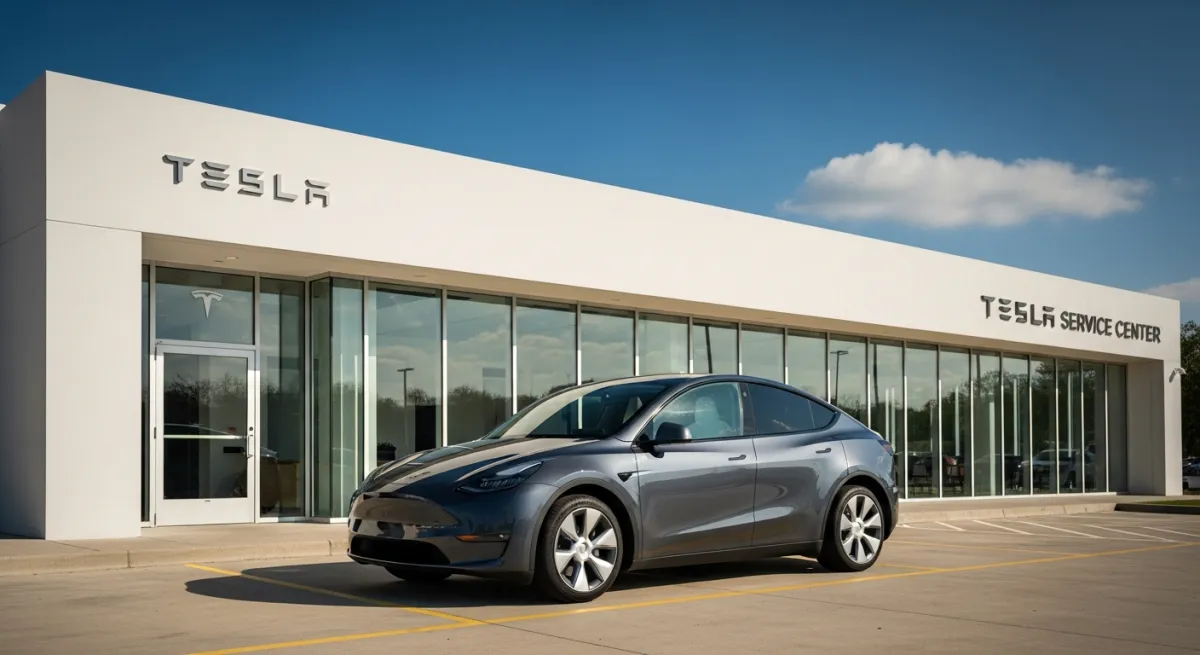
Tesla’s Austin locations — Domain Northside and the South Austin service center — are where you’d take delivery or service a leased vehicle in the metro. Pull current lease terms directly from Tesla’s website or in person. Tesla sets pricing centrally and doesn’t negotiate, which means the payment you see is the payment you get.
Confirm whether the $7,500 credit appears as a line-item cap cost reduction on your deal sheet. Verify this is still Tesla’s practice when you shop. Tesla has revised lease terms and credit pass-through policies before without much warning — sometimes significantly.
Four Austin Driver Profiles, Four Verdicts
Round Rock commuter, 20,000 miles per year, needs a reliable sedan. Buy. The mileage math alone kills the lease case. At 20,000 miles annually on a standard 12,000-mile cap, this driver is looking at roughly $2,000 a year in overage penalties. Upgrading to a 15,000-mile cap reduces but doesn’t eliminate the problem, and the Texas upfront tax treatment adds cost on top. Finance through UFCU or Amplify for 60 months, put a meaningful amount down to keep the payment manageable, and drive it to 150,000 miles.
South Austin resident, under 12,000 miles per year, wants a new Camry every three years. Leasing is worth a serious look. This driver maps cleanly onto a standard 12,000-mile cap. The Texas tax treatment still adds cost versus a lease in most other states, but with controlled mileage and a reasonable money factor, the Camry lease is defensible. Verify the money factor isn’t marked up at the dealer and negotiate the cap cost like a purchase price — because it is one.
Austin tech worker interested in a Tesla Model 3, wants the option to keep the car long-term. Buy, don’t lease. Tesla’s no-buyout provision is a hard stop for any buyer whose intent is long-term ownership. Finance through Tesla’s direct loan product or — better — get a pre-approval from UFCU or Amplify and compare before you sit down with anyone. Verify the Model 3’s current $7,500 credit eligibility for a purchase transaction given the vehicle’s battery sourcing status in 2026. If the vehicle qualifies on a purchase and this buyer meets the income threshold, the rent-vs-buy decision framework that applies to housing also illuminates how break-even thinking works for long-term asset ownership — the purchase math may be stronger than it looks.
Austin Energy customer inside city limits, interested in an EV. Leasing is the strongest available path. This driver has access to the best EV incentive combination in the Austin metro: the federal $7,500 lease pass-through with no income limit and no assembly restriction, plus the Austin Energy home charger rebate that residents outside the city utility territory can’t touch. A Tesla Model 3 lease or a competing EV lease from another manufacturer — provided the credit is being fully passed through — is the most effective use of what’s available in a state that offers nothing at the state level.
Before You Sign — An Austin-Specific Checklist
Generic lease checklists tell you to “read the fine print.” Here’s what the fine print actually contains in Austin.
Confirm the money factor, not just the monthly payment. Ask the finance office for the money factor in writing. Multiply it by 2,400 to get the approximate APR equivalent. Know what rate you’re actually paying.
Get both mileage quotes in writing at the same time. Ask for the 12,000-mile and 15,000-mile options side by side before the conversation narrows. Know the per-mile overage rate in your contract before you sign.
Verify your actual annual mileage before choosing a cap. Pull your most recent registration renewal — it typically reflects odometer readings. Do the commute math yourself before the finance office does it for you.
Check UFCU, Amplify, or Austin Telco before accepting dealer financing on a purchase. A pre-approval takes 15 to 20 minutes online and gives you a real comparison point. There’s no good reason to skip this.
Ask the F&I office directly about Texas lease tax treatment. Confirm whether your trade-in reduces the taxable cap cost. Confirm the total tax amount owed at signing, in writing, on the deal worksheet before you agree to anything.
On any EV lease, confirm the $7,500 credit is applied as a cap cost reduction. Request a deal sheet showing the gross cap cost and the adjusted cap cost after the credit. If the credit doesn’t appear as a line item, push for a real answer.
Budget for the disposition fee. Toyota Financial charges roughly $350 at lease turn-in if you don’t buy or re-lease a Toyota. Factor it into your 36-month total cost, not as a surprise on your final bill.
Verify your utility territory before counting on the Austin Energy charger rebate. Your utility provider appears on your monthly electric bill. If it says Pedernales Electric, Oncor, or anything other than Austin Energy, the city’s EV charging rebate does not apply to you.
The right answer for any individual Austin driver depends on their ZIP code, their commute, their credit profile, and whether they’re looking at a conventional vehicle or an EV. But the variables that actually swing this decision in Austin — the upfront tax treatment, the mileage exposure from suburban commutes, and the federal EV lease pass-through — are all local and specific.
Running the calculation on national averages will give you a number that has nothing to do with what you’ll actually pay.