Tesla Service in Austin Is Backed Up. Here Are the Alternatives
With Giga Texas deliveries flooding the metro and a single full-service location handling demand, Austin Tesla owners are discovering the independent shop market — if they know where to look.
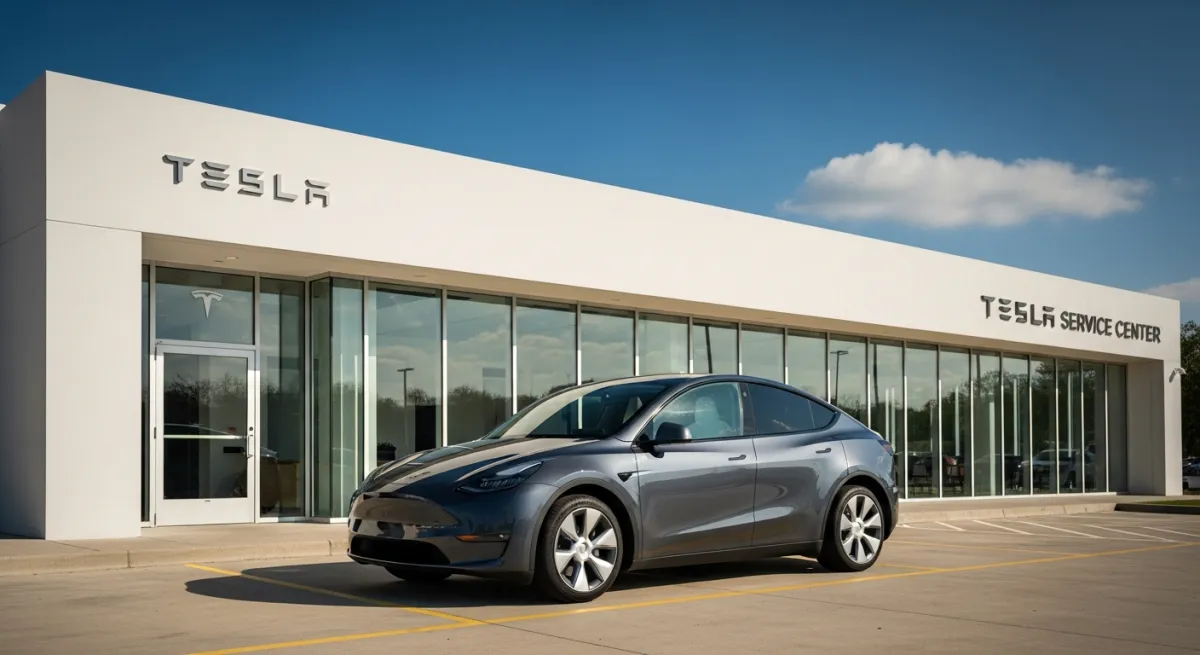
With Giga Texas deliveries flooding the metro and a single full-service location handling demand, Austin Tesla owners are discovering the independent shop market — if they know where to look.
The Tesla app on a Research Boulevard appointment request will currently show you a wait stretching past three weeks for non-urgent service. Brake fluid flushes. 12V batteries. Cabin filters. That’s where things stand as of late June 2025. When you call the Research Boulevard service center directly about a warning-light situation — a BMS fault, a charge-port error, anything the car flags as needing attention — the staff will tell you to document it through the app, that urgent cases get pulled from the queue. “Pulled” means you may move up. You’re still in a queue that runs past the first week of July for most repair categories.
For a city that added thousands of Tesla owners when Giga Texas opened in Del Valle in 2022, and has been adding more every quarter since, one full-service location in the Arboretum corridor cannot handle the load. Summer heat stress on battery cooling systems and HVAC units is about to make it worse.
This piece maps the alternatives: which independent shops in Austin perform Tesla work, what they can and can’t handle, and what the price spread actually looks like on the repairs Austin Tesla owners need most.
The Situation at Research Boulevard Right Now
The Research Boulevard Tesla Service Center at 9901 Research Blvd. is Austin’s only full-service Tesla facility. A second Tesla location at 11601 Domain Dr. handles sales and delivery but not repairs. You can buy the car there. Getting it fixed is a different conversation.
As of the last week of June, the earliest available non-urgent appointment visible through the Tesla app from an Austin-area zip code is July 21. Twenty-three days. For a car that, in many cases, is someone’s only vehicle.
When called directly at (512) 387-0800, the service center acknowledges the backlog and confirms that warning-light cases go through the app’s “is this urgent?” triage flow. They won’t schedule urgent repairs by phone. If your car shows a red warning indicator, they want you in the app. Whether the triage actually surfaces genuinely urgent repairs faster than three weeks is a question the service center declines to answer specifically — which is not exactly reassuring if you’re sitting in a parking lot with an unfamiliar dashboard light.
The 23-day figure isn’t an anomaly. Austin-area Tesla owners report similar or longer waits in forums going back through 2024, with June through September consistently the worst. That’s structural, not a bad week.
Why One Location Cannot Keep Pace With Austin’s Fleet
Giga Texas began producing Model Y vehicles in April 2022 and has since expanded to Model 3 Highland units as well. The factory sits roughly 13 miles southeast of downtown in Del Valle. Its arrival accelerated local deliveries dramatically — people who’d ordered cars from out of state started taking delivery locally, corporate relocations brought California Tesla owners into the market, and the metro’s overall EV adoption rate climbed. The Research Boulevard service center predates all of this, sized for a market that no longer exists.
Tesla has not announced a second full-service Austin location. Think about what that means: the company that operates one of the largest auto manufacturing plants in North America — in the same metro where it’s headquartered — has one service center for a fleet now estimated in the tens of thousands of registered vehicles in the Austin MSA. What the internal calculus is there, I genuinely don’t know. From the outside, it doesn’t add up.
Summer accelerates the problem. Battery thermal management systems and HVAC compressors in Teslas — particularly older Model 3 and Model S units — work substantially harder in Austin’s triple-digit heat. A battery cooling loop that’s been quietly degrading becomes a warning light in July. The service center sees the volume spike every year. The capacity hasn’t grown to match it.
What Independent Shops Can Do — and the Hard Limits
Texas doesn’t restrict non-Tesla mechanics from working on Teslas. Any licensed repair shop can legally service the vehicle. The federal Magnuson-Moss Warranty Act prohibits manufacturers from voiding warranties simply because a consumer used an independent shop for maintenance, provided that shop uses parts and fluids meeting manufacturer specifications. Your battery and drivetrain warranty does not evaporate because you had your brake fluid flushed somewhere other than Research Boulevard.
That said, there are real limits.
Over-the-air software updates require no physical service, but any software-dependent repair may need Tesla’s proprietary diagnostic interface, which independents don’t have full access to. Warranty and recall work must go to an authorized Tesla service center — an independent shop’s labor doesn’t qualify for reimbursement under Tesla’s warranty, full stop. High-voltage battery pack replacements under warranty fall here too. An independent can replace a 12V auxiliary battery (a routine, accessible job). They can’t perform a high-voltage pack swap Tesla would cover.
Collision and body repairs are a separate category entirely, covered below.
Within those limits, independent shops can handle the majority of what most Austin Tesla owners actually need: tire rotations, brake fluid flushes, 12V battery replacement, cabin air filter changes, wiper blades, TPMS service, HV battery coolant flushes, suspension inspections, and alignments. These are exactly the jobs piling up at Research Boulevard right now. For more on this corner of our automotive coverage, we track local shop options, pricing, and service access across the metro.
Austin Independent Shops Confirmed to Perform Tesla Work
Electrified Garage is the most capable independent option in the metro, and it’s not particularly close. Located at 1000 E. St. Elmo Rd., Ste. 1500 in South Austin’s St. Elmo commercial corridor, the shop was founded by technicians with direct EV service backgrounds and works exclusively on electric vehicles. They cover Model 3, Model Y, Model S, and Model X — all current production variants. As of late June, their appointment lead time for routine maintenance is five to seven business days, compared to 23 at Research Boulevard. Same work. They can’t do warranty recall repairs or firmware updates. For everything else on an out-of-warranty Tesla, call them first.
Austin EV operates in North Austin and handles Model 3 and Model Y work — brake service, tire work, cabin filters, 12V battery replacement. Current scheduling runs one to two weeks for routine jobs, with some flexibility depending on what you need. They’re more limited on Model S and Model X, which have air-spring suspension systems requiring additional tooling and experience they don’t advertise.
Christian Brothers Automotive has several metro locations building EV capability. The Cedar Park location (11410 Ranch Rd. 620 N.) and Pflugerville (1501 Pecan St. E.) are the furthest along, handling the most accessible maintenance items: tire service, 12V batteries, wiper blades, cabin filters, brake fluid flushes. Wait times run three to seven days. They’re not EV specialists, and they can’t touch high-voltage system diagnostics. But if you’re out in Round Rock or Leander and need a cabin filter swap on a Model 3, you don’t need to drive to St. Elmo for that.
The Garage on South Congress has EV-capable technicians and has serviced Model 3 and Model Y. Tire service, alignments, basic maintenance. They don’t advertise Tesla work prominently — which actually works in your favor. Owners who call ahead and ask specifically find availability that hasn’t been depleted by word spreading too widely. Current scheduling for routine maintenance runs about a week.
The Price Comparison
These figures come from direct quotes from Austin shops and Tesla app service estimates pulled from an Austin-registered VIN in late June 2025.
Tire rotation: Tesla app, $70. Electrified Garage, $50. Christian Brothers Cedar Park, $49.99.
Brake fluid flush: Tesla, $145. Electrified Garage, $110. Austin EV, $115.
12V battery replacement (Model 3/Y): Tesla, $245. Electrified Garage, $180–$195 depending on battery spec. Christian Brothers, $160–$185.
Cabin air filter replacement: Tesla, $85 for dual-filter vehicles. Electrified Garage, $65. The Garage, $60.
HV battery coolant flush: Tesla, $195. Electrified Garage, $155. Austin EV, $165.
Independent shops are running 15 to 25 percent below Tesla’s app-quoted prices across maintenance categories, with the gap widening on labor-intensive jobs. Over five years of ownership, an owner routing all eligible maintenance to independent shops saves somewhere around $800 to $1,200 on these items alone, based on typical service intervals. That’s real money.
Mobile Service and Whether It Actually Helps
If you were hoping Tesla’s Ranger program was a workaround for the Research Boulevard backlog — it isn’t. Not right now.
Ranger dispatches mobile service to your home or office for repairs that don’t require a lift: 12V battery replacement, wiper blades, door handle replacements, some sensor replacements, and certain software-addressable issues. Anything requiring the vehicle to be raised — brake fluid flushes, tire rotations, HV coolant flushes, brake pad replacements — Ranger can’t do. And in Austin, Ranger availability currently mirrors the service center backlog, with the same approximate three-week wait applying to most job categories.
An independent mobile Tesla service segment does exist in Austin, though it’s small. At least one former Tesla service technician has gone out on their own, offering mobile EV work in the metro at rates below Tesla’s Ranger pricing. They work primarily through word of mouth. Find them through the Facebook group “Tesla Owners of Austin,” where they occasionally post availability. This is worth watching as it grows, but it hasn’t reached scale to help most owners yet.
Collision and Body Work: A Separate Queue
If your Tesla has been in an accident, the independent mechanical shop market above doesn’t apply. Only Tesla Approved Body Shops can source certain structural parts directly from Tesla, interface with Tesla’s claims system, and perform repairs that maintain the vehicle’s safety certification.
In Austin, Caliber Collision holds Tesla approval at multiple metro locations. The North Austin location at 13201 N. Mopac Expy. (near Rundberg) and the Southeast Austin location at 9201 Wall St. are both listed as Tesla Approved. Call ahead to confirm current approval status before scheduling — the designation can lapse, and you don’t want to discover that mid-repair. Tesla approval means the shop can order Tesla-specific structural components, follow Tesla-approved repair procedures, and submit authorization for warranty-related collision work. Non-approved shops can handle cosmetic damage — a scratched bumper cover, a dented door skin — but should not perform structural repairs on a Tesla, and most will tell you that themselves.
Collision wait times in Austin run longer than mechanical service. At Tesla-approved Caliber locations, post-collision repair scheduling is currently in the four- to six-week range for significant structural work, longer for jobs requiring back-ordered parts. Tesla body component supply has improved since 2022 but remains unpredictable. A collision claim will take longer to resolve than a comparable gas vehicle. Plan for it if you’re managing a rental.
When to Use Tesla and When to Go Independent
Warranty or recall issue: Research Boulevard. No alternative. Tesla won’t reimburse independent shop labor under warranty, and some repairs require proprietary diagnostic access that independents don’t have.
Routine maintenance, out of warranty: Call Electrified Garage at 1000 E. St. Elmo Rd., Ste. 1500. Five to seven business days versus 23 at Research Boulevard, consistent savings on pricing, and they know the cars. Phone ahead; walk-in availability is limited.
Basic maintenance, North Austin or suburbs: Christian Brothers in Cedar Park or Pflugerville handles the accessible stuff — cabin filters, tire rotations, 12V batteries — if driving to St. Elmo doesn’t make sense for your location.
Collision damage: Caliber Collision at one of the two Austin Tesla-approved locations. Don’t assume your nearest body shop can handle structural Tesla repair.
High-voltage warning or BMS fault: Don’t take it to an independent shop first. This is where Research Boulevard’s urgency triage is the right call, even with the wait. High-voltage faults can have safety implications and require Tesla’s diagnostic access.
Buying a used Tesla out of warranty: Budget for Electrified Garage pricing rather than Tesla app estimates, and know that independent shop scheduling is currently three to four times more accessible than Research Boulevard. Ownership in this market works. You just have to know where to go and stop defaulting to the app.
CityDesk Austin will update appointment lead-time figures monthly through the summer service season. If you’ve used an Austin independent shop for Tesla work and want to share your experience, email our tips line.