How Much Does Car AC Repair Cost in Austin Right Now
We called a dozen Austin shops this week. Here's what they quoted, how far out they're booking, and what to watch for when demand is this high.

We called a dozen Austin shops this week. Here’s what they quoted, how far out they’re booking, and what to watch for when demand is this high.
Anyone who has sat in Austin traffic on MoPac in June knows what triple-digit heat feels like without checking the weather app. It’s either here or days away depending on when you’re reading this. Either way, every AC shop in the metro is now deep in the part of the season where the phone doesn’t stop ringing and the bay schedule slips daily.
We spent time this week calling shops across Austin — the Firestone on South Lamar, Christian Brothers Automotive on Research Boulevard, several Jiffy Lube locations, Monkey Wrench Autos on Airport Boulevard, and dealership service centers in Cedar Park and Round Rock. We wanted real current quotes, actual booking windows, and a straight answer on what an Austin driver genuinely needs to know before handing over a credit card.
What we found is that “a recharge” is not one service with one price. Depending on your car’s refrigerant type, the shop you call, and whether a leak check is included, you could spend $100 or $450 for what feels like the same job. Here’s what separates those numbers.
How Bad Is It Out There Right Now
June is the month Austin shops describe as the point where the backlog becomes genuinely unmanageable. It’s not that July and August aren’t brutal — they are — but by late July most drivers who put off the AC call have already made it. June is when everyone realizes simultaneously that something is wrong. It’s a little like trying to book a plumber the day your pipes burst, except every pipe in the city goes at once.
“We were same-day available through most of May,” one service advisor at an East Austin independent told us. “Now we’re booking about a week and a half out for anything that isn’t an emergency drop-off.”
A car interior parked in direct sun reaches dangerous temperatures fast. Children and pets face immediate danger. Adults commuting daily in stop-and-go Austin traffic without AC aren’t far behind. This is a safety repair in these months, not a convenience. If you’ve been telling yourself you’ll get to it eventually — this is eventually.
What You’ll Actually Pay: The June Price Table
The prices below come from direct calls to Austin shops this week. We asked for an all-in quote on an AC recharge, asked specifically whether the price included a leak check, and asked about diagnostic fees. Prices are for a standard passenger vehicle; trucks and SUVs may vary.
Firestone Complete Auto Care (S. Lamar Blvd) quoted $109 to $189 for R-134a depending on how much refrigerant the system takes, billed per-ounce after a base charge. R-1234yf came in at $249 to $379. A $19.99 diagnostic fee applies toward repair. Leak check is a visual inspection included with the recharge; dye testing is an add-on.
Christian Brothers Automotive (Research Blvd) charges a flat $89.99 diagnostic fee that applies toward repair. R-134a recharge runs $120 to $160; R-1234yf goes $290 to $420 depending on system capacity. UV dye leak check is included in the recharge price. They were booking one to two weeks out for non-emergency work.
Jiffy Lube — multiple Austin locations — quoted an AC service starting at $99 for R-134a, with the price rising based on refrigerant quantity. R-1234yf availability depends on the specific location. Leak diagnosis is not included at the base price; it’s offered as a separate service. Several locations confirmed same-day availability as of our calls. Right now, that availability is worth real money.
Monkey Wrench Autos (Airport Blvd, East Austin) charges a $75 diagnostic fee before any refrigerant work gets discussed. Their policy is to run a pressure test before recommending a recharge. “We don’t just top it off and send you home,” the service writer said. Full recharge after diagnosis runs $130 to $175 for R-134a, $310 to $390 for R-1234yf. Currently booking about 10 days out. Leak check with dye is standard procedure here — not an upsell.
Dealership service centers in Cedar Park and Round Rock quoted AC performance diagnostics at $130 to $155, applied toward repair. R-134a recharges run $175 to $220; R-1234yf commands the higher end. Booking windows at these suburban locations were generally shorter than at inner-city independents.
Austin’s Automotive Specialists quoted a $65 diagnostic fee. R-134a recharge runs $115 to $165; R-1234yf goes $280 to $400. Leak inspection included. The Burnet Road location is booking about one week out; Far West had marginally better availability.
The short version: a basic R-134a recharge at a chain with same-day availability and minimal diagnostics can land near $100. A proper R-1234yf recharge with a leak check and UV dye test at an independent can run $400 or more — before any actual repair work. Both numbers can be legitimate. What matters is knowing which service your car actually needs, not which price you’re hoping to hear.
R-134a vs. R-1234yf and Why Your Newer Car Costs More
If you drive a 2015 or newer vehicle, your car almost certainly runs on R-1234yf refrigerant rather than the older R-134a. Given Austin’s tech-sector demographics and relatively young vehicle fleet, a substantial share of drivers fall into this category. It matters a lot to your bill.
Federal regulations required R-1234yf for new vehicles as a lower-global-warming-potential alternative to R-134a. Shops pay roughly four to five times more per pound for it at current wholesale prices, and that cost passes directly to you. A car needing two pounds of refrigerant can turn a $120 R-134a job into a $350 R-1234yf job — same time on the lift, same work, very different check. As we note in our automotive coverage, refrigerant type is now one of the most consequential variables in what a repair will actually cost.
How to find out which one you have: open the hood and look at the AC service port label. It’ll specify the refrigerant type. Your owner’s manual lists it under AC or HVAC specifications. Service ports are also physically different sizes, so a shop physically cannot put R-134a into an R-1234yf system by accident — but not every shop stocks R-1234yf at every location. Confirm before you drive across town.
Some chains use per-ounce pricing, which means a system that’s slightly low might cost $80 while a system needing a full recharge runs $300. Ask upfront whether the quote is flat-rate or per-ounce. Ask for a worst-case number. Don’t skip that.
Recharge vs. Repair: The Part Most Guides Skip
Refrigerant does not evaporate. It doesn’t get used up over time like oil or brake fluid. If your AC system is low on refrigerant, there’s a leak somewhere. A recharge without a leak check is at best a temporary fix, often not even that. Depending on where the leak is and how fast the system is losing refrigerant, you might blow cold air for two weeks before you’re right back in the same situation — out another $150 and still no closer to an answer.
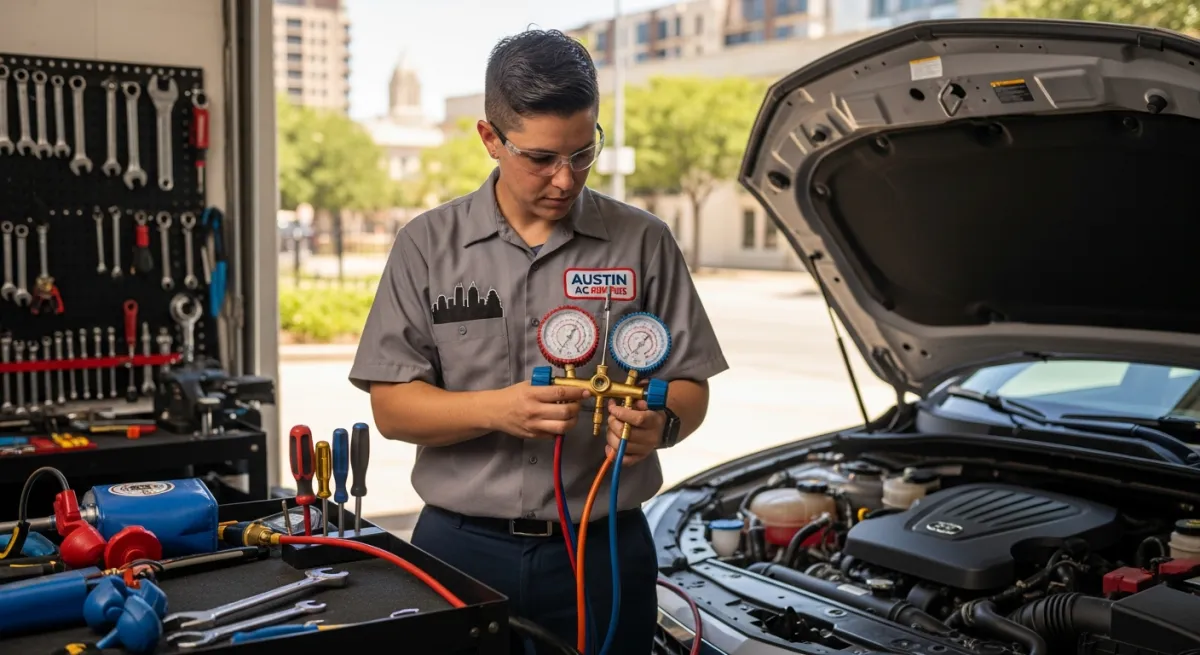
Any shop worth using will run a manifold gauge test before recommending a recharge. This tells the technician how much pressure is in the system — how low the refrigerant is, whether the system is holding pressure at all. Then comes the leak check. A UV dye test injects dye into the system; a UV light finds where it seeps out. An electronic leak detector works for faster leaks. A nitrogen pressure test locates failures quickly when the system is losing pressure rapidly. A UV dye test adds to your bill, but it’s the most common recommendation for slow leaks, and it’s worth it.
Once you know where the leak is, the cost picture changes entirely. Quotes we collected this week: evaporator core replacement, $800 to $1,400 depending on vehicle — labor-intensive access is the main driver. Condenser replacement, $400 to $900, more accessible and thus less labor-heavy. AC compressor replacement, $600 to $1,200. Best-case scenario: an O-ring or hose fitting, which can be a minor repair if caught early. Worst case is the evaporator core, which on some vehicles requires pulling the entire dashboard.
The diagnostic fee you pay upfront at any reputable shop is not overhead. It’s the only way to know which of those outcomes you’re actually facing. A shop that recommends a recharge without running diagnostics is either deferring a conversation they don’t want to have, or they haven’t looked. If a service writer recommends compressor replacement before running a manifold gauge test, get a second opinion before you authorize anything.
Who Has Openings Right Now
The booking situation breaks into fairly distinct tiers.
Jiffy Lube locations across Austin had same-day availability for basic AC services as of our calls this week. Firestone South Lamar had next-day openings. Chain locations in suburban markets — Cedar Park, Round Rock, Pflugerville — reported same-day availability with fewer constraints than inner-city shops.
The one-to-two-week category: Monkey Wrench Autos, Christian Brothers on Research Boulevard, and Austin’s Automotive Specialists Burnet Road. Typical for quality independents during peak weeks.
The geographic split is worth knowing. Suburban dealerships and chains are consistently less backlogged than comparable shops inside the city. If you can drive 20 miles, you might cut a week off your wait. For an urgent situation — transporting young children, a medical condition that makes heat exposure dangerous — that drive is worth making. A week in Austin heat is not abstract.
Practical routing: call Jiffy Lube or Firestone first if you need the car running today, but be explicit that you want a leak check included or quoted separately. If you can wait and the situation isn’t an emergency, the independents booking a week out will give you a more complete picture of what’s actually wrong.
Red Flags That a Shop Is Overcharging You
Peak season creates pressure to authorize work fast. Some shops use that pressure. Here’s what to watch for.
Undisclosed per-ounce upcharges added to a flat-rate quote. If a shop quotes $120 for a recharge and then adds per-ounce charges when they discover the system is empty, that’s not inherently dishonest — but it must be disclosed before work begins. Texas law requires a written estimate before automotive repair work starts. Ask for it.
A recharge sold without any leak diagnosis. A shop that tops off your refrigerant and sends you home without checking for a leak either doesn’t care about your car or is counting on you coming back in a month. Ask directly: “What leak check is included in this price?” If the answer is nothing, decide accordingly.
Compressor replacement recommended before a manifold gauge test. Compressor failure is one possible cause of AC problems. It’s not the most common one, and it’s not diagnosable by symptom alone. If a service writer tells you the compressor needs replacement before a technician has run any pressure testing, get a second opinion.
Pressure to authorize a full system flush without contamination evidence. A flush is legitimate when there’s evidence of moisture contamination or when a compressor has failed and metal shavings may have circulated through the system. It is not a routine maintenance item. If a shop recommends one without telling you specifically what contamination they found and how they found it, you almost certainly don’t need it.
“Refrigerant shortage” claims used to justify price spikes. R-134a is widely available. If a shop cites a shortage to justify prices significantly above market, call another shop before you authorize anything. It takes five minutes.
Quotes that should trigger a second call: R-134a recharge over $350 at a non-dealer without a clear explanation; R-1234yf recharge over $450 without a major component involved; any shop that won’t give a written estimate before beginning work. One more thing: Texas has no state-mandated inspection requirement for AC systems. No shop can legally tell you your car failed an AC inspection and must be repaired before it can be driven. If you hear that framing, walk out.
If you believe you’ve been overcharged or misled, the Texas Attorney General’s Consumer Protection Division accepts complaints at texasattorneygeneral.gov and takes automotive repair complaints seriously.
Independent vs. Chain vs. Dealer
Chain shops — Firestone, Jiffy Lube, Midas — offer consistent flat-rate pricing, online booking, and the best availability right now. Their technicians work from fairly scripted job procedures, which keeps things predictable. The tradeoff: complex diagnostic situations can exceed what the model handles well. If your AC problem turns out to be an evaporator core leak with an intermittent compressor issue, a chain shop may not be where you want to trace that down. You’re paying for speed and reliability, not investigative depth.
Independents like Monkey Wrench or Austin’s Automotive Specialists tend to offer more candid diagnostics and competitive labor on complex work. Monkey Wrench’s policy of requiring a diagnostic before any refrigerant work is genuinely consumer-protective — it should be standard practice everywhere and largely isn’t. The tradeoff in June is time: these shops are the hardest to get into because they’ve built loyal customer bases that fill their bays weeks out. If you can wait, an independent is usually worth it for anything beyond a routine recharge.
Dealerships carry the highest labor rates in the market. That premium is hard to justify unless your vehicle is under a powertrain warranty (AC coverage varies by warranty type — read your terms), the repair involves a recall or technical service bulletin a dealer would handle at no charge, or your vehicle has a manufacturer-specific refrigerant handling requirement. If you suspect a TSB applies to your AC problem, call the dealer service department and ask. That call is free.
Quick decision rule: chain shop if you need same-day service and a basic recharge is likely all you need. Independent if you have a week and want a real diagnostic before anyone touches the refrigerant. Dealer if you have warranty coverage or reason to think this is a manufacturer problem.
What to Do This Week
Before you call anyone, check your hood label or owner’s manual and confirm whether your car uses R-134a or R-1234yf. Five minutes. It immediately tells you whether you’re in the $100 to $200 range or the $300 to $450 range for a recharge, and whether the shop you’re calling even stocks the right refrigerant.
Call two shops. Ask both the same thing: “What is your all-in price for an AC recharge on my vehicle, and is a leak check included?” Note whether the quote is flat-rate or per-ounce. Ask for a worst-case number either way.
Ask for a written estimate before you authorize work. Texas law requires it. A shop that hesitates to put the estimate in writing is not a shop you should be using.
Ask about the diagnostic process. If you want to spend your money once, ask whether the shop will identify the leak source before or after the recharge. A UV dye test can save you from paying for a second recharge in three weeks.
The shops that still have same-day openings in Austin in June are worth calling first. Knowing your refrigerant type, understanding that a recharge without a leak check is often just a delay, and recognizing the red flags above will protect you more than any single shop recommendation we could make.
Prices and availability reflect calls made in June 2025. Shop pricing changes seasonally and with refrigerant wholesale costs. Confirm current quotes directly before authorizing work.