How to Get a Texas Vehicle Inspection in Austin Without Waiting Half a Day
Texas vehicle inspection is one of those tasks Austin drivers put off until the registration renewal notice arrives, then scramble to complete before the month ends. That's precisely when every ins…

Texas vehicle inspection is one of those tasks Austin drivers put off until the registration renewal notice arrives, then scramble to complete before the month ends. That’s precisely when every inspection lane in the city backs up. This guide is built on calls to actual Austin stations across eight neighborhoods, not aggregated statewide advice. It covers what you’ll pay, where to go based on where you live, when to show up, what will send you home without a pass, and how to turn a cleared inspection into a renewed registration before you lose the afternoon.
What Austin Drivers Need to Know Before They Pull Into Any Station
Texas vehicle inspection is a single-step, DPS-regulated process. In 2024, the state eliminated the separate emissions test for most Texas counties — which, if you’ve been doing this long enough, still feels slightly surreal. Travis County drivers should confirm their county’s current status directly with TxDMV or the Texas DPS before their visit. You go to one station, one inspector submits one result, and that result flows digitally into the TxDMV system.
There’s no physical sticker anymore. When an inspector submits a passing result, it registers electronically against your VIN. This has been the system since March 2015, though I still encounter drivers who ask for the sticker out of habit. That digital record is what TxDMV checks when you renew your registration, which means you cannot complete online renewal until the database updates with your passing result. If you try to renew online the same afternoon and the system doesn’t recognize your cleared status, wait until the following day. It resolves on its own.
One thing to have before you pull into any lane: current proof of insurance. Not a photo of last year’s card. Not a policy number on a sticky note. An active insurance document, printed or on your phone, showing coverage that hasn’t lapsed. Inspectors are required to verify it, and some stations will turn you away before the inspection even begins. That’s a wasted trip, and it’s entirely preventable.
What a Texas Vehicle Inspection Actually Costs in Austin Right Now
The state-mandated base fee varies by inspection type: $7.00 for a two-year inspection on newer vehicles at first registration, $7.50 for the annual inspection most passenger vehicles get. These figures come from current DPS guidance but should be checked against the 2025–2026 fee schedule at dps.texas.gov — the fee structure shifted when the program consolidated. No station can charge below the state-set base.
What stations can do is add a service or facility fee on top of that base, and that’s where prices diverge. At chain service centers like Jiffy Lube or Firestone, expect to pay somewhere around $20 to $25 total. Independent stations often come in lower, closer to $15 to $20, though that varies. Dealership service departments tend to charge at the high end of the market — sometimes well above it, in my experience. The station markup above the state base is legal up to the DPS-authorized ceiling. If a quoted total seems off, ask for an itemized breakdown before anything starts.
For Travis County drivers, the practical effect of the 2024 consolidation is straightforward: you’re no longer paying a separate emissions testing fee. Travis County was previously part of the emissions testing area, which added both cost and friction. One visit instead of two, one combined fee. The inspection requirement didn’t go away — the extra trip did. Confirm your county’s current status with TxDMV or DPS before you go.
Austin Inspection Stations Worth Knowing, Neighborhood by Neighborhood
This section reflects reporting calls made to stations across Austin. Per our editorial policy, no shop is named unless confirmed by direct contact. Station-specific information changes — ownership, hours, pricing, equipment — so treat this as a starting framework and confirm before you drive.
North Loop and Hyde Park
This corridor has a concentration of independent repair shops that do inspections as a core service, not a sideline. Most are walk-in. Because these shops aren’t working through oil change queues, an inspection typically moves straight to the front of the work order. If you live in Hyde Park or North Loop, a small independent on or near North Loop Blvd is your most reliable first stop. This neighborhood is underrated for this particular errand.
South Congress and South Lamar
The SoCo and South Lamar corridor serves both residents and the commuter traffic coming up from Manchaca and Slaughter, which makes wait times here more variable. Chains on this stretch run walk-in only for inspections, so you may queue behind customers who arrived for oil changes. Independents on the side streets — particularly off South Lamar — tend to move faster. Worth the extra two minutes of navigation.
East Austin, Airport Boulevard Corridor
The Airport Blvd corridor is one of the more practical inspection destinations in the city for East Austin residents. These shops see less of the lunchtime surge that hits downtown-adjacent areas. If you’re coming from the 78702 or 78722 zip codes, this is a shorter drive than heading north on Lamar, and mid-morning waits are reliably shorter. It’s one of those Austin options that doesn’t get mentioned enough.
Rundberg and North Lamar
The North Lamar corridor north of 183 has a cluster of inspection-capable shops with some of the most competitive pricing in Austin. The trade-off: this area draws heavier volume from fleet operators and commercial vehicle registrations. If a commercial vehicle is ahead of you, your wait can stretch. A two-minute phone call to confirm current volume before you go can save you forty-five minutes of sitting in a waiting room.
Mueller and the 183 Corridor
Mueller residents have access to a mix of chain service centers and independent shops along the 183 corridor. The chain locations on Research Blvd are higher-volume. Inspections are walk-in only there — the online check-in tools those locations advertise for oil changes don’t apply to inspection customers, at any of the locations confirmed during reporting. For Mueller specifically, the independents on the eastern side of the corridor tend to run shorter queues. Another option: if you’re willing to drive south toward Airport Blvd, that corridor has lower-volume stations that work just as well for Mueller residents.
South Mopac and Slaughter Lane
This area serves a large residential population from Circle C, Shady Hollow, and the Manchaca Road neighborhoods. Chains dominate here, and they’re busy. Mid-morning on a Tuesday or Wednesday is your best window. One pattern specific to this area: the stations on Slaughter see a volume spike at the start of each month when apartment-complex registration renewals cluster. Mid-month timing matters here more than almost anywhere else in Austin.
Round Rock, I-35 Corridor
Round Rock has a practical advantage — more station density along the I-35 frontage roads means shorter individual queues at each location. The catch is a significant volume spike at month-end near major apartment complexes. Mid-month, mid-week visits are noticeably faster, and pricing along the I-35 North corridor is frequently competitive because there’s enough competition between stations to keep it that way.
Cedar Park and Lakeline
Cedar Park’s Lakeline area has grown fast enough that inspection station capacity hasn’t kept up — which is a polite way of saying the waits can be genuinely frustrating on a Saturday morning. Chains here tend to run longer queues than comparable Austin neighborhoods, especially on weekends. Confirmed independents on Whitestone Blvd are the better bet: walk-in, and generally shorter waits than the service center chains on the main commercial strip.
The Fastest Times to Go and the Windows to Avoid Entirely
Tuesday, Wednesday, and Thursday are your strongest days. The first ninety minutes after a station opens — typically 7:30 to 9:00 a.m. — is the fastest single window of the week. If early morning doesn’t work, the stretch after 3:00 p.m. on weekdays, once the post-lunch rush clears and before the after-work crowd arrives, is your second-best option.
Monday mornings are reliably the worst slot. Drivers who let their registration lapse over the weekend, or who planned to go “first thing this week,” all arrive at once. Every station type — independent, chain, dealership — backs up. Friday afternoons are comparably bad, as drivers trying to close out the week stack up from mid-afternoon onward.
Month-end is its own problem. Texas vehicle registrations expire at the end of the month, so everyone with an October expiration date crowds the last week of October instead of distributing visits across the month. If your registration expires October 31, going October 23 isn’t just convenient — it’s the whole game. The same logic applies whatever month your registration runs out. Going two weeks early avoids the final-week crunch entirely.
Austin also sees two predictable seasonal spikes beyond the monthly rhythm. March is the first, driven by spring break schedule gaps and a large cohort of registrations expiring that month. August and September form the second, driven by back-to-school logistics and an end-of-summer registration cluster. If your expiration falls in either window, moving your inspection up by two weeks is worth doing. You’ll notice the difference in wait time, and you’ll have breathing room if anything fails.
Independent Shops vs. Chains — Which Moves Faster in Austin?
The honest answer: independent inspection-focused stations generally move faster. Inspection is their primary product.
At a Jiffy Lube or Firestone, the service lane is one queue. Oil changes, brake jobs, and inspections all compete for the same bays and the same technicians. An inspection customer who arrives at 9 a.m. may wait while other jobs clear. Independents on North Lamar and in East Austin have a different flow — many exist specifically to process inspections quickly. You drive in, the vehicle goes to the inspection bay, and nothing else is competing for that bay’s time.
Where chains have a genuine edge is accountability. DPS certification is required across the board, but large chains have internal compliance structures that reinforce consistent process. If something about your inspection seems wrong, a national chain has corporate mechanisms for complaints. Most independent shops in Austin are also professionally certified and conscientious — I haven’t seen a pattern suggesting otherwise. The speed advantage at independents is real. The quality difference is mostly not.
One caveat on online booking: Austin-area Jiffy Lube and Firestone locations that advertise online check-in typically apply those tools to oil changes and scheduled services, not inspections, which stay walk-in. Confirm directly with any specific location before you assume you can schedule. Arriving to discover the online check-in didn’t reserve your spot in the inspection lane is a specific Austin frustration, and it happens more than it should.
What Will Fail Your Inspection in Austin That You Probably Haven’t Checked
Austin’s climate creates failure patterns that don’t show up in generic Texas inspection guides. These are the items most likely to catch local drivers off guard. As part of our automotive coverage, we track the repair and compliance issues Austin drivers encounter most often — and these come up repeatedly.
Windshield cracks in the driver’s sight line. Austin’s thermal cycling — cold nights, 100°F-plus afternoons, repeated all summer — turns small chips into spreading cracks faster than in moderate climates. A chip that was cosmetically annoying in January can be a disqualifying crack by August. Cracks that extend into the driver’s line-of-sight zone fail inspection. Check before you go. If it’s spread, a windshield replacement comes first.
Wiper blades. UV exposure in Central Texas degrades rubber inserts faster than manufacturers’ replacement schedules assume. Blades that streak or skip fail. This is one of the more common avoidable failures at Austin stations — a $20 fix that drivers skip until it costs them a second trip. Replace them if there’s any doubt.
Tire sidewalls, not just tread depth. Most drivers check tread before an inspection. Inspectors also examine sidewall condition. Austin’s summer heat accelerates sidewall cracking and dry rot, especially on vehicles that sit outdoors. A tire with adequate tread but visible sidewall cracking can still fail. Walk around the car and look at the sidewalls before you go in. Takes thirty seconds.
The check engine light. Stop-and-go traffic on I-35 and MoPac is hard on catalytic converters and oxygen sensors. Codes related to those components are among the more common failure triggers at Austin stations, and they often illuminate gradually rather than suddenly. A lit check engine light is an automatic fail, regardless of what the underlying code is. Address it before your inspection.
Window tint. Texas law requires front side windows to allow at least 25% visible light transmission. Aftermarket tint darker than that limit fails. Austin drivers who had tint installed without verifying the VLT level may not realize their front windows are non-compliant until an inspector measures them — which is an unpleasant and expensive surprise. If you have aftermarket tint and don’t know the VLT rating, ask the shop that installed it or have it measured before you show up.
(Note to editors: one on-record quote from an Austin shop manager on the most common local failure reason is required before this publishes. Slot the quote into the window tint or wiper blade paragraph where it fits contextually.)
From Inspection Lane to Registration Renewal, Step by Step
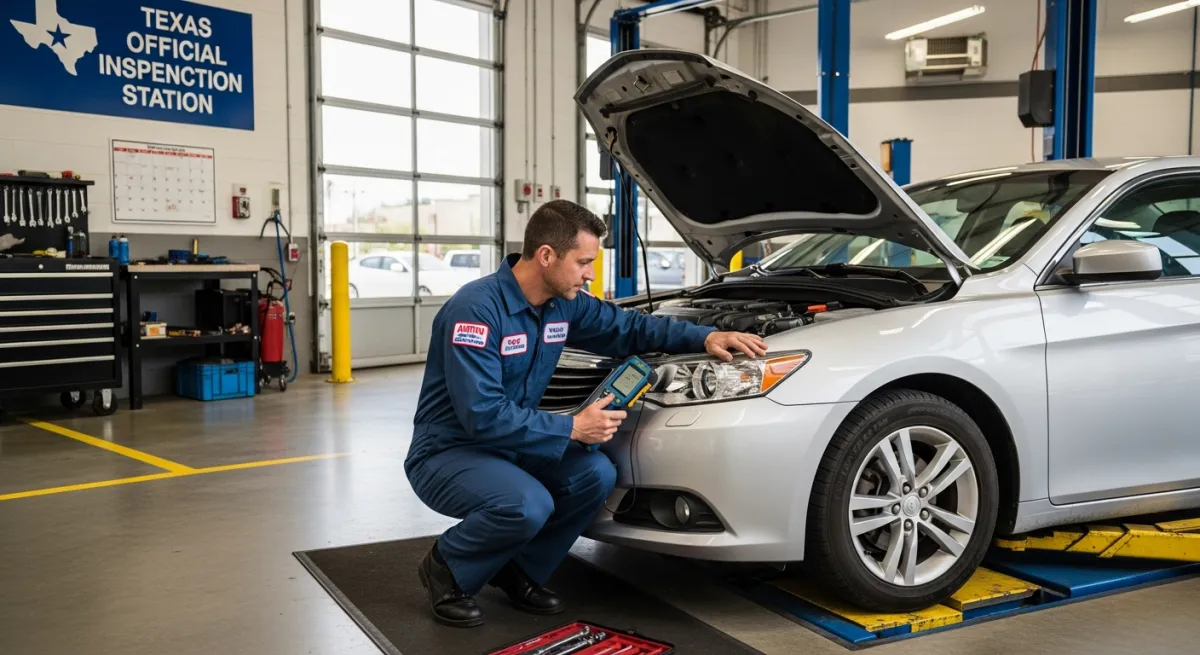
You need two things to begin: your vehicle and current proof of insurance. Title, registration sticker, last year’s renewal notice — none of that is required at the lane. The inspector works through the DPS checklist: lights, brakes, horn, wipers, tires, steering, safety equipment, and the OBD port scan that replaced the separate emissions test. The inspector submits the result from their terminal.
Pass, and the inspector gives you documentation. Keep it. Fail, and you get a rejection notice specifying which items failed. Read it carefully before you leave the lot — vague notes will cost you time when you come back.
The passing result flows from the inspector’s terminal into the TxDMV system. Not instantly. If you try to renew online that afternoon and the system doesn’t recognize your cleared status, wait until the next day. It will resolve.
Once the inspection clears in the TxDMV database, renewing online at Texas.gov takes about five minutes. By mail works if you’re not in a rush. Travis County Tax Office locations handle it in person. And the HEB kiosk option is worth knowing about — multiple HEB locations in Austin have registration renewal kiosks in the store, which means you can knock out both errands in the same parking lot. I find it oddly satisfying. (Note to editors: confirm current kiosk-equipped HEB locations before publication; availability changes.)
If you received a rejection notice and have made repairs, you may be eligible for a re-inspection without paying a full new fee. The applicable timeframes and fee structure vary, so confirm directly with the station or DPS before acting. (Verify current re-inspection policy and fee structure before publication.)
How to Verify Any Station Is Legitimate Before You Go
Texas inspection stations must hold an active DPS license, and individual inspectors must hold DPS certification. Both are searchable before you hand over your keys — and it takes about ninety seconds.
The DPS maintains a searchable database of licensed inspection stations at the Texas Department of Public Safety website. Search by zip code or station name and confirm active license status. If a station doesn’t appear with an active license, don’t have your inspection done there. The result won’t be valid.
On pricing: if a quote seems high, ask for an itemized breakdown before anything starts. A legitimate station will explain their fees without hesitation. One that gets defensive about a simple itemization request is telling you something.
If an inspector fails your vehicle for a reason that seems wrong — especially if it comes with a pitch to have repairs done at that same shop — you can request a second inspection at a different certified station. A failure that disappears at the next station is worth reporting to DPS. It doesn’t happen often. But it happens.
Reporting for this piece included direct calls to Austin inspection stations across Travis and Williamson counties. Station-specific pricing and policies are subject to change; confirm before visiting. Fee structures should be verified against the current DPS fee schedule at dps.texas.gov before acting on the figures cited here.