What to Know About Summer Coolant and Overheating Repairs Before Austin Hits Triple Digits
Austin's first 100-degree day typically arrives somewhere between June 10 and June 25. In 2023, it landed on June 14, and that month recorded 13 days at or above 100°F. By late May, afternoon highs…

Austin’s first 100-degree day typically arrives somewhere between June 10 and June 25. In 2023, it landed on June 14, and that month recorded 13 days at or above 100°F. By late May, afternoon highs are already clearing 95°F regularly. If you’re driving a vehicle whose cooling system hasn’t been serviced in two or more years, that calendar milestone isn’t just a weather story. It’s a maintenance deadline.
This piece is for Austin drivers who want to know what a coolant flush actually costs at local shops right now, what early warning signs look like before they become a costly repair, and why the difference between a flush and a top-off matters more than most service writers will take the time to explain.
The Austin Heat Window and Why June 1 Is Already Late
Austin summers don’t ease into triple digits. Based on historical National Weather Service data for Austin-Bergstrom, the metro routinely records its first 95°F day in the last week of May, and the transition to 100°F follows within two to four weeks. The 2023 season was representative rather than exceptional — thirteen days at or above 100°F arrived in June and stretched continuously through August.
What the calendar doesn’t capture is the thermal environment your car actually lives in before you turn the key. A vehicle parked in direct Austin sun on a 95°F afternoon — on a surface lot off East Riverside Drive, or in the open-air levels at the 183/290 interchange — has an engine bay that can passively reach 150 to 180°F before the combustion process adds any heat at all. The urban heat island effect in Austin’s denser corridors adds a documented 3 to 5°F on top of the official recorded temperature, which is measured at the airport. So when the forecast says 98°F, the air your radiator is working against is already past 100°F.
When you start your car at 5:15 PM on a July Tuesday after it’s been sitting outside all day, your cooling system is working against a deficit that simply doesn’t exist in October. A cooling system in marginal condition — degraded fluid, a softening hose, a water pump not moving full volume — may handle November without complaint and fail in July. The thermal stress window is narrow and predictable. It’s a strip of calendar when deferred maintenance becomes engine damage.
If you’re planning to book a coolant service before summer, the first two weeks of June is not ambitious. It’s catching up. The window that actually matters is May.
What Austin Shops Are Charging Right Now
Note to readers: CityDesk Austin contacted local shops to confirm current pricing and availability for this article. Rates and booking lead times shift week to week during the pre-summer rush. Confirm current pricing and scheduling when you call.
Coolant flush pricing varies by shop type, vehicle size, and whether the service includes a full system flush or a fluid exchange. Those two things are not the same service — a distinction that matters a lot and gets glossed over constantly. You’ll find that gap explained in detail across our automotive coverage, where we track local shop practices and seasonal maintenance issues specific to Central Texas driving conditions.
Austin’s Automotive Specialists on North Lamar is the kind of independent shop that tends to perform a true pressure-flush rather than a drain-and-fill: they circulate fresh coolant through the radiator, heater core, and engine passages under pressure to displace accumulated sediment and degraded fluid. That’s the procedure you actually want. Lead times at quality independents tighten considerably by mid-May, so call at least two to three weeks out — sooner if you can.
Christian Brothers Automotive operates multiple Austin-area locations including Cedar Park, Round Rock, and South Austin. Their coolant flush includes a courtesy inspection of the radiator and hose condition, and service advisors there tend to be direct about diagnostics. Their booking portal lets you check availability windows before you call, which saves time.
Jiffy Lube and Valvoline Instant Oil Change locations around Austin perform coolant fluid exchanges and are generally bookable same-day or next-day even in late May. The tradeoff: most quick-lube locations perform a drain-and-fill rather than a pressurized flush. For a newer vehicle with recent coolant history, that may be fine. For a car with unknown service history or one that’s run 80,000 miles on the same fluid, it’s probably not going to address what’s actually wrong.
Firestone Complete Auto Care has multiple Austin locations with online scheduling. Their service is categorized as a flush, but it’s worth confirming the specific procedure when you book — some locations have pressurized flush equipment, others stick to drain-and-fill. Ask before you show up.
When calling any shop, ask specifically what procedure they perform: full pressurized flush, drain-and-fill, or fluid exchange. The answer should shape both which shop you choose and how you evaluate the price.
A Flush and a Top-Off Are Not the Same Thing
Here’s the section that will save some readers an argument at a service counter.
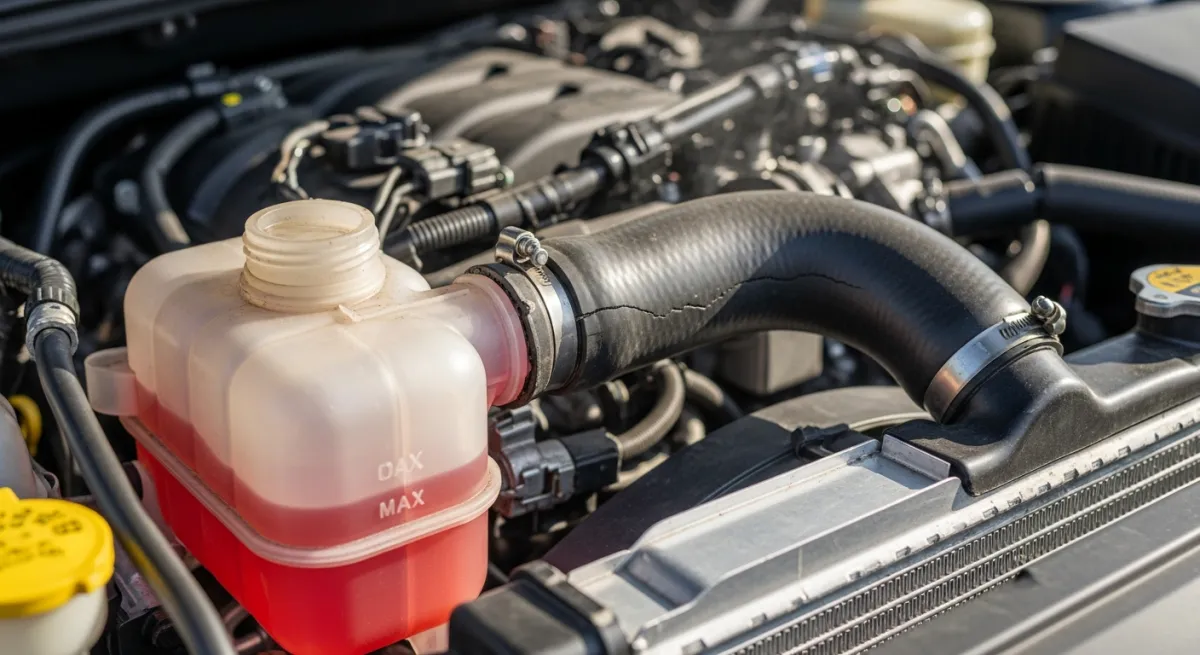
A top-off means adding fresh coolant to the reservoir until the level reaches the “max” line. It does not remove the existing fluid. If your coolant is two years old, a top-off leaves you with mostly two-year-old coolant and some fresh fluid mixed in. The degraded stuff stays in the system, still circulating through your engine block.
Coolant doesn’t just provide freeze and boil protection. It contains corrosion inhibitors, lubricants for the water pump seal, and a chemical buffer that keeps the fluid’s pH stable. As coolant ages, that pH drops. Acidic coolant attacks aluminum engine components — the heads, the water pump housing, the heater core. The degradation isn’t catastrophic overnight, but Austin’s sustained summer temperatures accelerate the chemical breakdown that turns a routine maintenance item into a component replacement.
A full coolant flush physically removes the old fluid, either by draining and refilling or by using a flush machine that circulates fresh fluid through the system under pressure. The pressurized version removes more residual old fluid from passages in the block and heater core. Most manufacturers recommend a flush every 30,000 to 50,000 miles or every two to five years, depending on coolant type. OAT-based coolants (the orange or red formulas common in GM and many European vehicles) carry longer service intervals than conventional green coolant.
The legitimate question — “is this an upsell?” — has a direct answer: it depends on your existing fluid’s age and condition. A quick-lube shop recommending a top-off when you’re two years out of interval is underselling you. A shop recommending a flush when you had one eight months ago is overselling you. Knowing which applies to your car is mostly a matter of knowing your service history, or being honest with yourself when you don’t.
The Temperature Math: When Risk Actually Starts
Your car’s thermostat opens at roughly 195 to 210°F — the operating range where coolant circulates at full flow through the radiator. A healthy system can maintain temperatures in this window even under load, because the radiator and fans dissipate heat at the same rate the engine generates it.
The margin shrinks as ambient temperature rises. On a 70°F day, the radiator sheds heat into air that’s 130 degrees cooler than the coolant. On a 100°F Austin afternoon, that differential drops to around 100 to 110 degrees. The system works harder for the same result. A cooling system running at 90 percent capacity in October may hit its limit in July. That 10 percent gap is the difference between unremarkable and roadside.
Measurable damage risk begins around 230 to 240°F. Coolant that has lost its additive package starts to gas out earlier, reducing the fluid’s ability to transfer heat from metal surfaces. Most temperature warning lights trigger somewhere between 240 and 250°F — which means if the light comes on, you are already past the point of no damage. You’re into potential head gasket stress, warped cylinder heads, scored bearings. The warning light is not an early warning. It’s a late one.
Where Austin Traffic Makes This Dangerous
The scenario that most reliably exposes a marginal cooling system isn’t the highway commute. It’s low-speed, stop-and-go traffic in full afternoon sun.
At highway speed, air pushed through the grille by forward momentum provides the majority of radiator cooling. Electric radiator fans — what you’re relying on when the car is stationary or crawling — move a fraction of that airflow. At 5 to 15 miles per hour in gridlock, you’re dependent almost entirely on a fan running in air that is itself 100°F.
The specific Austin stress points are worth naming. I-35 through downtown, particularly the Airport Boulevard to Riverside Drive segment during evening rush, where traffic regularly compresses to near-standstill between 5 and 7 PM. MoPac at the Bee Caves Road interchange, where the southbound slowdown can hold vehicles at near-zero speed in a corridor with minimal shade and surface asphalt temperatures regularly exceeding 150°F in July. The US-183/Research Boulevard corridor on the northeast side: heavy commercial traffic, multiple signal-controlled intersections, extended low-speed idling. If you commute any of these routes, you know exactly what this looks like.
A vehicle sitting over 150°F pavement is absorbing radiated heat from below while the engine generates it above. A water pump at 90 percent efficiency, or coolant at degraded concentration, or a thermostat that’s sticking — any single marginal condition that causes no trouble in October can trigger a 5:45 PM roadside emergency in July.
Seven Warning Signs to Check Before June
These are things a driver can observe without visiting a mechanic. Each has a specific meaning. None means “probably nothing.”
Temperature gauge climbing above midpoint during normal city driving. Not just in heavy traffic — if your gauge is creeping toward the three-quarter mark during a routine twenty-minute surface-road commute, the system is struggling. The midpoint is where a healthy system runs. Sustained elevation at moderate speeds is a signal, not a one-off. (A temporary spike while sitting in gridlock is different; watch for what happens once you’re moving again.)
Sweet smell from the engine bay. Ethylene glycol has a distinctive sweet odor. If you’re smelling it after you shut the car off and walk past the front, coolant is contacting a hot surface somewhere. It can indicate a leak from a hose, the water pump seal, or the radiator — or the overflow reservoir ejecting coolant from a system building too much pressure. Book a shop visit. Don’t talk yourself out of it.
Heater blowing cold when set to hot. The heater core is a small radiator inside the dashboard that circulates hot coolant to warm cabin air. If it’s blowing cold when the engine is fully warmed up, either coolant level is low enough that the heater core isn’t getting adequate flow, or there’s an airlock in the system — a pocket of air that has displaced coolant. Both warrant attention before summer.
Reservoir level dropping without a visible external leak. If the level is consistently dropping with no puddles under the car, you may have an internal leak: coolant burning in the combustion chamber (typically a head gasket symptom) or a slow seep that evaporates before it reaches the ground. Neither is something to sit on.
Rust-colored or milky coolant in the reservoir. Coolant should be a clear, bright color — green, orange, or pink depending on type. Rust-colored fluid means corrosion in the system. Milky or foamy fluid means oil and coolant have mixed, which points to head gasket failure or a cracked block. Either condition means a shop visit before heat season, not after.
Gurgling from the dash or engine bay after shutting off. This typically comes from the heater core or upper radiator hose and indicates air in the cooling system. A properly sealed system is pressurized and contains no air. Gurgling points to an incomplete seal somewhere: a loose hose clamp, a failing radiator cap, or a developing leak.
White steam from under the hood. Pull over. White steam is either coolant hitting a hot surface from a leak, or the beginning of active boilover. Driving through it turns a five-minute inconvenience into a significant repair.
What a Blown Head Gasket Costs Versus What a Flush Costs
The math here is simple. A blown head gasket — the most common severe outcome of sustained overheating — runs $1,500 to $3,000 or more at Austin independent shops, depending on the vehicle and whether overheating has warped the cylinder head, which adds machine shop work to the bill. On a newer vehicle with an aluminum head, it can go higher.
A preventive coolant flush costs roughly 10 to 20 times less.
Austin’s used-vehicle population has a specific exposure here. The 2021 to 2023 inventory crunch pushed a large number of buyers into vehicles purchased at elevated prices from sellers they didn’t know, often with no service documentation. If you bought a used car in Austin during that stretch and can’t point to a coolant flush record, that gap in history is itself a reason to have the service done before July. You’re not being overcautious. You’re filling in a blank that could cost you a few thousand dollars to leave empty.
What to Ask When You Call Any Austin Shop
You don’t need to know everything about cooling systems to have an informed conversation. A few specific questions do most of the work.
Ask for a full coolant system flush — not a fluid exchange or top-off. Use those words. If the service writer responds by explaining they offer an exchange rather than a flush, ask what the difference is in their procedure. A shop confident in its work will explain it clearly. Vagueness is information.
Ask which coolant type they use and whether it’s appropriate for your vehicle. The main categories: OAT (organic acid technology, typically orange or red, common in GM and many European vehicles), HOAT (hybrid OAT, typically yellow or gold, common in Ford and Chrysler), and conventional silicate-based green. Mixing types degrades both fluids’ inhibitor packages. A reputable shop will either use the manufacturer-specified type or ask what your vehicle requires before they start.
Ask about the earliest available appointment in the first two weeks of June. If the answer is “we’re booked through the third week of June,” that’s useful — and a reason to call around, or to book a less-preferred shop that actually has availability. Waiting for your preferred shop until late June is not a great trade.
One thing to watch for: being sold a top-off at full flush pricing. If the charge seems high for how quickly the service was completed, ask to see the invoice and ask what procedure was performed. The difference between a drain-and-refill and a top-off should be visible in the labor description on the receipt. If it isn’t, ask.
Austin’s heat doesn’t give much warning, and cooling systems don’t fail on a schedule. They fail in July, on I-35, when a water pump that was running at 90 percent capacity in October hits its limit in 100°F air with 150°F pavement underneath it. The narrow window between now and the first sustained triple-digit stretch is when a phone call to a shop costs nothing and a coolant flush costs a few hundred dollars. By the time your temperature gauge is moving in the wrong direction on MoPac at 5:45 PM, both of those options are gone.
Reporter verification note: Shop prices and availability windows must be confirmed by direct contact with Austin’s Automotive Specialists, Christian Brothers Automotive, Jiffy Lube/Valvoline, and Firestone locations before publication. National Weather Service Austin/San Antonio forecast office seasonal outlook for summer 2026 should be pulled for Section 1 specifics. Any shop-reported data on spring overheating call volume should be obtained and incorporated into Sections 2 and 7.