Where to Charge Your EV on a Drive Between Austin and San Antonio
For most modern EVs, this is a no-stop drive. Until it isn't. Here's which fast chargers actually work, which networks to avoid on a summer Saturday, and what to do if a station is down.

For most modern EVs, this is a no-stop drive. Until it isn’t. Here’s which fast chargers actually work, which networks to avoid on a summer Saturday, and what to do if a station is down.
The drive from Austin to San Antonio is 80 miles. Most new EVs are rated for 250 miles of range or more. On paper, this is a non-event: drive down, don’t think about it, plug in at your hotel.
In practice, a July Friday afternoon on I-35 with the AC running hard, a charge you didn’t quite top off before leaving, and a station at the San Marcos Premium Outlets showing stalls out of service on PlugShare tells a different story. This corridor is short enough that most drivers skip planning entirely, and occasionally long enough to strand someone who did.
This guide maps every viable DC fast charger between the two cities, gives you honest reliability data by network, explains what real range numbers look like in Texas summer conditions, and tells you exactly what a stop will cost. It’s written for drivers who want to know what’s actually on the road, not what the charging-network marketing says is there.
The 80-Mile Reality Check
The corridor’s central paradox: this trip almost never causes problems and occasionally becomes exactly a problem. Eighty miles of highway is well within the range buffer of any modern long-range EV. But “modern long-range EV” does a lot of work in that sentence.
Three variables determine whether you need a charging stop. Starting charge level is the one you actually control, and most drivers get it wrong. Leaving Austin at 45% because you figured you’d be fine and the Buc-ee’s took longer than expected is how a routine drive becomes a detour to a strip-mall ChargePoint that only has Level 2. Sound familiar?
Texas heat degrades battery range in two ways. The battery management system draws power to keep cells within operating temperature, and the cabin AC, running against 100°F ambient air, pulls significantly harder than it does in March. The practical adjustment for this corridor — 75 mph cruise speed, AC running, temps in the triple digits — is roughly 10 to 15 percent range reduction versus mild weather. That doesn’t sound like much until it’s the difference between arriving comfortable and white-knuckling the last ten miles.
Which car you’re driving matters, too. A Hyundai Ioniq 6 Long Range RWD and a Chevy Equinox EV are both “EVs” but they’re different vehicles for this conversation. So is the question of whether you’re in your own car, where you know the range behavior, versus a rental where you’re learning the car’s habits in real time on the highway.
The I-35 corridor also has a structural complication: construction. The ongoing rebuilding of I-35 through the Austin-to-Kyle stretch routinely creates stop-and-go traffic. Counterintuitively, this can help range. EVs recuperate energy during braking and consume it more slowly at low speed than at highway cruise. A 20-minute construction delay through Kyle may cost you less range than those same miles driven at 75 mph. Cold comfort, but there it is.
If you’re leaving Austin above 60% charge in a long-range EV, you can drive to San Antonio without a stop in almost any conditions. Below that, plan one. Below 40%, stop in San Marcos rather than watching the range estimate drop and hoping.
What Your EV Actually Does at 75 MPH in 100°F Heat
EPA range ratings are measured on a specific drive cycle that doesn’t approximate sustained Texas highway driving in summer. The practical adjustment for this corridor lands at roughly 70 to 80 percent of EPA-rated range once you account for 75 mph cruise, full AC, and triple-digit ambient temps.
A Chevy Equinox EV Long Range (about 300 miles EPA) will deliver real-world summer highway range somewhere in the 175–210 mile ballpark. On its face, that’s plenty for an 80-mile drive. But the margin is tighter than the EPA figure suggests. Leave below 60% on a hot day with traffic and your practical buffer before a necessary stop narrows fast. Charge to 80% or above before leaving Austin, regardless of trim.
The Hyundai Ioniq 6 Long Range RWD (361 miles EPA) is the strongest option on this corridor, and it isn’t particularly close. Real-world summer highway range runs around 255–290 miles. The buffer is substantial, and the 800-volt architecture means that when you do stop at a compatible 350kW Electrify America stall, you can reach 80% from 10% in about 18 minutes under good conditions. That changes the math on a “just in case” stop considerably — pull in, add a meaningful buffer, leave before you’ve finished a coffee. Ioniq 6 drivers above 60% leaving Austin have a genuine no-stop option even in peak summer heat. In a rental or loaner, build in more margin; you’re learning the car while you drive it.
The Tesla Model Y Long Range AWD (330 miles EPA) delivers real-world summer highway range around 235–265 miles. There’s no realistic scenario where an Austin-to-San Antonio drive requires a charging stop. Leave with 50% in July heat and you’ll still arrive in San Antonio with comfortable margin.
If you’re in an unfamiliar EV on this drive, build in 20 percent extra margin beyond what these figures suggest. You don’t know the car’s actual degradation. You may not know how to read the range estimate’s confidence. Stop in San Marcos if you’re below 70% leaving Austin.
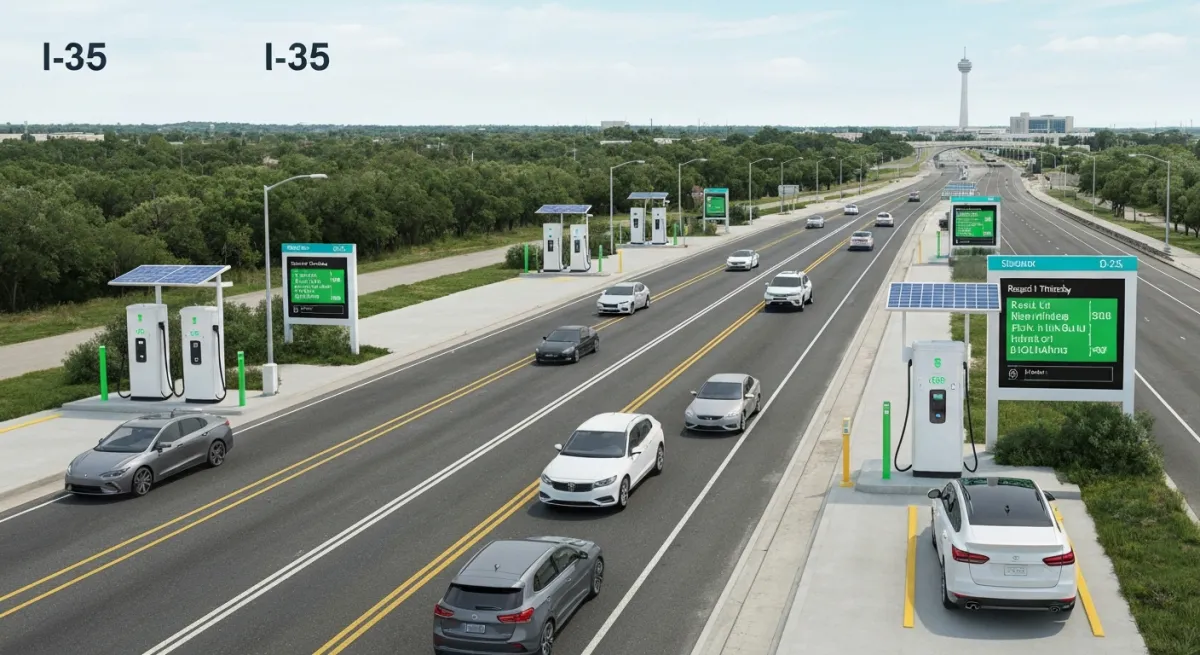
The Charging Station Map from Kyle to North San Antonio
Every viable DC fast charger on the I-35 corridor between Austin and San Antonio, listed north to south. “Viable” means DC fast charge capable. Level 2 at a Hampton Inn is noted where relevant but it’s not a highway charging option.
Austin pre-trip top-up options. If you’re starting a trip on a partial charge, two locations worth knowing: the Tesla Supercharger at the Domain (north Austin) and the Supercharger at Southpark Meadows near Slaughter Lane, which is convenient for drivers heading south. If you’re leaving on less than 60%, stopping at Southpark Meadows for 15 minutes before hitting the highway is smarter than gambling on San Marcos availability. Check current stall status in the Tesla app or PlugShare before you go.
Kyle — approximately Exit 213. The Kyle area has a Tesla Supercharger location in the Kyle Marketplace/Plum Creek corridor and an Electrify America station reportedly near the H-E-B/Kohl’s retail area. Verify both on PlugShare the morning of your trip. If you’re stopping in Kyle for charging reasons and didn’t plan to, something has already gone sideways. The primary stop on this corridor is San Marcos.
San Marcos — approximately Exit 200 (Premium Outlets). This is the main stop, and it has two networks present. The Tesla Supercharger runs 16 or more stalls and is open to non-Tesla drivers via NACS adapter. It’s the most reliably working fast charger on the corridor — by a wide margin, not by a little. Non-Tesla CCS vehicles need a NACS adapter; more on that below.
The Electrify America location sits in the same general lot with four to six 350kW stalls. When it’s working, this is where an Ioniq 6 earns its architecture advantage — roughly 18 minutes for a 10-to-80% charge at maximum output. EA’s reliability here has been the corridor’s primary weakness for non-Tesla drivers. Always check PlugShare before assuming the stalls are functional.
The San Marcos location also generates its own EV charging demand independent of through-traffic. The Outlets draw visitors who drive EVs, park, and plug in for hours. Friday and Sunday afternoons can have queues even when every stall is working. That part doesn’t make it into the network marketing.
New Braunfels — approximately Exit 182. New Braunfels is a popular weekend destination: Schlitterbahn, river tubing, the Gruene area. This creates real charging demand on weekends that current infrastructure doesn’t comfortably absorb. Verify DCFC availability on PlugShare before treating it as a reliable stop.
The New Braunfels Buc-ee’s at Exit 182 is one of the highest-traffic travel stops in Texas, and DCFC there has been under discussion and is plausible by 2026. If it’s live by the time you’re reading this, it changes the math for this stretch significantly — the location is ideal, and Buc-ee’s has real operational discipline that charging-only companies often lack. Check PlugShare or the Buc-ee’s website before your trip. Until then, treat any DCFC at New Braunfels as a backup, not a plan.
North San Antonio — Stone Oak and surroundings. The north San Antonio suburbs have better DCFC coverage than the New Braunfels stretch. Electrify America and Tesla Supercharger locations exist in the Stone Oak and Loop 1604 corridor. For most Austin-to-San Antonio drivers, arriving in this zone with 15 to 20 percent charge is fine — you’re functionally at your destination, and hotel charging takes over.
Downtown San Antonio’s fast charging coverage is thin for a major city. Thinner than you’d expect given the tourist volume around the River Walk. If your final destination is the River Walk, the Pearl, or the Convention Center district, don’t count on convenient fast charging at arrival. Plan to arrive with adequate charge or identify overnight Level 2 charging at your hotel. Getting into greater San Antonio with at least 20 percent is a reasonable standing rule.
Network by Network — Who’s Reliable and Who Isn’t
Tesla Supercharger. The most dependable network on this corridor. Since Tesla opened Superchargers to non-Tesla vehicles, the network is relevant to any driver with a NACS adapter. One caveat: sites with non-Tesla vehicles that charge more slowly — because they’re not preconditioned, or because adapter throughput is limited — have degraded effective site capacity. Still, Supercharger reliability is the baseline against which everything else on this stretch is measured. It’s not a close competition.
Electrify America. EA’s national reliability improved from roughly 75 percent uptime in 2022 to around 85–88 percent as of 2024 reporting. It’s still the weakest major DCFC network on this corridor. EA’s specific problem on Texas highway routes: its liquid-cooled charging cables have documented thermal management issues under sustained high-heat operation. In a Texas July, with stations running at high utilization all afternoon, outage clusters at EA sites are a known pattern — not a fluke. The San Marcos EA site is the most important non-Tesla charging location on the corridor, which makes its inconsistency the corridor’s biggest infrastructure problem. There’s no diplomatic way to say that.
If you’re a non-Tesla driver and EA San Marcos is down when you pull in, your fallback is the Supercharger in the same lot if you have a NACS adapter. If you don’t, you’re calling EA’s customer service line and figuring out next steps from a parking lot. EA Pass+ membership runs about $4 per month and brings the per-kWh rate to approximately $0.48. Without it, closer to $0.64 per kWh. Verify current pricing in the EA app before your trip.
ChargePoint. Predominantly Level 2 on this corridor. Not a highway fast-charge solution between Austin and San Antonio. If a mapping app shows a ChargePoint location in Kyle or New Braunfels, verify the charge level before going out of your way. A Level 2 charger is useful overnight. On a road trip stop, it’s a slow-motion disappointment.
EVgo. Limited presence on this specific corridor. Not currently a meaningful part of the Austin-to-San Antonio DC fast charging picture. Noted here as a gap rather than an option.
The Non-Tesla Driver’s Problem
If you’re not in a Tesla, your primary DCFC options between Austin and San Antonio are essentially Electrify America. Kyle has limited and inconsistent DCFC. New Braunfels has limited and inconsistent DCFC. San Marcos has the EA location, which is better than the other stops but still not at Supercharger reliability. If EA San Marcos is down when you pull in, you have three options: use the San Marcos Supercharger via NACS adapter, push south to north San Antonio if your range allows it, or backtrack north toward Kyle. None of those are good.
Whether your 2025 or 2026 Ioniq 6 or Equinox EV ships with a native NACS port or requires an adapter depends on trim and purchase date — verify with your dealer. Existing CCS owners should check adapter availability through Tesla or third-party sources. If you haven’t gotten NACS access sorted out yet, do it before this drive. It turns “EA is down in San Marcos” from a stranding scenario into a minor inconvenience.
The open-network infrastructure on this corridor is currently adequate for a no-plan trip in a non-Tesla only if you’re driving a long-range vehicle leaving Austin above 60% in mild conditions. For everyone else, this route requires deliberate planning: know which stalls you’ll use, have PlugShare open, have a fallback for each stop. That’s not a failure state. It’s the current reality of non-Tesla DCFC on this corridor. It’s better than it was in 2023. It’s not yet where it needs to be.
Summer Weekend Timing — When Queues Become the Problem
Reliability is one variable. Availability is another. A fully operational EA site with six 350kW stalls can still mean a 20-minute wait on a Friday afternoon in August if four cars are already queued when you pull in.
The high-risk windows are predictable. Southbound Friday afternoon, roughly 3 to 7 p.m., brings Austin commuters, weekend travelers, and San Antonio-bound visitors all converging on San Marcos simultaneously. Northbound Sunday afternoon is the return window from San Antonio, New Braunfels, and the Hill Country. Combined with river-tubing traffic coming off the Guadalupe, summer Sundays in New Braunfels create a secondary demand surge that the current DCFC infrastructure there simply doesn’t handle well.
The San Marcos Outlets compound things because they generate their own EV-driving visitors. Shoppers who park, plug in, and browse for two hours displace highway travelers from stalls that would otherwise turn over quickly. It’s not obvious when you pull in why a six-stall EA site is suddenly full at 2 p.m. on a Saturday. Now you know.
If you can stop before noon southbound on a Friday, do it. Hitting San Marcos between 11 a.m. and 1 p.m. northbound on Sunday typically beats the return rush. If you must stop during peak windows, check PlugShare’s real-time check-ins before you exit. A site with active check-ins showing most stalls working and no queue is worth stopping at. Half the stalls down with cars waiting might warrant pushing to the next option.
One more thing on construction traffic through Kyle: stop-and-go conditions early in your southbound trip cost you less range than you’d expect. EVs recuperate energy during braking and consume it more slowly at low speed than at 75 mph. A construction delay isn’t good. But it’s not as bad as it feels when you’re sitting in it.
What a Charging Stop Actually Costs
Electrify America charges approximately $0.64 per kWh at 350kW stations without Pass+ membership, and about $0.48 per kWh with it ($4/month). EA sometimes adds a session or connection fee — check the app. Tesla Supercharger rates vary by time of day, location, and account type; non-Tesla drivers pay a different rate than Tesla account holders. Check the Tesla app for current pricing at San Marcos before charging. Verify all rates in-app before your trip. These numbers change.
The broader point: the home-charging advantage — off-peak utility rates for Austin-area residents through Austin Energy — disappears the moment you’re paying per-kWh at a highway fast charger. DC fast charging on this corridor costs significantly more per mile than charging at home. EV road trips can still be economical overall, but “EVs are cheaper to fuel” needs an asterisk when you’re paying peak highway rates at San Marcos on a Friday afternoon. Worth knowing before you pull up to the stall. For more on how summer conditions affect driving and energy use in Austin, our coverage of heat and outdoor activity in Austin addresses the same triple-digit variables from a different angle.
Bottom Line by Vehicle
Chevy Equinox EV Long Range. Charge to 80% before leaving Austin. If you’re running low, the Southpark Meadows Supercharger is your last practical top-up before the highway. Drivers leaving above 60% have margin in most conditions but should stop in San Marcos if the range estimate looks tight by Kyle. Check PlugShare for both San Marcos locations the morning of the trip, not in the parking lot.
Hyundai Ioniq 6 Long Range RWD. The best vehicle for this corridor. Above 60% leaving Austin is genuinely no-stop territory in peak Texas summer heat. Below that, San Marcos is a quick stop — the 800V architecture keeps the time cost minimal. Get NACS access sorted before you go: native port or adapter depending on model year. EA is your primary open-network option and it’s not fully reliable; knowing the Supercharger is right there in the same lot is the backup that makes this manageable.
Tesla Model Y Long Range. There’s no realistic scenario where you need to stop. Leave with 40% in July heat and you’ll arrive with comfortable margin. The San Marcos Supercharger is convenient if you’re continuing south later, returning the same day, or just want to see 80% again. The in-car navigation will tell you a stop is unnecessary. It’s right.
Pull up PlugShare for San Marcos — both the EA and the Supercharger — the morning you’re leaving. Look at the last five check-ins. If you see a pattern of outage reports at EA in the last 48 hours, adjust before you leave the house. It takes three minutes and it’s the one habit that separates drivers who handle this corridor without drama from the ones posting about it on Reddit.
Most of the time, Austin to San Antonio is a non-event. When it isn’t, it’s usually a station that’s down, a car that left on a partial charge, or a driver who didn’t check. Two of those are within your control. The third one is Electrify America’s problem to fix, and they’re working on it — slowly.