Where to Find Reliable EV Charging in Austin by Neighborhood
A block-by-block look at Mueller, East Austin, SoCo, and the Domain. Which networks hold up. Where fast chargers actually exist. Why East Side drivers are left doing the math on empty.

A block-by-block look at Mueller, East Austin, SoCo, and the Domain. Which networks hold up. Where fast chargers actually exist. Why East Side drivers are left doing the math on empty.
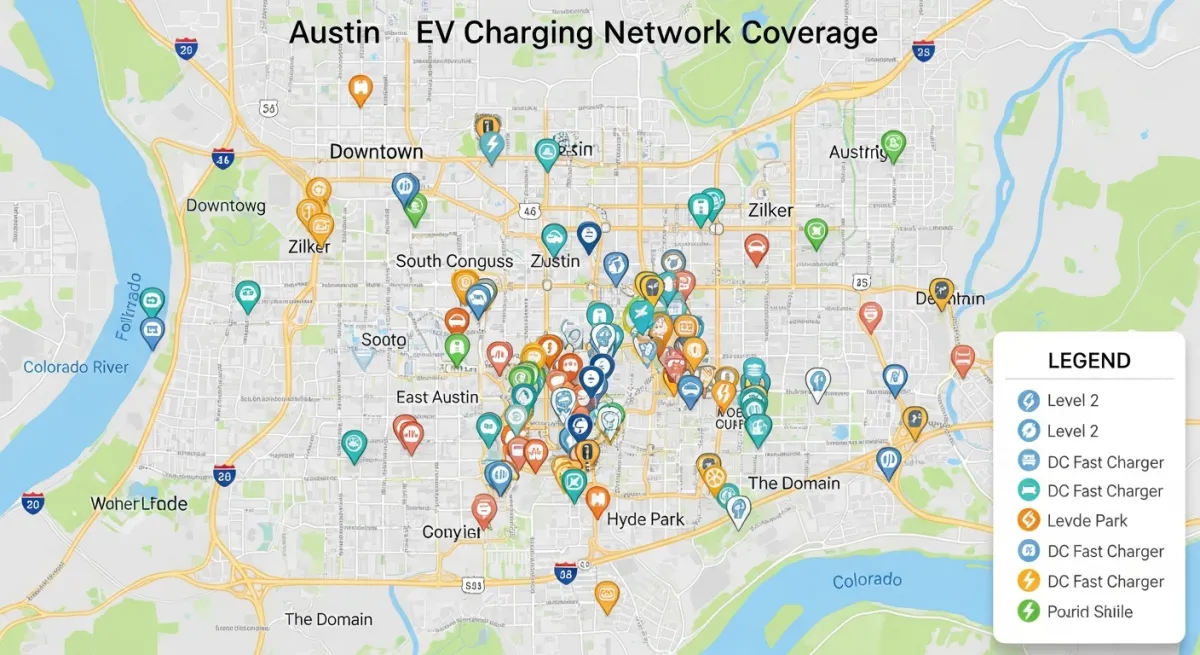
The Domain has the fast chargers. East Austin mostly doesn’t.
That sentence contains more useful information than most Austin EV coverage, which treats the city as a single market with a single charging experience. It isn’t. A driver in a Nissan Leaf on East 11th Street faces a genuinely different situation than someone in a Model Y stopping at Domain Northside on the way home from work. A guide that doesn’t account for that isn’t a guide—it’s a press release.
This piece covers four neighborhoods where Austin EV drivers actually spend their time: Mueller, East Austin, South Congress, and the Domain. We looked at PlugShare check-in data and user comments, which surface real-world outages that official network dashboards quietly ignore, and cross-referenced with ChargePoint, Electrify America, and Austin Energy’s public infrastructure maps. We verified Level 2 vs. DC fast charging designations on the ground.
Level 2 vs. DC Fast Charging in Real Austin Terms
One technical distinction matters before the neighborhood breakdown. It explains a lot.
Level 2 chargers—the kind bolted to the wall of most retail parking lots—deliver roughly 15 to 25 miles of range per hour depending on the vehicle. DC fast chargers (DCFC) can add 100 or more miles in under 30 minutes. The difference is not trivial.
Austin’s parking geometry and errand culture mean your charging window is often short. A run through the Mueller HEB on a Tuesday evening is maybe 45 minutes door-to-door. A Level 2 charger there gives you somewhere around 10 miles of recovery—enough if you live nearby, not enough if you drove in from Pflugerville. A two-hour dinner on South Congress is a different story: you might recover 30 to 40 miles, which is actually useful for most daily drivers. Anything faster than that—the equivalent of a gas station stop when you’re running late—requires DCFC.
Keep that framework in mind for everything below.
Mueller: Well-Maintained Equipment, but No Fast Charger in Sight
Mueller is the city’s most EV-friendly neighborhood by infrastructure density relative to size. It’s also the neighborhood most likely to make you feel like Austin’s charging problem is solved when it isn’t.
The master-planned district was built with charging in mind. ChargePoint Level 2 stations run through the HEB parking lot and the Aldrich Street retail corridor, with generally reliable hardware and consistent uptime based on PlugShare check-in history. Complaints about broken equipment are rarer here than elsewhere in Austin—which, if you’ve spent any time reading PlugShare comments, is genuinely saying something.
But Mueller is a Level 2-only neighborhood. There’s no DC fast charging within the core district. The nearest confirmed option is a Tesla Supercharger on Airport Blvd, which means leaving. For residents who charge at home overnight, this is a non-issue. For visitors from a distance, or for the Mueller residents in older apartment buildings without dedicated charging access, the density of Level 2 stations doesn’t compensate for the absence of a fast charger. If you’re shopping the HEB and want to top up, Mueller is as frictionless as Austin gets. If you need speed, you’re driving somewhere else.
East Austin: The City’s Clearest Charging Dead Zone
The corridor running from East 11th Street down to Cesar Chavez, between I-35 and 183, is the worst-served area for public EV charging in Austin’s urban core. That’s not editorial opinion—it’s what the data shows.
Sparse Level 2 coverage, no confirmed public DCFC within the residential fabric, and a Blink network presence that carries a poor reliability reputation. PlugShare comments from Austin Blink users follow a familiar pattern: drivers arrive to find a station that isn’t working. This happens often enough that the comments start to blur together.
The demographic dimension isn’t incidental. East Austin has a significantly higher renter population than Mueller or the Domain, and renters without dedicated parking can’t install a home charger. EV ownership in the neighborhood skews toward shorter-range vehicles—the Leaf and the Bolt—rather than the longer-range Model Y and Ioniq 5 that dominate wealthier zip codes. Shorter-range vehicles depend on public infrastructure for routine use, not just occasional top-ups. So the neighborhood that most needs reliable fast charging has the least of it.
Austin Energy has made equity-focused charging commitments in public statements and planning documents, including language about prioritizing underserved neighborhoods. The honest status: check current Austin Energy EV infrastructure documentation before citing any of it as completed. The gap between announced intent and installed hardware has historically been wide. East Austin’s charging density doesn’t reflect the equity framing in the utility’s public communications. Not yet.
South Congress: Good for a Long Dinner, Useless If You’re in a Hurry
South Congress has Level 2 ChargePoint coverage along the corridor, and it works well for the use case it actually suits—destination charging during a two-hour dinner or a long browse. Plan your evening around it and you’re fine.
The limitation is arithmetic. A 30-minute errand on Level 2 in SoCo yields maybe 10 miles of recovery. That’s not going to solve a range problem. Drivers who pull in hoping to grab a quick charge will be disappointed.
The Whole Foods on South Lamar—close enough to be part of many drivers’ mental map of the area—has free Level 2 ChargePoint stations. Free means occupied. If you’re counting on that station on a Saturday, have a backup plan.
South Congress also has a physical problem unrelated to hardware: ICE-ing. The weekend parking situation is chaotic, and EV charging spaces get blocked by non-EVs regularly. A charging station you can’t pull into is not a charging option. It’s just a sign.
The Domain: Austin’s Best Urban Fast-Charging Cluster, With One Real Caveat
If you need DC fast charging in Austin outside the highway Supercharger network, the Domain is the answer. The Electrify America station at Domain Northside is a multi-stall DCFC installation with stalls rated up to 350 kW—hardware that can add 100 miles in under 30 minutes on a compatible vehicle. Tesla Superchargers are also present in the area. For non-Tesla drivers who need a real charge and aren’t near a highway, Domain Northside is as good as it gets in Austin right now.
Here’s the caveat, and it’s a real one. Electrify America has a national uptime record that should make any driver pause before making a detour specifically to use one of their stations. The network has improved from its early years—it had nowhere to go but up—but PlugShare check-in comments at Austin-area Electrify America locations document recurring problems. A station that was fine on Tuesday may have stalls down by Friday. The comments tell you. The aggregate star rating doesn’t.
Before driving to Domain Northside specifically for a charge, open PlugShare and read the most recent check-in comments—not the rating, the actual text. Build this habit for any Electrify America location. It will save you at least one bad afternoon.
ChargePoint vs. Electrify America: The Honest Reliability Picture
Austin’s public charging is largely a two-network story for non-Tesla drivers. ChargePoint dominates Level 2 across retail, municipal, and commercial locations. Electrify America owns most of the urban DCFC capacity.
ChargePoint’s reliability advantage in Austin comes from better hardware maintenance and a larger local footprint—when one station is down, there’s usually another nearby. The Mueller retail cluster is among the city’s more dependable installations. The tradeoff is speed: Level 2 ChargePoint is not going to rescue you from a genuinely low battery quickly. That’s physics.
Electrify America offers significantly higher power output at its DCFC locations, which matters if you drive a vehicle capable of accepting 150 kW or more. The Domain installation is the relevant Austin example. But higher output means more complex hardware, and more complex hardware fails more often. Impressive when it works. Unreliable in a way that Level 2 ChargePoint rarely is. I find myself recommending ChargePoint to anyone who asks, and then immediately having to explain that no, it won’t charge you very fast.
On pricing: Texas law now permits EV networks to bill per kilowatt-hour rather than per minute—a change that benefits slower-charging vehicles. Whether specific Austin Electrify America locations bill per kWh or per minute varies by station. Check the EA app before you pull in. ChargePoint pricing varies by site host; some Austin locations are free, others charge per kWh. The ChargePoint app shows pricing before you commit.
Austin’s Apartment Problem: Charging Without a Driveway
A large share of Austin’s EV owners and potential buyers are renters who can’t install home chargers. This is most acute in East Austin, East Riverside, and the South Lamar corridor—all renter-heavy, all relatively underserved by public DCFC. Renters navigating the East Austin rental market this summer face the added friction of negotiating with landlords on charging access at the same time inventory is tight—a dynamic covered in more detail in our coverage of the UT-area lease market and how renters are navigating Austin’s summer 2026 rental conditions.
Austin doesn’t have a confirmed right-to-charge ordinance compelling landlords to allow or facilitate EV charger installation. Austin Energy has engaged multifamily property owners through incentive programs, but a building code requirement mandating EV-ready infrastructure in new multifamily construction hasn’t been definitively enacted as of this writing. Verify current status through Austin Energy and the City of Austin Development Services Department directly—this is a policy space that moves fast, and articles date faster than regulations.
What currently exists for renters: Austin Energy offers rebates for EV charger installation with provisions for multifamily properties when the property owner participates. Some apartment complexes have installed shared Level 2 chargers in parking structures through this pathway. The practical experience of renters trying to access it is mixed. It depends heavily on whether your landlord is motivated to engage, which is a polite way of saying it often doesn’t go anywhere.
If your building doesn’t have chargers, public infrastructure becomes your primary option—which circles back to the East Austin problem. The neighborhoods with the most renters have the least reliable public charging. The workaround for renters near commercial corridors is to identify nearby retail or municipal Level 2 stations and build long-duration charging into your schedule rather than relying on quick top-ups. It works. It also shouldn’t be necessary in 2025.
What Austin’s Summer Heat Does to Your Charging Math
Austin summers introduce a variable that most national EV coverage underweights, probably because most national EV coverage isn’t written by people who’ve sat in a black car on MoPac in August. Ambient temperatures above 100°F trigger aggressive battery thermal management in almost every EV on the market, and thermal management draws from the battery. Real-world range reductions of 10 to 15 percent are common during peak Austin heat.
A vehicle that comfortably meets its rated range in mild weather will fall short in July. A Level 2 stop that was adequate in March may not be in August. East Austin’s charging gap gets worse in summer, because the drivers most dependent on public infrastructure are often in shorter-range vehicles that lose the most ground to heat. It compounds.
One more nuance: some vehicles limit charging speed when battery temperatures are elevated, which means even a Domain Electrify America stop may take longer than the rated spec suggests. Most modern EVs offer battery pre-conditioning. Check your vehicle’s manual or app for how to activate it before a fast-charging stop. It makes a real difference and almost nobody does it.
Check Before You Drive
Given the reliability variance above, the most useful thing an Austin EV driver can do before routing to a charging stop is spend 60 seconds with PlugShare first.
Read recent check-in comments, not the aggregate rating. A ChargePoint station with a 4.2-star average that had multiple reported failures in the past two weeks is not a 4.2-star station this week. Comments surface recency; ratings don’t. Filter by the past 30 days on any station you’re depending on.
Then open the network’s own app for live status. PlugShare shows historical check-ins; ChargePoint and Electrify America apps show current occupancy and stall status. For Electrify America in particular, the live status screen is the closest thing to a real-time answer you’re going to get. Treat it with some skepticism—it’s still better than nothing.
If you’re a renter without home charging, contact Austin Energy about their EV charger rebate program and bring your landlord into the conversation. Getting your landlord to engage is the harder part, but the rebate has historically covered a meaningful share of hardware and installation costs for qualifying properties when they do. For context on how equity gaps in essential services track across East Austin neighborhoods, our reporting on East Austin’s food access gap and its health costs documents a similar pattern of underinvestment in the same zip codes.
The Domain cluster is genuinely good. Mueller’s Level 2 density is among the best in the city. But the improvement is uneven in ways that track too closely with neighborhood income and renter rates to ignore, and the gap between the city’s stated equity commitments and the actual hardware on East 11th Street is still wide enough to affect real people making real daily decisions. That gap is worth watching—and worth asking Austin Energy about directly when they publish their next infrastructure update.