What EV Tax Credits and Rebates Are Actually Available in Texas in 2026
A dealership-level guide to the incentives that survived Washington, the ones Texas never offered, and what Austin Energy adds that buyers in Round Rock or Georgetown simply cannot access.

A dealership-level guide to the incentives that survived Washington, the ones Texas never offered, and what Austin Energy adds that buyers in Round Rock or Georgetown simply cannot access.
Editor’s note: Several figures in this article — including the federal credit status post-2025 reconciliation, Austin Energy rebate amounts, and individual dealer registration — require direct verification before publication. Verification flags are noted inline. Readers should confirm current amounts at IRS.gov and austinenergy.com/go/evs before making purchasing decisions.
If you’ve spent any time on EV forums or talking to Austin dealers in the past six months, you’ve heard the same question: did Washington kill the federal EV credit? The anxiety is understandable. The 2025 federal budget reconciliation process generated months of conflicting headlines, most of them written before the final bill text existed.
Here’s a straight answer grounded in what’s actually on paper — then an honest accounting of what Texas offers on its own (short answer: very little) — then the part that matters most for anyone living inside Austin Energy’s service territory.
Does the Federal $7,500 Credit Still Apply in 2026?
[REPORTER VERIFICATION REQUIRED: Confirm §30D survived or was modified by checking IRS.gov and final reconciliation bill text before publication. The analysis below reflects the credit as it stood under the Inflation Reduction Act prior to any 2025 modification. Dollar amounts and caps should be confirmed against current law.]
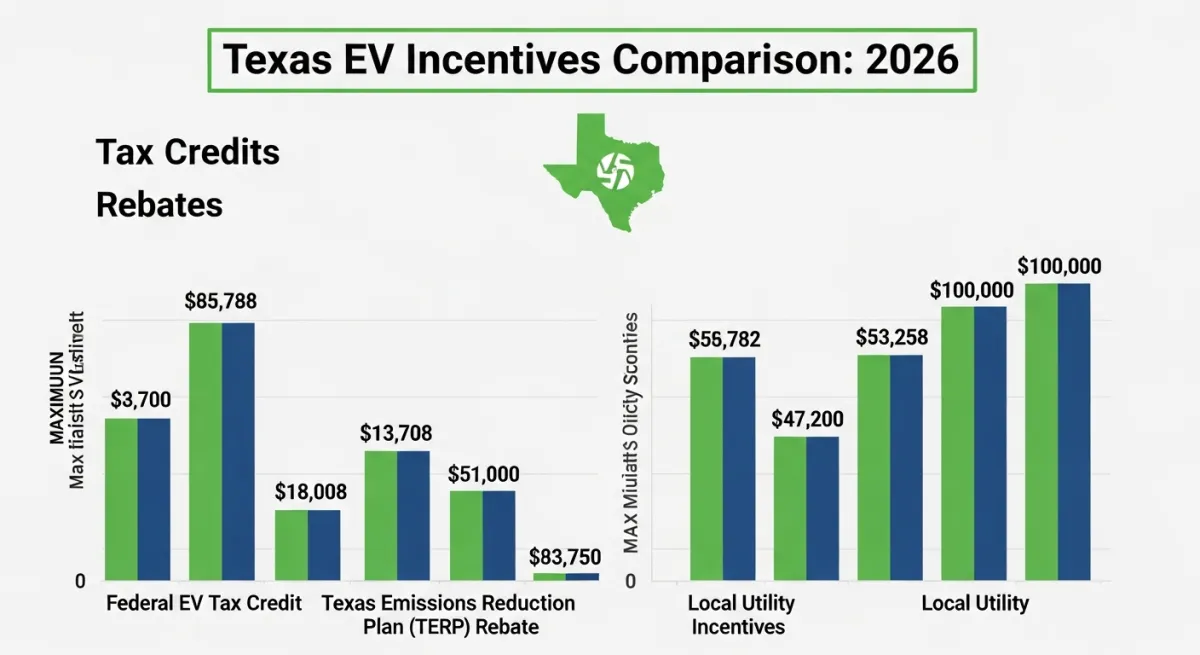
Under the Inflation Reduction Act, the §30D Clean Vehicle Credit provides up to $7,500 for a new qualifying electric vehicle. As currently written, it survives into 2026 with income and price caps that most Austin buyers can work with — if they prepare.
The income limits are based on Modified Adjusted Gross Income. Single filer: $150,000. Joint filers: $300,000. Head of household: $225,000. These are MAGI figures, not gross salary. Pre-tax 401(k) contributions, HSA contributions, and other above-the-line deductions can move a household under the threshold. This matters more in Austin than in most Texas markets. A dual-income tech household in Barton Hills or Westlake — two engineers at one of the semiconductor or software firms that cluster along the I-35 corridor — can clear $300,000 in W-2 income while assuming they qualify, then find out at tax time that they don’t. Austin’s median household income hovers around $75,000, which puts most of the city’s EV-buying population well under the cap. But the buyers cross-shopping a $70,000 truck or a loaded SUV are also the ones most likely to be near the edge. The credit was designed with that tension baked in.
Run your MAGI number before you negotiate the deal. Before.
The MSRP caps matter enormously for vehicle selection. Sedans, wagons, and hatchbacks must come in under $55,000. SUVs, trucks, and vans get an $80,000 ceiling. This catches buyers off guard on specific configurations. A fully optioned Hyundai IONIQ 6 SE can clear $55,000 depending on trim. The standard Chevy Equinox EV starts well below that threshold — which is a big part of why the Equinox has become the volume vehicle for dealers trying to move credits in markets like Austin.
The credit is nonrefundable in its tax-return form, meaning it can reduce your federal liability to zero but won’t generate a refund beyond that. The point-of-sale transfer mechanism covered below changes that calculus significantly for buyers who can use it.
Texas State Incentives: The Honest Short Answer
Texas does not offer a state-level consumer rebate for EV purchases. It didn’t through prior legislative sessions, and the 2025 session produced no new consumer EV incentive bills — though readers should verify the final outcome at capitol.texas.gov, since late-session amendments occasionally surface.
The structural reason is simple: Texas has no state income tax and no state energy agency with a consumer rebate mandate comparable to California’s CPCB or Colorado’s CDPHE. The Legislature has historically shown little appetite for consumer-facing EV subsidies. That pattern held through the most recent session.
What Texas does have, implemented in 2021, is a $200 annual EV registration surcharge collected through TxDMV. This is the cost that almost never comes up in dealership incentive conversations, and it should. Over five years of ownership, that’s $1,000 in additional registration costs — money the state captures to partially offset the gas-tax revenue that EV drivers aren’t paying at the pump. It’s a defensible policy argument. It’s also a real number that belongs in any multi-year ownership calculation, and most buyers in Austin showrooms have probably never heard it mentioned.
TxDOT’s NEVI corridor funding comes from federal sources. Texas received money to build EV charging along major highways. That infrastructure will eventually reduce range anxiety on drives to Houston, San Antonio, or the Hill Country, but it puts nothing in a buyer’s pocket in 2026.
Austin Energy’s Programs, Ranked by Dollar Value
This is the section that separates Austin buyers from the rest of the metro — frankly, from most buyers in Texas. Austin Energy is a municipal utility with the rate flexibility and program capacity that investor-owned utilities like Oncor often can’t match at the same speed. Its EV offerings in 2026 represent real money for buyers who use them strategically. That last part matters.
[VERIFY: Current rebate amount, TOU rate differential, and 2026 program funding status at austinenergy.com/go/evs before publication. Figures below reflect historically reported amounts.]
The EV Time-of-Use Rate Plan
Austin Energy’s EV Time-of-Use rate plan is not a rebate. It’s a rate structure, and most people significantly underestimate it. Under EV-TOU, Austin Energy charges substantially less per kilowatt-hour during off-peak hours — typically late night into early morning. On-peak periods cost more and align with Texas summer afternoons, when the ERCOT grid is under maximum stress and the utility’s wholesale power costs spike.
For an EV owner who plugs in consistently after midnight, the savings stack on every charge. Not once. Every time. The specific rate differential should be confirmed at austinenergy.com before you run your ownership math — the gap between off-peak and on-peak rates is what determines how much the plan is actually worth for your driving volume and vehicle efficiency.
There’s a secondary benefit almost nobody mentions: Austin’s heat accelerates lithium-ion battery degradation and increases thermal management load. The battery pack’s AC system runs more during summer months, drawing power even when the vehicle is parked and plugged in. Overnight charging, when temperatures drop, reduces that thermal stress. So EV-TOU isn’t just cheaper — it’s marginally better for battery longevity in the Austin climate than daytime charging at standard rates.
Enrollment requires scheduling charging through your vehicle’s onboard timer or a smart charger app. Buyers should understand that this behavioral adjustment — actually using the timer, consistently — will directly affect how much value they see from the plan.
The Level 2 Home Charger Rebate
Austin Energy has historically offered a rebate for qualifying Level 2 home charging equipment: the 240-volt hardware that charges an EV overnight rather than the trickle-charge speed of a standard wall outlet. The historically reported amount is $1,200. The rebate applies to approved equipment purchased and installed by a licensed electrician on residential property within Austin Energy’s service territory. It does not cover installation labor, which can run $300 to $600 depending on panel configuration and conduit run.
Budget for installation separately. It’ll surprise you if you don’t.
[VERIFY: 2026 rebate amount and current program funding at austinenergy.com/go/evs. Program funding has historically been allocated annually and has exhausted mid-year in prior cycles. Current availability cannot be assumed.]
Qualifying charger models are listed on Austin Energy’s portal. Not every Level 2 unit on Amazon makes the list — buyers who’ve already purchased hardware that isn’t approved are generally out of luck. Check the list before you buy the charger.
Smart Charging, Demand Response, and Green Choice
Austin Energy has tested demand response programs that compensate EV owners for allowing the utility to briefly delay or reduce charging during peak grid stress. These programs have limited enrollment and variable financial impact. Worth joining if available, but not a factor in a purchase decision.
Green Choice is Austin Energy’s voluntary renewable energy program. Customers can match their consumption with locally sourced wind and solar generation for a modest premium. For EV owners who want their driving to be genuinely zero-emission rather than grid-average, it’s a clean option — and given Texas’s substantial wind generation, the sourcing argument here is more credible than in most states.
Not on Austin Energy? Read This First
Cedar Park, Round Rock, Pflugerville, Georgetown, Manor, Buda, Kyle — if you live in the fast-growing suburbs surrounding Austin, this section applies to you.
Austin Energy is a municipal utility serving City of Austin residents and certain adjacent areas. If you live outside that service boundary, the programs in Section 3 don’t apply to you. Residents of the surrounding suburbs are most commonly served by Oncor Electric Delivery, Pedernales Electric Cooperative, or Bluebonnet Electric Cooperative, depending on location.
None of these utilities currently offer programs equivalent to Austin Energy’s EV-TOU rate or charger rebate. Oncor has filed EV-related rate programs with the PUC; check oncor.com for current 2026 status.
For buyers in those areas, the incentive picture is: federal credit (if you qualify), minus the $200 annual registration surcharge, and nothing else at the utility level until their provider builds equivalent programs. It’s a thinner stack. Not a reason to avoid buying an EV, but a reason to do the math honestly.
The service area boundaries are irregular. Some neighborhoods inside Loop 360 or near the city’s edges are served by co-ops, not Austin Energy. To confirm which utility serves a specific address, use the Power to Choose Texas lookup tool at powertochoose.org or Austin Energy’s service area map. Verify your address before you build any program assumptions into your purchase math.
Point-of-Sale Transfer: How to Get the Credit at the Dealership
The IRA established a point-of-sale transfer mechanism for the §30D credit, effective January 1, 2024. It’s one of the most important features of the current credit structure and one of the most inconsistently handled at the dealership level.
[CRITICAL: If §30D was modified in 2025 reconciliation, confirm the point-of-sale transfer mechanism still exists in the amended law before publication.]
A qualifying buyer can transfer the credit to a registered dealer at the point of purchase — effectively taking it as an upfront discount on the vehicle price rather than waiting to claim it on next year’s tax return. The dealer then seeks reimbursement directly from the IRS. For a buyer purchasing in late 2026 who doesn’t want to wait until spring 2027 to see $7,500, this matters.
The mechanism has conditions. You must still meet all eligibility requirements: income cap, vehicle MSRP cap, purchase from a registered dealer. Income is determined at the time of purchase. If your MAGI ends up higher than expected when you file, the IRS can recapture the transferred credit. Buyers with variable income — freelancers, commission-based salespeople, Austin tech workers expecting a liquidity event from equity — should be careful here. This is not a hypothetical risk in Austin’s economy. It’s a real one.
The dealer must be registered through the IRS Energy Credits Online portal. This is not automatic. A dealer can advertise the credit prominently in their marketing while having never completed registration. That mismatch has created real buyer frustration in Austin-area showrooms.
The IRS Energy Credits Online portal maintains a dealer locator. Before signing a purchase agreement, ask the dealer to show you their registration confirmation. Any registered dealer should be able to produce it immediately. If they can’t, you have your answer.
Austin’s EV Dealers and Where the Credit Gets Complicated
Austin’s EV inventory has broadened considerably over the past two years, which is genuinely good news for buyers who were used to a short list of choices. But the credit situation varies by brand in ways that matter.
GM’s pathway is the most straightforward. Maxwell Chevrolet and Covert Chevrolet are the primary volume Chevy dealers in the market, and both handle significant retail volume through GM’s registration infrastructure for point-of-sale credit transfers. The Equinox EV — base price well under $40,000, MSRP comfortably below the $55,000 cap — has become the most accessible GM EV for buyers who want a clean credit path. The Silverado EV and Blazer EV exist in the market but carry higher MSRPs that require closer attention to the price cap. Individual dealer registration can change regardless of brand affiliation; the IRS locator should be the final word, not a sales manager’s assurance.
Ford’s Austin presence centers on Leif Johnson Ford, with locations on North Lamar and near I-35. The dealership has been among the more active Austin outlets on Lightning inventory. Buyers cross-shopping the Lightning should confirm their specific trim and final build price against the $80,000 cap before configuring — higher-trim Lightnings push toward that ceiling in ways that aren’t always obvious when you start the build tool online.
Tesla handles point-of-sale credit transfers through its own purchasing interface, independent of the IRS dealer portal that franchised dealers use. The mechanism has generally functioned for qualifying vehicles, but Tesla’s eligibility on specific models can be affected by battery component sourcing rules that shift with Treasury guidance — which is a polite way of saying the rules have changed before and could change again. Confirm Model 3 and Model Y eligibility at the time of purchase, not based on what was true six months ago. Tesla’s South Congress location and Parmer Lane service center handle delivery and service for Austin-area buyers.
The Korean brands are where I’d urge the most caution. Hyundai IONIQ 5 and IONIQ 6, along with the Kia EV6, have had a complicated relationship with §30D due to final assembly location requirements — under IRA rules, assembly must occur in North America for the credit to apply. Hyundai opened its Metaplant in Georgia, which improved the picture, but Treasury guidance on which trims and model years qualify has shifted more than once. A dealer who says “it qualifies” without checking the VIN is guessing. Verify VIN-level eligibility through the Department of Energy’s AFDC vehicle eligibility tool before negotiating. You’re asking about a $7,500 question. Get a real answer.
Rivian operates a service center on Burnet Road but doesn’t maintain a traditional Austin sales floor; purchases go through Rivian’s online platform with local delivery coordination. The R1T and R1S carry MSRPs that have historically pushed or exceeded the $80,000 cap depending on configuration. Price your exact build carefully before assuming credit eligibility.
Lucid’s Domain Northside studio handles sales and configuration. Lucid vehicles are priced well above any credit cap and aren’t part of the incentive conversation for most buyers — but the studio is worth a visit if you’re curious about where the technology is heading. Just don’t walk in expecting to talk credits.
Used vehicles fall under the §25E credit: up to $4,000 (or 30% of the sale price, whichever is less) on qualifying used clean vehicles purchased through a registered dealer, with a $25,000 price cap and lower income limits ($75,000 single, $150,000 joint). Carvana’s Austin hubs have made it one of the more visible options for used EV shoppers. A CPO Bolt EUV or a used Model 3 priced under $25,000 can make this credit very accessible. For buyers who’ve been priced out of the new vehicle market, this is worth running the numbers on.
Before signing anything: ask the dealer to display their IRS Energy Credits Online registration number and confirm it against the IRS dealer locator. Registration can lapse. A dealer who can’t produce the number immediately may not be registered.
Quick-Reference Eligibility Table
| Credit/Program | Vehicle Type | MSRP Cap | Income Cap (MAGI) | Amount | How Claimed | Who’s Eligible |
|---|---|---|---|---|---|---|
| §30D New Vehicle Credit | New EV/PHEV, N. America assembled | $55K (car) / $80K (truck/SUV/van) | $150K single / $300K joint / $225K HoH | Up to $7,500 | Tax return OR point-of-sale transfer (registered dealer) | All Austin-metro buyers who meet caps |
| §25E Used Vehicle Credit | Used EV/PHEV, ≤$25K price, from registered dealer | $25,000 vehicle price | $75K single / $150K joint / $112.5K HoH | Up to $4,000 (30% of price) | Tax return OR point-of-sale transfer | All Austin-metro buyers who meet caps |
| Austin Energy Charger Rebate | Level 2 home charger, approved equipment list | N/A | None | Historically $1,200 — verify 2026 amount | Apply through austinenergy.com; post-installation | Austin Energy customers only |
| Austin Energy EV-TOU Rate | Any EV (charging behavior-based) | N/A | None | Savings vs. standard rate — verify current differential at austinenergy.com | Enroll through Austin Energy account portal | Austin Energy customers only |
| TX Annual EV Surcharge | All EVs registered in Texas | N/A | N/A | −$200/year (cost, not credit) | Collected at TxDMV registration | All Texas EV owners |
The $200 annual registration surcharge applies statewide regardless of incentive eligibility. Factor $1,000 in additional registration costs into any five-year ownership calculation. §30D and §25E figures reflect IRA provisions prior to any 2025 legislative modification — verify current law before purchase.
Timing Mistakes That Have Actually Cost Austin Buyers Money
Two timing errors have burned Austin buyers in prior years. Both are avoidable.
The December title transfer problem: the §30D credit is claimed in the tax year of vehicle delivery. The vehicle must be in your name, with title transferred, by December 31. A dealer who says “we’ll get the paperwork sorted in January” on a December deal is — perhaps without realizing it — telling you that you’ve missed the current tax year’s credit window. If you’re shopping in November or December, get the title transfer date in writing before you sign anything.
Austin Energy’s charger rebate program runs on an annual funding allocation that has historically exhausted before the end of the calendar year. Buyers who take delivery in August or September and then apply for the rebate have sometimes found the program closed until the following funding cycle. Apply early in the year, or immediately upon taking delivery regardless of season.
Before you walk into a showroom, work through these steps in order:
Confirm your utility service area at powertochoose.org or Austin Energy’s service area map. If you’re not on Austin Energy, the utility programs in this article don’t apply to you.
Run your MAGI before negotiating price. Line 11 of Form 1040 is your AGI — close to MAGI for most W-2 employees — and account for any expected changes in the current year. Don’t assume gross income equals MAGI.
Check the vehicle MSRP cap against the specific trim you’re purchasing, using the window sticker price, not the base MSRP in the ad. Added packages can push a compliant vehicle over the limit without much fanfare.
Verify VIN-level credit eligibility through the Department of Energy’s AFDC tool. Assembly location determinations are VIN-specific.
Confirm dealer registration before you’re at the signature stage. Ask for the IRS Energy Credits Online registration number and cross-check it at IRS.gov.
Apply for Austin Energy programs immediately after taking delivery. Don’t let either the TOU enrollment or the charger rebate application sit.
The federal credit, properly used, can still take $7,500 off a new vehicle purchase in 2026. Austin Energy’s EV-TOU plan adds savings on every charge for owners who actually use the off-peak window. The charger rebate, if funding is available, covers a substantial share of the hardware cost. None of it happens automatically. Buyers who treat these as automatic discounts are consistently the ones who miss them.
If you live inside Austin Energy’s service territory and you do the preparation work above, you have access to an incentive stack that most Texas buyers — and most buyers in the surrounding Austin metro — don’t. That’s the honest bottom line.
CityDesk Austin will update this piece when 2025 reconciliation bill text is finalized and verified. Current Austin Energy EV program status: austinenergy.com/go/evs. Current federal credit rules: irs.gov/credits-deductions/credits-for-new-clean-vehicles-purchased-in-2023-or-after.