How to Register Your Out-of-State Car in Texas After Moving to Austin
A step-by-step guide to Travis County's offices, documents, fees, and what happens if you miss the 30-day deadline.

A step-by-step guide to Travis County’s offices, documents, fees, and what happens if you miss the 30-day deadline.
If you moved to Austin from California, New York, Colorado, or anywhere else outside Texas, you have 30 days to register your vehicle with Travis County before you’re technically breaking the law. But here’s the catch: it’s not 30 days from when the moving truck showed up. It’s 30 days from when you legally establish Texas residency. That distinction matters more than most transplants realize, and it affects your deadline math significantly.
This guide covers the complete process specific to Travis County. Which tax office to visit. What to bring. How much to budget. What to do if you’ve already blown the deadline. Skip the generic TxDMV pages — those are written for the entire state. This is for Austin.
The 30-Day Clock and What Triggers It
Texas doesn’t start your clock the moment you haul boxes into a Hyde Park bungalow or sign a lease in Mueller. The 30-day registration requirement kicks in when you do one of three things: obtain a Texas driver’s license, start a job in Texas, or register to vote here. Any one of those actions legally establishes Texas residency under state law.
In practice, this distinction cuts both ways. Tens of thousands of tech workers, transplants, and remote employees arrive in Austin every year on a rolling basis. If you moved in October but didn’t get a Texas driver’s license until December because you were working remotely for a company still headquartered in Seattle, your 30-day clock arguably didn’t start until that DPS visit. The cleanest approach is to treat your first Texas establishment action as Day One and count from there.
Operating an unregistered vehicle past the deadline is a misdemeanor in Texas. You’ll also owe a delinquent registration fee on top of standard registration fees. Neither is ruinous, but a misdemeanor on your record over a paperwork delay is entirely avoidable. If you’re reading this right now and you’re already past the window — don’t panic, but do keep reading. There’s a section at the end with a legal safety valve that most guides never mention.
Step 1: Get Your Texas Vehicle Inspection Before You Do Anything Else
Before Travis County’s tax office will register your vehicle, you need a passed Texas inspection certificate. This is not a formality you handle on the way out of the tax office parking lot. It’s a prerequisite — and if you show up without it, you’re driving back home to start over.
Texas requires a safety inspection at a state-licensed station, and the certificate gets linked to your vehicle’s record in the state database. The inspection itself runs $14–$25 for a passenger vehicle, depending on the shop. Austin has licensed inspection stations throughout the city. You’ll find clusters of them on Lamar Boulevard, South Congress, and Research Boulevard, among many other corridors. Most quick-lube shops, Jiffy Lubes, and independent auto service shops that display state inspection certification are valid options. Search “Texas vehicle inspection near me” and filter for licensed stations, or use the TxDMV station locator at txdmv.gov.
Travis County has historically been part of Texas’s vehicle emissions testing program under the Texas Commission on Environmental Quality (TCEQ), which means a standard safety inspection alone hasn’t always been sufficient. Some Austin-area vehicles have also needed to pass an emissions test. There was significant legislative discussion in 2023 about restructuring or ending the emissions testing requirement, and I’ll be honest — the status of that program may have changed by the time you’re reading this. Before you schedule your inspection, confirm with TCEQ at tceq.texas.gov or your chosen inspection station whether Travis County currently requires emissions testing for your vehicle’s model year and type. Not every shop in Austin certifies for emissions tests even if the county still requires them. Calling ahead takes two minutes and can save you a return trip.
Step 2: Gather Your Documents Before You Leave Home
Arriving at a Travis County tax office without the right paperwork means starting over. The wait times don’t reward second chances. The complete document list for an out-of-state title transfer and new Texas registration:
- Your out-of-state title (original, not a photocopy)
- Proof of Texas liability insurance — your policy must meet Texas minimums, and it must be a Texas-compliant policy, not your old out-of-state coverage
- A valid Texas driver’s license or, if you haven’t yet obtained one, your current out-of-state license (though you should get the Texas license first, since it’s part of establishing residency)
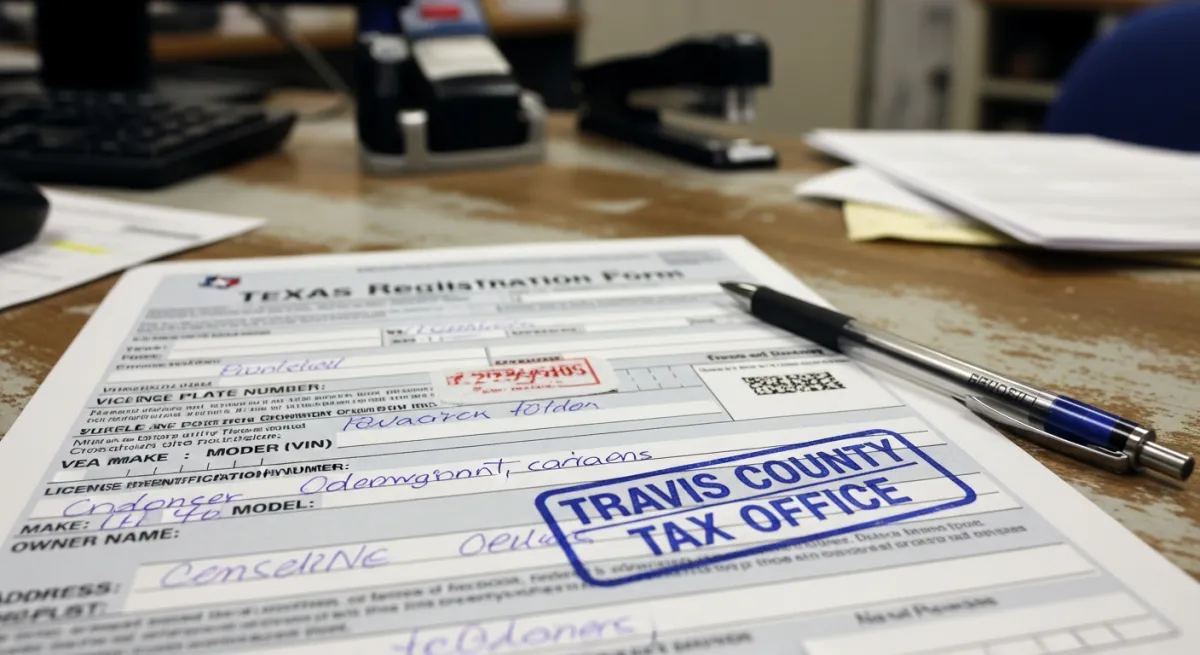
- Completed Form 130-U (Application for Texas Certificate of Title), available at txdmv.gov or at the tax office
- Odometer disclosure — for vehicles under 10 years old, this is typically completed as part of Form 130-U
- Your passed Texas inspection certificate (or confirmation that it’s been recorded in the state database by the inspection station)
Fill out Form 130-U before you walk in. It’s not complicated, but completing it at the counter slows everyone down — including the people behind you.
The Financed Vehicle Problem
Here’s the scenario that trips up a disproportionate number of Austin transplants, particularly people arriving from California, New York, and other states with large lending institutions: if your car is financed, you probably don’t have the title. Your lender does.
This is not a minor inconvenience. Texas requires the physical title — or lender authorization — to complete a title transfer. If Wells Fargo, Chase Auto, a credit union, or any other out-of-state lender holds your title, you cannot simply present a loan statement and ask the tax office to work around it.
Contact your lender before your scheduled tax office visit. Explain that you’ve moved to Texas and need to transfer the title to a Texas registration. Your lender will need to either send the title directly to the Travis County Tax Assessor-Collector’s office or provide a power of attorney authorizing the transfer. This process can take days to weeks depending on the lender’s procedures. Mailing documents alone can take 7–10 business days. If you’re working toward a 30-day deadline and you discover this issue in your final week, you have a problem. Make the lender call in your first week in Austin, not your last week before the deadline. The TxDMV 30-day temporary operating permit (discussed in the final section) exists precisely for situations where registration cannot be completed immediately because of a lender delay. But you need to know to ask for it — most people don’t.
Step 3: Choose the Right Travis County Tax Office for Your Zip Code
Travis County’s Tax Assessor-Collector operates multiple office locations. Choosing the right one based on where you live — and what time you show up — is honestly the most underrated factor in how painless this process becomes.
The Airport Boulevard main office serves central Austin, South Austin, East Austin, and nearby neighborhoods. It’s the highest-volume location in the county and the one most central Austin residents default to. Because it handles the most volume, it can also have the longest waits, particularly during August and September, which is peak moving season in a city that sees major corporate relocations every year. If you’re in 78704, 78701, 78702, 78703, or similar central zip codes, this is your closest option.
The county also operates a satellite office in Pflugerville that historically sees lower traffic than the Airport Boulevard location. If you live in far North Austin, the Domain area, Pflugerville proper, or any zip code in the 78660 or 78664 range, the Pflugerville office is worth the drive north to avoid the Airport Boulevard lines. Confirm the current address, hours, and walk-in versus appointment policy at traviscountytax.org before you go. Satellite office details change, and an outdated address from a Google search can send you to the wrong location. (Ask me how I know.)
Residents in Cedar Park, Lago Vista, and the northwest Austin corridor have access to additional satellite options. Verify current hours and services at traviscountytax.org, since not every satellite office handles all transaction types.
How to Check Wait Times Before You Drive
Travis County’s tax office website at traviscountytax.org has an online queue feature that lets you see current wait times at each location before you leave your house. A 10-second check can tell you whether you’re walking into a short wait or a very long one. On a slow Tuesday morning in March, that check might confirm you can walk right in. On a Monday in September, it might save you from a genuinely miserable afternoon.
The mid-week window — Tuesday through Thursday, arriving close to opening time — has historically been the lower-traffic pattern at most county offices. Mondays accumulate weekend backlog. Fridays bring end-of-week rushes. August and September are the worst months of the year for registration office waits in Austin because they coincide with both back-to-school season and the peak corporate relocation window, when large numbers of new employees arrive simultaneously. If you have flexibility in when you go, use it. If your 30-day deadline falls in late August, accept that you may wait longer and build that time into your schedule.
The Airport Boulevard office has a parking lot, but it fills quickly during peak periods. If you arrive and the lot is full, street parking is available on nearby blocks. Don’t let a full lot convince you to leave. It’s often faster to park a short walk away than to circle.
Step 4: What to Expect at the Counter
Once you’re inside with your documents, the process at the counter moves straightforwardly. A clerk will take your Form 130-U and supporting documents, verify your insurance meets Texas requirements, and collect fees. The paperwork moves through the system relatively quickly once you’re in front of staff who know what they’re looking at.
Texas requires a VIN inspection for vehicles transferring in from another state. Depending on current Travis County procedures, this may be handled in-office by tax office staff. Or it may require you to obtain a completed Form VTR-270 (Verification of Vehicle Identification Number) from a law enforcement officer, Texas DMV inspector, or licensed dealer before you arrive. Verify this requirement directly with the Travis County tax office or TxDMV before your visit. If VIN verification must happen separately and you arrive without it, you’ll leave without completing registration. A single phone call to the tax office at the number listed on traviscountytax.org will get you a definitive answer. It’s worth the two minutes.
Can You Do Any of This Online?
The short answer: not for the initial transfer.
New residents transferring an out-of-state title to Texas registration must appear in person at the Travis County Tax Assessor-Collector’s office. The title transfer is a physical document process. You can’t upload your out-of-state title to a website and have a Texas title issued remotely. This applies statewide, not just in Travis County.
Once your Texas title has been issued and your vehicle is registered in the TxDMV system, every future annual registration renewal can be handled online at txdmv.gov or by mail. You’ll receive a renewal notice with a unique code that makes the whole thing straightforward. But for your first Texas registration as a new resident, you’re going in person. Plan accordingly.
What It Will Cost Before You Walk In
Budget for approximately $115–$130 for a standard passenger vehicle registration, inclusive of inspection:
| Fee | Approximate Amount |
|---|---|
| Base state registration fee | ~$51.75 |
| Title fee | $33.00 |
| Travis County local fee | ~$11.50 |
| Processing and automation fee | ~$4.75 |
| Vehicle inspection | $14–$25 |
| Total | ~$115–$126 |
These figures are based on standard passenger vehicle fees and are adjusted periodically by the state legislature. If you’re registering a truck over a certain weight, a motorcycle, or a trailer, your base registration fee will differ. Confirm the current fee schedule at txdmv.gov before your visit, particularly if your vehicle is anything other than a standard passenger car. Payment methods accepted at Travis County tax offices include cash, check, and major credit cards, though credit card payments may carry a small processing fee.
If You’ve Already Missed the 30-Day Window
If you’re reading this because you’re already past your deadline, here’s the practical reality — and it’s not as bad as you might fear.
You’ll owe a delinquent registration fee on top of the standard registration fees. If you’ve already received a citation, you’ll need to register the vehicle and bring proof of registration to the issuing court to address the charge.
Texas offers a 30-day temporary operating permit (sometimes called a “TxDMV permit”) that works as a legal stopgap when registration cannot be immediately completed because of documented obstacles. The most common situation: a lender-held title in transit from an out-of-state lienholder. If you’re past your deadline because your California credit union took weeks to release the title, a temporary operating permit allows you to legally operate the vehicle while the paperwork catches up. Ask specifically about this option at the Travis County tax office or directly through TxDMV — it’s not always volunteered.
One more thing if you’re in an out-of-compliance situation: Texas uses the TexasSure system to verify that registered vehicles carry active liability insurance. When you show up at the tax office with a brand-new Texas insurance policy, there can sometimes be a same-day lag between when your insurer issues the policy and when it appears in the TexasSure database. If the counter clerk can’t find your policy in the system, your physical insurance card should resolve it. Call your insurer beforehand to confirm your new Texas-compliant policy has been filed into the TexasSure database. Timing hiccups here are minor and fixable, but they can slow down your transaction — and if you’ve already been waiting an hour, that’s the last thing you want.
Editors’ note: Several details in this guide — including Travis County’s current emissions testing requirement, satellite office addresses and hours, the VIN verification procedure, the current fine amount for unregistered vehicles, and the current delinquent registration fee — require verification against current TxDMV, TCEQ, and Travis County Tax Assessor-Collector records before publication. Fee amounts should be confirmed against the current TxDMV fee schedule. This guide is accurate as of research and should be updated when any of those verification items are resolved.