How Austin Commuters Are Getting Around the I-35 Construction in 2026
The Capital Express Central project is rebuilding 8 miles of central Austin through at least 2033. Street-level guidance for commuters from Slaughter Lane to Airport Blvd — organized by where you a…

The Capital Express Central project is rebuilding 8 miles of central Austin through at least 2033. Street-level guidance for commuters from Slaughter Lane to Airport Blvd — organized by where you actually live.
The short answer, for anyone commuting into downtown Austin right now: MoPac southbound from north of the river saves real time over I-35 during morning peak if you leave before 6:45 a.m. or after 9:15 a.m. Not if you’re heading downtown between 7 and 8:30.
During that window, MoPac’s Enfield bottleneck and I-35’s construction delays are close enough that corridor choice matters less than departure time. If you’re coming from the east side or East Riverside, you have fewer viable alternates than anyone else in the city — and that’s a real problem I’ll come back to.
The longer answer follows, organized by where you live and when you drive.
What’s Actually Happening and Why 2026 Is the Hard Year
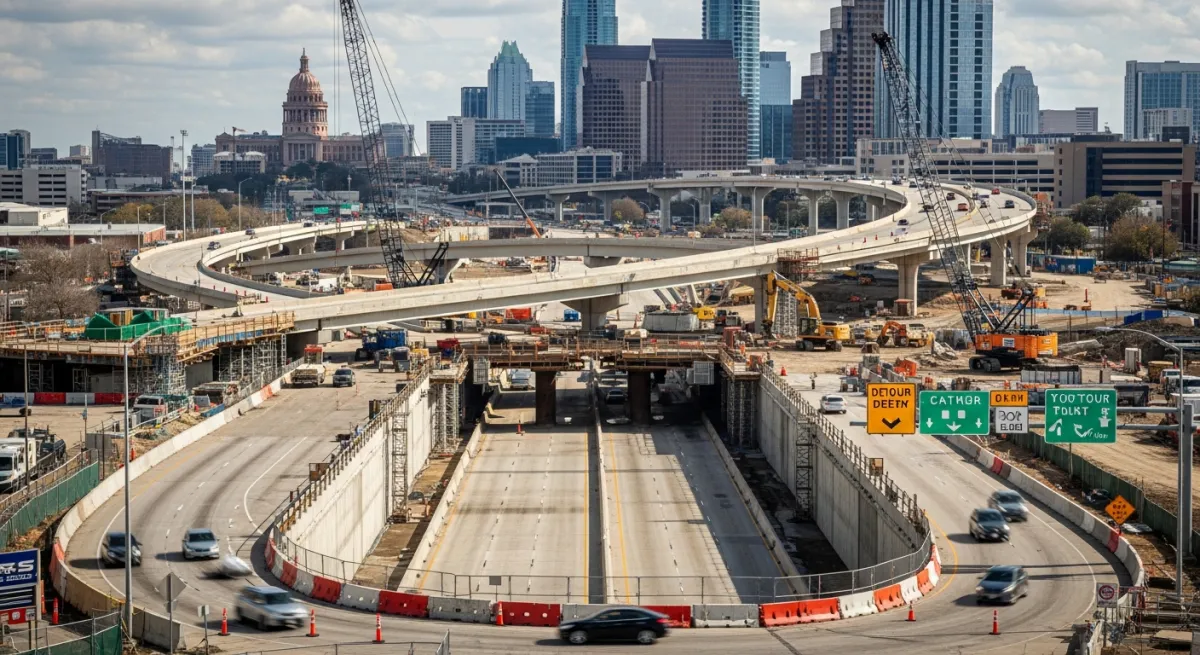
TxDOT’s Capital Express Central project is a complete rebuild of I-35 through central Austin. Eight miles from Oltorf Street to Airport Boulevard, $8.7 billion, a construction timeline through at least 2033. The core engineering move is lowering the main lanes below grade through the central segment — eliminating the elevated deck that has divided East Austin from downtown for six decades.
What that means for drivers right now: multiple interchange rebuilds are running simultaneously in 2026, surface access points are being eliminated or relocated mid-project, and the ramp configurations that existed six months ago are not the ones that exist today. This is the peak disruption year. It is not getting meaningfully better anytime soon.
Which Exits Are Open, Which Are Gone, and How to Check Before You Leave
The exit and ramp situation between Oltorf and Airport Boulevard changes often enough that any printed list is a snapshot, not a guarantee. Verified status as of publication week:
Riverside/Oltorf anchor: The southernmost edge of the active construction zone. Northbound access from Riverside Drive remains open but is reduced to modified ramp geometry — expect lane merges on the approach. Oltorf Street connects to the frontage road system; use it to enter or exit the corridor rather than fighting the main lanes through this transition.
Cesar Chavez reconstruction zone: The most heavily affected segment. If you haven’t driven through it lately, the scale of the work is genuinely jarring — it’s not road construction in the normal sense, it’s a full interchange demolition in progress. Direct on- and off-ramp access is severely limited in both directions. Northbound drivers trying to exit at Cesar Chavez should plan to use 4th Street or 6th Street and work back via surface streets. Southbound access from Cesar Chavez onto I-35 is similarly constrained — use Riverside Drive further south or access the frontage road from 4th/5th Street north of the interchange.
MLK/15th Street modified access: The MLK Boulevard interchange has modified access in place. Direct ramp access exists but is subject to nightly lane closures and occasional weekend full closures. The 15th Street connection to the frontage road is functioning but narrows significantly at the construction boundary. Verify before any trip where timing matters.
51st Street/Airport Boulevard ramp reconfigurations: The northern anchor of the project has seen significant ramp changes. Northbound exit at Airport Boulevard remains open; 51st Street ramp access has a shifted merge point. For commuters entering from the north, the Airport Boulevard on-ramp geometry has changed. The old approach line no longer applies — don’t trust muscle memory here.
The most useful tool for staying current is the TxDOT 511 real-time traffic and closure system, which shows real-time closure status layered on the corridor map. The Capital Express Central project also publishes a weekly construction advisory — subscribe at capexpresscentral.com. It drops every Thursday and covers closures for the following 10 days. Two minutes to sign up, and it’s more reliable than checking social media.
North Austin Commuters: Does MoPac or 183 Actually Beat I-35?
This is what north Austin commuters ask most, and it deserves a direct answer.
If you live in the Domain/78758 area or anywhere along the MoPac corridor north of the river, MoPac southbound is generally faster than I-35 during morning peak — with two caveats. You have to tolerate the Enfield/Lady Bird Lake bottleneck, and you cannot be hitting that stretch between 7:45 and 8:30 a.m., when MoPac can back up all the way to 35th Street. If you’ve sat in that backup convinced you made the wrong call, you probably did. But so did everyone on I-35.
Here’s how the numbers break down during AM peak (7–8:30 a.m.) for a Domain-area-to-downtown trip (Congress/5th Street):
I-35 southbound through the construction zone runs 38–52 minutes depending on active lane closures. On days when overnight work hasn’t fully cleared, add 8–12 minutes. The merge-down near 51st Street is where stalls develop.
MoPac southbound free lanes: 28–42 minutes. That range is wide because the Enfield curve is genuinely unpredictable. Light days it flows; heavy days it stacks.
MoPac Express Lane southbound with a TxTag: 22–32 minutes. The express lane exits into general traffic at Cesar Chavez — you’re still taking surface streets the last mile or so to wherever you’re going.
For commuters east of MoPac, 183 Toll south toward the I-35 interchange is complicated by the fact that the I-35/183 interchange is itself under construction. You save time on 183 Toll, then lose it at the merge back onto I-35. Surface 183 (Research Boulevard transitioning to Ed Bluestein) adds distance but skips both the toll and the interchange work — it’s a fallback for far northeast commuters routing downtown via Airport Boulevard, not a time-saver for anyone west of 183.
Leave before 6:45 a.m. and MoPac express gets you downtown in under 25 minutes. Leave at 7:30 a.m. and you’re gambling on whether the Enfield backup has developed yet. Leave at 8 a.m. and I-35 and MoPac are performing roughly equally badly. Departure time is the variable that matters most.
South and Central Austin Commuters: When I-35 Fails South of the River
78704 (Bouldin Creek, Travis Heights): South Congress and South Lamar are your parallel spines, and they work as alternatives — not because they’re fast, but because they connect you to downtown without touching I-35. South Congress to 1st Street adds 8–15 minutes over a pre-construction I-35 trip during peak hours. The tradeoff is signal timing on South Congress, which was not designed for through-traffic and shows it. South Lamar to Barton Springs Road to 1st Street is marginally faster during mid-peak but adds distance if you’re heading east of Congress. Neither route involves a toll. For 78704 residents, this is actually the most manageable situation in the construction zone — a relative bright spot, if you can call 15 extra minutes of South Congress signals a bright spot.
East Riverside/Montopolis: This is where the routing situation is genuinely difficult, and there isn’t a clever workaround. East Riverside Drive connects directly to I-35 at a point in the active construction zone. MoPac is not a practical alternate — it requires driving west across the river and then back, adding 15–20 minutes of distance before you’ve saved anything. Heading north via Pleasant Valley Road to Airport Boulevard to 51st Street to surface streets downtown avoids the worst of the central construction segment but adds meaningful time. The effective alternate for Riverside/Montopolis commuters heading downtown is Airport Boulevard to 7th Street east-west surface routing. Budget 12–18 extra minutes versus pre-construction drive times, with no toll-free shortcut available. CapMetro MetroRapid Route 801 is worth running the numbers on for this corridor more than any other — more on that below.
Mueller/78723: Mueller commuters heading downtown have the best geometry of the three central neighborhoods. Airport Boulevard north to 51st Street, then west via 51st or 38½ Street to Guadalupe or Lamar, routes entirely around the worst construction segments. This adds 6–10 minutes versus a pre-construction Airport Boulevard/I-35 combination but avoids the Cesar Chavez and MLK interchange work zones entirely. For Mueller residents heading to UT or the Capitol complex, 38½ Street to Guadalupe is the cleanest line.
How Much Extra Time to Budget by Corridor and Time of Day
These estimates combine INRIX corridor speed data for the I-35 central segment and timed drives on alternate routes. Where estimates are modeled rather than driven, that’s noted.
AM Peak (7:00–8:30 a.m.)
| Origin | Via I-35 (extra time vs. pre-construction) | Via best alternate | Alternate time-add |
|---|---|---|---|
| Domain/78758 → Downtown | +18–25 min | MoPac Express | +8–14 min |
| North Loop/78751 → Downtown | +12–18 min | MoPac free lanes | +10–16 min |
| Mueller/78723 → Downtown | +10–15 min | Airport Blvd/38½ St | +6–10 min |
| Bouldin Creek/78704 → Downtown | +8–14 min | S. Congress or S. Lamar | +8–15 min |
| East Riverside/Montopolis → Downtown | +14–20 min | Airport Blvd surface | +12–18 min |
Domain figures use INRIX modeled data. Mueller and 78704 estimates are based on driven routes during publication-week verification.
PM Peak (5:00–6:30 p.m.)
Add roughly 20–30% to AM peak estimates across all corridors. The I-35 northbound construction zone backs up more severely during PM peak than southbound does in the morning — which catches commuters off guard the first time they experience it. The Riverside on-ramp area and the 51st Street reconfiguration are the primary pinch points northbound. MoPac northbound during PM peak is affected by afternoon CapMetro bus volume on Lamar and the Enfield signal timing, which makes the express lane more valuable on the outbound run than the inbound one.
Before 6:45 a.m., all alternate routes — MoPac, 183 surface, South Congress, Airport Boulevard — move within 5 minutes of their pre-construction times. I-35 itself, while still carrying construction geometry, moves without significant delay before the morning surge. After 9:15 a.m., mid-morning conditions return most corridors to near-normal speeds; I-35 often clears to functional travel by 9:30 a.m. except on days with active daytime lane work. Check the TxDOT 511 feed before leaving.
Weekend Closures: The Calendar You Actually Need
TxDOT is required to post notice of major closures at least 10 days in advance. Those notices appear on drivetexas.org and in the Capital Express Central weekly advisory. If you have any weekend travel through the corridor, check the Thursday advisory every week without exception.
The pattern for high-disruption weekends in 2026 involves what TxDOT calls “bore-to-bore” closures — full shutdowns through specific interchange segments, typically running Friday night (10 p.m.) through Sunday morning (6 a.m.) or, in major cases, through Monday morning. These are not lane reductions. They close the segment entirely.
SXSW 2026 (approximately March 13–22): SXSW weekend traffic already pushes every downtown-adjacent corridor to saturation in a normal year. Add the active interchange work on the Cesar Chavez segment and you have a combination that will be bad in ways that are hard to overstate. If you’re driving into or out of the SXSW core on any Saturday or Sunday during festival weekends, plan for I-35 to be effectively unusable between Riverside and MLK. Route before you leave, not while you’re sitting in it.
UT Football Saturdays (September–November): DKR–Texas Memorial Stadium draws 100,000 people to the I-35/University Avenue corridor. On any home game Saturday when a bore-to-bore closure is also active — and TxDOT has historically not coordinated these schedules with UT Athletics, which remains its own ongoing failure of planning — the Cesar Chavez through MLK segment will be among the worst roads in Austin. Check the advisory for any fall Saturday before you commit to driving.
Formula 1 USGP Weekend (late October): The Circuit of the Americas sits southeast of the airport, accessed via Circuit of the Americas Boulevard off Highway 71 and Ed Bluestein. I-35 southbound has historically served as the main artery for USGP traffic from the north. In 2026, any closure in the Riverside or Oltorf zone during USGP weekend (typically Thursday through Sunday) compounds a traffic problem that already strains the corridor in a good year. If you’re not attending but live south of the river, avoid I-35 between Riverside and Oltorf entirely from Thursday evening through Sunday night. Not an exaggeration.
The Toll Math: What Avoiding I-35 Costs Over a Full Year
A commuter making a round-trip MoPac Express Lane run five days a week pays somewhere between $2.50 and $4.50 per segment depending on time of day and dynamic pricing. At a conservative $3.00 average per segment, that’s $6.00 round-trip, roughly $1,560 for a full work-year commute. More modest usage — northbound only in the evening, three days a week — still runs $700–900 annually. That’s real money.
MoPac Express requires a TxTag or an interoperable Texas toll transponder. No cash option. Drive the express lane without a tag and you’ll receive a ZipCash invoice at roughly 50% above the tagged rate. Ignore those invoices and you’ll eventually face registration holds. Get the tag if you’re using this route regularly.
The 183 Toll corridor north of the city adds more charges for commuters using it as an I-35 alternate. A 183 Toll commuter from Pflugerville or the Round Rock fringe who has been pushed off I-35 might spend $800–1,100 annually on that segment alone.
Here’s the equity dimension, and it matters: the commuters with the most limited routing options are overwhelmingly working-class East Austin and East Riverside residents. People whose neighborhoods sit closest to the construction zone and who have the fewest free alternates available. MoPac doesn’t serve the east side. 183 adds distance. The people most disrupted by the Capital Express Central project are, in many cases, the people least able to buy their way around it with a toll-road subscription. That’s not an argument against the project — it needed to happen. But it is a reason the city and CapMetro should be treating east-side transit capacity as urgent infrastructure right now, not a line item for the next budget cycle. That access gap and its broader consequences are part of what we track in our Austin transportation and mobility coverage.
The Summer Factor: Why July and August Hit Differently
Austin regularly exceeds 100°F through July and August. Anyone who’s been here a few summers knows what that does to concrete curing schedules, which is the relevant issue here.
Concrete work has strict temperature requirements. When ambient heat is extreme, contractors shift to overnight and pre-dawn pours to hit acceptable curing windows. Work that might otherwise spread across a weekday week gets compressed into Friday-night-through-Monday-morning patterns — lane closures running 55-plus consecutive hours.
Summer weekends are the highest-disruption window of the entire construction calendar. Sunday evening is the single worst driving time of the year for anyone returning to central Austin from a weekend trip. The I-35 corridor between Oltorf and Airport Boulevard is often emerging from a bore-to-bore or near-bore-to-bore closure as Sunday evening traffic builds. “Reopened” doesn’t mean “flowing freely.” It means the lanes are physically accessible, often at reduced capacity with construction equipment staged on shoulders.
Treat Sunday evening returns to Austin as a planning problem from June through August. Check the Thursday advisory before leaving for any weekend trip. Budget an extra 20–30 minutes. If you have the flexibility, consider a Monday morning return — the closure will have fully reopened and traffic will have thinned considerably.
If You’re Done Driving: Park-and-Ride and MetroRapid Options Near the Corridor
CapMetro MetroRapid Route 801 runs North Lamar to South Congress along a corridor that largely parallels I-35 to the west. For commuters from the Domain/North Lamar area heading downtown or to UT, the 801 runs at 10–12 minute headways during peak and is genuinely competitive with a driving trip that now takes 35–50 minutes. It doesn’t get stuck in the I-35 construction because it runs on surface streets to the west of the corridor entirely.
MetroRapid Route 803 runs Burnet Road/South Lamar and serves a slightly different diagonal that hits the medical district and connects to the 801 at several downtown stops. For 78704 and North Loop commuters who can walk or bike to a stop, it works during peak windows.
Howard Station park-and-ride, with the Red Line MetroRail south to downtown, is the cleanest way to exit the I-35 and MoPac disruption entirely. The catch: the Red Line runs at roughly 30-minute headways during peak, which makes it impractical for anyone with a rigid arrival time. If your schedule has flexibility, it works well.
CapMetro ridership data through late 2025 showed the 801 corridor running at elevated load factors, which suggests some I-35 diversion is already happening organically. That tracks.
The east side — East Riverside, Montopolis — is not well-served by these MetroRapid routes. Route 7 (Duval/Dove Springs) serves East Riverside but runs less frequently than the MetroRapid lines. For east-side commuters, transit works best as a one-way escape valve during the worst peak hours, not as a full-schedule replacement. Better than nothing, but the gap between what this corridor needs and what it has is significant. The same structural lack of east-side options — fewer alternates, less transit frequency, no practical toll road access — mirrors the food access gap already straining East Austin residents’ daily routines.
The CityDesk Cheat Sheet: Quick Reference by Neighborhood
Save this. Verify against the live TxDOT closure tool (drivetexas.org) before time-sensitive trips.
| Origin | Best Free Route | Best Toll Route | AM Peak Time-Add | Worst Windows |
|---|---|---|---|---|
| Domain/78758 | MoPac free lanes → Cesar Chavez → surface | MoPac Express Lane | +8–14 min (toll) / +12–20 min (free) | 7:30–8:30 a.m. daily; SXSW/F1 weekends |
| North Loop/78751 | MoPac free lanes → surface at 38th St | MoPac Express → 38th St | +10–16 min (free) | 7:45–8:45 a.m.; UT home Saturdays |
| Mueller/78723 | Airport Blvd → 51st/38½ St → Guadalupe | N/A (no toll benefit) | +6–10 min | 8–9 a.m. daily; F1 weekend |
| Bouldin Creek/78704 | S. Congress → 1st St OR S. Lamar → Barton Springs → 1st St | N/A | +8–15 min | 7:30–8:30 a.m.; SXSW weekends |
| East Riverside/Montopolis | Airport Blvd → 7th St surface routing | N/A (no practical toll route) | +12–18 min | 7–8:30 a.m. daily; all major event weekends |
Live resources:
- TxDOT 511 real-time closures: drivetexas.org
- Capital Express Central weekly advisory (subscribe): capexpresscentral.com
- CapMetro trip planner: capmetro.org
Exits and ramp configurations in this piece were verified during publication week. The construction calendar changes — exits close, ramps shift, new bore-to-bore closures get announced. Use the Thursday advisory email as your standing source. This guide will be updated at major project milestones.