How Austin's New I-35 Express Lanes and HOV Rules Actually Work After Reconstruction
The old upper-deck is gone. Before you merge into a managed lane for the first time, here's what you need to know about eligibility, tolls, transponders, and access points along the Capital Express…

The old upper-deck is gone. Before you merge into a managed lane for the first time, here’s what you need to know about eligibility, tolls, transponders, and access points along the Capital Express Central corridor.
If your mental map of I-35 HOV access still involves the old reversible upper-deck lane threading above Downtown Austin, you’re working from an outdated blueprint. That configuration is gone. What replaced it is the Capital Express Central project’s managed express lanes, which operate on completely different logic. The gap between what longtime Austin drivers assume and how the new lanes actually work is wide enough to generate real confusion — and real toll violations. I’ve seen enough Nextdoor threads where someone is furious about a bill they didn’t expect to know this gap is not theoretical.
This explainer tackles the questions Austin commuters are actually searching: whether you need a TxTag, who qualifies for HOV status, what the lanes cost, where you can get in and out, and whether any of it actually saves time on a corridor that INRIX ranked among the worst urban bottlenecks in the country during the 2022–2025 rebuild. The answers are specific where the data is confirmed. Where official figures require primary-source verification before publication, you’ll find a note pointing you to the source.
What Changed: The Old Upper-Deck vs. the New Express Lanes
For decades, I-35’s HOV accommodation through Downtown Austin was the upper-deck reversible lane — a physically elevated roadway running inbound in the morning, outbound in the evening, famously narrow, free for two-or-more-person vehicles. Not glamorous, but it worked. Carpoolers headed to UT or the Capitol complex used it constantly.
Capital Express Central retired that setup as part of TxDOT’s reconstruction of I-35 through the urban core. The project rebuilt approximately eight miles of corridor from Ben White Boulevard (US-290 East) on the south end to US-183 (Research Boulevard) on the north end — Oltorf, Riverside, the East Sixth corridor, Airport Boulevard, the MLK/UT edge, 51st Street, North Loop, and up toward Rundberg.
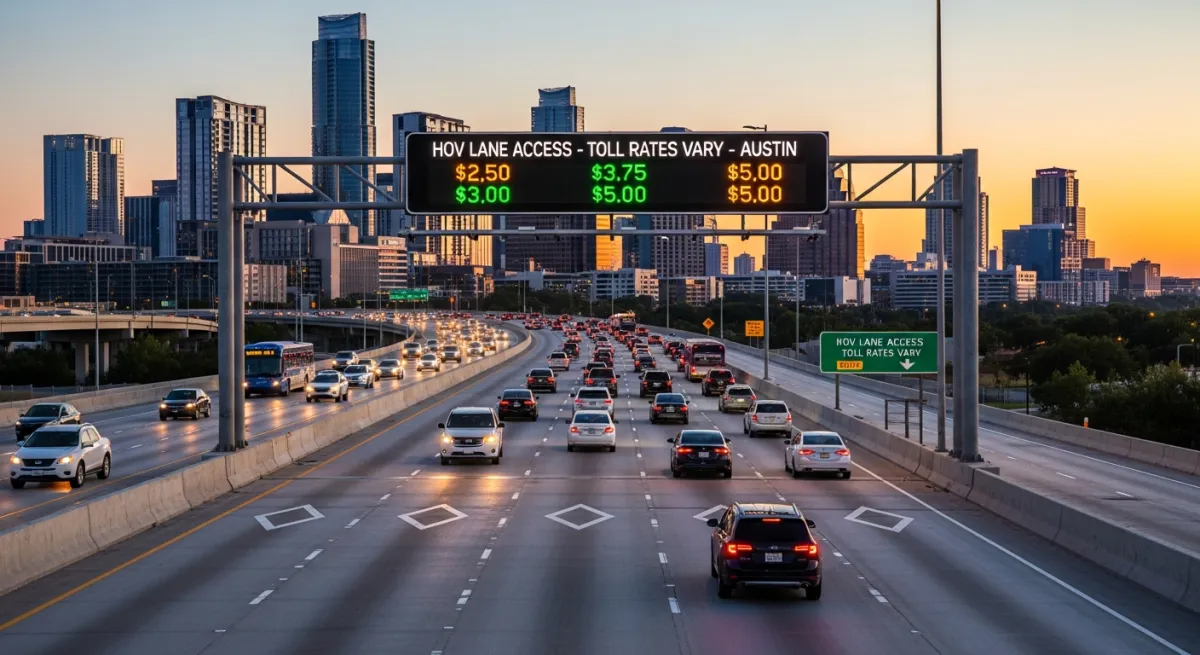
The replacement is a set of dedicated managed express lanes running within the reconstructed I-35 footprint, and “managed” is the word that matters. These aren’t free HOV lanes in the traditional sense. They’re not simply pay-to-use toll lanes either. They’re a hybrid: free for qualifying HOV vehicles with a registered transponder, priced dynamically for solo drivers, and physically separated from the general-purpose lanes in a way the old upper-deck never was. Everything else follows from that structure.
Do I Need a TxTag to Use the Express Lanes?
Yes. A transponder registered to a Texas toll account is required for regular use. TxTag — issued by TxDOT — is the native option, but Texas operates under statewide toll interoperability. An NTTA TollTag, HCTRA EZ TAG, or any other Texas-issued transponder works on the I-35 managed lanes without opening a second account. If you already have a valid Texas toll account, that device covers you.
License-plate billing exists as a fallback. Cameras capture your plate, a bill arrives, and a per-transaction surcharge lands on top of the toll. Check the current TxTag.org fee schedule before you commit to this as a routine strategy. It adds up fast. Out-of-state plates fall into the same Pay By Mail category automatically, so if you’ve recently moved here from another state or you’re visiting, expect billed-plus-surcharge until you establish a Texas account.
One misconception that keeps circulating on Austin’s Reddit and Nextdoor: electric vehicles get no automatic toll exemption on Texas managed lanes. Texas does not have an EV-equals-HOV policy the way some other states do. A single-occupant EV pays the same dynamic toll as any other single-occupant vehicle. The exemptions that actually matter here are occupancy-based HOV status and, in most Texas managed-lane configurations, motorcycles.
Who Qualifies for HOV Status, and Does HOV Mean Free?
The specific occupancy threshold for the Capital Express Central express lanes — whether 2-plus or 3-plus persons — must be confirmed against TxDOT’s current project documentation before publication, as requirements can shift between construction phases. Check TxDOT.gov’s Capital Express Central section directly, or contact the Austin District public information office.
Texas is surprisingly generous on what counts toward occupancy. Infants and children in car seats qualify. If you’re driving with a six-month-old in a rear-facing infant seat, you likely meet the 2-plus threshold. The law doesn’t require occupants to be of driving age or verbal. What doesn’t count, no matter how much your Australian Shepherd disapproves: pets. Animals don’t count toward HOV occupancy in Texas. I know. Hard conversation to have with the dog.
For qualifying vehicles, HOV status on Texas managed lanes typically means toll-free trips — but there’s a critical operational requirement that trips up otherwise-eligible drivers. You must have a TxTag or compatible Texas transponder registered to an account where HOV status is enabled. The transponder is still required even when the toll is waived. You can’t drive into the lane with three people in the car and expect the gantry cameras to give you a pass. The system reads your transponder, looks up your HOV registration, and waives the toll accordingly. Without that registration step, you get billed. MoPac Express users learned this the hard way a few years back. Don’t repeat it.
To register HOV status, log into your TxTag.org account and navigate to vehicle management or account settings. It’s not automatic when you create an account — you have to actively opt in. Do this before your first trip.
On most Texas managed lanes, motorcycles travel toll-free. Confirm this exemption applies specifically to the Capital Express Central corridor with TxDOT before assuming it — project-specific configurations can differ. If it holds here, motorcycle riders still benefit from carrying a TxTag so the system registers the exemption rather than triggering a Pay By Mail bill.
What Does It Cost During Peak Hours?
There’s no single posted rate. That’s the foundational fact about dynamic pricing that most Austin managed-lane newcomers need to internalize, and it’s not a dodge — it’s how the system is designed to work.
The express lanes use congestion pricing. The toll adjusts in real time based on traffic volume and target speed, and that price displays on overhead variable message sign gantries before you commit to entering. Once you pass the entry point, you’re locked in at the rate that was posted when you crossed. No take-backs.
Confirmed current peak and off-peak rate ranges for this specific corridor should be pulled directly from drivetexas.org or the TxTag app before publication, as pricing parameters evolve. For reference: the MoPac Express Lanes (Loop 1), which Austin drivers have had several years to observe, typically run $0.25 to $2.50 during moderate conditions and can spike above $4.00 during severe backups or event traffic. The Capital Express lanes operate under a comparable model, but the longer corridor and higher baseline volume mean they may behave differently in practice. I wouldn’t assume the two corridors will track each other closely.
Check the TxTag app or drivetexas.org before you leave if you want a sense of current conditions. Don’t budget a fixed per-trip amount — budget a range. The variance is the mechanism that keeps the express lane moving when the general lanes are stopped. That’s the whole point of dynamic pricing, and on MoPac it has generally delivered. Whether I-35 follows suit is still being demonstrated.
Where Can I Actually Enter and Exit?
Access point details matter most for day-to-day driving decisions, and they’re also the most likely information to shift as Capital Express Central moves through its construction phases. The following reflects the corridor’s general structure. Confirm current operational status against TxDOT’s construction updates before assuming any specific ramp is open.
Ben White Boulevard / US-290 East (south terminus): The southern anchor of the managed-lane corridor. Drivers coming from South Austin or points south enter here.
Oltorf Street: The first meaningful midcorridor access northbound. If you live in Bouldin Creek or along South Congress and you’re commuting north, this is your on-ramp decision point. Southbound, it’s the exit for East Oltorf and South First destinations.
Riverside Drive: High demand here, for obvious reasons. The density of East Riverside apartment corridors means a large commuter population is within range of this access point — and if you’ve ever sat on East Riverside at 8 a.m., you already know why the express lane math looks appealing.
Airport Boulevard: The key east-west connector for commuters whose trips cross the east side rather than terminating Downtown. Mueller, East Austin, and points toward Rundberg are within reach from this interchange.
MLK Jr. Boulevard / UT area: Critical for anyone accessing the University of Texas campus or the Capitol complex from the north. The UT commuter population is large enough that HOV eligibility matters here — if any carpooling arrangements exist, this is where they pay off. Commuters connecting across town may also find it worth comparing against Austin’s UT-area lease market dynamics, where parking and commute costs factor meaningfully into renter decisions.
51st Street: St. John’s, North Loop, and the Cherrywood-adjacent communities. Southbound commuters from this stretch heading Downtown are the natural users.
North Loop: Additional access for the residential neighborhoods between Airport and Cameron Road, where car commuting to UT or Downtown is common and the express lane distance is short enough to make the toll questionable for some trips.
US-183 / Research Boulevard (north terminus): The northern end of the managed-lane corridor. Drivers from Pflugerville or Round Rock who join I-35 at or above US-183 are in general-purpose lanes until they reach this point. Buyers weighing those northern suburbs should factor real commute costs into their decisions — for a broader look at what ownership actually runs out there, see our coverage comparing the full costs of Kyle, Pflugerville, and Hutto including tolls and other expenses most listings don’t surface.
Not every access point may be at full operational status simultaneously — this is a multi-phase project. Check the TxDOT Capital Express Central project page before assuming a particular entrance or exit is available. Don’t learn this one by missing your exit.
How Do the Express Lanes Physically Relate to the General I-35 Lanes?
They’re physically separated. You can’t drift between the managed lanes and the general-purpose mainlanes between access points — entry and exit happen only at the designated interchanges listed above.
This matters practically for Downtown exits. If your destination is East Sixth Street, the Convention Center, or the Capitol, those ramps originate from the general-purpose mainlanes, not the express lanes. You need to exit the express lane before you reach those interchanges, not as you’re approaching them. Drivers who’ve spent years relying on old I-35 muscle memory — weaving toward exits at the last second — should recalibrate. The geometry no longer accommodates it.
Confirm specific lane count per direction and barrier configuration with TxDOT project documentation, as construction phasing affects what’s in place at any given point.
Are the New Express Lanes Actually Faster?
Austin drivers have earned the right to ask this with skepticism. The construction disruption that defined I-35 from roughly 2022 through 2025 was real and prolonged, and optimism about post-construction performance deserves scrutiny.
The structural case is sound. Managed lanes with dynamic pricing have a demonstrated mechanism for maintaining speed: when the toll rises, some solo drivers opt back to the general lanes, volume in the managed lane drops, and target speed holds. On MoPac Express, this mechanism has generally worked — CTRMA’s quarterly performance reports, publicly available on their website, document it with actual travel-time data. Whether Capital Express Central is delivering comparable results is a question TxDOT and CTRMA will need to answer with published corridor-specific data. I haven’t seen enough of it yet to call it.
What I’d push back on: the bar this corridor is being measured against is extremely low. INRIX’s traffic scorecards consistently ranked the I-35 Downtown Austin segment among the worst urban bottlenecks in the country during the peak construction years. “Better than a construction zone” is not the same as “working well.”
For commuters trying to decide whether the toll is worth it: track your own commute times for a few weeks using Waze or Google Maps. Compare against general-lane trips on the same route. Your commute has specific variables — entry point, destination, departure time — that no aggregate data will capture accurately.
Quick Reference: What You Need Before You Drive
Set up your transponder account first. Go to TxTag.org to open an account or verify your existing account is active. NTTA TollTag and EZ TAG both work on this corridor under statewide interoperability.
Register HOV status if you qualify. Log into TxTag.org, go to vehicle or account settings, and enable HOV status before your first qualifying trip. The toll system reads your transponder registration. Your passenger count is invisible to the gantry.
Check real-time rates before peak trips. Download the TxTag app or go to drivetexas.org. Gantry signs display current rates at entry points, but checking ahead lets you decide before you leave the driveway.
Confirm current access point status. Before your first commute on the new corridor, check the TxDOT Capital Express Central project page at txdot.gov for the latest on which entry and exit points are fully operational. Construction-phase restrictions can affect specific ramps with little advance notice.
For billing questions: Contact TxTag customer service at the number listed on TxTag.org. For questions specific to the Capital Express corridor, the TxDOT Austin District public information office is the right contact. For real-time construction updates: DriveTexas.org. Bookmark it.
Note to editors before publication: HOV occupancy threshold, current toll rate ranges, Pay By Mail surcharge amounts, lane count per direction, barrier configuration details, and operational status of intermediate access points as of June 2026 require primary-source confirmation from TxDOT Capital Express project documentation and TxTag.org. Do not publish with placeholder figures in those sections.