What Austin's Used Car Market Actually Looks Like in Summer 2026
A reported price check at Covert, AutoNation South, and the independents on S. Congress finds a market that has shifted since last summer — here's what buyers need to know before they sign.

A reported price check at Covert, AutoNation South, and the independents on S. Congress finds a market that has shifted since last summer — here’s what buyers need to know before they sign.
There’s a 2021 Honda CR-V EX-L sitting on the Covert Ford lot on Town Creek Drive asking $28,495. KBB’s Fair Market Range for that vehicle in 78704 puts the target transaction price at $25,800 to $27,200. That’s a gap of at least $1,300, possibly closer to $2,700. Real money, not a pricing anomaly.
It’s roughly what we found across Austin’s major franchise lots this summer: prices above KBB, but not dramatically so, and dealers more willing to negotiate than they were eighteen months ago. Whether that’s encouraging depends entirely on what you’re shopping for — and on how much patience you can afford.
The Price Picture in Austin This Summer
Used vehicle prices in Austin are down from their 2022 peak, but the normalization analysts were forecasting through 2025 hasn’t moved evenly across segments. Using Q2 2025-to-Q2 2026 data from Cox Automotive’s regional dealer reports and iSeeCars’s Austin-specific index, the five most commonly cross-shopped vehicles in this market tell a mixed story.
The 2021 Honda CR-V is down roughly 4.2% year-over-year in the Austin metro, tracking national compact SUV softening. The 2022 Toyota Camry is nearly flat, off just 1.8% — Toyota’s resale strength in Central Texas persists, partly because the Georgetown plant keeps brand loyalty high and trade-in cycles tight, and that’s not changing. The 2020 Ford F-150 is down 6.1%, about $1,800 off the average transaction on a mid-trim SuperCrew. The 2019 Chevrolet Silverado has dropped 7.4%, making it one of the stronger buys on the market in dollar terms right now. The 2021 Jeep Grand Cherokee is off 5.9%, with some listings sitting longer than 45 days — always a reliable sign that a dealer has more flexibility than they’ll volunteer on the lot.
Austin’s job market has cooled from its 2021–2023 tech-boom highs, but unemployment is still below 4%, and demand for reliable used transportation in a city without meaningful transit doesn’t soften the way it might in a denser metro. Dealers here aren’t desperate. They’re just less aggressive than they were when a used Silverado moved in under a week.
What’s on the Lots at Covert and AutoNation South
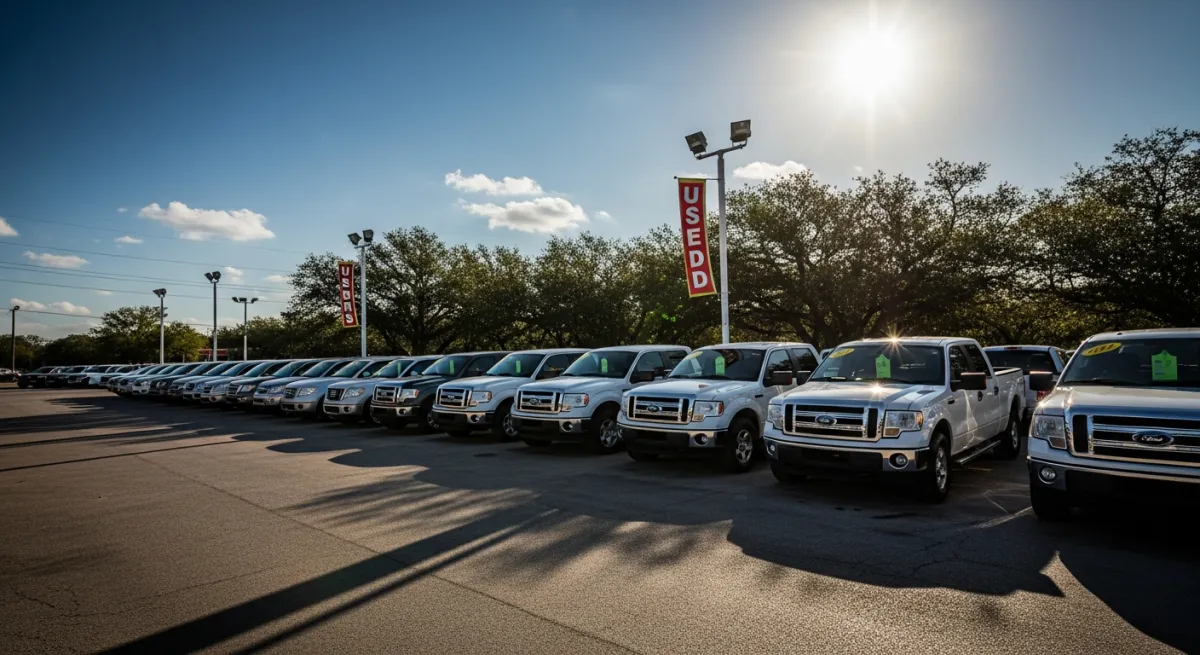
Covert Ford on Town Creek Drive was carrying around 190 used units at the time of our check. The lot skews toward F-Series trucks and Ford SUVs but carries cross-brand inventory — GM trucks, Japanese crossovers, some luxury pre-owned. Most of the floor sits in the $22,000–$32,000 band, with solid availability there. Under $18,000 units move fast and the lot replenishes them inconsistently. If you’re hunting in that range, check back more than once.
Covert Chevrolet on Research Boulevard runs a notably heavier truck concentration than the Town Creek location. Shopping for a Silverado or Sierra in the 2019–2022 range, this lot currently has better depth than almost anywhere else in the central Austin market. Bulk truck inventory runs $19,000 to $35,000. The salespeople work traditional commission and they know the market has shifted. Come in with printed KBB Fair Market Range data for your ZIP code — they’re accustomed to that conversation and it anchors the negotiation. Walking in without it is leaving money on the table.
AutoNation South Austin on South IH-35 operates on a no-haggle, one-price model, which changes everything about your approach. You’re not walking in to negotiate; you’re walking in to decide whether their fixed number beats comparable inventory elsewhere. The lot carries the largest single-lot used inventory in the South Austin corridor, somewhere north of 220 units, with strong CPO availability on Honda, Toyota, and domestic product. The one-price model isn’t inherently a bad deal — on several vehicles we priced, AutoNation’s posted number was within $400 to $600 of KBB Fair Market Value. But if a vehicle is priced $2,000 over KBB, that’s the price. Know the number before you go.
The Independent Dealer Corridor on S. Congress and Slaughter Lane
The stretch from South Congress south through the 78745 and 78748 corridors has historically been Austin’s independent dealer zone. It’s thinned over the past decade as land prices pushed smaller operations out, but there are still working independents worth knowing about.
South Austin Motors focuses primarily on the $10,000–$20,000 range, running 2015–2019 model years on compact cars, small trucks, and crossovers. The lot turns fast — typically 30 to 60 units on hand, not 200 — so availability swings week to week. On a direct comparison, we found a 2017 Toyota RAV4 LE at a comparable independent on the Slaughter Lane corridor priced at $17,900 versus a similar-spec RAV4 at AutoNation South at $19,450. That gap is real. The tradeoff is reconditioning standards and the absence of any CPO warranty if something goes wrong in month two.
Before you walk onto any independent lot, understand the distinction between traditional independents and buy-here-pay-here dealers. They are fundamentally different businesses. J&L Auto Sales and similar small-to-mid independents in the 78745 corridor are traditional dealers — they sell vehicles outright and accept outside financing. Buy-here-pay-here operators extend in-house financing to buyers who can’t qualify for conventional loans. They’re not in the business of finding you the best car; they’re in the business of collecting weekly payments. Rates run brutal — 18–29% APR is common — and the vehicles tend to be high-mileage. The total cost of ownership on a $10,000 car financed in-house at 22% over 36 months is closer to $14,500. If you can qualify for a credit union loan, almost no scenario makes buy-here-pay-here math work in your favor.
Dealers don’t always make this distinction obvious upfront. For buyers in the $8,000–$14,000 range who want to skip the franchise lot, the independent corridor offers value — but you need to know the vehicle’s history, pay for an independent pre-purchase inspection ($125–$175 at a mechanic of your choosing, not theirs), and accept that there’s no warranty backstop.
The Same Car, Priced Three Ways
We ran a matched comparison on two vehicles — a 2021 Toyota Camry SE with roughly 38,000 miles and a 2020 Ford F-150 XLT 4WD SuperCrew with approximately 52,000 miles — across Carvana, CarMax South Austin, and local franchise inventory.
On the Camry: Carvana (delivered to 78704) was asking $24,990 plus a $599 delivery fee with a seven-day return window. CarMax South Austin on S. IH-35 had a comparable unit at $24,500, no delivery fee, 30-day return. AutoNation South Austin listed a comparable at $23,995, no-haggle, CPO-eligible with warranty.
The spread across all three is maybe $1,000. Austin buyers sometimes assume online platforms like Carvana offer a cost savings. On Camrys right now, that’s not the case. CarMax has comparable inventory you can walk around the same afternoon. Go kick the tires.
The F-150 tells a different story. Carvana: $36,450 plus $599 delivery. CarMax South Austin: $35,200. Covert Ford had a comparable unit at $34,800 with room to negotiate down to around $33,500, based on current market conditions.
On the truck, buying locally at a dealer that negotiates gets you a tangible advantage of $1,700 to $2,500 over Carvana once delivery is factored. Carvana’s main advantage in Austin right now is selection breadth — if you want a very specific configuration that local lots don’t carry, the platform earns its fee. If you’re flexible on trim and color, go to the physical lot.
Buyer’s Market or Seller’s Market? A Direct Verdict
This is a cautious buyer’s market in mid-2026 — but only in specific vehicle categories.
Trucks and full-size SUVs are where buyers have negotiating room right now. F-150s, Silverados, Tahoes, and Expeditions are sitting longer on Austin lots than compact crossovers and sedans. Financing rates have kept monthly payments on a $36,000 truck at levels that genuinely suppress demand.
UFCU (University Federal Credit Union, which covers a large share of Austin buyers) is currently offering used auto rates starting around 6.9% APR on 60-month terms for well-qualified borrowers. Amplify Credit Union is in a similar range, around 7.1–7.4% depending on vehicle age and term. Dealer financing at franchise lots typically runs 8.5–11% unless a manufacturer-supported rate promotion is active.
On a $35,000 truck, the difference between 7.0% at UFCU and 9.5% at the dealer F&I office is about $44 per month — $2,640 over five years. Get your credit union pre-approval before you walk onto any lot. This is the single most actionable thing in this article.
Compact SUVs and Corollas and Camrys are not buyer’s market vehicles right now. Inventory is tighter, they move quickly, and dealers know it. A well-priced 2022 RAV4 or CR-V won’t sit 45 days. If you’re shopping in this category, move when you find fair pricing and don’t anchor on a deep discount that isn’t coming.
If you need a truck or a larger SUV and you have a UFCU or Amplify pre-approval in hand, this summer is a reasonable time to buy. Prices are off peak, inventory is present, and you have room to negotiate. If you’re shopping a compact crossover and can wait, watch whether the seasonal softening that typically hits in October and November materializes. It’s not guaranteed, but late fall is historically the weakest quarter for used car demand in Texas.
Austin-Specific Buying Risks That Most Guides Skip
This is where out-of-state buying advice becomes useless and local knowledge matters. In our automotive coverage, these regional wear patterns come up repeatedly — but most national car-buying guides never address them.
A vehicle that’s spent Austin summers running at sustained 100-degree-plus ambient temperatures has worked its cooling system and AC compressor harder than the same car in Minneapolis. Before purchase: verify the AC blows cold within 60 seconds of startup, check that the condenser fins aren’t clogged with Central Texas cottonwood debris, and have a mechanic pressure-test the cooling system. Battery health matters here too — the 12V batteries in modern vehicles degrade faster in sustained heat, and a battery that tested fine in February can be marginal by August. Ask for a battery load test; any competent shop can do it in five minutes.
Hail damage is one of the most common quality problems on Austin lots right now. Central Texas springs are hard on outdoor inventory, and March and April 2026 brought at least two significant hail events through the Austin–San Marcos corridor. Hail damage that’s been poorly repaired — or not disclosed at all — can escape a CarFax report if repairs were paid out-of-pocket rather than through insurance. Check the roof, hood, and trunk lid in direct sunlight by angling your line of sight low and parallel to the surface. Dimpling that’s been painted over catches light differently than the surrounding panel. CarFax will flag a prior damage claim if it went through insurance. Not all hail repairs do. Don’t assume the report tells the whole story.
Flood titles from Houston are a perennial risk that cycles with Gulf Coast hurricane seasons. After major events, flood-damaged vehicles from the Houston market move into Central Texas inventory, sometimes after title washing through states with weaker disclosure requirements. Warning signs: musty or heavy-cleaning-product odor in the cabin, corrosion behind interior panels and under floor mats, moisture in headlight or taillight assemblies, and undercarriage rust inconsistent with the vehicle’s age. If a price looks anomalously low for the year and mileage on an independent lot, flood history is the first thing to investigate.
The Tax and Title Math Austin Buyers Miss
Texas charges 6.25% sales tax on used vehicle purchases, applied to the higher of the transaction price or the Standard Presumptive Value (SPV), which the Texas Department of Motor Vehicles calculates from regional sales data. This matters most on private-party and older independent-dealer transactions where the agreed price might be legitimately below market. Buy a 2015 F-150 from a private seller for $14,500 but SPV says the truck is worth $16,200, and Texas taxes you on $16,200. On a $1,700 difference that’s an extra $106 at the tax window — not ruinous, but unexpected if you didn’t know the rule existed.
Texas eliminated the traditional safety inspection requirement in 2025, consolidating it with emissions testing for counties that require it. Travis County does require emissions testing on vehicles less than two years old and on certain older vehicles. The old annual mechanical safety inspection is gone for most vehicles. That makes me uneasy. The state is no longer running a baseline mechanical check before vehicles are sold, which removes the minimal floor-level assurance that a recently inspected vehicle at least passed a cursory mechanical review. Pay for your own pre-purchase inspection. That $150 is now doing more work than it used to.
The 30-day title transfer deadline is enforced in Texas and bites hardest on small independent and private-party deals where paperwork moves slowly. Miss it and you face a $25 penalty that escalates to $250 at 181 days. More practically, you can’t legally sell the vehicle until the title is clear in your name. Franchise dealers handle this routinely. At smaller independents and in private-party deals, walk away with a properly signed title and a bill of sale, and don’t let anyone hold your title for processing longer than a week without something in writing.
Where to Look Beyond Central Austin
Toyota of Round Rock carries significantly deeper Toyota CPO inventory than any Austin-proper store. If you’re specifically hunting a certified Camry, RAV4, or Tacoma, call Round Rock before making the trip downtown. Leif Johnson Ford in Georgetown is one of the larger Ford stores in Central Texas and historically runs aggressive pricing on F-Series inventory — the suburban cost structure is lower than franchise lots on prime Austin real estate, and it sometimes shows up in the sticker.
The Pflugerville and Cedar Park corridors have a mix of franchise satellite lots and independents that serve buyers who don’t need to be in 78704 or 78745. No single lot dominates, but the aggregate inventory in those ZIP codes adds real selection depth. If you’re using Cars.com or AutoTrader to research before visiting, expand your search radius to 30–40 miles from Central Austin rather than the default 15. Most buyers never see half the inventory that’s sitting 25 minutes away.
The Austin used car market in summer 2026 is workable. Not euphoric for buyers, but not the seller’s free-for-all of 2021–2022 either — and despite what the next lot salesman implies, we’re not going back to those days anytime soon. Come in with your KBB data, a credit union pre-approval, and a willingness to inspect carefully for the specific wear patterns this city puts on vehicles. Know which lots negotiate and which ones don’t. That’s what separates buyers who get a fair deal from buyers who don’t.