Which Austin Gyms and Rec Centers Let You Drop In Without a Membership
From $3 at a City of Austin rec center to $30 at a CrossFit affiliate — here's what you'll actually pay, where to go, and what to skip.

From $3 at a City of Austin rec center to $30 at a CrossFit affiliate — here’s what you’ll actually pay, where to go, and what to skip.
Finding a gym to use for a day, a week, or just twice a month in Austin is surprisingly hard to research. Most roundup pieces list venues without publishing prices. You end up calling around, showing up unprepared, or Googling forum threads from 2019. This piece aims to fix that. Below is a reported look at what Austin’s gyms and city recreation centers actually charge for no-commitment access — real numbers, named facilities, and enough context to make a decision before you walk out the door.
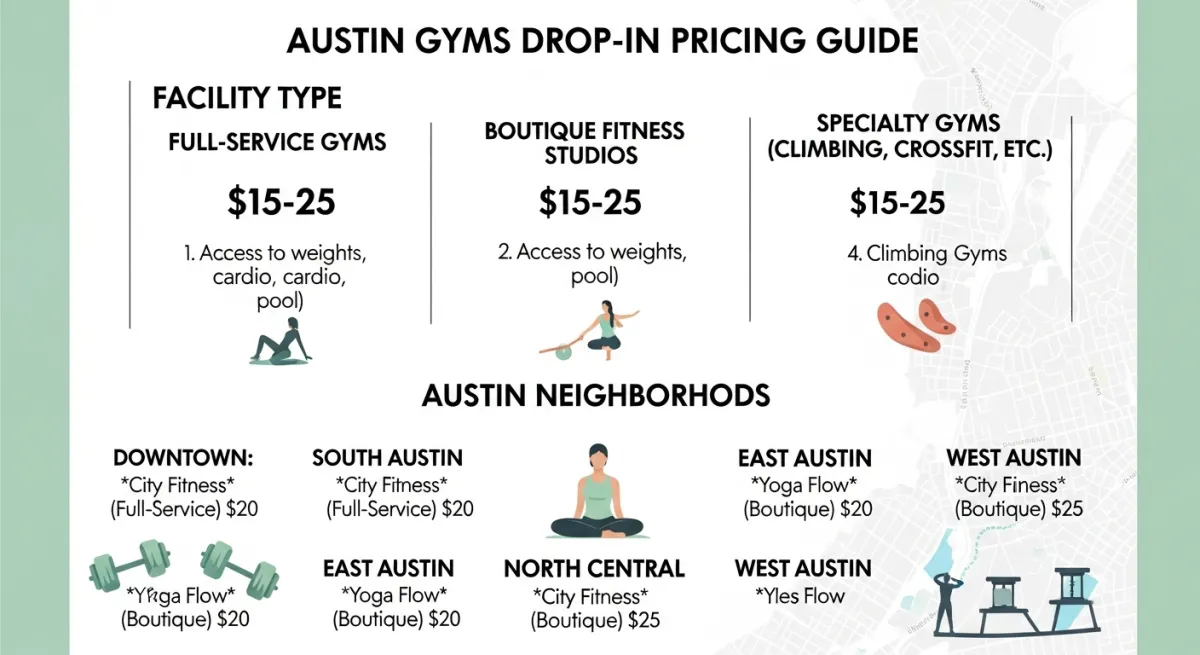
The range is wide. A City of Austin rec center costs roughly $3 to $5 per visit. A single boutique yoga class can run $28. A CrossFit drop-in will likely cost you $20 to $30. Where you land depends on what you need, where you are in the city, and whether you’re here for two weeks or just trying to avoid a $50/month contract.
This piece is written for four readers in particular. First: the SXSW or Formula 1 visitor who needs to move their body for a week without signing anything. Second: the person who just moved to Austin and is in trial mode. Third: the local who works out sporadically and has no interest in paying monthly for the privilege. Fourth: the resident who hasn’t yet done the math on whether a City of Austin annual pass might already be worth it.
The Best-Value Option Nobody Talks About — City of Austin Recreation Centers
The City of Austin Parks and Recreation Department operates more than 21 recreation centers across the city. Their drop-in fee structure is one of the best fitness deals in Austin, and almost nobody outside of regular users discusses it — though as part of our health & wellness coverage, it’s something we return to regularly. Adult daily admission runs approximately $3 to $5, with reduced rates for seniors and youth. That’s less than a gas station coffee — and includes access to weight rooms, cardio equipment, gyms, and indoor pool access at many locations.
Gus Garcia Recreation Center (1201 E. Rundberg Ln.) is the anchor facility for North Austin’s Rundberg corridor. It has a full weight room and gymnasium. Rosewood-Zaragoza Recreation Center anchors East Austin with the same amenities at that same $3–$5 drop-in rate. Both are straightforward: show up during hours, pay the fee, use the equipment. No tour, no pitch, no wristband drama.
Austin Recreation Center (1011 W. Dean Keeton) sits near the UT campus and Hyde Park. The location works well for that part of the city, but parking is limited, and arriving by car during busy periods is genuinely inconvenient — I’d call it a feature, not a bug, for anyone walking in from campus or Clarksville. Northwest Recreation Center (7000 Ardath St.), near the Arboretum area, is well-maintained and typically less crowded than central locations — a solid option for residents in the 78731 and 78759 zip codes. Dittmar Recreation Center (7211 Dittmar Rd.) covers South Austin and draws a steady crowd from the Slaughter Lane and Manchaca Road neighborhoods.
Outdoor water access complicates the picture. Barton Springs Pool charges approximately $5 for adults, with reduced rates for youth. Deep Eddy Pool runs approximately $3 to $4. These are outdoor, naturally fed pools — not lap-pool replacements for everyone, but legitimate open-water swimming options much of the year. Some PARD recreation centers include indoor pool access in the general admission fee; others charge separately. Call the specific facility before assuming pool access is bundled.
Fee schedules at PARD facilities change periodically. Before your first visit, check austintexas.gov/department/recreation for the current fee schedule, or call the specific facility directly. An outdated rate is worse than no rate at all when you’re standing at the front desk.
Private Chains — Who Actually Lets You Pay at the Door
Major gym chains are inconsistent on drop-in access. A few have built their models specifically around not offering it. Worth knowing before you drive.
LA Fitness operates two Austin locations worth knowing: one near the Arboretum and one on Brodie Lane in South Austin. A day pass typically runs around $15. These are full-facility clubs with pools, basketball courts, racquetball, free weights, and cardio floors. The catch: day-pass friction varies significantly by location and by who’s working the desk. Some visits are smooth. Others involve a membership pitch before they hand over a wristband. If you’re in a hurry, be direct when you walk in — say you’re looking for a day pass, not a membership. Most staff will comply without drama.
Gold’s Gym has had a presence in Austin, though the corporate-versus-franchise status of specific locations affects pricing and policies. Day passes have been reported at Texas locations, but current location status should be verified before you make a trip. Check goldsgym.com for current Austin locations and call ahead.
YMCA Austin operates multiple branches, including Downtown Austin and North Austin locations. Non-member day passes run approximately $15 to $20 for adults. Here’s the useful detail: YMCA members nationwide typically get reciprocal access at Austin branches, either at no additional cost or at a meaningfully reduced guest rate. If you’re visiting from Dallas, Chicago, or anywhere with a Y membership in your wallet, this is your default answer before you pay full price anywhere else.
Planet Fitness does not offer a public day pass. Their $10/month base membership is structured to make monthly sign-up the only real option. The Black Card tier that allows guest access is a member benefit, not a drop-in mechanism for non-members. This isn’t a criticism of their model — plenty of people love the $10 deal — but it’s a fact several Austin visitors discover only after walking in the door. Know this in advance and save yourself a trip.
Life Time Fitness at The Domain in North Austin is Austin’s premium club option. The facility is exceptional — pools, spa, group classes, turf areas, full-service amenities. But Life Time has historically required prospective members to complete a full tour and sit through a sales presentation before gaining access. A single-visit drop-in is not realistic for most people. If you’re considering a membership and want to see the facility, a scheduled tour makes sense. If you need a gym for Tuesday morning, go somewhere else.
Boutique and Specialty Studios — Class-by-Class Pricing
Austin’s boutique fitness market is dense and genuinely good, particularly in 78704 (South Congress, South Lamar, Travis Heights) and 78702 (East Austin). Most studios sell class packs and introductory offers, but drop-in single-class rates are typically available without commitment. Drop-in rates at Austin yoga studios run $20 to $28 per class. If you’re paying above $28 for a single drop-in, you’re at the premium end of the local market — and you should know that going in.
Black Swan Yoga operates on a donation-based model. You pay what you can, with no mandatory minimum. Black Swan has locations on South Lamar, North Loop, and in East Austin. For new arrivals, visitors, or anyone who finds the boutique pricing model exclusionary, this is one of Austin’s most accessible fitness options. It gets far less attention than it deserves and is worth checking out on principle alone.
Austin has a cluster of CrossFit affiliates, and most have an established protocol for drop-in visitors — particularly traveling CrossFitters already comfortable with the methodology. CrossFit Austin (near North Loop on Duval St.) welcomes drop-ins at approximately $20 to $30 per visit. The norm across CrossFit affiliates nationally is to post drop-in rates on their websites. Check the specific affiliate’s site before showing up, since class schedules and coach availability affect whether a drop-in makes logistical sense on a given day.
Austin Bouldering Project (979 Springdale Rd., East Austin) is both a climbing gym and a broader fitness facility. A day pass runs approximately $20 to $22, with no membership required. Gear rental (shoes, harness) is available at additional cost if you’re arriving without equipment. For a visitor looking for a full-morning activity that combines fitness with something more engaging than a treadmill, ABP is a legitimate option. The facility is large, well-maintained, and draws a wide range of skill levels — I’ve seen absolute beginners next to people doing things that look medically inadvisable.
Single-class drop-in rates at Austin’s spin studios run approximately $25 to $35 per class. This is the high end of the per-workout price range in Austin. A daily drop-in at a City rec center and a single spin class carry about as much difference in cost as a tank of gas. If you’re a dedicated cyclist or spin enthusiast, the price might not matter. If you’re casually looking for an indoor cardio option, the math points elsewhere.
ClassPass and Reciprocal Networks — Options Most Visitors Miss
ClassPass functions as a practical drop-in aggregator for Austin’s boutique scene. Entry-level plans start around $19 to $25 per month and operate on a credit system that unlocks access to participating yoga, Pilates, cycling, boxing, and strength studios across the city. For a visitor spending 10 days in Austin who wants flexibility across different studio types without buying into individual studio memberships, ClassPass is worth the setup friction. The limitation is that credits don’t go as far at peak times or premium studios — a single spin class during prime hours might consume all your monthly credits. Read the credit costs per class before booking, not after.
If you hold a YMCA membership from another city, verify reciprocal access availability at Austin Y branches before paying any drop-in rate. This is the single most overlooked benefit among gym-going visitors to Austin. The reciprocal network is real and saves serious money if you’re eligible.
The IHRSA Passport Program historically allowed members of participating clubs to access other clubs in the network at reduced guest rates. Network participation has contracted in recent years. Not all Austin clubs that once participated still do. If your home gym is an IHRSA member, call ahead to the Austin location you’re targeting and ask directly whether they honor Passport rates. Don’t assume.
Silver Sneakers and Active&Fit are insurance-linked fitness benefit programs available to many Medicare-eligible adults. Both provide access to a network of gyms — including some YMCA branches and other participating Austin facilities — at reduced or no additional cost. If you’re 65+ and have Medicare Advantage or a supplemental plan, check your benefits before paying any drop-in rate. These programs are legitimate and frequently overlooked, and they can eliminate most or all of the cost barrier entirely.
For longer-term non-student Austin residents who want something more substantial than drop-ins without a full commercial gym membership, UT RecSports sells community memberships to non-students for approximately $400 to $600 per year depending on access tier. The facilities are excellent. This isn’t a drop-in solution, but for someone settling into Austin for a year or more who lives or works near campus, it’s worth knowing the option exists.
What a Single Workout Actually Costs You in Austin
| Option | Typical Daily Cost | Best For |
|---|---|---|
| City of Austin Rec Center | $3–$5 | Budget-conscious locals, frequent visitors, anyone near a PARD location |
| YMCA Austin (non-member) | $15–$20 | Travelers with national Y memberships; full-facility users |
| LA Fitness | ~$15 | Full-facility access with pool; Arboretum or South Austin |
| CrossFit Austin drop-in | $20–$30 | Traveling CrossFitters who know the methodology |
| Boutique yoga (conventional) | $20–$28 | Class-experience seekers; South Lamar or East Austin |
| Black Swan Yoga | Donation | Zero-barrier access; any Austin neighborhood |
| Austin Bouldering Project | $20–$22 | Activity + fitness combined; East Austin |
| Spin/cycling boutique | $25–$35 | Dedicated indoor cycling; high end of local market |
| ClassPass (per month) | $19–$25/month | Visitors wanting multi-studio flexibility |
| Planet Fitness | No day pass | — |
| Life Time at The Domain | No practical day pass | — |
The Math for Visitors and Occasional Users
If you’re a two-week visitor working out daily at City of Austin rec center rates ($3–$5/visit), 14 days of workouts costs you $42 to $70. That’s the baseline. Against that, Planet Fitness’s $10 first month sounds cheaper — until you factor in the cancellation process, which is a real inconvenience for someone leaving town in a week. A YMCA day-pass approach over two weeks at $15–$20/visit gets expensive fast ($210–$280 for 14 visits) unless you have reciprocal membership access. The math strongly favors PARD facilities for visitors doing multiple workouts over a week or two, unless location or equipment specifically requires otherwise.
For the Austin resident who works out twice a month at a City rec center ($3–$5 per visit), the annual math is different. You’re spending roughly $72 to $120 per year on drop-ins. A PARD annual pass runs approximately $200 to $250 for adults. The break-even point is roughly 4 to 6 visits per month. If you’re there 4+ times a month, the annual pass pays for itself by June. If you’re genuinely only going twice monthly, the drop-in rate is the honest answer.
One Austin-specific factor changes this calculation: summer. From June through September, Austin routinely runs triple-digit temperatures for weeks at a time. Access to air-conditioned indoor exercise space shifts from amenity to genuine necessity. Residents who never think twice about outdoor workouts in March are often looking for indoor options by July — sometimes desperately. Running the annual-pass math in February, when you’re comfortable outside, can lead to seriously underestimating how much you’ll want a rec center in August. Ask anyone who’s tried to run the Barton Creek Greenbelt trail in 104-degree heat.
Finding Your Closest Option by Neighborhood
Austin’s traffic is real enough that driving 20 minutes across town to save $5 on a day pass is a bad trade. Here’s a rough district breakdown.
Near UT campus and Hyde Park: Austin Recreation Center at 1011 W. Dean Keeton is the PARD option. Walkability from the UT campus makes it accessible without a car, though parking is limited if you’re driving. The Downtown YMCA provides an alternative if you need full-facility access and aren’t walking distance.
East Austin (78702): Rosewood-Zaragoza Recreation Center is the PARD anchor. The Austin Bouldering Project on Springdale is the boutique standout. East Austin also has high density of independent yoga and fitness studios — Black Swan Yoga locations here are worth a visit if you’re trying to keep costs low.
South Austin (78704): Dittmar Recreation Center for budget access. The South Lamar and South Congress corridors have boutique yoga and fitness studios, including Black Swan Yoga. LA Fitness on Brodie Lane serves the full-facility private chain contingent.
North Austin and Rundberg corridor: Gus Garcia Recreation Center is the primary PARD facility. The Rundberg/North Lamar corridor has significantly fewer private gym options than South or Central Austin. For residents in that area, Gus Garcia isn’t just the cheapest option — it’s often the most practical one within reasonable distance. The YMCA North Austin branch on Rundberg provides additional access. For that community, it functions as essential fitness infrastructure, full stop.
Practical Notes Before You Go
Bring your own lock. Most PARD facilities have lockers but do not provide locks. This is not optional if you’re carrying valuables.
Towel policies vary considerably. Some facilities provide towels; many don’t. PARD facilities typically do not. Boutique studios often charge for towel rentals or offer them to members only. Call ahead to clarify, especially if you’re traveling light without gym gear.
PARD hours are facility-specific and subject to seasonal adjustment. Summer hours often differ from the fall schedule. Holiday closures affect facilities on schedules that aren’t always posted prominently online. Call the specific facility or check the individual location page on austintexas.gov before building a morning around a facility being open. This matters more than it sounds — a facility listed as “open” on a general page might have abbreviated hours on the specific day you need it.
Verify before you drive. Day-pass policies, hours, and management decisions can change faster than any published roundup can track. The prices in this piece reflect the best available reported rates at time of publication. Call ahead, check the facility’s current website, or email before your first visit — especially for higher-cost options where a policy change matters more financially. The range from $3 to $30 per workout is wide enough that knowing where you fall before you show up is worth five minutes of verification. Austin’s options, taken together, are better than most mid-sized cities. You just have to know where to look.