How UFCU, Amplify, Austin Telco and Velocity Compare on HELOC Rates Right Now
We called every HELOC desk in June 2026 to document what each institution is currently offering — and what Chase and Bank of America are charging Austin homeowners by comparison

We called every HELOC desk in June 2026 to document what each institution is currently offering — and what Chase and Bank of America are charging Austin homeowners by comparison
Austin homeowners sitting on equity built during the 2021–2022 run-up are back on the phone with their lenders this summer. The 2023–2024 price correction trimmed values in some neighborhoods, but longtime owners in 78702 (East Austin), 78704 (South Congress and Bouldin Creek), and 78703 (Tarrytown and Clarksville) still hold substantial equity cushions. That equity is being put to work.
Three specific projects are driving current demand: ADU construction enabled by Austin’s post-2023 zoning reforms, pre-sale kitchen and bath renovations in a competitive resale market, and high-interest debt consolidation. The HELOC is the financing tool of choice for all three.
Timing matters here. The Federal Reserve has been cutting rates from its 2023 peak through late 2025 and into 2026, and lenders are competing more actively for HELOC volume as a result. What the national rate-comparison sites won’t tell you is which Austin institution is actually quoting what — and which ones you can even join. We made direct calls to UFCU, Amplify Credit Union, Austin Telco Federal Credit Union, and Velocity Credit Union in June 2026. Before you read what we found, read the Texas rules section below. It’s not optional.
Before the Rate Table, Read the Texas Rules
If you’ve been researching HELOCs on Bankrate or NerdWallet, the content you read almost certainly doesn’t reflect what you’ll actually be offered in Travis County. Texas home equity lending is governed by Article XVI, Section 50(a)(6) of the Texas Constitution, and the rules are restrictive enough to make Texas a structurally different HELOC market from every other state — a distinction worth understanding as part of our legal and finance coverage of Austin’s borrowing landscape. This surprises people every time. It shouldn’t.
The 80 percent CLTV cap is absolute. Your first mortgage balance plus your HELOC cannot exceed 80 percent of your home’s appraised value. No exceptions. On most Austin properties, that cap limits how much equity you can actually touch, and it’s stricter than most other states allow.
One home equity loan at a time. Texas homeowners can have only one outstanding home equity loan or HELOC against a primary residence. Want to open a second line? Close the first one and get the lien released.
Mandatory 12-day waiting period. After you submit a completed application and receive required disclosures, you cannot close for at least 12 calendar days. Constitutional law, not lender policy. It applies even if you’re in a hurry and even if the lender would happily move faster.
Three-day right of rescission after closing. After the HELOC closes, you have three business days to cancel without penalty. Funds can’t be disbursed until that window expires.
Neutral-location closing requirement. The closing must occur at a title company, attorney’s office, or similar neutral location — not at the property itself. Most Texas lenders have consistent closing procedures for this, but confirm with yours.
Any rate or term you see quoted on a national comparison site should be treated as potentially inapplicable to your Texas transaction until you verify it directly with the lender.
The Rate Table: What We Found When We Called in June 2026
All figures below were obtained by direct phone calls and rate sheets pulled in the first two weeks of June 2026. Where an institution declined to provide a quote without a completed application, that is noted.
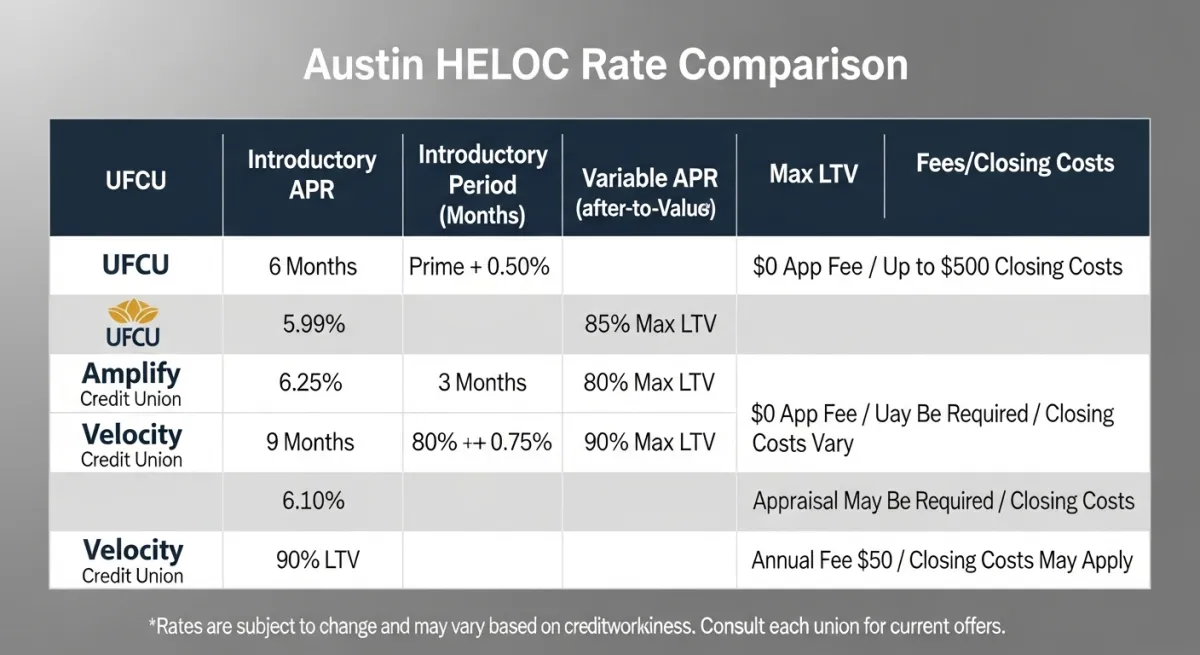
All four credit unions price their HELOCs as Prime plus a margin. The all-in variable APR equals the current Prime Rate plus the margin listed below. Before you do any cost calculations, verify the current Prime Rate — it moves, and so do these numbers.
Verify with your lender: The rate figures below were obtained directly from each institution in June 2026. Variable rates tied to Prime will change as Prime changes. Confirm all figures in writing before proceeding.
UFCU (University Federal Credit Union)
UFCU indicated that margins vary by CLTV and credit profile. There’s room to negotiate, and most borrowers don’t ask. Call directly and ask for the specific Prime-plus margin you qualify for given your credit score and current CLTV. The HELOC desk provided rate range information on an inbound call without requiring a formal application, which is more than some lenders will do.
UFCU indexes to the Wall Street Journal Prime Rate. Maximum CLTV is 80 percent. Promotional introductory rates are available for new HELOCs during a limited window for members meeting specific credit score and CLTV thresholds — get the expiration date in writing, because these windows close without warning.
Confirm draw period and repayment period terms, HELOC amount range, annual fee structure, and early-closure penalty terms directly with UFCU. Ask whether appraisal costs are passed through to you for your loan size and LTV. The Texas 12-day waiting period is a floor, not a closing timeline guarantee.
Amplify Credit Union
Amplify prices on Prime-plus margins that vary by CLTV and credit profile. The repayment period is longer than some competitors — a material detail for payment planning that’s easy to overlook when you’re focused on the headline rate. When we called, Amplify’s loan officer volunteered the annual fee that kicks in after the first year without being asked. That’s not universal practice; Austin Telco, for comparison, wouldn’t discuss fees at all without a formal application. Confirm the current fee amount directly.
Amplify indicated no closing costs on most HELOCs. Confirm whether an appraisal is required for your specific property. The institution also offered a margin reduction tied to automatic payment enrollment from an Amplify checking account — confirm those terms if that interests you.
Amplify has the lowest barrier to membership of the four. The credit union serves Travis, Williamson, Hays, and Bastrop counties under a community charter. If you live, work, or go to school in any of those counties, you qualify. Most Austin-area residents are eligible and don’t realize it.
Austin Telco Federal Credit Union
Austin Telco doesn’t publish HELOC rates on its website in useful detail. When we called, the lender declined to provide a specific rate range without initiating a formal loan inquiry. A loan officer described margins as competitive with Prime-based products in the market, but nothing specific was disclosed. The institution indexes to Wall Street Journal Prime Rate. Maximum CLTV is 80 percent. A 10-year draw period was mentioned on our call, but full terms require a formal inquiry.
Annual fee details, early-closure penalties, minimum credit score, closing costs, appraisal treatment, and promotional rates were all withheld pending application initiation. Austin Telco was the least forthcoming of the four on an inbound call — which means you’ll spend more time in their process before you can compare them accurately against the others. Factor that into your timeline.
Austin Telco was founded to serve telecommunications employees and retains employer relationships with telecom companies and related organizations. The institution has expanded, but eligibility specifics weren’t clearly confirmed on our call. If you don’t work in telecom or for a recognized employer group, call directly and ask what membership pathway is available before investing time in their application process.
Velocity Credit Union
Velocity offered competitive low-end margins on our June call, with the same Prime-plus structure and CLTV variation as the other three. Interest-only payments during the draw period were confirmed available. The institution indicated it covers standard closing costs — confirm whether appraisal is required and whether that cost lands with you for your specific loan amount.
Velocity also indicated a promotional introductory rate for members meeting specific credit score and CLTV thresholds, and described it as the longest promotional window of the four. Promotional windows shrink when rate environments shift, so confirm current availability and exact terms before applying. No annual fee applies for the first year; a fee applies annually after that. Confirm the current amount directly.
Velocity’s staff provided margin ranges and promotional details on an inbound call without requiring a formal application. Given Austin Telco’s approach, that difference is worth noting when you’re planning your comparison calls.
Velocity was originally chartered to serve Travis County and City of Austin employees. City and county employees are automatic members. Everyone else should call Velocity’s membership department before spending time on a rate inquiry.
Big Bank Comparison: Chase and Bank of America
Chase offers variable HELOCs in Texas with rates dependent on draw amount, CLTV, and credit profile. Origination fees and closing costs apply and aren’t consistently disclosed in Chase’s online HELOC materials — which tells you something about how they want you to think about the comparison process. Verify current rate and fee details directly with a Chase loan officer, not the website.
Bank of America offers a rate discount structure for Preferred Rewards members, which can shift the math meaningfully for existing BofA customers with significant deposit or investment balances. If you already bank with BofA at a qualifying tier, get the specific discount you’d receive in writing and factor it into your comparison. If you don’t, their rates are unlikely to compete with what the credit unions are quoting.
Wells Fargo suspended HELOC originations nationally in 2020 and hasn’t uniformly resumed them across all markets. Verify directly with Wells Fargo whether they’re originating HELOCs for Texas borrowers before spending any time on a comparison.
On fees: big banks often advertise competitive headline rates and recover margin through origination fees, appraisal costs, or annual fees. When comparing any two institutions, ask each one to disclose the total first-year cost — margin, annual fee, and any closing costs paid out of pocket, not just the APR. That number is what actually matters.
The Fine Print Most Austin Borrowers Miss
The rate table is the starting point. Several structural features of HELOC products matter more than most borrowers realize — usually not until they’re already in the middle of a draw period.
Variable rate caps. Some HELOC agreements include periodic caps (how much the rate can move in a single adjustment period) and lifetime caps (the maximum the rate can ever reach above your initial margin). Others offer only a lifetime cap with no periodic limit. In a falling-rate environment this matters less. But if Prime reverses, a product without a periodic cap can move your rate significantly in a single adjustment. Ask every lender: “What is my periodic cap and my lifetime cap?” UFCU and Velocity were the most straightforward about these structural details on an initial call. Amplify was direct about fees but required more pointed questioning on rate cap structure.
Payment shock at draw-period end. Every HELOC has a moment when the interest-only draw period ends and the balance converts to fully amortizing repayment. If you’ve drawn your line substantially and carried the balance, the payment jump at that transition is real — not a rounding error. Ask each institution specifically how long the repayment period runs and what a fully amortizing payment would look like on your anticipated balance at currently quoted rates. Amplify’s longer repayment period softens this somewhat; confirm the exact term directly.
Early-closure penalties. The credit unions in this comparison carry early-closure penalties if the line is closed within a set window after opening. These exist because lenders absorb closing costs upfront and recover them through interest income over time. Confirm the exact penalty amount and the trigger window in writing. If there’s any real chance you’ll sell the property or refinance within a few years, price this into your decision before you sign anything.
Minimum draw requirements. Some institutions require a minimum initial draw at closing and minimum amounts on subsequent draws. If you’re opening a HELOC to fund phased ADU construction and plan to draw incrementally as contractors complete work, confirm that the institution’s minimum draw structure actually accommodates that. This is where a HELOC can get awkward for construction use — confirm it regardless of how the loan officer describes it verbally.
Interest-only draw periods. Velocity confirmed these are available on our call. Confirm directly with UFCU and Amplify as well. Don’t assume it’s available; it isn’t universal.
What Austin Homeowners Are Actually Using HELOCs For in 2026
ADU construction. Austin’s post-2023 zoning reforms liberalized ADU permitting considerably, and construction activity has increased as a result. A HELOC suits this use case because construction draws are incremental — you don’t need the full loan amount on day one, and interest accrues only on what you draw. Before you apply, check current ADU permitting timelines with the City of Austin’s Development Services Department. Anyone who’s tried to pull a permit in East Austin recently knows the timeline can slip by months, which compresses your funding schedule in ways that matter.
Pre-sale renovation. Austin’s resale market in Q2 2026 remains active in the sub-$600,000 range, but buyer expectations for turnkey condition have risen noticeably. Whether a kitchen or bath renovation pencils out depends on your specific neighborhood and scope of work — and our reporting on home improvements that add resale value in Central Texas breaks down which projects tend to pay off by area. Talk to a listing agent who works your zip code before you commit to the project — that conversation is worth more than any national ROI estimate. Some neighborhoods reward kitchen work. Others don’t, and the difference is real money.
Debt consolidation. Consolidating high-interest credit card balances into a HELOC at lower rates is a real cost reduction when the rate differential is significant. The risk is equally real: you’re converting unsecured debt to debt secured by your home. Texas’s constitutional protections add procedural requirements to foreclosure on a homestead equity loan, but that’s cold comfort if you default. The math can look very attractive. Run it carefully anyway.
A Reporter’s Checklist for Your HELOC Calls
When you call each institution, ask these questions. Write down the answers with the date and the name of the person you spoke to. Lender phone reps turn over, and what you were told verbally won’t help you if the terms at closing look different.
-
What is the exact current margin over Prime you’re quoting me, and is that margin negotiable based on my credit score or CLTV?
-
Is there a promotional introductory rate available right now, and when does it expire?
-
What is my periodic rate cap and my lifetime rate cap?
-
What triggers the early-closure fee, and for how many months does it apply?
-
What closing costs will I actually pay out of pocket, and is an appraisal required for my property value and loan amount?
-
How long are you currently taking from completed application to close?
-
Is an initial minimum draw required at closing, and what is the minimum on subsequent draws?
-
Can I make interest-only payments during my draw period?
On Austin Telco specifically: call them earlier in your process rather than last. Their terms aren’t published with the same detail as the other three, and you’ll need to initiate a formal loan inquiry before getting the specifics you need to make a real comparison. That’s not a reason to skip them. It’s just the reality of how they operate.
Once you receive a written rate quote, the Texas 12-day constitutional waiting period begins after you receive your required disclosures — not after your initial call. Don’t sign disclosures until you’ve compared rates across at least two institutions and are confident in your choice.
Rates reported in this article reflect direct calls and rate sheets obtained in the first two weeks of June 2026. Variable rates are tied to Prime and will change when Prime changes. Verify all rates in writing with the institution before proceeding. This article is not financial advice. Consult a licensed mortgage professional or Texas real estate attorney before committing to a home equity lending product.