What Happens to Earnest Money in an Austin Home Deal That Falls Through
From option periods to interpleader actions in Travis County, here's how deposits are protected — and lost — under the TREC contract Austin buyers and sellers actually sign

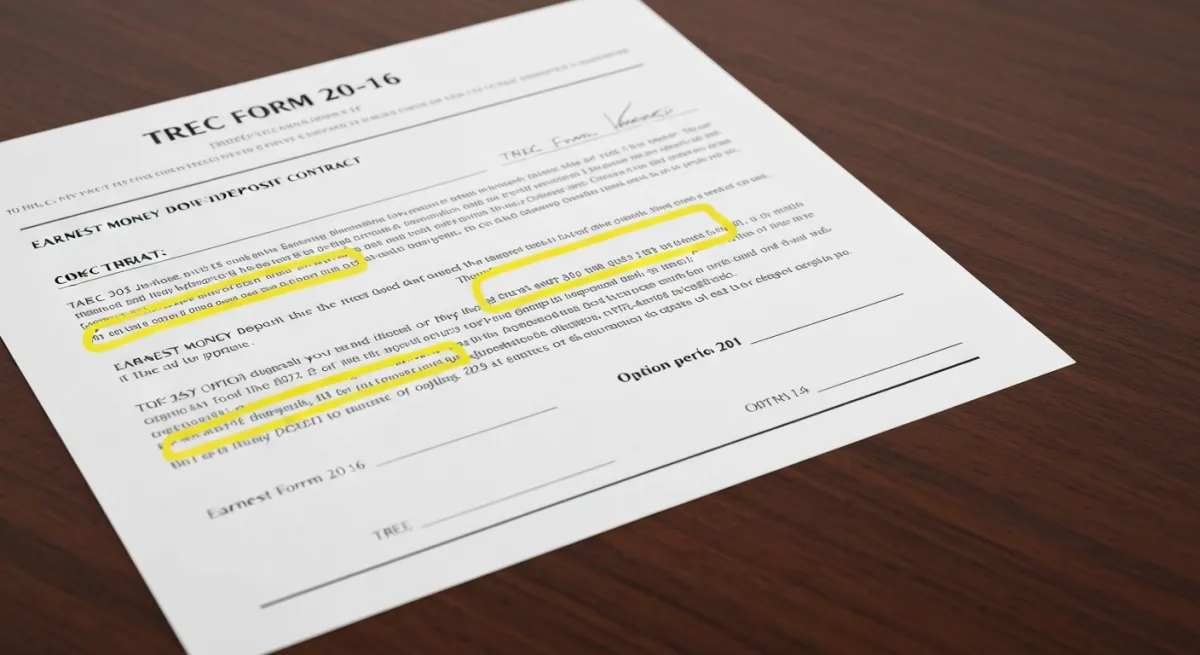
From option periods to interpleader actions in Travis County, here’s how deposits are protected — and lost — under the TREC contract Austin buyers and sellers actually sign
When an Austin home purchase collapses — and in the past two years, thousands have — the first question both sides ask is the same: who gets the earnest money?
Not abstract. A buyer under contract on a $540,000 home in Travis County has roughly $8,100 sitting at Independence Title or Capitol Title while the deal unravels. Whether it comes back depends on a specific chain of contractual conditions most parties don’t fully understand until they’re already in a fight about it.
Austin’s 2022–2023 market correction created a wave of these situations. Buyers who had waived contingencies at the peak found themselves trying to exit deals in a softening market, with sellers arguing the deposits were forfeit. Some sellers were right. Some weren’t. The difference came down to specific language in the Texas Real Estate Commission’s One to Four Family Residential Contract, Form 20-16, and the timing of events relative to the option period — neither of which most buyers had read carefully when they were competing for a house in 2021.
What follows is a detailed walkthrough: the contractual structure, the scenarios where sellers have legitimate claims to the deposit, what happens when both parties refuse to budge, and what to do in the first 48 hours if your deal falls apart.
The Option Fee and Earnest Money Are Two Different Things
This is the single most common confusion among Austin buyers. It matters enormously in a dispute.
When you go under contract on an Austin resale home, you make two separate payments in the first few days. The first is the option fee — typically $500 to $2,500 in current transactions — paid directly to the seller, not the title company. In exchange, you get what Paragraph 23 of the TREC contract calls an “unrestricted right to terminate” during the option period. Unrestricted means exactly that: no bad inspection required, no failed appraisal, no documented reason. You can terminate because you changed your mind.
The option fee is always non-refundable. That’s not a negotiable point. It’s the consideration the buyer pays for the termination right. If the deal closes, it’s credited toward the purchase price. If the buyer terminates during the option period, it stays with the seller. If the seller defaults, the buyer loses the fee unless they specifically pursue recovery through litigation.
The second payment is earnest money — typically 1–2% of the purchase price, held in escrow by a licensed title company. This is a deposit against performance, not a payment for a right. Unlike the option fee, earnest money is refundable under specific contractual conditions. When and whether it’s refundable depends on the TREC contract’s contingency structure.
TREC Form 20-16, Paragraphs 5 and 23, govern these mechanics. Any Austin buyer or seller in a dispute should have a printed copy in front of them — actually printed, actually in front of them, not half-remembered from when they signed it three weeks ago.
What the Option Period Actually Protects
Paragraph 23 gives buyers their cleanest exit right, but it has a hard edge: it expires on a specific date and time. Texas courts have not been sympathetic to buyers who let it lapse.
The option period in Austin compressed dramatically during the 2021–2022 frenzy. Three to five days was common; buyers sometimes waived it entirely to compete. It has since normalized to roughly 7 to 10 days, though this varies. Luxury properties and off-market deals often see longer periods negotiated; hot corridors still produce shorter ones.
During the option period, a buyer who wants to terminate must deliver written notice to the seller before the period expires. Not verbal. Not through a third party. Do that, and they recover earnest money in full, forfeiting only the option fee. The title company releases funds on execution of a release form.
Here’s what trips up a lot of buyers: the option period does not protect them after it expires, regardless of what the inspection found. A problematic inspection report often creates negotiating leverage — buyers and sellers routinely use findings to renegotiate price or repairs — but if negotiations stall and the option period expires without a termination notice or a signed amendment, the buyer is bound by the original contract. Exiting after that point requires a specific contractual contingency to kick in. Otherwise, the buyer is in default.
Texas has no statutory cooling-off period for real estate transactions. None. The option period in the TREC contract is the only structured, unconditional exit right a buyer has. Once it expires, the contract governs everything.
When an Austin Seller Can Legally Keep the Earnest Money
If a buyer simply refuses to close after the option period expires — cold feet, found another property, personal change of circumstance — the seller has a legitimate contractual claim to the earnest money, provided no active contingency remains that would excuse performance. The seller typically must formally notify the buyer of default, but the right exists. This became extremely common in Austin’s 2021–2022 market, when buyers routinely waived financing protections to compete. It felt fine until rates moved and the math didn’t work anymore.
The financing contingency in TREC Form 20-16 protects buyers who are formally denied credit after genuinely pursuing a loan. Buyers who included this language and receive a formal denial letter have a contractual path to a full earnest money refund. Buyers who waived it — offering cash or effectively guaranteeing performance — have no such protection. If they fail to close for any financing-related reason, the earnest money is properly the seller’s.
This hit hardest in East Austin, Mueller, and other areas that attracted significant investor activity. Buyers who had waived contingencies to win deals, then wanted out when conditions changed, found themselves with no contractual exit and a title company holding their deposit. When attorneys got involved, the financing contingency question was almost always the first thing examined. In our legal and finance coverage, this pattern — waived contingencies creating unresolved disputes — is one of the most consistent themes in Austin real estate litigation.
One more exposure point: the TREC contract requires the buyer to deliver earnest money to the designated title company within three days of contract execution. Failure to meet that deadline can itself constitute a default. In practice, agents and title companies catch this quickly. But it’s a real obligation, and buyers need to treat it like one.
When Both Sides Claim the Deposit and the Title Company Is Stuck
The title company cannot unilaterally decide who gets the earnest money. It’s not an adjudicator. Both parties must execute the TREC Release of Earnest Money form (TXR 1904) before funds can be disbursed. If one party refuses, there’s a formal process — and it has teeth.
Under Texas law, when both parties claim the same funds and neither will sign a release, the title company issues written demand notices to each side, typically within a 15-day window. If that doesn’t resolve it, the title company can file an interpleader action in Travis County District Court at 200 W. 8th Street in downtown Austin. The title company deposits the disputed funds with the court, notifies both parties, and walks away from the dispute. It’s now the court’s problem.
Realistic timeline for interpleader resolution in Travis County: 6 to 18 months, depending on the docket and how hard both sides fight. That’s a long time to wait for $8,000.
For most Austin earnest money amounts, there’s a faster path. Travis County Justice Court has a jurisdictional limit of $20,000, and most residential deposits fall within that. Filing fees run roughly $100–$150. Small claims is substantially faster than district court, doesn’t require an attorney (though having one helps), and is appropriate for disputes where the facts aren’t complex.
One thing that confuses people: filing a TREC complaint against an agent involved in the transaction does not resolve the money dispute. TREC has disciplinary authority over license holders. It can investigate whether an agent violated professional obligations. It cannot order money returned or retained. File a TREC complaint if agent misconduct occurred. File in court for the money. These are separate tracks entirely, and treating them as the same costs time.
What to Do in the First 48 Hours
Pull the executed contract and read it. Confirm which contingencies were included and which were waived. Check the option period expiration date and time — exactly. Determine whether the option period was still active when termination occurred. These facts establish your position before you do anything else.
Document your timeline against the contract dates. Buyers claiming termination during the option period need proof of written notice delivered before expiration. Sellers claiming buyer default need to establish clearly what obligation failed and when. Emails, texts, dated correspondence — all of it matters. Courts look at paper trails.
Contact the title company in writing to confirm the earnest money status. Find out whether any release has been signed or submitted. Don’t assume nothing has happened. Title companies can process releases quickly if one party has already submitted a form.
Do not sign any release form under pressure without understanding what you’re releasing. Sellers sometimes pressure buyers to sign a mutual release simply because they want to relist quickly. That’s their problem, not yours. Confirm you’re actually entitled to the return before signing anything. Buyers should similarly not sign releases assigning funds to the seller without being certain a genuine default occurred.
Consult a Travis County real estate attorney before the dispute escalates. Texas allows the prevailing party to recover attorney’s fees in a breach of contract action — and that cuts both ways. A seller who wrongfully withholds earnest money, or a buyer who abandons a contract without justification, may end up paying the other side’s legal costs. Knowing that tends to sharpen both parties’ willingness to negotiate once attorneys enter the room. The Austin Bar Association’s Real Property Section can provide referrals. If the dispute involves questions about what you paid at signing, understanding how much estate planning attorneys in Austin charge and what a basic package includes gives useful context for evaluating real estate legal fees in the same market.
What the NAR Settlement Actually Changed — and What It Didn’t
Since August 17, 2024, the industry has operated under the terms of the NAR commission settlement, and there’s real confusion about what that means for Austin transactions. Many agents are still explaining it badly.
The settlement did not alter TREC contract forms, earnest money mechanics, the option period structure, or contingency language. Those are governed by TREC, not NAR or MLS rules, and they haven’t changed. Any claim that the settlement rewrote how deposits work is wrong.
What changed: buyer-broker compensation was removed from MLS offers of compensation, and buyer-broker representation agreements are now required before agents can show homes to prospective buyers. Buyers who want full buyer-agent representation now negotiate and document that compensation directly rather than having it embedded invisibly in the listing-side transaction.
The indirect connection to earnest money worth watching: some buyers are now absorbing broker compensation costs directly, or negotiating seller concessions to cover them. Either scenario can affect how much cash a buyer has available — and may influence the earnest money amounts they’re willing to commit, particularly at lower price points. Whether this is reshaping deposit norms in Austin isn’t clear yet. The 2025 transaction data will tell that story.
New Construction Is a Different Category Entirely
Buyers pursuing new construction in Austin-area master-planned communities — Pflugerville, Cedar Park, within Austin city limits — need to understand that builder contracts are not TREC resale contracts. This catches people off guard more than it should, and the financial consequences can be significant.
Builder agreements are drafted by the builder’s legal team, for the builder. They often require earnest money deposits meaningfully larger than typical resale amounts, with non-refundable provisions that kick in at various stages of construction. Some builder contracts have no financing contingency equivalent, or include one that’s narrowly drawn. Default language is often more aggressive than anything in TREC Form 20-16.
The option period structure that protects resale buyers simply doesn’t exist in most builder contracts in the same form. There may be a due diligence window, but the builder defines it, not TREC. Buyers who assume new construction works like a Travis County resale are taking on materially more risk than they realize. In higher-priced new construction, earnest money deposits sometimes reach $50,000 or more. Have an attorney review the specific builder contract before you sign. That’s not boilerplate advice — at those deposit levels, it’s just math.
Where to Find Help With an Austin Earnest Money Dispute
The Austin Bar Association Real Property Section’s referral service can connect buyers and sellers with Travis County real estate attorneys who handle contract disputes.
For disputes within the $20,000 limit, small claims filings can be made at Travis County Justice of the Peace courts in the relevant precinct. Filing fees run roughly $100–$150. The Travis County courts website lists precinct locations and can confirm the correct venue based on the property’s address.
TREC, at 1700 N. Congress Avenue in Austin, handles complaints about agent conduct — failure to disclose, misrepresentation, escrow mishandling by a licensed party. To be explicit: TREC does not adjudicate money disputes between buyers and sellers. It cannot order a refund. File a TREC complaint for agent misconduct; file in court for the money.
The Austin Board of Realtors publishes current market data that can be useful when establishing what typical deal terms looked like at the time a contract was executed — relevant if a dispute involves whether certain terms were standard or anomalous for that moment in the market.
The buyers and sellers who understand the TREC contract structure before they sign are in a dramatically better position than those who discover its mechanics mid-dispute. The option fee is gone regardless. The earnest money depends entirely on which contingencies were active, when they expired, and whether a contractual default occurred. The title company cannot decide for you. Travis County courts can, but it takes time and money.
Almost every Austin earnest money dispute that ends up in litigation could have been settled at the negotiating table with a real estate attorney present, for a fraction of what the litigation costs. The contract gives both sides leverage in specific circumstances — knowing exactly where that leverage comes from is what makes the negotiation possible. And it’s what keeps $8,000 from becoming a $20,000 legal bill.
CityDesk Austin covers real estate, business, and civic affairs in Travis County and the greater Austin metro. This article is informational and does not constitute legal advice. Readers with active disputes should consult a licensed Texas real estate attorney.