What Austin Home Sellers Must Disclose About Flooding Under the Updated Texas Property Code
Two significant legal developments arrived in the same window this summer. Most Austin home sellers have no idea both of them apply simultaneously to their next transaction.

Two significant legal developments arrived in the same window this summer. Most Austin home sellers have no idea both of them apply simultaneously to their next transaction.
In 2025, FEMA finalized revisions to the Flood Insurance Rate Maps governing Travis County, reclassifying parcels in several of Austin’s most active real estate corridors into Special Flood Hazard Areas for the first time. [Confirm specific FIRM effective dates and affected areas with FEMA’s Map Service Center at msc.fema.gov and the City of Austin Watershed Protection Department before publication.] At the same moment, the 89th Texas Legislature took up amendments to Texas Property Code §5.008, the statute governing what home sellers must put in writing before closing. [The specific bill number and enrolled text of the 2025 §5.008 amendment must be confirmed at capitol.texas.gov before this claim is published as established fact.] The interaction of those two developments creates compounding legal obligations that neither sellers nor buyers have fully reckoned with as the summer 2025 closing season accelerates.
The central tension is straightforward, and it’s the kind of thing that gets expensive when people miss it. Being newly placed in a flood zone is not the same thing as having a flood history. Texas law treats those two facts differently on the disclosure form, and the distinction carries real legal consequences for buyers signing contracts right now — and real liability for sellers who conflate the two, or who assume that because their home has never flooded, they have nothing new to disclose.
What Texas Sellers Are Actually Required to Put in Writing
The governing document is TREC Form OP-H, the Seller’s Disclosure Notice that Texas Property Code §5.008 requires sellers of most existing residential properties to deliver to buyers before an executed contract becomes binding. The flood-related obligations are concentrated in a specific cluster of questions that sellers and their agents often treat as a quick checkbox exercise.
They are not.
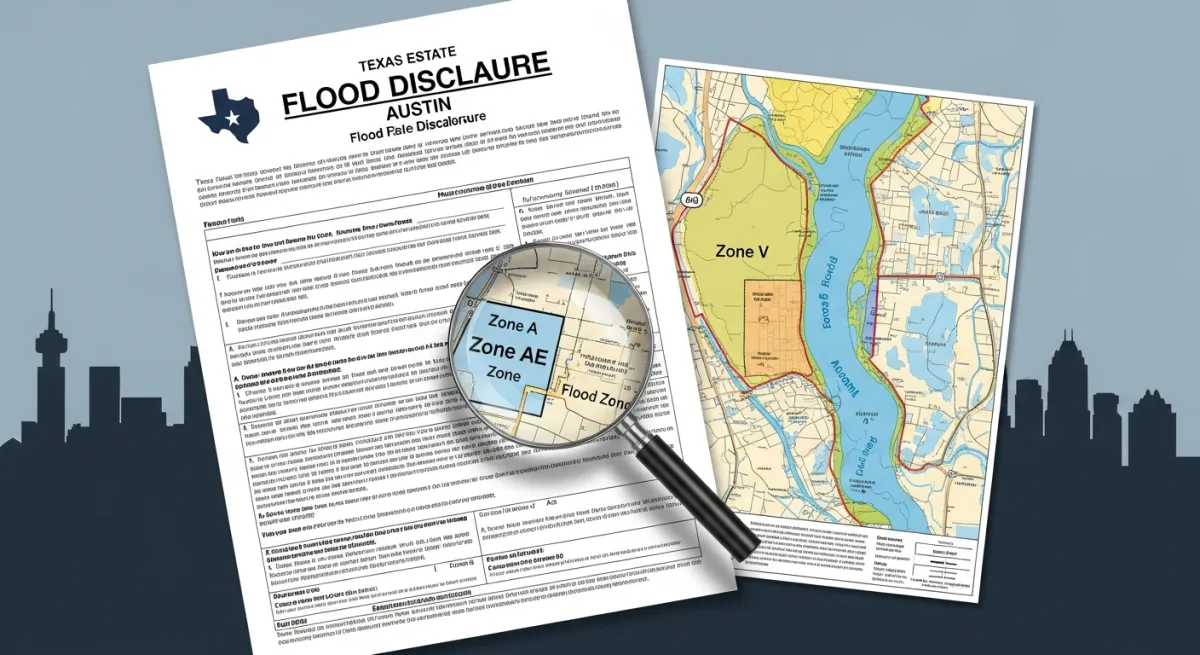
Under the current form, a seller must affirmatively disclose whether the property has ever flooded from any source — interior flooding, drainage backup, surface water intrusion — to the seller’s knowledge. The form separately asks whether the property sits in a FEMA-designated 100-year floodplain (Special Flood Hazard Area, or SFHA) or 500-year floodplain. It asks whether the seller has ever filed a flood insurance claim. Whether the seller has received FEMA disaster assistance related to flood damage at the property. Whether the property has experienced standing water following rain events, even when formal flooding didn’t occur.
Each question is independent. A seller who accurately checks “no” on flood damage history can still be required to check “yes” on the flood zone designation question. The reverse is equally true. These are not the same question, and treating them as interchangeable is exactly how sellers end up in trouble.
There’s a critical limitation buried in the statute that disadvantages buyers. Sellers must disclose what they know — Texas law does not require a seller to conduct an independent flood history search before listing. If a seller genuinely has no knowledge of a prior claim or FEMA assistance payment, they’re not legally required to discover it. That gap falls on buyers to fill.
Form OP-H also carries important exemptions. New construction sales, foreclosure transfers, and certain court-ordered conveyances aren’t covered. Buyers in those transactions receive no statutory disclosure and navigate entirely without the baseline protections OP-H provides. Worth knowing before you assume you’re covered.
The Remapping Question Sellers Are Getting Wrong Right Now
The question Austin sellers and listing agents are actively asking — and frequently misanswering — is this: if FEMA placed my property in a Special Flood Hazard Area for the first time in 2025, but it has never physically flooded, what am I required to disclose?
The answer is that the flood zone designation question and the flood history question are two separate obligations. A new SFHA designation triggers the first one regardless of whether the second applies. A seller whose property was mapped into a flood zone this year must answer the flood zone question on OP-H to reflect the current designation — not the one that existed when they bought the house.
What complicates this is the scenario where a seller listed before the new FIRM panels took effect but closes after the effective date. Texas Property Code §5.008 requires sellers to notify buyers of any changes in the property’s condition they become aware of after delivering the original disclosure. Whether a FEMA zone change constitutes a “change in condition” under that provision remains unsettled — and I’d genuinely want a named Travis County real estate attorney on the record before stating definitively either way. [A named Travis County real estate attorney must be obtained for the following legal analysis before publication. The position below is editorial summary, not verified legal opinion. Suggested outreach: Austin Bar Association Lawyer Referral Service real estate section; Travis County District Court plaintiff/defense counsel in flood disclosure cases; UT School of Law real property faculty.]
The 2025 FEMA remapping revisions have been publicly available through FEMA’s Map Service Center and the City of Austin’s floodplain viewer for months. That makes “I didn’t know” a harder argument for any seller whose listing agent had access to those databases — which is to say, every listing agent in Austin.
Which Austin Neighborhoods Are Most Affected
The 2025 FIRM revisions touched several of the city’s historically flood-prone drainage corridors, but the impact is distributed unevenly. Some ZIP codes face meaningfully higher exposure than the Austin-area average; others are largely unaffected. Here’s where buyers and sellers need to be paying attention.
Onion Creek (78748, 78747) has a documented flood history that most longtime South Austin residents know too well. The creek flooded badly in 2013 and again in 2015, and the city subsequently executed a buyout program removing the most vulnerable properties. The 2025 FIRM revisions extended SFHA boundaries along portions of the creek that had previously been mapped as Zone X, bringing additional parcels into the 100-year floodplain for the first time. If you own or are buying here, confirm your specific panel number at FEMA’s Map Service Center and compare it against the prior effective date. Don’t assume. [Parcel counts and specific panel numbers should be confirmed with the City of Austin Watershed Protection Department before publication.]
Shoal Creek (78756, 78757) presents a different profile. The creek flooded significantly during the Memorial Day 2015 event — if you were anywhere near 45th Street that night, you remember it — and the 2025 revisions adjusted SFHA boundaries in its lower and middle reaches. Properties that were previously in Zone AE or Zone X Shaded experienced boundary adjustments in preliminary panels. A property’s zone status determines what flood insurance costs and what development restrictions apply. Sellers and buyers in these ZIP codes shouldn’t assume their parcel’s flood zone classification remains what it was at the last sale. [Verify current panel numbers with the Watershed Protection Department and confirm whether preliminary panels have been adopted as final.]
Boggy Creek (78702, 78721) has flooded repeatedly despite the rapid redevelopment that transformed East Austin over the past decade. Here’s what’s particularly sharp about East Austin: property values have climbed faster than almost anywhere else in the metro, which means buyers purchasing at elevated prices near Boggy Creek face the highest dollar-denominated exposure when a disclosure goes wrong. The 2025 FIRM update included a review of Boggy Creek drainage basins, with some previously unmapped areas receiving SFHA designations. [Specific panel revisions require confirmation from FEMA’s Map Service Center.]
Walnut Creek in Wells Branch (78728) is a different story entirely. Buyers in this corridor are frequently first-time homeowners purchasing at the lower end of Austin’s price range — people who are least likely to independently verify flood zone status and most likely to be relying entirely on the seller’s OP-H. The 78728 Walnut Creek basin revisions in the 2025 update cycle affected portions of Wells Branch and adjacent areas within Travis County’s jurisdiction. Getting the OP-H right here matters more than anywhere else, not less. [Parcel counts from Travis County Appraisal District should be confirmed before publication.]
Colorado River and Lake Austin shoreline in Westlake (78746) saw FIRM panel adjustments related to backwater flooding during high-release events managed by LCRA. The financial stakes are obviously different — a $3 million property newly mapped into an SFHA carries a very different insurance cost impact than a $350,000 starter home. The legal obligations are identical either way.
You can verify any Austin-area address against current and preliminary FIRM panels using the City’s floodplain viewer at austintexas.gov/floodpro. It reflects both local classifications and federal designations, it’s searchable by address, and it requires no registration. Do this before you make an offer, not after.
What Buyers Closing This Summer Should Demand in Writing
A completed OP-H is a baseline, not a finish line. Given how extensively drainage basins were reviewed in the 2025 cycle, buyers near any remapped corridor should be asking for more in writing before the contract period closes.
Get a specific written representation from the seller regarding the flood zone designation as of the contract effective date — distinct from the date the OP-H was originally delivered. If a seller delivered a disclosure in March that reflected a pre-remapping Zone X designation and the new FIRM panel took effect in April, a buyer closing in June should have an updated disclosure or an addendum in the contract file. A buyer’s agent who doesn’t obtain this leaves their client exposed.
Then order an independent flood history search through Travis County deed records, paid for by the buyer, independent of anything the seller represents. Insurance claim histories attached to a specific address are sometimes discoverable through public databases. FEMA disaster assistance records can be requested through federal public records channels. The seller’s OP-H discloses what the seller knows. Deed records and insurance history can surface what the seller may not know — or chose not to mention.
Cash buyers face the highest exposure in this framework, and it’s worth being direct about why. A buyer using financing from a federally regulated lender is required by federal law to obtain flood insurance if the property is in an SFHA. That requirement functions as an automatic tripwire: the lender orders a flood zone determination, the determination surfaces the new SFHA designation, and the insurance requirement forces the flood conversation before closing. A cash buyer has no such tripwire. Nothing in Texas law requires a cash buyer to check FEMA’s map, obtain a flood determination, or carry flood insurance. Someone can close on a newly mapped SFHA property in 78748 without ever learning it sits in a 100-year floodplain — if they don’t ask and the seller’s OP-H is incomplete. That gap is entirely legal, and it swallows buyers whole.
One more thing buyers consistently miss: Austin maintains its own local floodplain classifications through the Watershed Protection Department, which in some areas impose stricter development restrictions than the federal FEMA designations. A property can sit outside the federal SFHA but within a City of Austin regulatory floodplain, which affects permitting, what can be built or modified, and how future buyers will perceive the property’s resale value. The city’s floodplain viewer reflects both designations simultaneously. For more on how Austin’s expanding flood zones are hitting homeowners’ insurance and mortgages, the financial ripple effects go well beyond the initial disclosure question.
What Buyers Can Do If a Seller Got the Disclosure Wrong
Buyers who close and later discover the seller misrepresented or omitted flood information have two primary legal theories available in Travis County courts.
The first is common law fraud. The buyer must show that the seller made a false statement of material fact, knew it was false or made it recklessly, intended the buyer to rely on it, and that the buyer suffered damages as a result. Common law fraud supports actual damages plus, in cases of gross fraud, punitive damages. The knowledge element is the hard part — a seller who genuinely believed the property had never flooded is harder to reach than one who knew about the 2015 slab flooding and checked “no” anyway.
The second theory has longer reach. Texas Deceptive Trade Practices Act, Tex. Bus. & Com. Code §17.46, prohibits false, misleading, or deceptive acts in consumer transactions. A residential buyer is a consumer under the statute. If a seller knowingly made a false representation about flood history, the DTPA allows recovery of economic damages, and in cases of knowing violation, treble damages — actual damages multiplied up to three times. The statute also allows recovery of attorney’s fees, which is what makes this theory viable in cases where the underlying damages might not otherwise justify litigation costs.
The limitations period on a DTPA claim is two years from the date the buyer discovered, or reasonably should have discovered, the misrepresentation. In flood cases, discovery often doesn’t happen until the property floods for the first time after closing, which can push the accrual date well past closing day. Don’t assume you’ve missed the window.
If you suspect a disclosure failure: collect photographs of any water intrusion, the property’s insurance claim history, FEMA disaster assistance records (searchable by address through FEMA’s public database), Travis County deed records for any prior disclosure documents in the chain of title, and statements from neighbors who were present during earlier flood events. Neighbor accounts aren’t formal evidence, but they’re often the first thread that unravels a defective disclosure — they point you toward the documents that are.
Buyers who want to understand how Travis County courts have actually handled these cases can search the Travis County District Clerk’s case management system for flood disclosure filings. Reviewing a handful of filed complaints gives you a realistic picture of what evidence plaintiffs have brought and what happened next.
The New Construction and Cash Sale Blind Spots
Two categories of buyers receive no OP-H protection and are the most exposed in a remapping year.
New construction is explicitly exempt from TREC Form OP-H requirements. A buyer purchasing a newly built home in a flood-prone corridor — the Onion Creek redevelopment area, South Manchaca, portions of East Austin near Boggy Creek — receives no statutory seller disclosure. Builders aren’t required to disclose whether the lot previously flooded, whether the drainage infrastructure is sized for the mapped floodplain, or whether the city’s local classifications impose restrictions beyond the federal SFHA. Buyers of new construction should request flood zone and flood history information from the builder in writing, verify the property’s FEMA designation independently using the city’s floodplain viewer, and have a real estate attorney review the builder’s contract before signing. Builder contracts are drafted to favor the builder. That’s not an opinion — it’s their standard practice, and it’s legal.
Cash buyers, as discussed, face no lender-triggered flood zone determination. The transaction can proceed from contract to close without anyone formally asking where the property sits on FEMA’s map. Given Austin’s strong investor presence and a cash buyer pool that includes out-of-state relocators and equity-rich repeat buyers, this gap affects a meaningful share of transactions in the corridors most affected by the 2025 remapping. Both groups — cash buyers and new construction purchasers — are more exposed than buyers using financed transactions. And they’re often the buyers who are most confident they know what they’re doing.
How to Verify What You Need to Know Before Closing
These resources are Austin-specific. All of them are directly relevant to a buyer or seller in Travis County right now. This is also the kind of practical, transaction-level detail we cover regularly in our legal and finance coverage.
The City of Austin Floodplain Viewer at austintexas.gov/floodpro is the first place to check. Search any Austin-area address and see both the federal FEMA designation and the city’s local floodplain classification. No registration required. Bookmark it before you make an offer.
FEMA Map Service Center at msc.fema.gov lets you look up the specific FIRM panel number for a property, confirm the effective date, and compare it against the prior panel to determine whether the 2025 revision changed anything. The panel number is on the property’s title commitment and available from the City of Austin Watershed Protection Department.
The City of Austin Watershed Protection Department — reachable through austintexas.gov — can confirm whether a specific parcel falls within a revised FIRM panel and whether the city’s local classifications differ from the federal designation. This is the most direct source for parcel-level confirmation and, in my experience, the most underused resource in this entire process.
Travis County Appraisal District at tcad.org provides property records and ownership history useful for identifying prior owners who might be sources of flood history.
Travis County Deed Records through the County Clerk at countyclerk.traviscounty.gov can surface prior disclosure documents, affidavits of condition, and flood history representations recorded in the deed chain.
Texas Real Estate Commission at trec.texas.gov lets you download the current version of Form OP-H directly. If the form a seller provides doesn’t match the current TREC version number, ask why before you sign anything. [Confirm the specific current version number with TREC before publication.]
89th Legislature, Texas Property Code §5.008 Amendment: Search for Senate Bill or House Bill activity amending §5.008 at capitol.texas.gov. [Confirm bill number, enrolled text, and effective date before publication.]
Travis County District Clerk at districtclerk.traviscounty.gov can be searched for civil case filings to understand how flood disclosure disputes have played out locally.
Austin Bar Association Lawyer Referral Service at austinbar.org connects buyers with real estate attorneys. A one-hour consultation before closing costs a few hundred dollars. Discovering a flood problem six months after you own the house costs considerably more.
The 2025 FEMA remapping and the 89th Legislature’s Property Code activity don’t rewrite the fundamental framework of Texas disclosure law. Sellers disclose what they know. Buyers bear the burden of asking the right questions. What changed is the ground those rules operate on.
Austin-area parcels now carry flood designations they didn’t carry two years ago, and a meaningful number of the homeowners who own those parcels haven’t connected that fact to what they’re legally required to put in writing when they sell. Some of those sellers are listing right now. The system gives buyers the theoretical right to sue afterward — it doesn’t give them the information they needed before. That asymmetry is a feature of Texas disclosure law, not a bug, and buyers who treat the seller’s OP-H as the last word rather than the starting point are the ones who learn that lesson the hard way.
Buyers closing this summer, particularly those paying cash or purchasing near any of the affected drainage corridors, should not wait for the seller to connect those dots.