What Changed in the Travis County Homestead Exemption After the 2025 Texas Legislative Session
From the $100K school district cap to the over-65 freeze, here's what Travis County homeowners need to do right now — and what's still waiting on voters this November.

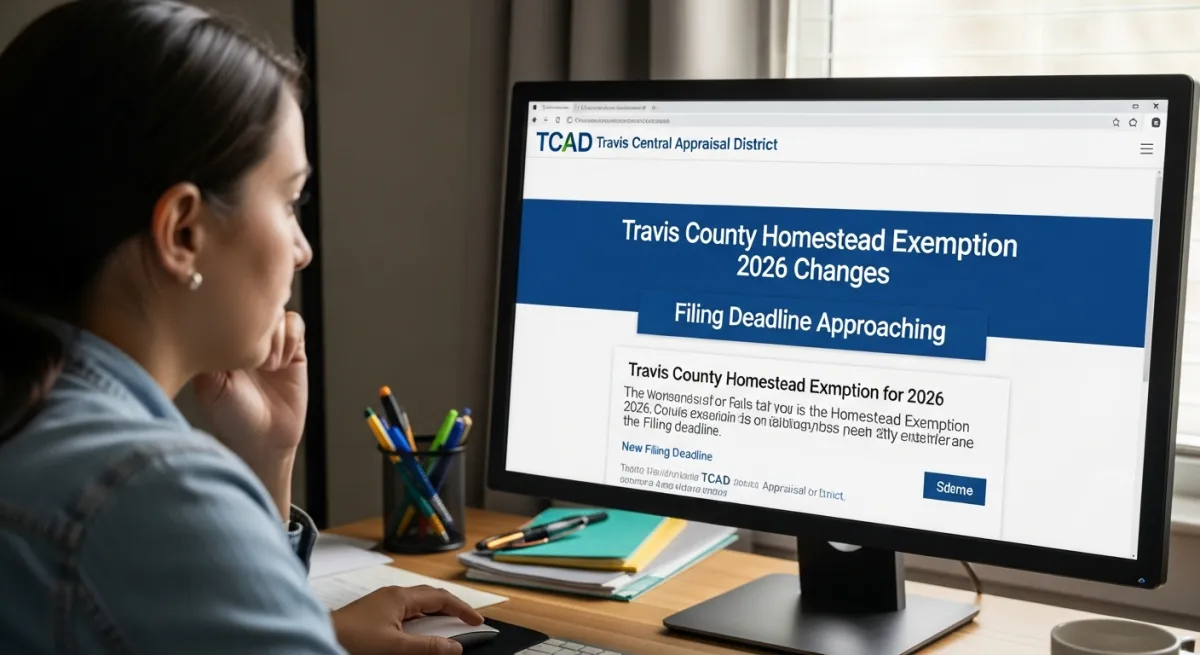
From the $100K school district cap to the over-65 freeze, here’s what Travis County homeowners need to do right now — and what’s still waiting on voters this November.
If you own a home in Travis County and haven’t thought about your homestead exemption since you filed and forgot it, look again. The school district exemption was doubled in late 2023. The 2025 legislative session advanced proposals to raise it further — but those require a November voter referendum before they mean anything to your tax bill. The April 30 filing deadline applies to anyone who bought in the past two years and hasn’t yet filed. There’s real money here, and a real deadline.
This piece covers what the current exemption actually saves you in Travis County dollars, how the 2023 and 2025 sessions relate to each other, how to file through TCAD’s portal, what the over-65 freeze means and how to claim it, and what to watch for in November. It doesn’t bury the deadline or conflate the protest process with the exemption process.
What the $100,000 School District Exemption Saves an Austin Homeowner
Start with actual numbers for an actual Travis County property.
The median appraised home value in Travis County sits around $550,000 for the 2025 tax year. The Austin Independent School District’s current rate is approximately $0.7892 per $100 of assessed value. Under the $100,000 school district homestead exemption — which applies across all Texas school districts — that $550,000 home gets taxed as if it’s worth $450,000 for AISD purposes.
The math: 100,000 × 0.007892 = roughly $789 per year saved on school taxes alone.
That grows when you add the other exemptions available in Travis County. The county offers a 20% optional exemption on county taxes. At the 2024 adopted rate of approximately $0.3449 per $100, a 20% reduction on a $550,000 home — that’s $110,000 off the taxable value — saves about $379 per year. The City of Austin sets its own optional exemption amount annually by Council vote; don’t rely on whatever figure showed up in a Reddit thread from two years ago. Confirm the current number directly at tcad.org or with the City of Austin Finance Office.
Combining just the verified AISD and county exemptions, a homeowner at median value saves roughly $1,168 per year before the City of Austin and Austin Community College amounts are added.
Two things to keep in mind. First, these are savings relative to paying full appraised value — not compared to last year’s bill. If your appraisal jumped, the exemption softens the blow; it doesn’t reverse it. Second, the $100,000 school district exemption is a flat dollar reduction, which means it’s proportionally more valuable at lower home values. For a $300,000 home, that exemption cuts taxable value by a third. For a $1.2 million house in Tarrytown, it’s rounding error. The 78704, 78702, and East Austin corridors skew toward higher valuations than most Texas metros, so when state officials describe the exemption as transformative, they’re describing a real benefit — just not an evenly distributed one. For more context on how Travis County appraisals break down by neighborhood, our coverage of Austin home prices by ZIP code in 2026 shows where values are rising and falling.
A Clear Timeline: 2023 Versus 2025, and What Still Requires a Voter Yes
Competing coverage has tangled these two legislative sessions in ways that create genuine confusion. Let’s separate them.
2023: The $100,000 school district homestead exemption is not a 2025 development. It came from House Bill 2, passed during the third special session of the 88th Legislature in 2023. Because it required a constitutional amendment, it went to Texas voters as Proposition 4 and passed at the November 2023 election. It took effect for the 2023 tax year. Travis County homeowners have already been receiving this benefit for two tax cycles. If you’ve read coverage treating the $100K exemption as new in 2025, that coverage is wrong.
2025: The 89th Legislature convened in January 2025 and considered proposals to build on what passed in 2023 — primarily raising the school district exemption to somewhere between $140,000 and $200,000, and increasing the additional over-65 and disabled person exemptions. SB 4 and related bills drew significant committee attention.
The critical constraint: any increase to the homestead exemption requires amending the Texas Constitution, which means any bill that passed in the 2025 session must go to Texas voters before it becomes law. The most likely vehicle is the November 2025 statewide election. If voters approve it, the change takes effect January 1, 2026 — meaning it shows up in your tax statements in early 2027.
If you’re searching for “Travis County homestead exemption 2026” because you heard something changed, you’re anticipating legislation voters haven’t confirmed yet. Check the specific enrolled bills at capitol.texas.gov. In the meantime: file for the exemption you qualify for today, and watch the November 2025 ballot.
Do You Have the Exemption? Who Qualifies and the One Deadline That Matters
To receive the residential homestead exemption from any taxing unit in Travis County, you must own the property as of January 1 of the tax year you’re claiming, use it as your primary residence, and be the owner of record. Renters don’t qualify. Secondary properties don’t qualify.
The filing deadline is April 30.
If you bought in 2023 or 2024 and haven’t filed, you’re the most likely person reading this who’s leaving money on the table. This is especially common in Mueller, the East Riverside corridor, and newer North Austin subdivisions where a high share of recent buyers were first-timers and closing day was not the moment anyone had a clear conversation about property tax exemptions. It’s not a character flaw — it just happens, and the fix is straightforward.
If you already have the exemption on file, you don’t reapply each year. It carries forward automatically until you sell, move, or lose eligibility. If it shows on your TCAD account, you’re covered.
One group worth flagging specifically: homeowners in Travis County ZIP codes served by Round Rock ISD or Pflugerville ISD — parts of 78660, 78664, and 78681 — have the same school district exemption rights under state law, but the savings calculation will differ from the AISD figures used above. Use your specific district’s rate.
Texas Tax Code §11.431 allows homeowners to file a late application claiming up to two prior tax years. If you missed 2023 or 2024, you can still recover those exemptions by filing the late application alongside this year’s through TCAD. Worth the ten minutes.
How to File Through TCAD: What You’ll Actually Need
TCAD processes homestead exemption applications through its online portal at tcad.org, using the Tyler Technologies iFile system. Here’s what the process actually requires — including the step where most applications stall.
Find your TCAD account number first. It’s on your appraisal notice (the document TCAD mails in April showing your proposed value) or on a prior year tax statement. You can also search by address at tcad.org under “Property Search.”
Log into iFile at tcad.org. Look for the “Exemptions” or “iFile” link in the main navigation. You’ll need your account number and a PIN, which is printed on your appraisal notice. No notice handy? TCAD can provide the PIN by phone, or you can request it through the portal.
Select “Residence Homestead Exemption” from the exemption type menu. The application form is short — ownership information, primary residence confirmation.
Upload your documentation. This is where applications get rejected. TCAD requires a Texas-issued driver’s license or state ID with the property address listed — not a P.O. box, not your old address from three apartments ago. The address on your ID must match the property address on your TCAD account. If you recently moved and haven’t updated your license, go to DPS before filing, not after. TCAD will also accept a Texas voter registration card or certain utility and financial documents if the ID address issue can’t be resolved immediately; call 512-834-9317 to discuss alternatives before submitting something that’ll get kicked back.
Submit and confirm. You’ll get a confirmation number and typically a follow-up email within a few days. Processing takes four to eight weeks. Log back into your TCAD account afterward and confirm the exemption appears under your property detail — look for “Residential Homestead” in the exemptions section. Don’t assume it went through. Check.
TCAD also accepts paper applications by mail or in person at 850 E. Anderson Lane, Austin, TX 78752. The form is on tcad.org under Exemptions. If you’re filing for prior years under the late-filing provision, note the specific tax years you’re claiming on a separate sheet. Phone: 512-834-9317. Confirm walk-in hours at tcad.org before you drive out there.
For Homeowners 65 and Older: The Tax Freeze
The over-65 benefit is more valuable than the standard homestead exemption for most people who qualify — and a surprising number of longtime Austin homeowners haven’t claimed it.
Once you receive the over-65 exemption from your school district, that district’s school taxes freeze at the amount you paid in the year the exemption first applies. If your appraised value rises after that — and in 78702, 78704, and the South Congress corridor, values in some cases doubled between 2019 and 2023 — AISD can’t collect more than the frozen amount. The ceiling doesn’t stop your taxes from dropping if rates fall. It just prevents them from climbing. For homeowners who bought in those neighborhoods a decade ago, the cumulative value of that freeze is not hypothetical. It’s real money.
Travis County and the City of Austin have the option to adopt a similar tax ceiling for over-65 residents on their respective portions of the tax bill. Verify the current status of those optional freezes directly with TCAD — adoption is optional and policies can shift.
You qualify in the tax year you turn 65. Not the year after. If you turn 65 at any point during 2025, you qualify for the 2025 tax year.
If you already have a homestead exemption on file, adding the over-65 designation means submitting an updated application through TCAD. You’ll need proof of age — a Texas driver’s license or state ID works; bring a birth certificate if the ID doesn’t make your age clear — a Texas-issued photo ID with the matching property address, and your Social Security number on the application.
If your spouse held the freeze and has died, you may be entitled to maintain that frozen ceiling as a surviving spouse, provided you’re at least 55 at the time of their death and the property is your primary residence. Bring a copy of the death certificate and proof of your age when you contact TCAD.
The April 30 deadline applies here too. The late-filing provision under §11.431 also extends to the over-65 exemption, so if you qualified in 2023 or 2024 and didn’t file, you can still claim those years retroactively. Call 512-834-9317 or visit 850 E. Anderson Lane.
What the 2025 Session Did and Didn’t Change About Filing Rules
The short answer: the procedural mechanics didn’t change.
The eligibility requirement — own and occupy the property as of January 1 of the tax year — is a constitutional standard. The 2025 session didn’t touch it. The two-year late-filing window under §11.431 wasn’t among the provisions targeted in the primary homestead exemption bills. It’s still there.
Property held in a qualifying trust — specifically one where the beneficiary has the right to use the property as a residence and holds a present possessory interest — can still qualify for the homestead exemption with additional documentation. Property held in an LLC cannot. That didn’t change in 2025 either, and it catches people off guard more often than it should.
The 2025 session included some discussion of appraisal reform. Some of that touched on protest procedures, which are a completely separate process from exemption filing. If you’re tracking a specific bill on appraisal reform, check capitol.texas.gov. For a deeper look at how Austin’s property tax caps interact with bills like these, our legal & finance coverage tracks the ongoing legislative and appraisal landscape.
If you have the exemption on file and nothing has changed about your situation, no action is required. If you bought recently, moved, turned 65, or have never filed — act before April 30.
Don’t Mix Up the Exemption Deadline and the Protest Deadline
Two deadlines hit Travis County homeowners in the spring. They are not related.
April 30 is the deadline to file or update a homestead exemption application with TCAD. Miss it and you wait another year, unless you qualify for the late-filing provision.
May 15 — or 30 days from the date on your appraisal notice, whichever is later — is the deadline to protest TCAD’s proposed appraised value with the Appraisal Review Board. Filing an exemption is not a protest. Filing a protest doesn’t get you an exemption. These are separate institutions running separate processes. The appraisal notice arrives in April, typically around the same time both deadlines are approaching, which is exactly why people confuse them.
If your notice shows a proposed value that looks wrong, you have every right to protest it, and plenty of Travis County homeowners do. If you’re considering that route, how to protest your Travis County property tax appraisal in 2026 walks through the process step by step. But don’t let that process distract you from April 30, and don’t assume one substitutes for the other.
The November 2025 Referendum: What Travis County Voters Will Decide
If the 89th Legislature referred a constitutional amendment to voters — and the trajectory of SB 4 and related bills through the session strongly suggests that was the intent — Texans will see a measure on the November 2025 ballot asking whether to raise the school district homestead exemption beyond $100,000. The most discussed threshold was $140,000, though some proposals went higher.
What that means in Travis County dollars, at the current AISD rate:
| Exemption Level | Annual Savings vs. Full Value |
|---|---|
| $0 (no exemption) | $0 |
| $100,000 (current) | ~$789/year |
| $140,000 (proposed) | ~$1,105/year |
| $200,000 (higher proposal) | ~$1,578/year |
Based on AISD rate of $0.7892/$100. Rounded to nearest dollar. Rates adjust annually.
The difference between the current $100,000 exemption and $140,000 is about $316 a year for the median Travis County homeowner at current AISD rates. It’s a real number. It’s also still a flat-dollar benefit — a $250,000 home in eastern Travis County gets proportionally far more relief than a $900,000 house in Allandale.
If voters approve it in November, the change takes effect January 1, 2026. You’d see it in your 2026 tax bill, due January 31, 2027. Watch the Texas Secretary of State’s office for the finalized ballot language, and check TCAD and local election authorities for Travis County voting information as November approaches.
Key Numbers at a Glance
Current school district exemption: $100,000 off appraised value (all Texas school districts, including AISD) Savings at AISD rate: approximately $789/year on a $550,000 home
Travis County optional exemption: 20% of appraised value Savings at county rate: approximately $379/year on a $550,000 home
City of Austin optional homestead exemption: Set annually by City Council; confirm current amount at tcad.org or with the City of Austin Finance Office
Combined estimated savings (AISD + Travis County, verified rates): approximately $1,168/year on $550,000 home; higher once the City of Austin and ACC amounts are confirmed
Filing deadline: April 30 — new filers only; existing exemptions carry forward automatically
Late-filing window: Up to two prior tax years (Texas Tax Code §11.431)
Over-65 freeze: School district tax ceiling applies in the year you turn 65; file through TCAD with proof of age and matching ID
TCAD contact:
- Phone: 512-834-9317
- Address: 850 E. Anderson Lane, Austin, TX 78752
- Hours: Confirm current hours at tcad.org before visiting
- Portal: tcad.org
Possible 2025 session change: Proposed increase to $140,000–$200,000 school district exemption requires November 2025 voter approval; if passed, effective January 1, 2026
Appraisal protest deadline (separate process): May 15 or 30 days from appraisal notice, whichever is later
CityDesk Austin covers local government, business, and civic affairs for Austin residents. For questions about your specific tax account, contact TCAD at 512-834-9317 or visit tcad.org. Tax rates referenced in this article are based on adopted 2024 rates and are subject to annual adjustment by each taxing entity.