How Austin Chefs Are Using Texas Summer Produce Right Now
We asked four chefs to show their sourcing receipts. Here's what local buying looks like in July, what it costs, and where the farm-to-table claim breaks down.

We asked four chefs to show their sourcing receipts. Here’s what local buying looks like in July, what it costs, and where the farm-to-table claim breaks down.
It’s July in Austin, and if you’ve eaten at a restaurant lately that promises “local, seasonal ingredients,” you might want to ask harder questions. The city’s farm-to-table marketing hasn’t changed much in a decade. The farms have.
The spring tomato crop is gone. Weeks of 100-plus-degree heat collapsed fruit set across Central Texas in late May. The lettuces, spinach, and arugula that graced menus in April are gone too — and if you’ve been to enough Austin restaurants this summer, you’ve probably noticed that some menus don’t seem to know it yet.
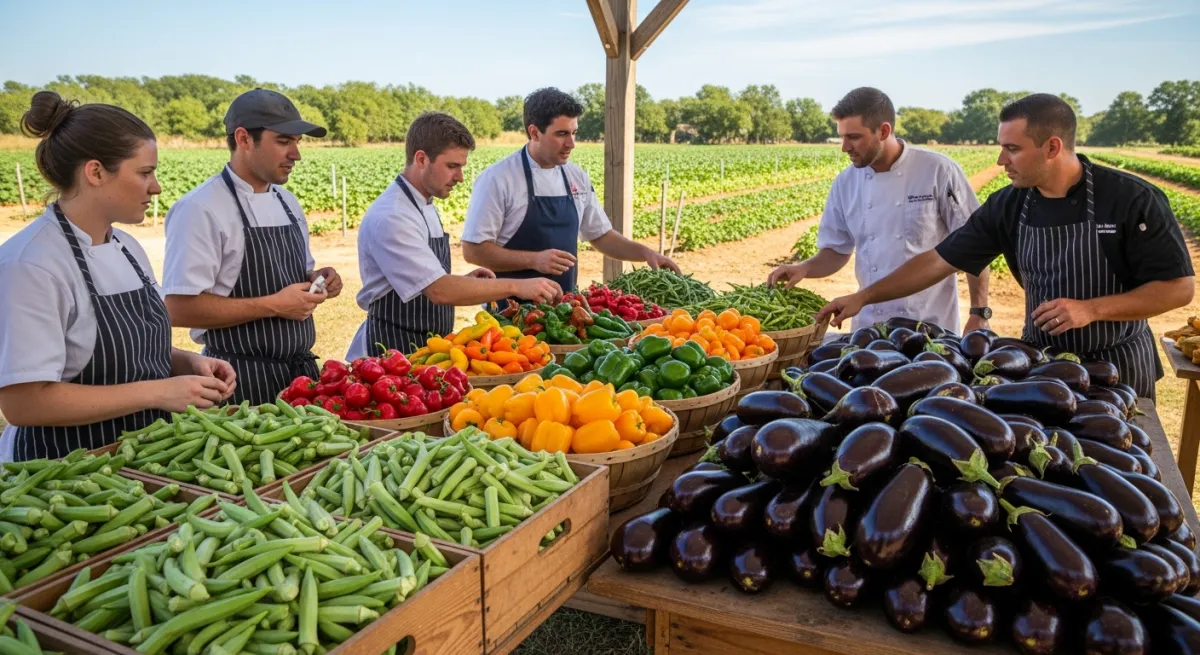
What’s actually growing right now in the fields between Austin and Georgetown and Bastrop is okra, black-eyed peas, peppers, eggplant, figs, watermelon, and the last of the sweet corn. The restaurants genuinely sourcing locally this summer are cooking around that reality. The ones that aren’t are either buying commodity produce trucked in from California or Mexico, or quietly redefining what “local” means — a renegotiation they’re not advertising.
CityDesk Austin asked four chefs to walk us through their current sourcing. Not their mission statements. Not last year’s harvest dinner menus. The specific farms, specific ingredients, and specific dishes on their menus right now in summer 2026. Here’s what we found, and what it costs everybody involved.
What’s Actually Growing in Central Texas This Month
Before evaluating any restaurant’s claim, you need a baseline. Hank Peoples has farmed at Tecolote Farm in Georgetown since 1998 — long enough to have watched several waves of Austin farm-to-table enthusiasm crest and recede — and he gave us a direct accounting of what’s coming out of Central Texas fields in July 2026.
“Okra is going absolutely crazy right now,” Peoples said. “We’re harvesting every single day. Black-eyed peas, purple hull peas, southern peas of all kinds — those are peaking. We’ve got Jimmy Nardello peppers, shishito peppers, Poblanos. Eggplant is in great shape. The figs started about two weeks ago and we’ll have them through August. Watermelon is there. Summer squash is still coming on, though it’s getting tired.”
Tomatoes, he explained, are not what most diners think. “The spring tomato season — the big slicers, the heirlooms — that’s done. It ended in early June for most farms out here. What some people are growing now are heat-tolerant cherry tomatoes, small varieties that can survive the overnight temperatures. We have a few. But a tomato on an Austin restaurant menu in July, if it doesn’t say cherry or Sun Gold or a specific heat-tolerant variety, I’d be skeptical about where it’s coming from.”
Cool-season crops — lettuces, spinach, kale, chard — are not grown commercially in Central Texas in July. Full stop. “Anyone serving a Texas-grown spinach salad in July is either using greenhouse product or they’re not being honest about the source,” Peoples said. That’s a blunt statement from a farmer who sells to the restaurants that would benefit from softer language.
Johnson’s Backyard Garden, farming the Bastrop corridor about 30 miles east of Austin, confirmed a similar picture. They’re also pulling sweet potatoes now, with cucumbers and Armenian cucumbers at peak production. Heat-tolerant cherry varieties exist in small volume, but the constraints are the same: what works in spring doesn’t work in summer heat without significant infrastructure.
The Farms Supplying Austin Kitchens Right Now
The working farms with confirmed wholesale relationships to Austin restaurants this summer are largely clustered within a 7-to-50-mile radius of the city — which is either reassuring or humbling, depending on how much of Austin’s farm-to-table reputation you took at face value.
Tecolote Farm in Georgetown, roughly 35 miles north, is one of the most consistent wholesale suppliers to Austin’s serious-sourcing restaurants. Peoples confirmed active summer 2026 relationships with Lenoir and L’Oca d’Oro. July production is focused on okra, peppers, eggplant, southern peas, and figs.
Johnson’s Backyard Garden runs one of the larger certified-organic operations in the Bastrop area. They confirmed wholesale accounts with several Austin restaurants this summer and also sell through the SFC Farmers’ Market. Their summer lineup: cucumbers, sweet potatoes, peppers, watermelon, summer squash, southern peas.
Boggy Creek Farm occupies six acres on East 7th Street inside Austin city limits. Six producing acres where land sells for several million dollars a comparable footprint — it’s a remarkable fact that tends to get overlooked in the broader farm-to-table conversation. The farm runs primarily a walk-up direct-sales model rather than wholesale distribution. Some chefs buy there, but it requires showing up in person during sale hours. Summer production includes peppers, eggplant, okra, and herbs.
Rain Lily Farm, also in East Austin, is smaller, focused on specialty crops and cut flowers, with some vegetable production that certain chefs have sought out deliberately.
One thing worth flagging: several Austin restaurants cite farms in their marketing based on relationships that were current two or three years ago but are no longer active. We verified current relationships before reporting them. If a menu cites a farm but the chef can’t name a current delivery schedule, that citation deserves skepticism. It happens more than it should.
Four Chefs, Four Sourcing Realities
Todd Duplechan, Lenoir
Duplechan is one of the chefs most willing to talk about the unglamorous mechanics of the work, which is probably why Lenoir has had a more durable sourcing reputation than most restaurants that opened around the same time. Right now, his kitchen is running a roasted eggplant dish from Tecolote Farm, finished with a Poblano pepper mole and local honey.
“Hank’s eggplant is extraordinary right now,” Duplechan said. “We got a delivery Tuesday and I was genuinely excited, which sounds like chef talk, but it’s real. The fruit is dense, it’s not bitter, it holds up to high heat in a way that commodity eggplant doesn’t.” He’s also running black-eyed peas from Tecolote in a summer bean salad, and watermelon from a farm near Luling on his current dessert plate.
“July is actually one of the months I love most from a sourcing standpoint, because the ingredients are specific and Texas,” he said. “You just have to actually want to cook them, which not everyone does.”
That last clause is doing a lot of work.
Fiore Tedesco, L’Oca d’Oro
Tedesco’s Italian-leaning kitchen on North Loop has maintained steady relationships with Tecolote Farm and Johnson’s Backyard Garden for several years. This summer, he’s using Jimmy Nardello peppers from Tecolote — slow-cooked in olive oil until they’re jammy, tossed with house-made pasta and breadcrumbs. “It’s one of those cases where what’s growing locally and what fits the cuisine are genuinely aligned,” he said.
He’s also running blistered shishito peppers as an antipasto and is planning fig preparations for the next few weeks as Tecolote’s production peaks.
L’Oca d’Oro names farms on the table card. Diners can verify the claim just by reading what’s in front of them. Most restaurants don’t make it that easy, and the ones that don’t should ask themselves why.
Bryce Gilmore, Odd Duck and Barley Swine
Gilmore’s sourcing picture is more distributed than a single-farm relationship because he needs the volume for two kitchens. “We’re buying from multiple farms right now because we have to. No single farm can supply both kitchens at the volume we need.” He cited Johnson’s Backyard Garden for cucumbers and sweet potatoes, a Hill Country farm for watermelon that he declined to name, and Boggy Creek for occasional specialty herbs and small pepper quantities.
The current Odd Duck menu includes a chilled cucumber preparation with buttermilk and dill using Johnson’s cucumbers. Those run $2.80 to $3.20 per pound wholesale. Commodity cucumbers from a broadline distributor cost around a dollar. “We absorb some of that differential,” Gilmore said. “Some of it moves through to pricing. But the bigger cost isn’t per-pound price — it’s the management time.”
He estimates his sous chefs collectively spend five to six hours a week on sourcing coordination that would vanish if they just called their Sysco rep. At full labor cost, that’s real money, not a talking point.
Michael Fojtasek, Olamaie
Fojtasek’s approach is structurally different from the others. Rather than deciding what he wants and hunting for sourcing, he builds menus around what two or three farms tell him is coming. “It inverts the process, which is uncomfortable until you get used to it,” he said.
Right now that means a summer field pea preparation — purple hull peas from a farm in the Elgin area, served simply with pork fat and hot sauce. The menu shifts weekly based on what’s actually harvestable. If you’ve eaten at Olamaie on a Tuesday and again on a Friday, you’ve probably noticed.
The Sourcing Math
Duplechan was willing to go furthest on the numbers, which is useful because chefs almost never talk about this publicly. His Tecolote eggplant comes in at roughly $2.50 per pound. Commodity eggplant from his broadline distributor: $0.65 to $0.80. “That’s a meaningful difference at volume,” he said. “And eggplant doesn’t command $40 on a plate on its own.”
Lenoir handles it through tighter portion sizing, using every part of the vegetable, and accepting a lower margin on produce while maintaining targets elsewhere. The restaurant’s overall food-cost target runs 28 to 32 percent — standard for the price point. Some local items blow past that. They make it up in other places.
For diners, the math works out roughly like this: a dish that would cost $16 at a restaurant using commodity produce might run $22 here, some of that ingredient cost, some operational overhead from actually running the model. Whether the premium is worth it is your call. But you’re making it either way, so you may as well know.
The Okra Problem
Here is the ingredient that is genuinely, unambiguously at peak right now in Central Texas — available in quantity from multiple farms, inexpensive, and almost entirely absent from Austin fine-dining menus: okra.
Tecolote is harvesting it every day. Boggy Creek has it. Johnson’s Backyard Garden has it. It is the most Texas-summer vegetable in existence. The number of Austin restaurants with a prominent okra dish on their July menu can be counted on fewer than ten fingers. I find that genuinely strange.
Duplechan is running it. Lenoir currently offers a fried okra preparation made with Tecolote product, which is an aggressively unpretentious choice for a restaurant at his price point. “Okra is the test,” he said, unprompted. “If someone says they’re cooking seasonally in Texas in July and they don’t have okra on the menu, I wonder what they mean by that.”
The honest answer to why more restaurants skip it: it doesn’t photograph as well as a cherry tomato or a shaved fennel salad. The texture requires skill and conviction — done wrong, it’s slimy; done right, it’s extraordinary. Diners have been conditioned to associate it with Southern home cooking rather than fine dining, which creates a marketing anxiety some chefs aren’t willing to navigate. That’s understandable. It’s also a little cowardly.
Fojtasek doesn’t hesitate. “Okra is incredible right now. We’re using it. It’s on the menu. I don’t think about whether it’s glamorous.”
The presence or absence of okra on an Austin menu in July is a functional sourcing integrity signal. Not a perfect one. But not nothing.
Where Chefs Are Actually Shopping
The SFC Farmers’ Market at Republic Square runs Saturday mornings and permits commercial purchasing, but it’s first-come alongside retail customers — no separate wholesale access, no pre-sale. Several chefs send a cook on Saturday mornings to walk specific vendors they’ve cultivated relationships with, but it only works at modest scale. “I can’t supply Odd Duck’s weekly produce needs through Saturday morning market runs,” Gilmore said. “It’s supplemental at best.”
The Mueller Farmers’ Market on Sunday mornings at Mueller Lake Park similarly allows commercial buyers, though vendors vary week to week and it skews retail. A handful of chefs mentioned it for specialty herbs and small quantities.
For volume, most serious operations run direct farm accounts — weekly or twice-weekly deliveries managed by a produce buyer or chef de cuisine. Boggy Creek, with its walk-up model, is the notable exception; several chefs mentioned making the drive to East 7th specifically for herbs and specialty items the farm doesn’t wholesale.
The distinction matters. A chef who has built farm relationships into the restaurant’s logistics infrastructure is doing something structurally different from one who occasionally sends a cook to the Saturday market and calls it local sourcing. Both might use the same language on the menu. Only one of them means it. As we track in our food & hospitality coverage, that gap between menu language and operational reality keeps showing up across Austin’s restaurant scene.
What They Can’t Source
The most revealing question we asked each chef was what they wish they could buy from Texas farms in July but can’t.
Duplechan: “Good tomatoes in quantity. The spring season is over. I can do a cherry tomato, a Sun Gold, but I can’t get enough of them from local farms to put them on the menu at real volume.”
Tedesco: “Garlic. I go through enormous quantities of garlic and virtually none of it comes from Texas. There is Texas garlic; I’ve found it at the market. But at the scale we need, we’re buying California. That bothers me more than it probably should.”
Gilmore: “Beef, honestly. I’m not using commodity beef from a national packer, but the traceability at the level I want — specific ranch, specific pasture — is really hard to maintain at consistent volume and grade for two kitchens. We’re close with one rancher near Fredericksburg but we’re not there yet.”
Fojtasek: “Summer mushrooms. We’re using some things from a small cultivated grower, but wild mushrooms in Central Texas in July are basically nothing. It’s a dead zone for fungi. I’d love to be running a chanterelle dish right now.”
A chef who can’t answer this question — or who gives you something vague about “sometimes things aren’t available” — probably isn’t tracking their sourcing closely enough to make confident claims about when it succeeds. The gaps are as telling as the wins.
How to Read a Menu for Real Sourcing
Look for three things together: a named farm with a named location (Tecolote Farm, Georgetown), a named variety of a specific ingredient (Jimmy Nardello peppers), and an ingredient that is seasonally plausible for Central Texas in July. All three together is a strong positive signal.
Language like “locally inspired,” “farm-fresh,” or “locally sourced” without a named farm has no enforceable content. None. “Supporting local farmers” with no specific attribution is marketing copy, not a sourcing claim.
Check seasonal plausibility. A spinach salad or spring tomato dish in July, without specifying hydroponic or out-of-state sourcing, is not coming from a Central Texas field. That doesn’t mean the food is bad. It means the restaurant is not, in that dish, doing what “local seasonal” implies.
And ask your server which specific farms the restaurant is buying from this week. A kitchen with genuine farm relationships will have a real answer. A kitchen trading on the brand category will give you something vague or redirect you to a website. Either answer tells you something. If you want to deepen your own relationship with local producers, using Austin’s farmers markets to actually eat better this summer gives a ground-level look at which vendors and markets are worth your time.
The farm-to-table category has been commercially valuable long enough in Austin that the marketing has drifted well ahead of the practice at many restaurants. Running a profitable restaurant here in 2026 is hard. Food costs are punishing. The operational burden of genuine small-farm sourcing is real. The chefs named in this piece are doing the harder version of this work, and the specificity of what they’re buying — what it costs them, where the gaps are — ought to be the baseline for how this city talks about seasonal sourcing. Not the exception.
Okra is peaking. Figs are starting. The chefs paying attention know it, and right now you can taste it on their menus.