How Austin Restaurants Are Handling Summer Heat on Their Patios
We checked the misting systems, measured the shade, and asked operators what it actually costs to keep a patio viable when it's 103°F outside.

We checked the misting systems, measured the shade, and asked operators what it actually costs to keep a patio viable when it’s 103°F outside.
The question isn’t whether Austin summers are hot. It’s whether sitting outside at a restaurant in July is a reasonable thing a person should do, and if so, where, and at what hour, and under what conditions. That’s an infrastructure question, not a lifestyle one. Most patio coverage in this city fails to answer it because most patio coverage is written in October.
Austin’s summer of 2023 saw more than 45 consecutive days above 100°F, according to the National Weather Service Austin/San Antonio office. The city’s outdoor dining industry expanded dramatically during COVID-era patio buildouts and suddenly found itself operating infrastructure designed partly for ambiance and partly for public health compliance, now being tested as genuine cooling engineering. Some of it held up. A lot of it didn’t.
This piece audits that infrastructure: which restaurants have genuinely solved the summer patio problem, which ones are running degraded systems and hoping guests don’t notice, what the cooling technology actually does and costs, and when outdoor dining in Austin is a reasonable choice versus a punishing one.
The Usable Window
Outdoor dining in Austin summer isn’t uniformly impossible. It’s time-constrained in ways most diners don’t fully account for when booking.
The practical morning window closes around 10:30 a.m. East-facing patios are already receiving direct sun, but air temperatures are manageable — low-to-mid 80s even in peak July. Hardscape hasn’t yet stored the thermal load it’ll carry all afternoon. For brunch, an east-facing patio with any shade is workable.
From about 11:00 a.m. to 7:00 p.m., direct sun exposure and peak air temperatures converge with maximum hardscape radiation. Concrete and flagstone that have been absorbing sun since morning are now radiating heat upward while the sun continues heating from above. This is the dead zone. Even well-designed patios with strong misting lose the battle here unless they’re essentially fully enclosed by shade sail or solid pergola coverage.
The post-7:00 p.m. window is the operative one for most Austin patio dining in summer, but it’s less clean than people assume. The sun sets around 8:30 p.m. near the solstice. West-facing patios are still receiving direct sun through the peak dinner seating at 7:30 p.m. East-facing patios gain relief roughly an hour earlier. Shade from the building or neighboring structures typically arrives on east-facing courtyards by 6:00 to 6:30 p.m. On hardscape-heavy patios in any direction, heat stored in the surface can make the space uncomfortable until 8:30 or 9:00 p.m. regardless of sun angle.
The neighborhoods where the evening window opens earliest tend to be those with mature tree canopy or with patios shielded by the building itself. East Austin along East Cesar Chavez, where several restaurants have courtyard designs set back from the street under older live oaks, gets relief earlier than West 6th or Rainey Street. Those corridors have patios that often face open sky to the west over concrete or pavers and continue radiating well into the evening. If you’ve ever sat on a Rainey Street patio at 7:00 p.m. in August wondering why the air felt like it was coming out of a dryer vent, now you know why.
Not All Patios Cook the Same
The differences between Austin’s outdoor dining neighborhoods are significant enough to matter in a reservation decision.
East 6th and East Cesar Chavez is the most forgiving zone for summer outdoor dining. Restaurants here tend to occupy converted houses or bungalows, which means patios are often courtyard-style or backyard-set with east or north orientation and existing mature oak canopy. Justine’s, on East 11th, is the clearest example. The entire property operates at night and leans heavily on outdoor seating under tree cover with string lights. That’s not accidental — the restaurant’s hours, opening at 5:00 p.m., are explicitly structured around when the space becomes comfortable. The thermal design and the dinner-only identity are essentially the same decision.
South Congress has a mixed record. The corridor is commercial and the patios tend to be street-facing with western exposure. Without significant shade infrastructure, most South Congress patios — especially those above the 1300 block where the street widens — are difficult before 8:00 p.m. Perla’s, with its awning-covered front patio, ranks among the better-positioned spots here. The awning itself works: it blocks direct overhead sun while allowing prevailing breezes through the front. Not a perfect solution, but meaningfully better than nothing.
South Lamar has one standout: Loro, the Asian smokehouse from Tyson Cole and Aaron Franklin. It sits on a property with deliberate design — gravel yard, partial tree coverage, fans in covered structures. The operators have invested more visibly in summer usability than almost any other high-volume patio in Austin. Most guests walk across the gravel without registering what it’s doing. Loose aggregate doesn’t store heat the way a solid paver surface does. You can see actual infrastructure thinking here, rather than inherited circumstance.
West 6th and Clarksville is the hardest zone. Patios face west or southwest onto the street or parking, with concrete underfoot and minimal overhead coverage. El Patio on Guadalupe is a long-running exception because of its mature live oak, which is doing more thermal work than any installed system on that block. The tree is old enough that it predates the restaurant’s current ownership — it’s a 40-plus-year asset that can’t be replicated quickly or bought. Every operator in this neighborhood without a similar tree is managing a structural disadvantage, and no amount of shade sail closes that gap.
Rainey Street functions largely as a post-9:00 p.m. zone in summer, which aligns with how much of it operates anyway. The bar-heavy nature of the street means outdoor seating is less about a seated dining experience and more about standing drink service, where tolerances are different. For seated dinner, the usable window is narrow. Anyone attempting an early dinner on Rainey faces a choice between abandoning the patio or enduring genuine discomfort. Most people endure it. Most people also order another drink and pretend they’re fine.
The Domain benefits from newer construction with purpose-designed outdoor spaces, some HVLS fan coverage in pavilion structures, and more consistent shade infrastructure. It also lacks the mature canopy that does the real ambient cooling work in older East Austin properties. Engineered comfort rather than natural comfort — which means it performs predictably but without the marginal benefit that an 80-year-old oak provides. You know exactly what you’re getting. That’s not nothing.
Downtown rooftops are their own category and largely their own punishment. They receive radiant heat with no building shading, often face prevailing south winds that feel like convection heat in peak summer, and most misting systems installed at height are low-pressure and prove inadequate. Worth visiting after 9:00 p.m. in summer. Not before. The view of Lady Bird Lake at sunset is genuinely beautiful. So is the heat radiating up from a tar and gravel roof surface, in the way that touching a hot stove is a memorable experience.
The Infrastructure Audit
What follows is a ground-level assessment of named Austin restaurants with prominent patios, evaluated on shade coverage, misting system quality, fan configuration, and surface material. The ratings at the end of each entry reflect evening dining, not midday.
Loro (South Lamar) has the most thoroughly thought-out outdoor dining space in Austin for summer. The property uses a combination of metal roof coverage over the main seating structure, ceiling fans with serious CFM output, a gravel surface that dramatically reduces radiant heat compared to concrete or flagstone, and landscaping that creates partial natural shade. There are uncovered areas of the patio — worth knowing before you book a specific spot. But the covered zone with misting and gravel genuinely functions in peak heat. Mid-afternoon usability in the covered section is workable in a way that almost nothing else on this list can claim.
Contigo (Mueller) sprawls across a yard-style patio with established live oaks and a layout that lets guests self-select into shadier positions. There’s no heavy installed misting infrastructure. The cooling strategy is primarily canopy and orientation, and when the natural elements cooperate, that works better than most engineered systems. The tradeoff is inconsistency: tree canopy creates shade that moves. A table directly under a limb at 6:00 p.m. may be fully exposed by 7:00 p.m., or vice versa. Ask for the corner under the largest oak. You’ll know the one. Evening usability is moderate to high depending on where they seat you.
Justine’s (East 11th) operates almost entirely in darkness, which is a cooling strategy as much as an aesthetic one. Tree canopy, east orientation, and a deliberate avoidance of the midday hours mean the space is generally comfortable by the time guests arrive. There’s no sophisticated misting infrastructure. The restaurant doesn’t need it. This is a case where business model and thermal design align perfectly — whether by intention or happy accident, it doesn’t matter. By 8:00 p.m., it’s one of the more comfortable patios in the city.
Fonda San Miguel (North Loop) has the most architecturally interesting answer to the patio question. The restaurant’s courtyard is interior — open to the sky but surrounded by the building, creating a microclimate that benefits from building shade earlier in the evening and insulation from ambient street heat. The design predates the current patio infrastructure buildout by decades. It works better than most things built since, which is either a tribute to good original design or a mild indictment of what the industry has assembled more recently. The courtyard retains heat less aggressively than an open patio because it’s partially shielded from afternoon wind patterns. Highly dependent on hour, but often the right answer for an 8:00 p.m. reservation.
El Patio (Guadalupe) has its primary cooling infrastructure in the form of a large, mature live oak that extends significant canopy over the main seating area. This is a western-sun corridor, so exposure is still a factor in the late afternoon. The tree changes the experience materially. The building’s covered arcade section adds a secondary refuge where staff can move guests who need shade relief. The oak’s effectiveness varies day-to-day based on cloud cover and wind — it’s a tree, not a thermostat. Post-7:30 p.m. is the usable window.
Perla’s (South Congress) runs a covered front patio with awning and partial overhead coverage. The misting system is functional but low-pressure. It provides some relief without achieving the flash-evaporation cooling of a properly engineered high-pressure system — guests get humid rather than cool when temperatures are high. The surface holds heat. The patio faces east onto South Congress, which means direct afternoon sun is less of a problem than the ambient heat radiating off the corridor. Moderate usability post-7:30 p.m.
Lenoir (South Congress) sits slightly south of the main SoCo strip on a quieter block, with a backyard-oriented patio that functions differently than the street-facing spaces to the north. The covered section is small but effective for four-to-six-top groups. Lenoir’s dinner service aligns with the post-heat window by default — 5:00 p.m. opening, partly because the kitchen couldn’t operationally support lunch at the restaurant’s scale. It works as a thermal advantage anyway. Moderate usability post-8:00 p.m.
Olamaie (West Lynn/Bouldin Creek) occupies a historic house, and the outdoor seating has the covered-porch character of the building itself. Not an add-on patio structure — an architectural feature that provides solid overhead coverage on the front and side. A solid porch roof outperforms a shade sail because it blocks both direct sun and radiant sky heat. The fan situation is adequate rather than strong. The porch also benefits from the building’s natural thermal mass, which means it doesn’t radiate the way an open patio does. The architecture is doing significant work here, and the restaurant’s scale means staff can shuffle tables in a way a 200-seat operation can’t. Moderate to high usability post-7:30 p.m.
The Odd Duck (South Lamar) shows the limits of shade sail infrastructure. The sails cover a meaningful percentage of the space but leave gaps. The surface is hardscape that retains heat. Fans are present but not HVLS-spec. This is a pleasant space in April that becomes genuinely marginal in July before 8:00 p.m. — and still uncomfortable at 7:30 with the west-facing exposure catching late sun. The restaurant’s volume means the patio remains full despite the thermal challenges, which suggests guests arrive with adjusted expectations. That’s one way to run a patio. Moderate usability post-8:00 p.m.
Juniper (rooftop, downtown) is the cautionary case. Rooftop dining in Austin in July is largely aspirational. The views are real. The heat is real. The misting system — and on most downtown rooftop bars — is low-pressure, the kind that adds moisture without flash-evaporating, meaning guests get humid rather than cool. When the ambient temperature is 100°F, even a functional high-pressure system only reduces perceived temperature by 10 to 20 degrees. That’s not enough at midday, and at 7:00 p.m. on a rooftop with no building shade, it’s often not enough either. The restaurant hasn’t invested in shade infrastructure, which would require structural engineering and permitting that would alter the roofline visibility that helps market the space. That’s a real constraint. It’s also a choice about what to prioritize.
The Technology Behind the Comfort
The core distinction in patio cooling technology is between systems that actually work and systems that are cosmetic. Most Austin patio operators have installed something. Far fewer have installed something that actually changes the thermal math at 103°F.
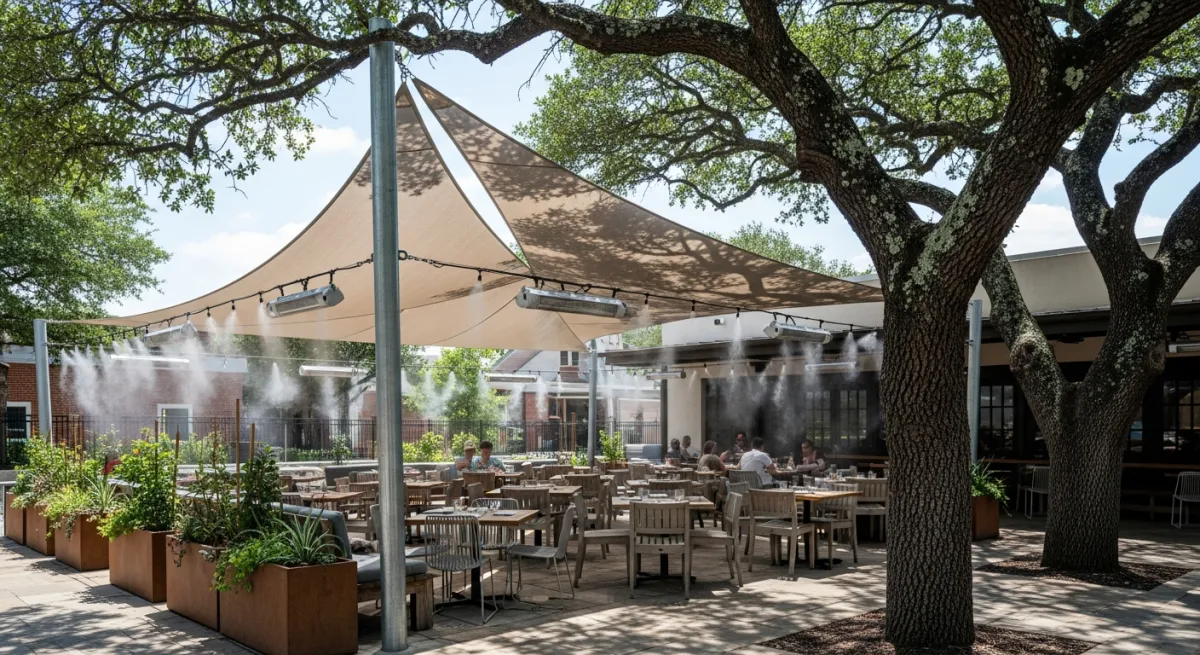
High-pressure misting systems operating at 1,000 PSI or above atomize water into droplets fine enough that they flash-evaporate before contacting skin or clothing. The evaporation pulls heat from the surrounding air — same physics as sweating — and can reduce perceived temperature by 10 to 20 degrees in low-to-moderate humidity. The critical variable is humidity, and Austin’s summers have gotten more humid. Misting systems are evaporative technology. They work better in the drier Junes of a decade ago than in the muggy July conditions that have become common. Local HVAC contractors have noted the shift: recommendations increasingly favor shading and airflow over misting as the primary strategy, which puts a lot of the expensive misting infrastructure installed in 2020 and 2021 in an awkward position. For a parallel look at how heat and ozone interact for people spending time outdoors, the ozone and heat data for outdoor activity in Austin adds useful environmental context to the same conditions.
Installation costs for high-pressure commercial systems run from roughly $3,000 to $15,000 or more depending on linear footage and pump capacity. Nozzles clog with Austin’s mineral-heavy water and need regular replacement. By late August, operators running deferred maintenance schedules are often running systems at reduced capacity. This is why some patios that looked good in June feel inadequate by Labor Day. Operators who can’t commit to monthly nozzle cleaning are effectively running degraded systems whether they know it or not.
Low-pressure systems operate from standard water line pressure at roughly 60 PSI and produce larger droplets that don’t fully evaporate before contact. Guests feel moist rather than cool. Cheaper to install. Adequate in low humidity and the mid-80s. At 103°F, they’re a disappointment dressed up as a solution — and they’re what you’ll find on most Austin patios that have “misters” without having made a real infrastructure investment.
HVLS ceiling fans — High Volume, Low Speed — are large-diameter commercial fans designed for covered structures. A properly sized HVLS fan moves air across a covered patio in ways that genuinely change the experience. The standard commercial patio oscillating fan does not. If you’ve ever sat under one and wondered why you were still sweating, that’s your answer. HVLS installation requires a covered structure with appropriate mounting clearance and electrical infrastructure. The fans themselves run $4,000 to $8,000 per unit before installation. Loro and a small number of other operators have moved in this direction. Most Austin patios haven’t.
Shade sails versus solid pergola covers: the difference matters more than most guests realize. A shade sail is tensioned fabric that blocks direct solar radiation but doesn’t block radiant sky heat the way a solid cover does. On a hot day, a shade sail reduces sun exposure without creating the same thermal shelter as a solid porch roof or metal pergola with roofing. Sails also degrade faster than operators expect under Austin’s UV load. Many operators are replacing them on a three-to-five-year cycle, and sails in the latter part of that window are losing their UV-block rating. Per-sail replacement costs run $500 to $2,500 depending on size. A patio with four sails installed in 2020 is likely facing $2,000 to $10,000 in replacement costs by 2025, with the effectiveness of the original installation already diminished. That’s a maintenance treadmill a lot of small operators didn’t fully price in.
Evaporative coolers — swamp coolers — are broadly unsuited to current Austin summer conditions. They’re designed for dry heat and become ineffective above roughly 40 percent relative humidity. Austin’s humidity during summer thunderstorm cycles routinely exceeds that. Several South Congress operators installed evaporative systems around 2019–2020 and have since shelved them or repurposed the equipment. Expensive lesson.
What Operators Spent, and Whether It Paid Off
The COVID-era patio buildout forced investment that most Austin operators would not have chosen at that pace or cost. The outdoor dining infrastructure installed in 2020 and 2021 — hastily permitted, sometimes structurally improvised — is now aging into its first or second major maintenance cycle, coinciding with the summers that stress-test it hardest.
One South Congress operator reported spending $28,000 on shade sail and misting infrastructure in 2020 and replacing half the sails by 2023. A Rainey Street venue spent $15,000 on an evaporative cooler system that proved unusable after the third week of July that year. These aren’t outliers. They’re the pattern.
On the revenue side, summer patio capacity drops to roughly 30 to 50 percent of shoulder-season levels — a figure worth pressing operators to confirm with their own numbers, because most prefer not to discuss it publicly. Some report that summer happy hour traffic partially migrates indoors, pressuring bar revenue when interior space is limited. Loro reported that their post-7:00 p.m. patio turns actually increased year-over-year after completing their infrastructure upgrades. The case is straightforward: guests will use outdoor space when the thermal environment stops being punitive. They’re not avoiding patios because they dislike them. They’ve just been burned before, literally.
The maintenance failure story is particularly acute for misting systems. A degraded system with blocked nozzles produces lower pressure, larger droplets, and wet guests rather than cool ones. Most guests can’t distinguish between a system working as designed and one running at partial capacity. They just know they’re uncomfortable. By mid-August, some high-profile patios have half-functional systems that are actively making the experience worse rather than better. This is the category of operational failure that’s almost entirely invisible until someone complains online.
The Regulatory Layer
The infrastructure operators can build and the water they can use to run it are both regulated in ways that directly constrain what’s possible.
Permanent shade structures — pergolas, attached awnings, solid-roof patio covers — require City of Austin Development Services permits if attached to the building or exceeding certain square footage thresholds. The permitting process can take months and involves setback review, impervious cover calculations, and in some historic overlay districts, design review. Freestanding structures under certain sizes can sometimes avoid full permitting, which is why you see so many market umbrella arrays and tension shade sails. They’re the path of least resistance. One operator on East 6th reported waiting four months for a permit to enclose a patio with screen panels, then discovered mid-process that the enclosure would require setback modifications to comply with historic district guidelines. The project was shelved. Four months and nothing to show for it.
Austin Water’s drought contingency plan restricts outdoor water use at Stage 1 and above. Commercial misting systems that operate on standard water supply are subject to these restrictions. In 2023, Austin reached Stage 1 during summer, which technically restricted some forms of outdoor water use including certain commercial applications. Several operators were uncertain about whether their misting systems were compliant during that period, and at least one was visited by Austin Water staff regarding potential over-use. Current drought stage status is at austintexas.gov/department/water. Most operators aren’t actively tracking this. They probably should be.
TABC licensing governs outdoor service areas and creates friction when an operator wants to partially enclose a patio with screen panels or shade walls. The modification may read to TABC as changing the licensed area, requiring an amendment. One North Loop operator who attempted to add screen panels for thermal comfort discovered the project would require TABC notification and potentially a license amendment, adding three months and $1,200 in consulting fees. Screen panels. Three months.
The Floor Plan Question
The design story that almost no patio coverage addresses is which restaurants have a physical layout that allows a party to move from outdoor to indoor seating without triggering a service disruption or a new reservation queue.
Most Austin restaurants with patios run the patio as a separate section. Moving from patio to interior is a server-section transfer at best, a negotiation with a host at worst. Frequently it’s impossible on a full Friday night when the interior is already seated. Guests who book a patio table in July and find themselves overheated at 7:45 p.m. often face a choice between enduring it and losing their table. This is a design failure that few restaurants acknowledge but many guests experience — and mostly don’t mention until they’re writing a review from the comfort of an air-conditioned apartment.
Fonda San Miguel offers the best structural answer to this problem. Its interior courtyard design — open to the sky but surrounded by the building — creates a zone that functions as a transitional space between the fully outdoor and the fully climate-controlled interior. Guests seated in the courtyard are already part of the interior service flow. Moving to an inside table is a matter of availability rather than section logistics. The courtyard remains viable longer than an open patio because building mass provides some thermal buffering. None of this was designed as a COVID-era feature. It’s just an accident of good architecture that happens to solve a problem most restaurants can’t.
Olamaie is another case where the covered porch creates a genuine transition zone. Proximity to the interior and a small total cover count — roughly 40 on the porch, 20 inside — means staff can shuffle without major disruption. The restaurant doesn’t advertise a formal flexibility policy, but guests who communicate heat concerns at seating typically find accommodation.
The operators who’ve thought most carefully about this problem are building interior-adjacent seating zones: partially enclosed, fan-cooled spaces that are technically indoors but designed to feel transitional. This is the direction several East Austin operators have moved with their renovation cycles. It’s also significantly more expensive to build than an open patio — a screened-porch addition with ceiling fans runs $15,000 to $40,000 depending on size and proximity of plumbing and electrical. Capital most small operators can’t absorb, especially after heavy patio spending in 2020 and 2021. Broader questions about Austin’s food and hospitality coverage offer additional context on how the industry is navigating cost pressures citywide.
Before You Book
Vague questions about patio comfort get vague answers. These get real ones.
What direction does the patio face? East-facing gets direct morning sun but relief by evening. West-facing is a problem until after sunset. North-facing is the safest for afternoon heat. South-facing is exposed all day.
Is your misting system high-pressure or low-pressure? High-pressure (1,000 PSI or above) flash-evaporates and cools. Low-pressure leaves guests wet. If the person you’re speaking with doesn’t know, that’s useful information too — it tells you something about how much the operator has thought through the experience they’re selling.
What percentage of the patio seating is under solid cover? A shade sail is not solid cover. A pergola with roofing or a solid awning is.
Do you have HVLS fans or standard oscillating fans? HVLS fans are expensive enough that operators usually advertise them if they have them. Silence on this question is informative.
What’s the primary surface material underfoot? Concrete and flagstone store and radiate heat aggressively. Gravel, wood deck, and artificial turf are meaningfully cooler. Grass is best but rare in commercial settings.
If we get too hot, can we move inside without losing our reservation? The honest answer from most restaurants is “it depends on availability.” Knowing whether the restaurant operates patio and interior as separate sections tells you your real options. A host who says movement is possible without qualification may be overstating what a full Friday night actually allows.
Are you currently under any Austin Water misting restrictions? Stage 1 or above drought restrictions can affect commercial misting operation. This question also signals to the host that you know what you’re asking about, which tends to produce more accurate answers than a generic comfort inquiry.
Do you run the patio for lunch service in summer? A restaurant that promotes all-day patio service in April but shifts to evening-only in July is telling you something real about how management rates its daytime usability. Just not out loud.
Austin’s outdoor dining infrastructure was built in stages. Some of it is decades old and accidentally excellent — El Patio’s oak tree, Fonda’s courtyard. Some of it was rushed into existence in 2020 and is now aging without adequate maintenance. The restaurants that invested in actual engineering — solid overhead coverage, high-pressure misting, HVLS air movement, heat-dissipating ground surfaces — are protecting real revenue. The ones running degraded systems are betting that guests will blame the weather.
Most of the time, guests do blame the weather. But they don’t come back.