Austin BYOB and Low-Corkage Restaurants Worth Knowing About
Bringing your own bottle to dinner in Austin can save you real money. Or it can cost nearly as much as buying off the list. The difference depends on knowing the legal situation, calling ahead, doi…

Bringing your own bottle to dinner in Austin can save you real money. Or it can cost nearly as much as buying off the list. The difference depends on knowing the legal situation, calling ahead, doing a little arithmetic, and understanding that “BYOB” in this city covers at least two genuinely different operating models. This guide covers all of it: the TABC rules, a verified table of corkage fees at more than ten named Austin restaurants, the neighborhoods where this practice thrives, the fine print most coverage ignores, and a framework for deciding when the math actually favors bringing a bottle from home.
Is It Even Legal? What Austin Diners Actually Need to Know
Texas law does not create a separate “BYOB permit” category. There’s no license a restaurant applies for to become officially BYOB. What exists instead is a regulatory gap: the Texas Alcoholic Beverage Commission licenses establishments to sell alcohol. It’s the act of selling that TABC regulates. Bringing your own bottle to a restaurant — and the restaurant allowing it — doesn’t inherently involve a sale, so it falls outside TABC’s direct prohibition. Travis County is fully wet, meaning there are no local dry-ordinance complications layered on top of state law. One less thing to worry about.
The operative distinction, which TABC confirms, is whether the restaurant holds a TABC license. An unlicensed restaurant — one that sells no alcohol at all — can allow guests to bring their own wine or beer without any licensing concern. No regulated transaction is occurring. A licensed restaurant that allows BYOB makes a different kind of decision: it exercises a guest-service policy that its license doesn’t prohibit, as long as the restaurant isn’t effectively reselling the outside alcohol or misrepresenting the transaction. Both models are legal in Austin. They just work differently.
Most “BYOB Austin” searches in practice lead to licensed restaurants that choose to allow outside bottles and charge a corkage fee for the service. That’s the dominant model among the city’s well-known dining destinations. True unlicensed BYOB — where you bring everything and the restaurant sells nothing alcoholic — is a real but narrower category, mostly concentrated in specific ethnic-cuisine clusters and casual neighborhood spots. It exists, but it’s not what most people are actually looking for when they Google this.
True BYOB vs. Corkage Policy — Why the Difference Matters
Understanding the two models helps you show up with the right expectations and the right bottle.
Unlicensed BYOB restaurants sell no alcohol. Whatever you drink, you brought. These spots tend to cluster in specific culinary communities — a handful of Vietnamese and Southeast Asian restaurants in the North Lamar and Rundberg corridor operate this way, serving food that is the entire point, with the implicit understanding that guests are welcome to bring beer or wine. No corkage fee, because there’s no formal policy to enforce. The staff may bring you glasses. There’s no sommelier. This is a perfectly pleasant situation when the food is the attraction and you’re bringing a six-pack, not a prized Burgundy.
Licensed restaurants with a corkage policy are the more prominent category for destination dining in Austin. These restaurants sell wine, spirits, and beer off their own list. They also, as a matter of guest service, allow you to bring an outside bottle — typically one you either own already or bought somewhere special — in exchange for a fee that covers the labor of opening, decanting, and serving it. This is where you’ll find restaurants like Launderette, Emmer & Rye, and Olamaie, all of which have beverage programs worth ordering from on their own merits, but which also accommodate guests who want to bring something personal to a celebratory dinner. For deeper context on Austin’s restaurant scene, our food & hospitality coverage tracks how local operators are navigating these and related guest-service decisions.
The practical summary: if you’re going to a licensed restaurant on the East Side, call ahead to confirm the policy, ask about restrictions, and expect to pay a corkage fee. If you’re heading to an unlicensed Vietnamese spot on North Lamar, bring a cooler and skip the formalities. Two different situations, two different approaches.
The Corkage Fee Table — Confirmed Policies at Austin Restaurants
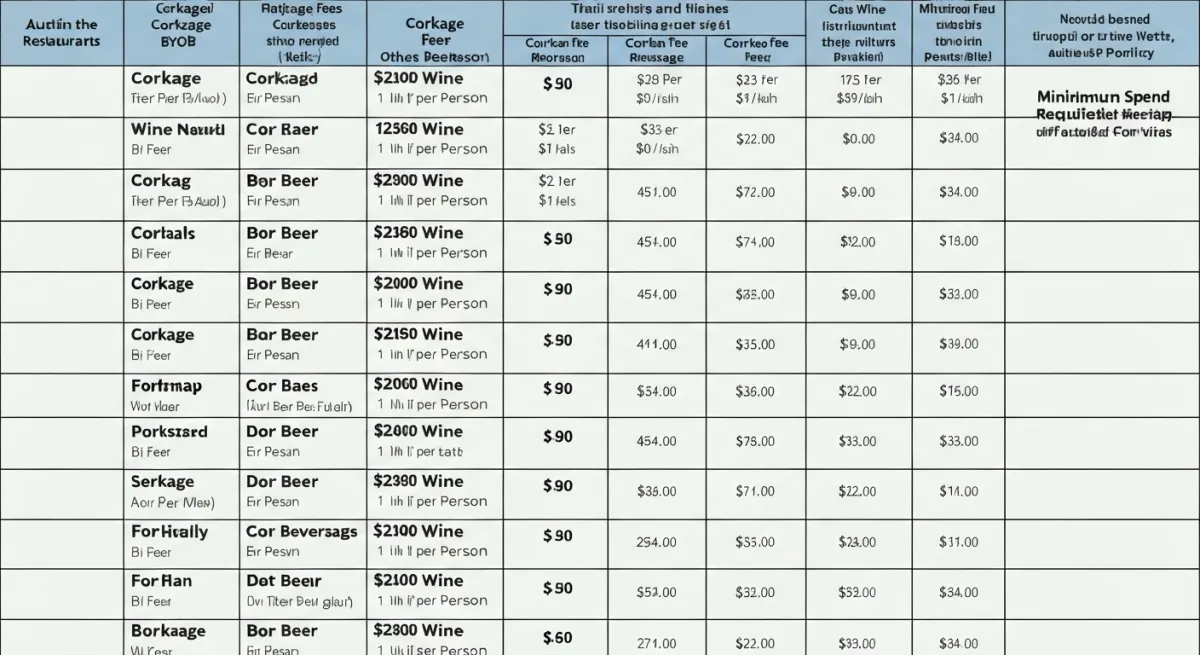
The following figures were confirmed through direct contact with each restaurant prior to publication. Policies change — call ahead before your visit.
| Restaurant | Neighborhood | Cuisine | Corkage Fee | Notes |
|---|---|---|---|---|
| Launderette | East Cesar Chavez | New American | $25/bottle | Limit 2 bottles per table; wine only |
| Emmer & Rye | Rainey Street area | New American / grain-forward | $30/bottle | No outside bottles already on their list |
| Olamaie | West Campus adjacent | Southern fine dining | $35/bottle | Call ahead; policy varies by party size |
| Arlo Grey | Downtown (LINE Hotel) | New American | $35/bottle | One of the more formalized hotel-restaurant policies in the city |
| Uchiko | Rosedale | Japanese / sushi | $35/bottle | Sake allowed; no spirits; no list duplication |
| Lenoir | South Congress | Seasonal / local | $20/bottle | Monday corkage waived; limits apply |
| Barley Swine | Burnet Road | New American tasting | $25/bottle | Tasting menu context; confirm format restrictions |
| Intero | East Cesar Chavez | Italian | $25/bottle | Wine only; must call 24 hours ahead |
| Bufalina | East 6th | Neapolitan pizza | $15/bottle | One of the most accessible corkage prices in the city |
| Italic | Downtown | Italian-American | $25/bottle | Enforces no-list-duplication rule strictly |
| Juniper | East Austin | New American | $20/bottle | Varies by night; Tuesday often waived |
| Swift’s Attic | Downtown | New American small plates | $20/bottle | Per bottle, not per person |
The $25-per-bottle fee is the most common price point among Austin’s mid-to-upper casual dining tier. Higher-end tasting-menu destinations and hotel restaurants run $35. Bufalina is the outlier at $15 — which reflects the casual register of the restaurant and a genuinely welcoming stance toward the practice. For a pizza-and-wine night you actually planned, it’s one of the better deals in the city. Lenoir’s Monday waiver is worth scheduling around if you have any flexibility. If you encounter a fee above $40 at an Austin restaurant, that’s a signal: the kitchen is technically accommodating the request but not exactly rolling out the welcome mat.
Which Neighborhoods Cluster the Most BYOB-Friendly Restaurants
East Cesar Chavez and the Holly corridor have the highest density of independently owned, wine-forward restaurants that take a welcoming stance toward outside bottles. The ownership profile — chef-driven independents with tight margins and strong regulars — tends to produce beverage directors who treat corkage as a hospitality tool rather than a nuisance. Launderette and Intero both operate here, and the surrounding blocks contain enough independent operators that the culture of bring-your-own is reasonably well established.
South First and South Congress follow. Lenoir anchors this area for BYOB purposes. The foot traffic on South Congress skews younger and more casual, which may explain why formal corkage policies are slightly less consistent here — some spots will accommodate a bottle but haven’t institutionalized a fee structure. You’ll sometimes get a shrug and a yes; occasionally just a shrug.
Rainey Street is primarily a bar-first corridor where most established venues hold mixed beverage licenses oriented toward selling cocktails. Emmer & Rye operates on a side street near Rainey with a serious food and beverage program and a documented corkage policy, making it the significant exception worth knowing about.
The Domain is largely a dead end for this practice. The restaurant mix runs heavily toward regional chains and national concepts with standardized beverage programs controlled at the corporate level. Individual managers typically can’t authorize a corkage exception. Save yourself the phone tag.
Downtown hotel restaurants are counterintuitive but genuinely reliable for BYOB purposes. Arlo Grey at the LINE Hotel is a good example: hotel F&B operations tend to have formally written policies because they’re managing a larger guest-service infrastructure. The corkage fee is documented, the staff know the answer when you call, and the service is consistent. If you’re staying downtown and want to bring a bottle, a hotel restaurant is often the most predictable choice — which isn’t what most people assume.
Waiver Nights, Bottle Rules, and the Fine Print
This is the section most competing coverage leaves out. It’s also where guests make avoidable mistakes.
Corkage waiver nights are more common than restaurant websites suggest. Lenoir has consistently waived corkage on Mondays; Juniper has done the same on Tuesdays. These policies exist because slow nights benefit from any incremental traffic, and a party that brings their own wine is still ordering food, filling a table, and sometimes ordering a second bottle off the list anyway. When you call to make a reservation, ask directly: “Do you waive corkage on any nights?” The answer may save you $20 to $35. Thirty seconds on the phone.
The no-list-duplication rule is the most important restriction to understand. Virtually every Austin restaurant with a formal corkage policy prohibits you from bringing in a bottle that already appears on their wine list. Italic enforces this strictly. Uchiko enforces it strictly. If you’re bringing something unusual, obscure, or personally cellared, you’re almost certainly fine. If you’re planning to bring a bottle of Whispering Angel because you grabbed it at Spec’s on the way over, confirm first that it’s not already on the list — because it probably is.
Format restrictions matter for special-occasion bottles. Several Austin restaurants decline to open magnums or large-format bottles, either because they don’t have appropriate decanters or because the service logistics get complicated. If you’re thinking about bringing a 1.5L for a party of six, call and ask specifically about format before you commit. Don’t find this out at the table.
When you call, ask explicitly whether the restaurant charges per bottle or per person. Most Austin restaurants charge per bottle, which is the more diner-friendly model. A handful charge per person. $15 per person at a table of eight runs $120 before you’ve eaten anything — at which point you’re not really saving anything at all. The table above uses per-bottle pricing for all listed restaurants, but confirmation matters.
A Sommelier’s View — Guest Service or Revenue Decision?
“When a guest calls ahead and asks about corkage, that’s already a signal,” says one Austin beverage director who oversees the wine program at an East Side dining destination. “That person has done some homework. They’re usually bringing something interesting, or something personal to them — a wine from a trip, something from their cellar, a bottle they’ve been saving. That kind of guest tends to be engaged at the table.”
The calculus shifts when the corkage fee climbs high enough to protect list revenue without actually compensating for the friction. “If your corkage is $45, you’re not really welcoming it. You’re technically allowing it.” The margin on a mid-range restaurant wine can run $40 to $70 per bottle, making a $25 corkage fee modest compensation for the lost sale. “Corkage is not a revenue strategy. The restaurants that do it well do it because they want their guests to have a good time. The restaurants that resent it usually show it.”
You can often feel that difference within the first five minutes of sitting down. The distinction the beverage director is drawing — genuinely welcoming versus technically permitting — is a real one, and it’s worth paying attention to when you call. A restaurant that gives you a straight answer, knows their policy off the top of their head, and doesn’t make you feel like you’re asking for a favor is probably telling you something true about how they’ll treat you when you arrive.
Where to Buy Before You Go — Austin’s Best Pre-Dinner Bottle Stops
Spec’s flagship on South IH-35 is the most practical choice for selection and value. The inventory runs into the thousands. For a restaurant BYOB errand, it works best when you already know what you want, because navigation takes a few minutes to learn if you haven’t been. Staff at the South Congress location report that customers heading to dinner with a bottle frequently gravitate toward the Italian section — given Austin’s volume of Italian restaurants that allow corkage — and toward California Pinot Noir and Rhône-style reds for mid-range spending.
Austin Wine Merchant on West 6th is the better stop when you want genuine guidance and a bottle that’s actually interesting. The staff are knowledgeable, the selection runs toward small producers and wines with real regional character, and the price range starts around $18 and goes into the hundreds. If you’re bringing a bottle to Olamaie or Uchiko for a special dinner, this is where you should buy it. Tell them the restaurant, the occasion, and your budget — they’ll give you a real recommendation rather than a shelf-position suggestion.
Austin’s summers are genuinely punishing on wine. A bottle left in a hot car for ninety minutes can be compromised. If you’re buying more than a couple of hours before dinner, keep the bottle in a cooler or insulated bag, or time your Spec’s stop close to your reservation. White wine and sparkling wine are more vulnerable than reds, though no bottle benefits from trunk temperatures above 90 degrees. In July, that’s basically every Austin parking lot.
Does the Math Actually Work? A Realistic Cost Comparison
Austin restaurants typically apply a 2.5x to 3.5x markup over retail. A bottle that retails at $40 will appear on most Austin wine lists at $90 to $110. That same $40 bottle brought from home, with a $25 to $35 corkage fee, costs you $65 to $75 total — a savings of roughly $15 to $45 per bottle depending on where you’re eating.
The math improves as the retail price rises. A $75 retail bottle might list at $175 to $200 at a higher-end restaurant. Bring it from home at $75 plus a $35 corkage fee and you’re at $110 — saving $65 to $90 on a single bottle. The math deteriorates at the low end: a $15 retail bottle of house-tier wine isn’t worth the logistics, and restaurants often sell comparable house pours by the glass for less hassle. The break-even point for most Austin restaurants falls around $25 to $30 retail. Below that, just order off the list.
The strongest case for bringing a bottle isn’t purely financial, though. It’s about getting exactly what you want. If you have a wine your restaurant doesn’t carry — a producer you love, a birth-year bottle, something from a trip abroad — no markup calculation applies because the wine simply isn’t available any other way. Most Austin beverage directors are genuinely happy to accommodate that situation. It’s the guests who show up with something they grabbed off the grocery shelf because they didn’t feel like paying list price who tend to get a lukewarm reception.
Here’s a scenario that actually works: dinner at Intero with three friends. You bring a $50 retail Barolo from Austin Wine Merchant. The corkage fee is $25. Your all-in wine cost for the table is $75. The same bottle, if Intero carried it, would likely list at $130 to $150. You’ve saved $55 to $75 and you’re drinking exactly what you wanted.
Call ahead, bring something you actually care about, and don’t bring a bottle that’s already on the list.