Where Austin's Cooling Centers Are in 2026 and Which Neighborhoods They Miss
As the first heat advisory of summer hits Travis County, a ZIP-by-ZIP look at who can actually reach a cooling center — and what they'll find when they get there.

As the first heat advisory of summer hits Travis County, a ZIP-by-ZIP look at who can actually reach a cooling center — and what they’ll find when they get there.
The National Weather Service issued the first Excessive Heat Warning of the summer on a Tuesday morning, forecasting heat indexes above 110°F across the Austin metro for at least three consecutive days. By 10 a.m., Austin Public Health had activated the city’s formal cooling center network. By afternoon, 311 call volume had spiked.
For most Austinites, the city’s heat response is background noise. In Travis County in 2023, at least 18 people died of heat-related causes — and the county medical examiner considers that a floor, not a ceiling, because heat is often listed as contributing rather than primary cause of death. NOAA’s Climate Prediction Center is forecasting above-normal temperatures across Central Texas through September. That matters more than most of the city’s official communications suggest.
This piece is for the people who actually need cooling centers: elderly residents in apartments without reliable AC, outdoor construction workers on the eastern edges of the city, car-free renters in Dove Springs and East Riverside. Anyone who relies on the city’s infrastructure rather than their own means. What follows is a ground-level inventory of what Austin has built, where it falls short, and what you need to know on a hot day when you need somewhere to go.
What the City Says It Has
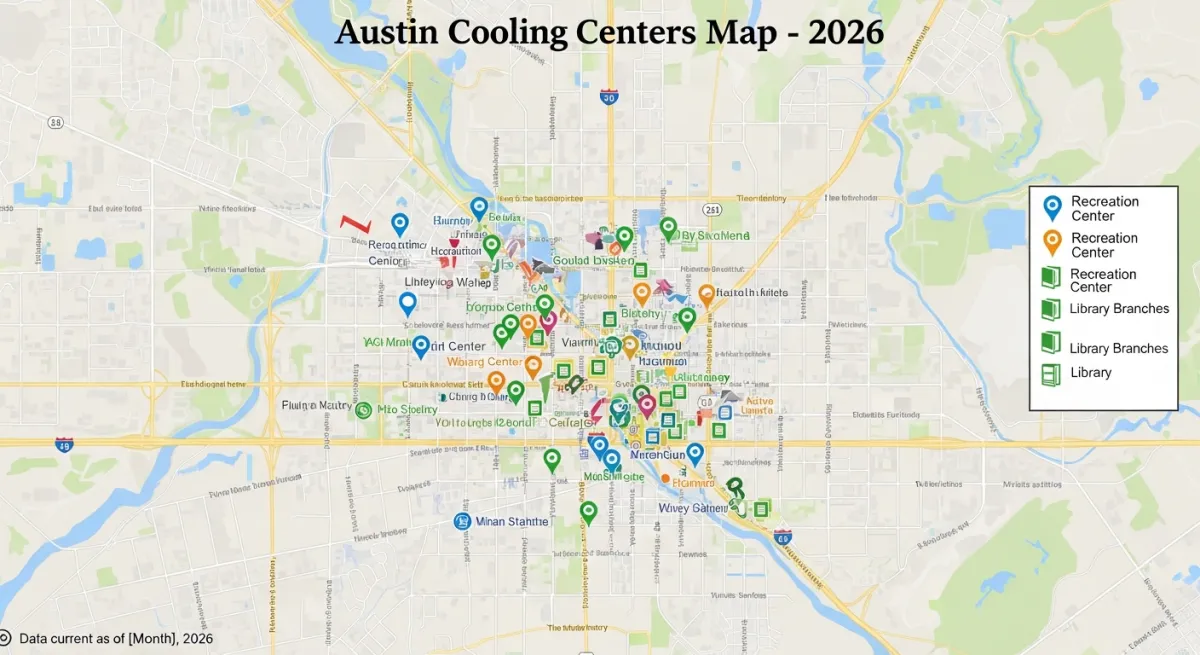
Austin’s formal cooling center network in 2026 runs on two anchors: Austin Recreation Centers through Parks and Recreation, and Austin Public Library branches. When the city activates its Heat Emergency Response Plan, these sites go onto the official list at austintexas.gov/heatemergency. They get announced via 311, Austin-Travis County Emergency Management social media, and the wireless emergency alert system.
The confirmed designated cooling centers for summer 2026, as listed by Austin Public Health and Parks and Recreation:
Austin Recreation Centers (ARCs):
- Dittmar Recreation Center — 1009 W. Dittmar Rd., 78745, (512) 978-3940
- Dove Springs Recreation Center — 5801 Ainez Dr., 78744, (512) 978-3950
- Givens Recreation Center — 3811 E. 12th St., 78721, (512) 978-3960
- Hancock Recreation Center — 811 E. 41st St., 78751, (512) 978-3970
- Mabel Davis Recreation Center — 3427 Parker Lane, 78741, (512) 978-3980
- Northwest Recreation Center — 2913 Northland Dr., 78757, (512) 978-3990
- Rosewood Recreation Center — 2317 Rosewood Ave., 78702, (512) 978-4000
- South Austin Recreation Center — 1100 Cumberland Rd., 78704, (512) 978-4010
- Williamson Creek Recreation Center — 5500 Williamson Creek Dr., 78749, (512) 978-4020
Austin Public Library Branches:
- Carver Branch — 1161 Angelina St., 78702, (512) 974-1010
- Cepeda Branch — 651 N. Pleasant Valley Rd., 78702, (512) 974-7481
- Hampton Branch at Oak Hill — 5125 Convict Hill Rd., 78749, (512) 974-9900
- Manchaca Road Branch — 5500 Manchaca Rd., 78745, (512) 974-8700
- Milwood Branch — 12500 Amherst Ave., 78727, (512) 974-9980
- Ruiz Branch — 1600 Grove Blvd., 78741, (512) 974-7500
- St. John Branch — 7500 Blessing Ave., 78752, (512) 974-7570
- Windsor Park Branch — 5833 Westminster Dr., 78723, (512) 974-9840
All Austin Public Library branches are air-conditioned and publicly accessible during normal operating hours regardless of whether a formal heat emergency has been declared. You don’t need an emergency declaration to walk into a library and sit down. Worth knowing.
Libraries and recreation centers differ in ways that matter, though. Libraries have no cold water distribution systems, no designated personnel for heat-related medical situations, and their hours don’t extend during emergencies the way some ARCs do. For a resident choosing where to go on a 115-degree afternoon, those distinctions are real.
For real-time activation status, check austintexas.gov/heatemergency or call 311 (within Austin city limits). Austin-Travis County Emergency Management: (512) 974-0450.
The Real Hours — Including When Centers Close
This is where the city’s communication breaks down. The official cooling center page lists sites but doesn’t consistently publish verified current hours during an active emergency, and it doesn’t flag when hours differ from a facility’s standard schedule.
Most Austin Recreation Centers run roughly 6 a.m.–10 p.m. on weekdays during summer. Weekend hours are typically 8 a.m.–6 p.m. or 8 a.m.–8 p.m. depending on the facility. Austin Public Library branches generally run 10 a.m.–8 p.m. Monday through Thursday, 10 a.m.–6 p.m. Friday and Saturday, and are closed Sundays at most locations.
The overnight gap isn’t a scheduling detail. It’s a life-safety problem.
Heat indexes in Austin during a major heat event don’t reliably drop below dangerous levels after dark. During the 2023 heat wave, overnight lows hovered near 85°F for consecutive nights, with heat indexes above 95°F past midnight. The NWS warning issued this week specifically noted dangerous overnight conditions. Yet by 10 p.m. — and often as early as 6 p.m. on weekend evenings — every formal city cooling center closes. A person without AC in a Dove Springs apartment at 11 p.m. on a Saturday, heat index still above 90, has nowhere to go. Same story for outdoor workers ending a shift at dusk, elderly residents whose apartments warm to 95 degrees after sunset, anyone depending on the city’s network instead of their own four walls.
During a declared heat emergency, the city has authority to extend ARC hours. Parks and Recreation staff confirmed in a 2025 City Council briefing that extended hours to midnight were activated on two occasions during the 2023 emergency. That extension is not automatic, not pre-announced, and not uniform across all sites. A resident counting on a center being open at 9 p.m. on a Saturday in 78744 cannot verify that in advance. Call the facility directly — not just the city webpage — to confirm hours before you travel.
The Gap Map: ZIP Codes With No Center Within Reach
The city’s cooling center footprint is meaningful in central Austin. It becomes a serious problem when mapped against where Austin’s most heat-vulnerable residents actually live.
78724 — Colony Park and the northeast corridor has no designated cooling center. This equity failure was documented well before 2023, and the city has known about it for years without fixing it. Colony Park is a majority-Black neighborhood in northeast Austin. The nearest recreation center with formal designation is Govalle, roughly 4 miles southwest, or Givens on East 12th, nearly 5 miles from the far end of the neighborhood. For a resident without a car, that’s not a reasonable option. The neighborhood also sits within the urban heat island corridor along the US-183/MLK Jr. Boulevard axis, where impervious cover is dense and tree canopy is sparse — which is to say, it’s one of the hottest parts of the city, and it has no cooling center.
78725 — Walter E. Long corridor and Hornsby Bend has no designated cooling center and no library branch. The nearest formally designated site is miles away via roads not served by direct Capital Metro routes. This ZIP has a significant outdoor worker and low-income renter population and is among the fastest-growing residential areas on Travis County’s eastern edge.
78617 — Del Valle is technically outside Austin city limits but within the city’s extraterritorial jurisdiction, served by Austin ISD and Travis County. Del Valle ISD buildings aren’t part of the city’s heat response activation. The nearest Travis County option is Dove Springs, a significant drive south. The farmworker and agricultural worker community here faces some of the highest outdoor heat exposure of any ZIP code in the county, and the city’s network doesn’t reach them.
City of Austin Watershed Protection Department research, corroborated independently by UT Austin’s Planet Texas 2050 initiative, shows neighborhoods in the Dove Springs, East Riverside, and Colony Park corridors run 4 to 7 degrees hotter than Tarrytown, Westlake Hills, or the Domain. The people with the least access to cooling centers live in the hottest parts of the city. That’s the sentence the city’s heat response materials never quite say out loud.
78741 — East Riverside/Oltorf has two formally designated sites nearby: Mabel Davis Recreation Center and Ruiz Branch library. But East Riverside’s dense renter population and high proportion of car-free residents mean transit access is the operative question, not just whether a site appears on the city’s list. This is the kind of infrastructure story we track in our health & wellness coverage.
For east Austin residents: Givens Recreation Center at 3811 E. 12th St. (78721) and Rosewood Recreation Center at 2317 Rosewood Ave. (78702) are the most centrally located ARCs. Carver Branch library at 1161 Angelina St. is formally activated and accessible by multiple Capital Metro routes.
For the Domain area (78758, 78727): Milwood Branch library at 12500 Amherst Ave. is the nearest formally designated site but closes at 6 p.m. Saturdays. Northwest Recreation Center at 2913 Northland Dr. in 78757 offers extended weekday hours and is the nearest ARC.
Getting There Without a Car
Geographic proximity means nothing if transit doesn’t connect. For Austin’s cooling center network to function as a safety net, it has to be reachable by the people most likely to need it.
Givens Recreation Center is served by the 20 (Manor Rd.) and nearby routes through the East Austin corridor. Rosewood is accessible via the 20. Carver and Cepeda library branches sit within 78702’s service density, accessible via multiple east Austin routes. Ruiz Branch in 78741 is near East Riverside, served by the 3, 7, and 20. Hancock connects via routes along Airport Boulevard and East 41st. South Austin Recreation Center is accessible via the 5 and routes along South Congress.
The transit picture gets worse from there. Williamson Creek Recreation Center at 5500 Williamson Creek Dr. in 78749 requires a transfer and a walk of half a mile or more in direct sun with no shade cover — genuinely impractical in extreme heat, not just inconvenient. Hampton Branch at Oak Hill in 78749 is a car-dependent destination; Capital Metro coverage is thin and the nearest stop requires a walk with no shade. Milwood Branch in 78727 is theoretically near the 392 corridor but practically requires a car from most surrounding neighborhoods.
The Colony Park situation in 78724 is compounded by transit access that was already thin before you account for the fact that there’s no cooling center to travel to. A neighborhood that’s among the hottest in the city, with no designated site and limited bus connections to the ones that exist elsewhere — that’s not a gap, it’s a decision. Someone decided, year after year, not to fix it.
Capital Metro’s trip planner is at capmetro.org. During heat emergencies, the agency has in prior years offered free or reduced-fare access for cooling-related trips; confirm current policy at (512) 474-1200.
What You’ll Find Inside — and What You Won’t
The city’s official communications tell you where to go. They say almost nothing about what to expect when you get there.
At Austin Recreation Centers, activation typically means air-conditioned public areas are open, bottled water is available (supply varies and has run short during prolonged emergencies), and seating in common areas is accessible. Restrooms are open. Electrical outlets for device charging exist in lobby and lounge areas at most ARCs, though the count isn’t standardized — don’t count on walking in and finding a free plug. Several ARCs have gymnasium space that can accommodate more people during a prolonged emergency.
There is no medical monitoring. No exceptions. ARCs have no on-site medical staff during heat emergencies. Austin-Travis County EMS and Austin Public Health have coordinated welfare checks at some sites during past emergencies, but don’t assume a nurse or paramedic will be present. If someone shows signs of heat stroke — confusion, stopped sweating, skin that is hot and dry — call 911. Don’t wait for center staff to manage it.
At library branches, the picture is more passive. Air conditioning and seating, restrooms, library staff. Cold water distribution and any organized response capacity aren’t guaranteed. Libraries are genuinely useful as cooling stops, but they’re not equipped to function as medical refuges.
You don’t need ID to enter a cooling center in Austin. The city’s policy is explicit: no sign-in, no name, no reason required. This applies equally to ARCs and library branches.
Austin Public Health materials are published in English and Spanish. In-person language assistance at individual sites is inconsistent. Residents who need Spanish-language assistance should call 311, which has Spanish-language operators. For other languages, 311 can connect to an interpreter.
Service animals are permitted. Personal pets are not. This is a documented barrier for some elderly residents and people in unstable housing situations who won’t leave animals behind — and honestly, it’s hard to argue with their logic. The city has no coordinated pet-friendly cooling option heading into summer 2026, despite advocates raising it repeatedly since 2023.
All formally designated ARCs and library branches are ADA-accessible. If a specific accommodation is needed, call the site before you travel.
Before and After 2023: Did Austin Actually Expand Capacity?
Following the 2023 deaths, Austin City Council approved $2.7 million in heat resilience funding in the fiscal year 2023–24 budget cycle. Did that produce a measurably larger, better-distributed network in 2026?
The 2026 designated site list includes more formally listed library branches than were consistently activated in 2022 or early 2023. That’s a real expansion of the network’s accessible floor. Austin Public Health also hired additional staff for heat response coordination and improved 311 integration during activations.
What the funding did not produce: a new cooling center in Colony Park, Walter E. Long, or Del Valle. City staff presented the Colony Park gap in a 2024 briefing and noted that the forthcoming Colony Park Branch Library, part of the Colony Park Sustainable Community Initiative, would eventually address part of it. That library isn’t open. Until it is, 78724 has no cooling center. “Eventually” is cold comfort to someone trying to get out of a 95-degree apartment tonight.
The Travis County Medical Examiner recorded 18 confirmed heat-related deaths in 2023. Preliminary figures from 2024 were lower — Austin Public Health cited nine confirmed heat-related fatalities — but officials noted that 2024 didn’t produce the same multi-week extreme event that 2023 did. Whether the reduction reflects improved infrastructure or a less brutal summer is genuinely unclear, and anyone claiming credit should probably wait for a summer that actually tests the system.
One more thing worth flagging: the city doesn’t track or publish total cooling center capacity as a figure — not for 2022, 2023, or 2026. A reporter asking the heat response coordinator for that comparison will come up empty. It’s a strange omission for a program that’s supposed to be accountable for people’s lives.
How the Emergency Activation System Works — and Where It Falls Short
Austin’s Heat Emergency Response Plan uses a tiered trigger system. A Heat Advisory from NWS (heat index 103–107°F) prompts public messaging. An Excessive Heat Warning (108°F or above for two or more consecutive days) formally activates the cooling center network.
When a warning is issued, Austin Public Health notifies Parks and Recreation and the Austin Public Library director’s office. Site coordinators at each ARC are contacted by the Parks and Recreation emergency coordinator. Library branch managers are notified by library administration. The city’s communications office pushes notification through social media, the ATX Alerts system, the city website, and 311.
In 2023, advocates and some site staff reported gaps of two to four hours between NWS warning issuance and confirmed site opening at certain facilities. In a morning advisory, that lag is manageable. In a rapidly escalating afternoon, it isn’t. The city’s 2024 after-action review acknowledged the lag and stated that protocols had been updated. The target response time was not made public. Draw your own conclusions about what that omission signals.
The information access problem is structural. The city’s primary activation notifications run through social media and the city website. Elderly residents without smartphones, Spanish-dominant residents who don’t follow English-language city accounts, and residents in areas with lower broadband penetration are less likely to receive timely notice. The city partners with KLRU, KUT, and Spanish-language radio stations for emergency alerts, but the consistency of those partnerships during activations varies. The people most at risk of dying in a heat emergency are often the least likely to see a city tweet.
What Advocates and Residents Say Is Still Missing
The Austin Justice Coalition has pushed on heat equity since the 2021 power crisis. Its 2026 demands going into summer were specific: a permanent cooling center in Colony Park before the season starts, overnight heat refuge options at any city facility, and a pet-friendly cooling option in partnership with Austin Animal Services. None of those have been met.
Beat Civic, a community information organization active in Dove Springs and Montopolis, documented resident experiences during the 2023 emergency that don’t appear anywhere in the city’s after-action reporting. Residents reported parking lot heat at Dove Springs Recreation Center making the approach miserable, water supply running short in the first 24 hours of activation, and no Spanish-language communication about hours changes at the city’s primary option for a majority-Latino neighborhood. The city wasn’t paying attention to those details. Beat Civic was.
Residents in Rundberg — along North Lamar between North Loop and Rundberg Lane, one of Austin’s highest-density low-income corridors — have noted that the nearest formally designated site, St. John Branch Library, closes at 6 p.m. on Saturdays and is dark on Sundays. In a neighborhood where large numbers of residents work hourly jobs six days a week and live in older apartment stock without AC, weekend evening access isn’t a luxury feature. It determines whether the network reaches them at all.
After 2023, advocates asked for more sites in east and southeast Austin, overnight access at a minimum of one site per council district, culturally competent outreach in Spanish and other languages, and real accountability metrics tied to heat deaths and cooling center reach. What they got was more library branches on the formal list, improved 311 integration, and additional Public Health staff. Those are real improvements. They’re also a fraction of what was asked. That distance is the accountability story of Austin’s heat preparedness heading into 2026.
Quick Reference: How to Find a Center on a Hot Day
Call 311 (within Austin) for the current list of open cooling centers, real-time hours, and transit information. Spanish-language operators available. 311 runs 24/7.
Website: austintexas.gov/heatemergency — activation status, addresses, updates during an active emergency.
Austin Public Health: (512) 972-5520
Austin-Travis County Emergency Management: (512) 974-0450
Capital Metro: capmetro.org or (512) 474-1200. Ask specifically about routes to your nearest cooling center and whether reduced-fare emergency access is active.
If it’s after 8 p.m. and centers appear closed, call 311 to ask whether any site has extended hours under the current emergency declaration. If you or a neighbor is in heat-related medical distress — confusion, hot dry skin, stopped sweating — call 911. Heat stroke moves fast. Don’t wait.
If you’re in 78724: Givens Recreation Center at 3811 E. 12th St. is the closest formally designated site. Plan the transit route in advance; it’s not a quick trip.
If you’re in 78617: Dove Springs Recreation Center at 5801 Ainez Dr. is the nearest ARC.
If you’re in 78725: There’s no good answer in the current network. Call 311 for any temporary or pop-up sites that may have been activated.
Verify before you travel. This article reflects the city’s published 2026 cooling center list at time of writing. Hours and activation status change during an active emergency. The 311 line is the most reliable real-time source.
CityDesk Austin will update this piece as the summer progresses. Readers with on-the-ground information about cooling center conditions — supply shortages, access barriers, hours discrepancies — can reach the newsroom at tips@citydeskaustin.com.