What Barton Springs Water Quality Test Results Actually Mean for Swimmers
The city posts E. coli data regularly. Here's how to read it, what triggers a closure, and why June is the riskiest month to assume the pool is open.

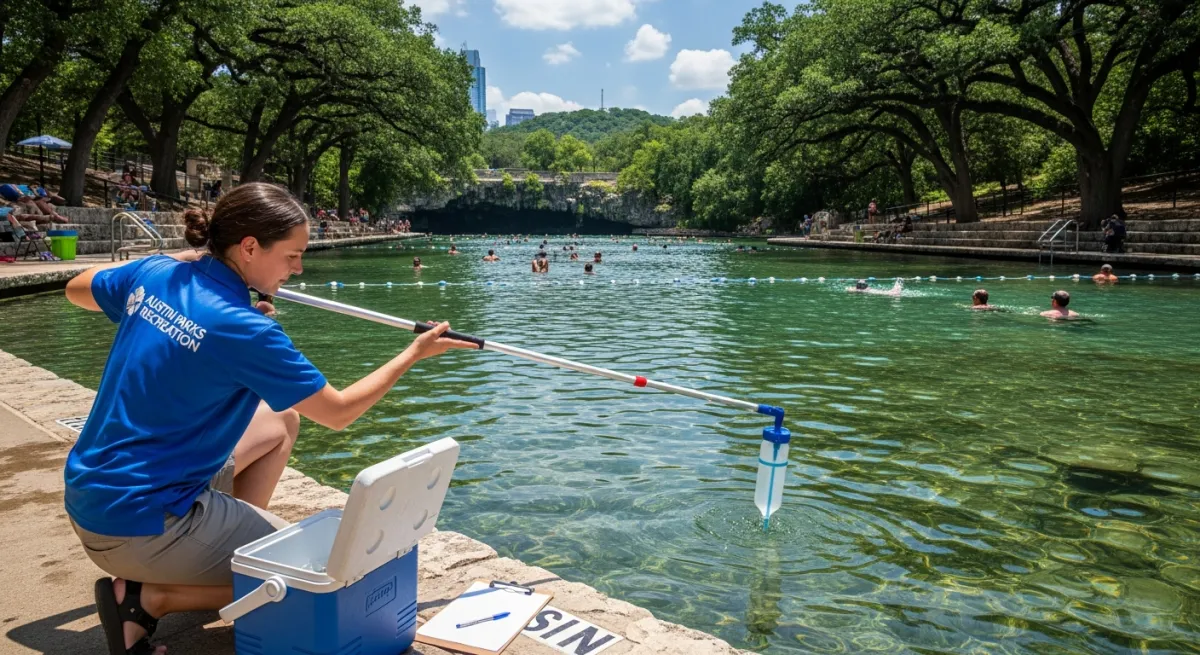
The city posts E. coli data regularly. Here’s how to read it, what triggers a closure, and why June is the riskiest month to assume the pool is open.
Barton Springs Pool draws visitors year-round. Most of them show up assuming the water is fine. Sometimes they’re right. Sometimes they drive 20 minutes, find a closed gate, and turn around having learned nothing about why—or how to avoid it next time.
The City of Austin publishes water quality test results for Barton Springs with enough information to make a genuinely informed decision before you leave the house. The problem is that the data uses shorthand most swimmers have never had explained to them. This piece explains it.
Why Barton Springs Water Quality Works Differently Than Any Other Public Pool in Austin
Most public pools in Austin recirculate their water through filtration systems and treat it with chlorine or salt-chlorine chemistry. Barton Springs does neither. The pool is fed directly and continuously by springs discharging from the Edwards Aquifer—cold, clear water pushed up through limestone that keeps the pool temperature around 68 degrees Fahrenheit year-round, regardless of what August does to the rest of the city.
That’s what makes it special. It’s also what makes it genuinely vulnerable in a way that a conventional municipal pool simply isn’t.
There’s no recirculating filtration and no chemical treatment, so whatever reaches the aquifer through the recharge zone eventually shows up in the pool. The Barton Springs segment of the Edwards Aquifer sits within a Texas Commission on Environmental Quality (TCEQ) designated recharge zone. Austin’s Save Our Springs (SOS) Ordinance limits impervious cover in new development specifically to reduce stormwater contamination loads. That ordinance has real regulatory weight. It also signals, by its very existence, how serious the contamination risk is when it goes unmanaged.
Barton Springs is not unsafe in a general sense. It’s conditionally safe. The conditions matter, and they change.
The Number That Matters: What CFU Means and Where the Closure Threshold Comes From
When the City of Austin’s Watershed Protection Department posts water quality results for Barton Springs, the key figure is expressed in CFU/100mL. That stands for colony-forming units per 100 milliliters of water. It’s a measure of how many living bacterial organisms capable of reproducing are present in a given water sample.
The specific bacteria being measured is E. coli (Escherichia coli), which indicates fecal contamination. E. coli itself encompasses a wide range of strains. Most cause no illness in healthy adults at recreational exposure levels. But elevated E. coli counts indicate the presence of fecal matter from warm-blooded animals, which in turn indicates potential presence of other pathogens—including bacteria, viruses, and parasites—that aren’t individually measured in routine screening.
The federal EPA’s recreational water quality benchmark for freshwater is 126 CFU/100mL, expressed as a geometric mean across multiple samples. This threshold was established through studies linking bacterial counts to gastroenteritis rates in swimmers. It’s calibrated to reflect public health protection against the practical reality that most natural swimming bodies contain some fecal indicator bacteria.
Here’s where it gets locally specific—and where most Austin coverage misses an important distinction: Austin has historically applied a single-sample threshold of 235 CFU/100mL as the trigger for issuing a swimming advisory or closing Barton Springs Pool. That’s an older standard, derived from earlier EPA guidance that used a single-sample maximum rather than a geometric mean of multiple readings. The newer EPA framework (2012) moved toward geometric means precisely because single-sample results can be noisy. One high reading during a rainfall event doesn’t necessarily reflect sustained contamination. Readers checking results should confirm with Austin Public Health which standard is currently operative, because the number you’re comparing against matters significantly.
If a result reads 180 CFU/100mL, it sits above the EPA’s 126 CFU/100mL geometric mean benchmark but below the older 235 CFU/100mL single-sample threshold. Whether that triggers a closure depends entirely on which rule the city is using at any given moment. This distinction has real consequences for whether you’ll find the pool open or closed on a given afternoon—and it’s not something most people know to ask about.
Children who ingest more water while swimming face higher risk than healthy adults. Immunocompromised individuals, swimmers with open wounds, ear infections, or compromised immune systems should apply a stricter personal threshold than the city’s posted closure number, regardless of what advisory is or isn’t in effect.
How Often the City Tests, Who Does It, and When Results Go Live
The City of Austin’s Watershed Protection Department is responsible for routine bacterial sampling at Barton Springs. During the summer swim season—roughly May through September—sampling frequency is higher than the rest of the year. Readers planning a visit should contact Austin Public Health (512-972-5600) or Watershed Protection directly to confirm current testing frequency, as protocols can shift between seasons and in response to emerging conditions.
Results are posted to the City of Austin’s website at austintexas.gov under the Watershed Protection Department’s water quality data pages. Once a sample is collected and analyzed, the notification chain moves through several hands. Watershed Protection generates the lab results. Austin Public Health evaluates them against the closure threshold and issues a formal advisory if warranted. Parks & Recreation staff physically close the pool gate based on that advisory.
In practice, the chain has gaps. Lab analysis takes time. The pool may operate for a portion of a day before a closure is posted. And many swimmers—probably most—don’t check the city’s water quality page before they leave home. They find out when they arrive.
For a pre-visit check, your options are straightforward: Call Austin 3-1-1 or use the app to ask about current pool status. City staff can confirm whether an advisory is in effect. The pool maintains a phone line with current hours and status information. Confirm the current number through the Parks & Recreation website at austintexas.gov/department/barton-springs-pool, as contact numbers are updated periodically. The City of Austin Parks & Recreation accounts on Facebook and X (formerly Twitter) post closure notices. Whether this is an official notification channel with guaranteed posting protocols or an informal practice varies—which is exactly why you shouldn’t rely on it exclusively. Do not treat social media as a substitute for the city’s official data page or 3-1-1.
The fundamental limitation of the notification system is that it’s reactive. Results post after testing. Advisories issue after results. Closures happen after advisories. A storm hits Tuesday night. Sampling may occur Wednesday morning. Results may post Wednesday afternoon or Thursday. By then swimmers have already made decisions. This lag is a structural feature of any natural swimming environment that requires laboratory analysis—it’s not unique to Austin, and it’s nobody’s fault. But it means swimmers who want reliable information need to build checking into their routine, not just wait for a notification to find them.
What Triggers a Spike: The Karst Terrain Explanation
Understanding why Barton Springs gets contaminated requires a brief geology detour. The mechanism is genuinely different from what most people assume about how groundwater works.
The Edwards Plateau beneath the Barton Springs watershed is karst limestone: fractured, porous rock honeycombed with conduits, fractures, and sinkholes. It functions less like a slow-filtering sand aquifer and more like an underground drainage network. Surface water that enters the recharge zone—through sinkholes, stream crossings, or direct infiltration through thin soils—can reach the aquifer and emerge at Barton Springs within hours, not weeks. There’s minimal filtration lag. Whatever was on the surface before the rain can be in the spring water very soon after the rain.
The contamination sources in the Barton Creek watershed are multiple. Urban stormwater carries fecal matter from pets, wildlife, and bird populations across the impervious surfaces of Oak Hill, Westlake Hills, Bee Cave, and the Loop 360 corridor. That’s a suburban development band where runoff concentrations are high and land-use buffers are limited. Older septic systems in unincorporated Hill Country areas of the watershed contribute during heavy rainfall when systems are overwhelmed or when ground saturation forces lateral flow to the surface. Agricultural and ranch land in the upper watershed contributes livestock waste. Canada geese in Zilker Park, which borders the pool, produce measurable fecal coliform loads directly adjacent to the water. This last one isn’t a rainfall-dependent problem—it keeps baseline counts elevated even on perfectly dry days, which surprises most people when they first hear it.
Barton Springs responds to contamination differently than a reservoir or a river with extensive floodplain would. The karst connection between surface events and spring output is fast, direct, and unfiltered. A rainfall event over the recharge zone isn’t a vague, indirect risk. It’s a near-direct pipeline for whatever was on the ground upstream.
Algae is a secondary concern worth addressing separately. Cold spring temperatures (consistently near 68°F) suppress the algal blooms that create problems at warmer surface swimming holes in Central Texas. Readers should confirm with Austin Public Health or Watershed Protection whether algae has ever independently triggered a Barton Springs closure. The two contamination types—bacterial and algal—are separate issues. Conflating them leads to misplaced concern about the wrong variables.
Why June Is the Highest-Risk Month
Austin’s convective storm season peaks during the May-to-June transition. Afternoon thunderstorms, often rapid and intense, drop significant rain in a short window over a specific area of the watershed. This is the mechanism that produces acute contamination spikes at Barton Springs. Because of the karst terrain, even moderate rain events over the contributing zone above the recharge zone can produce elevated bacterial concentrations at the spring relatively quickly. The 2015 Memorial Day floods sent Barton Creek surging through Zilker Park and delivered an extraordinary contamination load through the recharge zone. That’s the extreme version of this dynamic. But the ordinary version can happen multiple times in a typical June. The storm doesn’t have to be catastrophic to contaminate the spring. It just has to move surface runoff into the karst conduits.
Watershed Protection annual reports document closure frequency by month. Readers wanting historical closure data for a specific year range can request it through Watershed Protection or review annual water quality reports posted at austintexas.gov. Years with wetter-than-average late spring seasons tend to show elevated closure frequency relative to drier years. These wetter periods correlate with La Niña patterns that increase Gulf moisture transport into Central Texas.
Two categories of closure get confused regularly, and the confusion causes real frustration. Water quality closures happen throughout the year when E. coli counts exceed the advisory threshold. They’re unpredictable, triggered by contamination events, and can last from a day to several days depending on how quickly counts return to safe levels. The annual winter maintenance closure is a planned, scheduled closure that runs for several weeks in late fall or winter. It typically spans November through mid-January, though dates vary by year. The pool is drained, cleaned, and inspected. These are not the same thing. Checking water quality results tells you nothing about the maintenance closure schedule and vice versa.
The 48-to-72-Hour Rule After Rain
Here’s the gap that most existing coverage of Barton Springs water quality doesn’t address: what should a swimmer do in the period after a significant rain event when no formal advisory has been posted?
Standard public health guidance on recreational freshwater, drawn from EPA and CDC frameworks, suggests that E. coli counts can remain elevated for 48 to 72 hours after a significant rain event even when no advisory has been formally issued. Testing takes time. Results take time. The contamination itself takes time to flush through and dilute. Austin Public Health representatives, when asked directly, can provide the city’s specific recommendation about post-storm waiting periods. Swimmers should ask directly and get the answer in writing or from a named spokesperson. The city’s official position on informal waiting periods (as opposed to formal posted advisories) is worth knowing exactly.
If a significant rain event has occurred over the Barton Creek watershed within the past 48 hours, your baseline assumption before checking results should be elevated risk, not normal conditions. That’s not a reason to never swim after rain—it’s a reason to check current results actively rather than assuming no news means good news.
The 48-to-72-hour window isn’t a hard cutoff. Contamination timing depends on the intensity of the rain, the saturation state of the ground, the specific location of the rainfall relative to the recharge zone, and flow conditions in Barton Creek. A brief, intense storm directly over the recharge zone can produce faster contamination than a slower, broader rainfall event. Checking results and comparing them to the closure threshold in the 48-to-72-hour window post-event gives you a meaningful data point rather than a guess.
How to Check Before You Go
These are the specific resources available for checking Barton Springs water quality before a visit, covered in depth in our health & wellness coverage.
City of Austin Water Quality Sampling Results: Watershed Protection posts E. coli sample results at austintexas.gov. Navigate to the Watershed Protection Department page and look for the recreational water quality or swimming advisories section. The direct URL can shift when the city redesigns its site (and it does redesign its site). Searching “Barton Springs water quality” directly on austintexas.gov should surface the current results page. Confirm the URL is pulling live, current data. The page should show a sample date within the past week during swimming season. When you find the results page, look for the most recent sample date, the CFU/100mL reading, and whether an advisory is currently in effect. Compare the CFU number against the closure threshold—currently understood to be 235 CFU/100mL under the single-sample standard, though readers should verify the current operative threshold with Austin Public Health. A reading well below that number on a recent sample date, with no advisory posted and no significant rainfall in the past 48 hours, indicates a reasonable swim day.
Austin 3-1-1: Dial 3-1-1 within Austin city limits, or 512-974-2000 from outside. The 3-1-1 app is available for iOS and Android. City staff can confirm current advisory status for Barton Springs.
Barton Springs Pool Information Line: The Parks & Recreation department maintains a recorded information line for pool hours and status. Find the current number at austintexas.gov/department/barton-springs-pool. It’s worth saving in your phone if you visit regularly.
Parks & Recreation Social Media: Austin Parks & Recreation posts closure notices on its social media accounts. Treat this as a supplementary channel, not the primary source. A notice may not always be posted promptly. The absence of a social media post is not confirmation that the pool is open. No exceptions.
Reading a Test Result: How to Apply the Numbers
The key questions are how old the most recent sample is (a result from four days ago tells you less than a result from yesterday), what the actual CFU number is (not just whether an advisory is posted—the raw number tells you how close to threshold the water is), and what the weather has done since that sample was taken.
A result well below the closure threshold on a sample taken recently, with no rain since, is a solid green light for a healthy adult swimmer. A result near or above the EPA’s 126 CFU/100mL benchmark on a sample taken several days ago, with rainfall since, is a different picture entirely. You may be near threshold on old data with new contamination potential that hasn’t been captured yet. The number alone isn’t sufficient. The date and the weather context together give you an actual decision. That’s the read. It takes 90 seconds if you know where to look.
Quick Reference: Barton Springs Water Quality at a Glance
Closure threshold: Approximately 235 CFU/100mL under the single-sample standard (confirm current standard with Austin Public Health at 512-972-5600)
EPA recreational benchmark: 126 CFU/100mL geometric mean—the federal reference point for freshwater swimming
Where to check results: austintexas.gov → Watershed Protection Department → recreational water quality / swimming advisories
Austin 3-1-1: Dial 3-1-1 (or 512-974-2000) to confirm current advisory status
Pool information line: Find the current number at austintexas.gov/department/barton-springs-pool
Post-rain guidance: Treat any significant rain event over the Barton Creek watershed as a reason to check results actively before visiting; standard public health guidance suggests E. coli can remain elevated 48–72 hours after significant rainfall even without a formal advisory
Highest-risk months: May through June, when convective afternoon storms over the recharge zone most frequently trigger contamination spikes
Winter maintenance closure: Planned, scheduled annual closure (typically late fall to mid-January)—separate from water quality closures; check Parks & Recreation for exact dates each year
Not a reliable signal: The absence of a social media post about a closure does not mean the pool is open
CityDesk Austin will update this piece when Austin Public Health confirms the current operative E. coli threshold standard, Watershed Protection confirms current testing frequency, and historical closure data for recent years is on record. Readers with specific health concerns should contact Austin Public Health directly before swimming.