How to Protest Your Travis County Property Tax Appraisal in 2026
Every April, Travis County property owners open a Notice of Appraised Value from the Travis County Appraisal District and face the same decision: accept the number or fight it. Most accept it. That…

How to Protest Your Travis County Property Tax Appraisal in 2026
Every April, Travis County property owners open a Notice of Appraised Value from the Travis County Appraisal District and face the same decision: accept the number or fight it. Most accept it. That’s a mistake.
Roughly half of all protests filed in Travis County result in some reduction. The process is bureaucratic, but it’s far more straightforward than TCAD’s website makes it look — which says plenty about the website.
This guide walks through the 2026 protest process step by step. It’s built around a composite case drawn from the profile of East Austin homeowners who’ve filed on their own in recent cycles: pulled comparable sales from TCAD’s own property search, resolved the whole thing at the informal stage with a phone call, no attorney, no contingency firm. The composite result: about $33,000 shaved off the assessed value, roughly $594 saved on the annual tax bill. Here’s how to do what that homeowner did.
Your 2026 Filing Deadline Is Almost Certainly May 15
Texas law sets the protest deadline at May 15 or 30 days after the date printed on your Notice of Appraised Value, whichever is later. TCAD typically mails notices in April — in recent years, most residential notices went out in the first two weeks of the month, which makes May 15 the controlling deadline for the majority of Travis County homeowners.
TCAD has extended deadlines in previous cycles when mailing delays created backlogs. Don’t count on that happening again. Once your notice arrives, confirm the exact 2026 deadline at tcad.org or call TCAD at 512-834-9138. The deadline is also printed on the notice itself.
One trap worth knowing: not every Austin address falls under TCAD. Properties in parts of Pflugerville, Cedar Park, and Round Rock with Austin mailing addresses may actually sit in Williamson County, which means your appraisal comes from the Williamson Central Appraisal District, not TCAD, and the protest is governed by WCAD’s calendar. Check your most recent tax statement — the county taxing entity listed will tell you immediately. You can also search by address at wcad.org.
Filing a protest with the wrong appraisal district wipes out any chance of relief for the year. There’s no appeals process for it. It’s a surprisingly common error.
What Your Notice Actually Says
The Notice of Appraised Value contains two dollar figures that confuse people every year: market value and assessed (taxable) value. They’re not the same thing.
The market value is TCAD’s estimate of what your property would sell for on the open market as of January 1, 2026. That’s the number you’re protesting. Your protest argues it’s too high.
The assessed value is what your taxes are actually calculated on. For homestead properties, Texas law caps annual increases in assessed value at 10 percent. If TCAD jumps your market value from $550,000 to $640,000 in a single year, your assessed value may only move to $605,000. Your protest targets the market value. If TCAD reduces your market value but it still sits well above the capped assessed value, you may see zero change on your tax bill this year — but you’re building a lower baseline for future years, and that compounds quietly over time.
Run the math before you invest serious time in this. For a homestead in Travis County, the combined effective tax rate in 2025 ran around $1.80 per $100 of assessed value across most jurisdictions — blending Austin ISD, Travis County, and smaller taxing entities. Verify your exact rate on your most recent tax statement. At that approximate rate, a $28,000 reduction in assessed value saves roughly $504 a year. A $50,000 reduction saves about $900. Whether that justifies the time is a question only you can answer, but for most homesteads, it does.
Also check your exemptions before anything else. The 2023 legislative session raised the school district homestead exemption from $40,000 to $100,000. If you haven’t confirmed your exemption reflects that increase, do it now at tcad.org. This is separate from the protest process and, for some homeowners, more valuable than the protest itself.
DIY, Consultant, or Attorney
Most Travis County homestead protests are filed and resolved by the homeowner without professional help. For standard residential properties, that’s the right call most of the time. The honest answer is that simple.
Do it yourself if your property is a homestead, TCAD’s market value is in a range where comparable sales support a reduction, and you’re willing to spend a few hours pulling comps and putting together a simple evidence package.
Consider a contingency-fee firm if you’d rather not spend the time. The major local firms operating in Travis County include O’Connor & Associates, Ownwell, and Resolute Property Tax Solutions. Fee structures typically run 25–40 percent of first-year savings — verify current terms directly with each firm. If they save you $1,000, they keep $250–$400. The contingency structure aligns their incentives with yours, but you net less of any reduction. Worth knowing going in.
You need an attorney if you own commercial property, a high-value residential property with a complex valuation dispute, or you’re heading to binding arbitration or district court after the ARB rules against you. That’s rare for homesteads. For the properties where it happens, the stakes are usually large enough that it’s obvious.
How to File: Use the Online Portal
TCAD accepts protests online at tcad.org, by mail, or in person at 850 E. Anderson Lane. Use the online portal. It generates a timestamped confirmation that’s harder to dispute than a postmark. Mailed protests are acceptable, but if something goes wrong in delivery or intake, “the post office lost it” is not a compelling argument before the ARB.
To file online, you’ll need your TCAD account number from your Notice of Appraised Value. Log into the iFile system at tcad.org, enter your account number, and select your grounds for protest. Almost always that’s “value is over market value” and “value is unequal compared to similar properties.”
After filing, watch for access to iSettle — TCAD’s online informal settlement tool, and one of the most useful features most homeowners never hear about. iSettle lets you upload your evidence and receive a settlement offer from a TCAD appraiser without scheduling a hearing or making a phone call. If the offer works, accept it online and you’re done. If not, you proceed to a scheduled informal hearing or the ARB.
TCAD has offered iSettle in recent protest cycles. Confirm 2026 availability at tcad.org after you file. Not every property type qualifies, but most residential homesteads do. If it’s available for your property, use it. It’s the fastest path to resolution and requires the same evidence you’d need for any hearing anyway.
The Evidence That Actually Moves TCAD Appraisers
This is where most guides go vague. Here’s what specifically works.
Comparable sales are the primary tool. TCAD’s appraisers set your value using sales data; your job is to find sales that support a lower number and present them cleanly. Pull your comps directly from TCAD’s property search at tcad.org. Search nearby addresses, filter for recent sales, look for properties similar in size, age, and condition to yours.
The critical date: TCAD’s appraisal is as of January 1, 2026, so the most relevant sales are arm’s-length transactions that closed in 2025, particularly the second half. Sales from 2024 and early 2025 provide useful context. You’re looking for legitimate market transactions — not foreclosures, estate sales, or related-party transfers. TCAD’s own mass appraisal methodology excludes those. Exclude them from your comp set too, or you’ll undermine your own argument.
What makes a strong comp: same neighborhood or immediate surrounding blocks, square footage within about 15–20 percent of yours, similar lot, similar age and build quality, sale date as close to January 1, 2026 as possible. Six to eight well-chosen comps that average meaningfully below TCAD’s market value is a credible evidence package. Don’t submit twenty. Appraisers respond to a tight, well-reasoned set — not a data dump.
Condition evidence is underused and often decisive. If your home has deferred maintenance, a roof that needs replacing, foundation issues, or other deficiencies that similar homes in your neighborhood don’t share, document them. Contractor estimates, home inspection reports, dated photographs — all of it supports a condition-based adjustment. TCAD’s mass appraisal can’t assess individual property condition. A condition argument with documentation can shift the outcome even when comps alone wouldn’t. Most homeowners never think to bring it up. If you’re unsure which repairs carry the most weight, what home improvements actually add resale value in Central Texas is a useful reference for understanding how appraisers and buyers weigh deferred maintenance against upgrades.
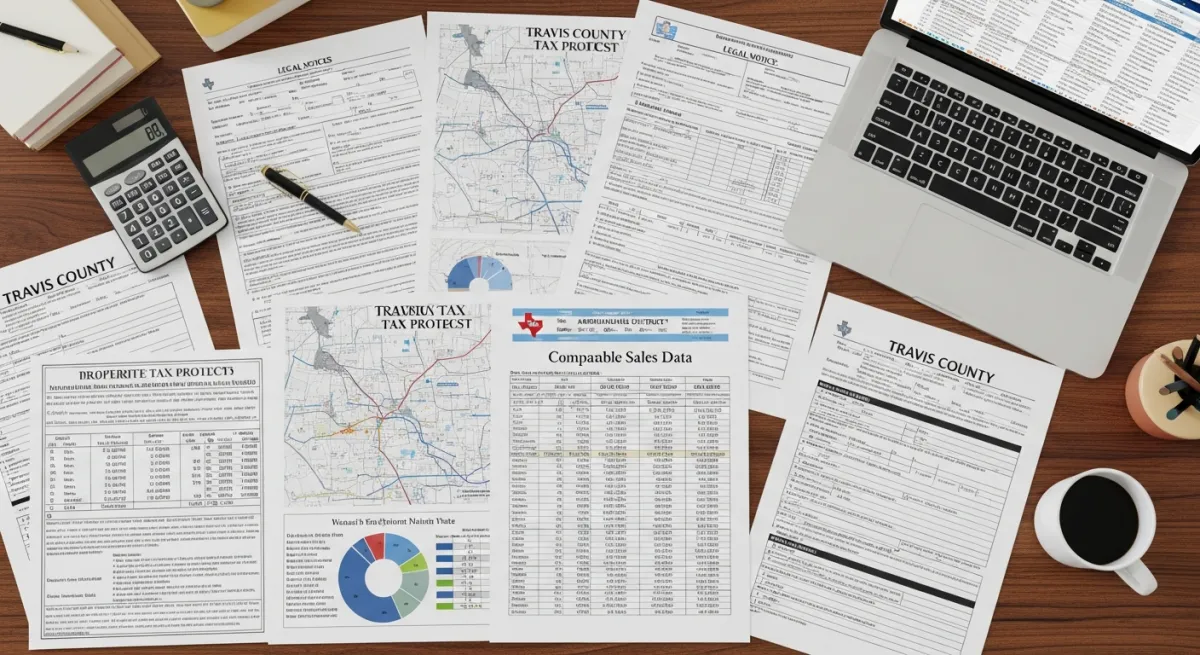
The composite case at the center of this piece: a 2025 protest on an appraised value of $585,000. The homeowner pulled six comparable sales from a four-block radius — arm’s-length transactions that closed between June and December 2024, ranging from $508,000 to $565,000 for homes with similar square footage and lot sizes, averaging $539,000. She also included a roofing contractor estimate for $14,500 in deferred work flagged by a pre-sale inspection. The evidence packet ran eight pages: a cover sheet stating the requested value, a comp table with addresses, sale dates, and square footage, a map showing comp locations relative to the subject property, and two photos of the roof with the estimate attached. Eight pages. That’s it.
The Two-Stage Process: Informal Hearing First, ARB Second
After you file — and after any iSettle offer if you go that route — TCAD schedules an informal meeting between you and a staff appraiser. In recent cycles, most residential cases have been handled by phone, though some are scheduled in person at 850 E. Anderson Lane. The informal stage is a negotiation, not an adversarial proceeding. The appraiser has latitude to adjust the value if your evidence supports it.
These calls typically run 20 to 30 minutes. Go in with a specific number you’re requesting — not “lower than this” but an exact figure backed by your comps. Appraisers respond to specific, documented requests. If the appraiser makes an offer, you don’t have to accept it on the spot. Ask to review it. If it’s reasonable relative to what the evidence supports, take it.
If you reject the informal offer or don’t reach agreement, your case goes to the Appraisal Review Board — an independent citizen panel that hears property tax protests. ARB hearings are held at 850 E. Anderson Lane. Based on 2023 and 2024 cycle data, wait times from filing to ARB hearing ran roughly six to ten weeks after the protest deadline. Verify current 2026 scheduling at tcad.org or call 512-834-9138; volume and staffing affect timelines year to year.
The ARB takes significantly longer, and the incremental gain over a reasonable informal settlement is rarely worth the additional months. If you do proceed, one rule matters above everything else: the 14-day evidence exchange requirement under Texas Property Tax Code §41.67. You must submit your evidence to TCAD at least 14 days before your scheduled ARB hearing, and TCAD must do the same for you. Show up with evidence that wasn’t exchanged in advance, and the board can exclude it. No exceptions. Put the exchange deadline on your calendar the moment your hearing is scheduled.
In the composite case, the homeowner never reached the ARB. At the informal stage — a 25-minute phone call — the six comps and the roofing estimate produced an offer to reduce the value to $552,000. She accepted. At a combined rate of roughly $1.80 per $100, the $33,000 reduction saves approximately $594 per year.
What Reduction to Realistically Expect
Set honest expectations before you file. TCAD’s ARB results data shows that roughly 50–60 percent of Travis County protests in recent cycles yielded some reduction. The median successful reduction for homestead properties has historically run in the 3–8 percent range. On a $600,000 appraisal, 5 percent is $30,000 — worth roughly $540 annually at the combined rate. That’s the central tendency, not a promise.
Outcomes vary significantly by neighborhood. In East Austin, Hyde Park, and other urban core areas that saw sharp appreciation through 2021 and 2022 followed by a softening market, there’s often real evidence of sales below TCAD’s market value. Those protests tend to go better. In Steiner Ranch, the Lake Travis corridor, and areas where values have held or kept rising, TCAD’s estimates may actually be conservative relative to recent sales. A quick scan of comp sales before you invest hours in the process will tell you whether the evidence is likely to support a reduction at all.
Missing the deadline is a hard stop. If May 15 passes without a filed protest, there’s no recourse for the 2026 tax year.
Before You File: Exemptions, Errors, and Five Things to Check
A protest and an exemption application are different filings. Exemptions reduce your taxable value regardless of appraised market value — worth confirming before you spend time on a protest.
The most important exemption for Austin homeowners: the homestead exemption, which now includes a $100,000 school district exemption under SB 2. If your homestead exemption doesn’t reflect that, file an amended application at tcad.org. Also check whether you qualify for the over-65 exemption, disabled person exemption, or disabled veteran exemption. Each carries additional relief that no protest result can replicate.
Before you file, run through these five items in our home & property coverage for additional context on Austin-area ownership decisions, then confirm the following:
-
Confirm your county. Is your property under TCAD or WCAD? Check your tax statement or search at tcad.org. If you’re in Williamson County, go to wcad.org instead.
-
Locate your TCAD account number. It’s on your Notice of Appraised Value. You need it to file online.
-
Note the appraisal date. January 1, 2026. This determines which comparable sales are relevant.
-
Pull your comp sales. At least six arm’s-length transactions from TCAD’s property search — similar properties, similar proximity, closed in 2025. Filter out foreclosures and non-qualifying transfers.
-
Save your notice. Keep a digital copy of the notice as mailed, including the market value, assessed value, and mailing date. If there’s ever a question about the deadline or the baseline value, you want that record.
Key contacts: TCAD’s main line is 512-834-9138. The protest portal and property search are at tcad.org. TCAD’s office and ARB hearing location is 850 E. Anderson Lane, Austin, TX 78752.
The composite case — an East Austin homeowner, eight pages of documentation, a half-hour phone call — produced a $33,000 appraisal reduction with no professional help. At current rates, that’s roughly $6,000 over the next decade. The deadline is May 15. The portal is at tcad.org.