Is It Cheaper to Rent or Buy in Austin in 2026 If You Plan to Stay Five Years?
The honest answer, built from Travis County tax rolls and actual submarket rents, is that five years puts you right at the knife's edge. Which side you land on depends almost entirely on your appre…

Is It Cheaper to Rent or Buy in Austin in 2026 If You Plan to Stay Five Years?
The honest answer, built from Travis County tax rolls and actual submarket rents, is that five years puts you right at the knife’s edge. Which side you land on depends almost entirely on your appreciation assumption. And if you’re hoping I’ll tell you one answer fits everyone, I can’t — and anyone who does is selling something.
Why National Calculators Fail Austin Residents
Every major financial website has a rent-vs-buy calculator. Almost none of them will give an Austin resident a useful answer.
The problem isn’t the math. It’s the inputs. National calculators typically plug in a 1.2% property tax rate — a reasonable approximation for somewhere like suburban Columbus. In Travis County, the combined effective rate runs 1.8–2.1% depending on which taxing entities cover your parcel. On a $450,000 home, that gap corrupts the model before you’ve touched anything else.
Austin’s homeowners’ insurance premiums bear no resemblance to national medians. The metro sits in one of the most active hail corridors in the country — not marketing language, just meteorology. Wildfire interface risk is real in the western and northwestern parts of the city. A HO-3 policy on a $450,000 home in Austin runs $2,400–$4,200 annually, reflecting the 20–40% premium increases since 2022. That’s a variable no national model captures.
The calculators also treat Austin as a stable, mature rental market. It isn’t. The 2022–2025 period saw an enormous wave of new apartment supply hit the market. That wave has mostly crested, but its legacy is a rent environment meaningfully softer than the 2022 peak. A calculation that anchors to peak rents to make ownership look more competitive does the reader a disservice.
And Austin isn’t one market. The rent-vs-buy math in Pflugerville is a different problem than the math in Bouldin Creek. Central Austin has different tax treatment than the Domain area. Treating them the same is where generic guidance fails the people who actually live here.
This piece uses Travis County–specific effective tax rates, current submarket rent data, a realistic Texas homeowners’ insurance range, and a 6.875% mortgage rate — the approximate prevailing 30-year conventional rate in Texas at publication. The goal is a model that tells a real Austin household something true.
What Austin Rents Actually Cost Right Now, by Submarket
Before you can evaluate ownership, you need an honest baseline for what renting actually costs in the neighborhood you’re considering.
Central Austin — the downtown core, Clarksville, Old West Austin — commands the steepest rents. One-bedrooms in 78701 and 78703 run about $1,550–$1,900 per month; two-bedrooms in the same zip codes hit $2,100–$2,700. New high-rise supply along the Sixth and Lamar corridor has pushed concessions into the market, with some landlords offering four to six weeks free on 12-month leases. These are asking rents, not net-effective rents. If you’re calculating true monthly cost, subtract that concession value proportionally across the lease term. That distinction matters more than people realize.
South Austin — Bouldin Creek, Travis Heights, South Congress, South Lamar — is a different story. One-bedrooms in 78704 range from $1,450–$1,850 depending on age and exact location; two-bedrooms from $1,900–$2,500. The submarket has seen modest softening from new supply along South Lamar, but 78704’s desirability keeps floors relatively high. Smaller bungalow rentals here command premiums that new apartment product doesn’t. The rental stock is older and more fragmented, which means availability is thinner — and landlords know it.
The Domain area and surrounding North Austin corridors absorbed the supply wave most directly. New apartment deliveries in 2023–2024 were heaviest in 78758 and 78759, and concessions are still visible. One-bedrooms currently run $1,300–$1,650; two-bedrooms $1,700–$2,200. If you’re willing to live in slightly older stock or farther north on Lamar, you can drop into the $1,100–$1,400 range for one-bedrooms. Whether the rent savings justify the commute time into central Austin is something only you can price.
East Austin — the 6th Street corridor, Holly, MLK, and the 78721 zip codes south and east of there — complicates simple pricing. One-bedrooms range from $1,400–$1,750; two-bedrooms $1,850–$2,400. Like 78704, East Austin’s cultural identity has limited how far rents have fallen even as new supply came online. New product in the 78721 corridor is softer and offers some of the better concession deals in the city for renters who want proximity without the premium address. The tradeoff is that you’re renting an apartment, not a house with any particular character.
For a realistic two-bedroom baseline across the metro center — somewhere decent, well-located, within range of jobs and commerce — budget $1,900–$2,400 per month. That’s the number against which a comparable ownership scenario must compete.
The True Monthly Cost of Owning a $450,000 Home in Austin
This is where the exercise gets uncomfortable for buyers. It’s also where using correct local inputs stops being academic.
Start with the debt service. Assume a $450,000 purchase price with 20% down ($90,000), leaving a $360,000 loan. At a 6.875% 30-year fixed rate, the principal and interest payment is approximately $2,365 per month. That’s the baseline. Everything else stacks on top of it.
Property taxes in Travis County are not a minor line item. The combined effective rate — incorporating the City of Austin levy, Travis County proper, the Austin ISD rate post-compression under HB 3, Austin Community College, and the Central Health hospital district — lands at roughly 1.85–2.05% on most City of Austin parcels. On a $450,000 assessed value, that translates to about $730 per month. Nearly $9,000 a year. Paid monthly whether you’ve paid off the house or not.
Homeowners’ insurance is another shock for buyers coming from lower-risk regions. Austin’s position in Hail Alley is not theoretical — the 2023 storm season reminded homeowners and their insurers of that with substantial losses. A standard HO-3 policy on a $450,000 home currently runs $2,400–$4,200 annually. Homes in the wildland-urban interface in West or Northwest Austin face further premium pressure; some insurers have withdrawn from those areas entirely. Budget $250–$290 per month, with the higher end for anything touching the interface zone.
Then there’s maintenance. The standard recommendation of 1% of home value per year is often cited as a baseline. In Austin, it’s the minimum. This is Blackland Prairie clay country. Foundation movement is a real issue in drought cycles and after heavy rain, and even well-maintained homes can develop settling problems. Hail-damaged roofs happen regularly and run $15,000–$25,000 to replace. Budget $375 per month, and know that some years will blow past that number — a foundation repair can run $10,000–$30,000 on its own. That’s exactly why the reserve needs to exist before you need it, not after.
HOAs vary too much to generalize. Basic neighborhood associations run $50–$100 per month. Condominiums and master-planned communities run $200–$500 or more. For this model, assume a non-HOA detached home and add your specific fee explicitly if it applies.
Adding it up: $2,365 for principal and interest, $730 for property taxes, $270 for insurance (midpoint), $375 for maintenance. Total: roughly $3,740 per month.
The realistic range, accounting for insurance variation and assessed value differences, is $3,665–$3,820. This figure does not include any federal tax benefit from mortgage interest deduction — because most Austin homebuyers in 2026 won’t receive it. The 2017 tax changes raised the standard deduction high enough that it exceeds itemized deductions for most households, especially single filers and couples without unusually large deductible expenses. If a lender is emphasizing the mortgage interest deduction as a selling point, ask them to run your specific numbers before you factor it in.
The gap between $3,665–$3,820 monthly ownership cost and the $1,900–$2,400 rental baseline is roughly $1,265–$1,920 per month. That gap is what appreciation and equity accumulation need to overcome for ownership to make financial sense over five years. It doesn’t close on its own.
The Property Tax Problem, and Why Moving to Williamson County May Not Fix It
Travis County’s effective rate gets complained about constantly. The complaints are justified. On a $500,000 home, you’re paying roughly $9,000–$10,000 per year in property taxes alone.
The conventional move for buyers trying to escape this is to cross the county line into Williamson County — Round Rock, Cedar Park, Georgetown, Leander. The pitch is lower tax rates. The reality is messier. Williamson County’s effective rates typically run 1.9–2.3%. That’s often higher than City of Austin proper, despite the common perception. Many master-planned developments in the growth corridors of Leander, Pflugerville, and northeastern Williamson County carry Municipal Utility District assessments adding $50–$150 per month on top of the base property tax bill. When MUD debt service is totaled alongside county, ISD, and other levies, buyers who expected to save significantly by crossing the county line frequently find the combined burden within range of what they would have paid in Austin proper. You’ve changed your zip code without changing your effective tax burden — and added 15–30 minutes to your commute. That’s not a trade I’d take.
The meaningfully valuable tax advantage of ownership in Austin — regardless of county — is the homestead exemption. Texas provides a $100,000 school district exemption on a homesteaded property, which at current AISD rates translates to roughly $970 in annual savings. More valuable over time is the 10% annual appraisal cap: once you’re homesteaded, the Travis Central Appraisal District cannot raise your assessed value more than 10% per year regardless of what the market does. In a rapid-appreciation environment, this protection compounds. After five to seven years of the cap, your assessed value can fall substantially below market value, creating real tax savings that accumulate in the background. Renters get none of this. Their landlord’s tax bill may be capped, but there’s no mechanism that forces those savings to pass through to rent. In practice, they don’t.
The Closing Cost Drag
Before you can compare monthly costs, you need to account for the money you spend just to acquire the property.
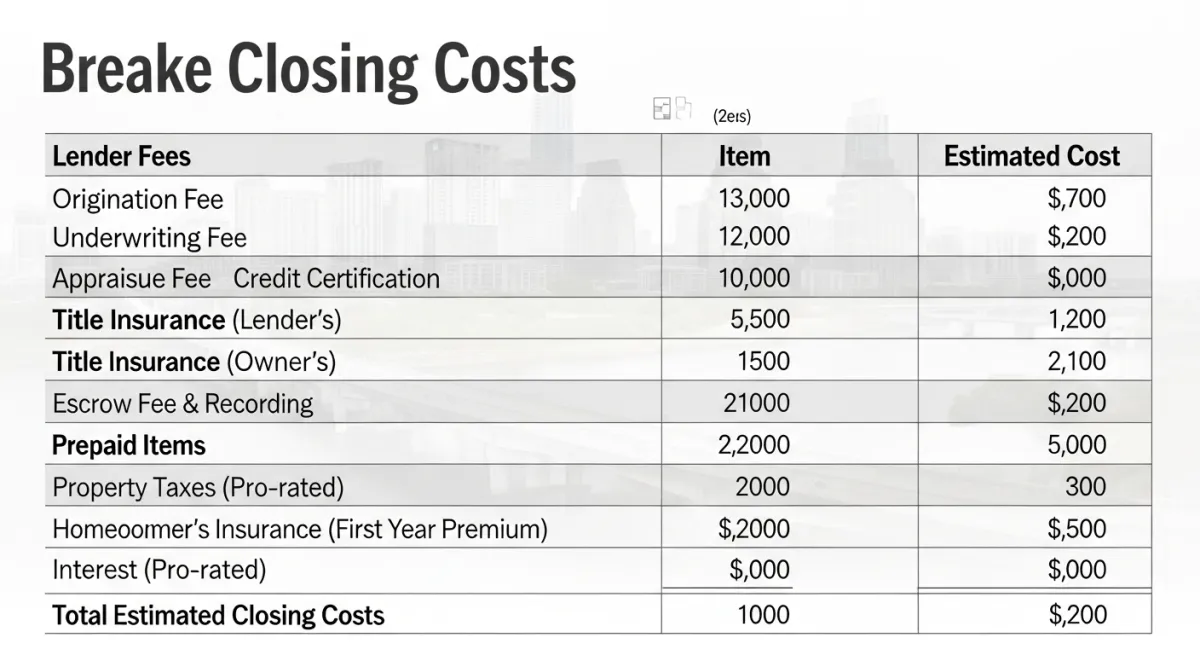
Texas has state-regulated title insurance, which creates consistency but does nothing to reduce the cost. On a $450,000 purchase: title insurance (owner’s and lender’s policies) runs $2,800–$3,200. A required survey — Texas lenders require a current survey — runs $500–$800. Lender origination and processing fees typically land $2,250–$4,500. Prepaid items (insurance escrow, tax escrow, prepaid interest) typically run $3,500–$5,000. Recording fees and miscellaneous costs add another $300–$500.
Total cash required at closing beyond the down payment: call it $15,000. That hole needs to be filled before you’ve earned a single dollar of net advantage over renting. Spread over five years, it adds roughly $250 per month to your true cost of ownership — a cost that shows up as a lump sum on closing day and promptly gets forgotten in every subsequent rent-vs-buy conversation.
The exit cost is larger and more commonly ignored. A 6% sales commission on a $450,000 home at resale runs $27,000. Even in the post-NAR settlement environment, transaction costs on the selling side are a substantial claim on whatever equity you’ve built. In a scenario where you’ve accumulated $40,000–$50,000 in equity through a combination of paydown and appreciation, that $27,000 commission absorbs more than half your gain. The math only works if appreciation is sufficient to cover both ends.
The Opportunity Cost Nobody Puts in the Calculator
The $90,000 down payment is real money with a real alternative use.
Invested in a diversified index fund at a conservative 6–7% annual return, that $90,000 generates roughly $450–$525 per month in growth. Over five years at 6.5% annual returns, that $90,000 grows to approximately $123,000. You gave up $33,000 in investment growth by locking the capital in a down payment. That’s not an argument against buying. It’s just a cost that deserves to sit on the ledger alongside everything else.
The counterargument is that you’re building equity instead. True, but modest. In the first year of a $360,000 loan at 6.875%, you’ll pay roughly $24,400 in interest and retire roughly $3,900 in principal. Over the first five years of a 30-year mortgage, principal paydown amounts to about 5–6% of the original loan balance. Mortgage paydown alone is slow going in year one through five. The equity story depends heavily on price appreciation — which is the central variable.
Break-Even Scenarios for Austin
Three cases, using Austin-specific inputs.
At 0–1% annual appreciation, the transaction costs, opportunity cost of the down payment, and monthly ownership premium over renting push break-even to seven to nine years. This assumes Austin homes appreciate modestly or stagnate — not unreasonable given the 2022–2025 correction that returned prices close to long-run trend. A buyer who sells after five years in this scenario will have paid transaction costs at entry and exit, forgone investment returns on the down payment, and carried the monthly premium every month. They come out behind. That’s the math, and it’s not close.
At 2–3% annual appreciation — roughly consistent with long-run Austin metro appreciation excluding the pandemic — a $450,000 home reaches roughly $497,000–$521,000 after five years, generating $47,000–$71,000 in gross appreciation. Net of combined transaction costs (roughly $42,000 entry and exit), net of the opportunity cost on the down payment ($33,000), and net of the monthly ownership premium over five years ($76,000–$115,000 depending on your rental alternative), break-even falls somewhere in the five-to-six-year range. Five years is right at the edge. A buyer who stays exactly five years in a moderate-appreciation environment breaks even roughly, with the homestead exemption’s compounding either pushing them slightly positive or keeping them just negative. It’s that close.
At 4–5% annual appreciation, the timeline compresses. A $450,000 home approaches $547,000–$574,000 after five years. That cushion covers transaction costs, opportunity cost, and monthly premium with room to spare. Break-even falls closer to three to four years, and a five-year holder comes out meaningfully ahead. But this scenario needs a catalyst — constrained supply as the construction pipeline thins, resumed tech sector expansion, something specific. Assuming 4–5% appreciation because that’s what Austin did in 2021 is not a thesis. It’s a memory.
Heading into 2026, the market is tracking somewhere between conservative and moderate. The City of Austin’s HOME Initiative — which allows up to three units by right on any single-family lot starting in 2025 — adds supply-side pressure that could dampen appreciation in inner-ring neighborhoods over the next five to seven years. On the other hand, the apartment construction pipeline is thinning, which may tighten the rental market and push more demand toward ownership over the next two to three years. Both forces are real. My read is that the moderate-appreciation scenario is the appropriate baseline for planning purposes, not the optimistic one. But I’d encourage some humility in either direction. The five-year horizon sits precisely at the margin.
Three Austin Submarkets Where the Math Looks Different
Mueller, the 78723-zoned mixed-use development built on the site of the old Mueller Hospital, is one of the few places in Austin where you can make a direct apples-to-apples comparison. The master-planned development has both rental units and for-sale homes within the same project — same walkability, same amenities, same commute math. For-sale homes currently list in the $450,000–$700,000 range, with a mandatory HOA of roughly $150–$200 per month. Mueller has demonstrated consistent demand and price stability that makes the moderate-appreciation case more defensible here than in outer-ring submarkets. For a buyer who wants that specific community and has a honest five-to-seven-year commitment, Mueller is the closest thing Austin has to a straightforward buy decision. For someone on a three-year lease cycle or genuinely uncertain about staying, renting within the development is the better financial call.
South Congress and Bouldin Creek in 78704 make the ownership case difficult on any reasonable medium-term timeline. Bungalows in Bouldin Creek trade at $600,000–$850,000 — frequently more for anything with a garage and recent updates. The monthly ownership cost at those price points, after property taxes, insurance, and maintenance reserve, is significant against a two-bedroom rental baseline in the same neighborhood of $1,900–$2,500. In 78704, you’re paying for neighborhood identity and a bet on long-term appreciation in one of the most desirable zip codes in Texas. As we cover in our home & property coverage, the math doesn’t work decisively until the ten-year mark or beyond. If you’re buying in 78704 in 2026, be clear-eyed that you’re making a lifestyle decision and a long-term wealth bet, not a five-year financial optimization. That’s a fine reason to buy. Just don’t tell yourself it’s purely financial, because the numbers don’t support it.
Pflugerville makes the suburban ownership pitch in 78660, where single-family homes run $320,000–$380,000. The problem is that the “buy cheaper in the suburbs” thesis requires scrutiny. MUD fees of $50–$150 per month are common in newer developments, and Williamson County’s effective tax rate typically runs 1.9–2.3% before those overlays. Here’s the thing about Pflugerville that surprises people: the buy-vs-rent math is actually closer to balanced than they expect, but not because ownership is a great deal — it’s because both sides of the equation reset lower together. Rents in 78660 are considerably lower than central Austin. One-bedrooms run $1,000–$1,250; two-bedrooms $1,300–$1,600. The gap between ownership costs and rental costs doesn’t change as dramatically as the absolute dollar difference in home prices suggests. Buyers with a genuine five-plus-year commitment and a local employment anchor can make a reasonable case. Buyers who are stretching to buy there while working downtown need to price the commute honestly — a 30-minute drive five days a week costs real money and real time, and both should come off any apparent savings.
Six Questions That Actually Determine Your Answer
How long will you stay? The five-year threshold is real but thin. If there’s genuine uncertainty — a job that might relocate you, a relationship in flux, a strong possibility of upsizing in two years — the conservative-case break-even math argues for renting. If you can honestly say six to eight years, ownership becomes a cleaner case even under moderate-appreciation assumptions. If you’re hedging your timeline, rent. You cannot hedge your way into a good buying decision.
Do you have 20% down without depleting reserves? The $90,000 down payment on a $450,000 home is the minimum. If clearing that amount leaves you with less than three to six months of expenses in liquid savings, you’re one foundation crack or one bad hail season away from a financial crisis. Austin’s maintenance realities are not gentle. Under-capitalized homeownership here is riskier than in markets with less geologic and climatic volatility. Don’t buy without reserves.
Can you absorb a significant unplanned repair in year two? Foundation issues, hail-damaged roofs, aging mechanical systems — these aren’t hypothetical costs in Austin, they’re nearly inevitable over a long enough horizon. A foundation repair can run $10,000–$30,000. A roof replacement after a hail storm is $15,000–$25,000. If you’d carry a large repair on a credit card, you’re not ready to buy.
Do you actually plan to itemize federal deductions? The mortgage interest deduction is frequently cited as a major benefit of homeownership and is frequently illusory. The 2017 tax law raised the standard deduction substantially enough that most Austin homebuyers — especially single filers and couples without unusually large deductible expenses — will take the standard deduction and receive zero marginal benefit from mortgage interest. Verify your situation with a tax professional before counting this benefit. Someone else’s talking points are not your tax situation.
Are you comparing ownership to a specific rental unit or to a national average? The calculation is only honest if you’re comparing a home you would actually rent to a home you would actually buy. Comparing a $450,000 purchase to the national median rent is useless. Comparing it to the specific two-bedroom in 78704 that you’d actually take — with its square footage, its commute time, its actual rent — gives you a number you can act on. Do the comparison at the submarket level. That’s the only version that means anything.
What is your appreciation assumption, and can you defend it? This is the variable that determines the outcome, and it’s the one most vulnerable to motivated reasoning. The Austin of 2020–2022 printed extraordinary returns, and that memory is still doing a lot of work in buying decisions I hear about. The subsequent correction brought prices close to long-run trend in many submarkets, and the recovery has been gradual. If you’re weighing home improvements that add resale value in Central Texas as part of your appreciation thesis, run the numbers honestly rather than assuming the market will do the heavy lifting. Anchoring to 2–3% annual growth is defensible. Anchoring to 8–10% requires a specific thesis about why Austin’s supply-demand dynamics will tighten significantly. If your answer is “because Austin always goes up,” that’s not a thesis. That’s hope.
The Bottom Line
For an Austin resident planning to stay five years, buying a $450,000 home in 2026 is a defensible financial decision. It’s not an obviously correct one.
The true all-in monthly cost of ownership runs roughly $3,740 for a non-HOA detached home, against a realistic two-bedroom rental baseline of $1,900–$2,400 in central submarkets. That monthly gap closes only with genuine appreciation, enough time for the homestead exemption to compound, and the discipline not to sell before transaction costs have been absorbed. In Mueller or a comparable supply-constrained central submarket, a buyer with a real five-to-seven-year commitment and full reserves makes a reasonable case. In Bouldin Creek, the math doesn’t work until the ten-year mark. In Pflugerville, the calculation is more balanced than the price difference suggests, but MUD-inflated effective tax rates and commute costs erode the apparent savings faster than buyers expect.
Nobody knows where Austin home prices go from here, and the people who claim otherwise are usually trying to sell you something — a house, a fund, a newsletter. The moderate-appreciation scenario isn’t guaranteed. Neither is stagnation. The honest conclusion is that five years in Austin puts you at the margin, and the decision you make should reflect that — not the assumption that you already know how it turns out.