What the Travis County Homestead Exemption Covers and Saves You
Austin homeowners on a median-value home are leaving roughly $1,700–$2,000 a year on the table. Here's who qualifies, what the dollar savings look like on a real Travis County home, and the one doc…

Austin homeowners on a median-value home are leaving roughly $1,700–$2,000 a year on the table. Here’s who qualifies, what the dollar savings look like on a real Travis County home, and the one documentation mistake that gets applications denied.
The homestead exemption is one of the most straightforward tax benefits available to Austin homeowners — and also one of the most commonly missed, which is maddening once you understand how simple it is to claim. It doesn’t apply automatically when you buy a home. TCAD’s own FAQ is accurate but dry, leaving most residents uncertain about what the exemption actually costs them in real dollars when they don’t have it. This piece explains that. If you own the home you live in and you haven’t checked your TCAD record recently, start here.
Am I Already Getting This Exemption?
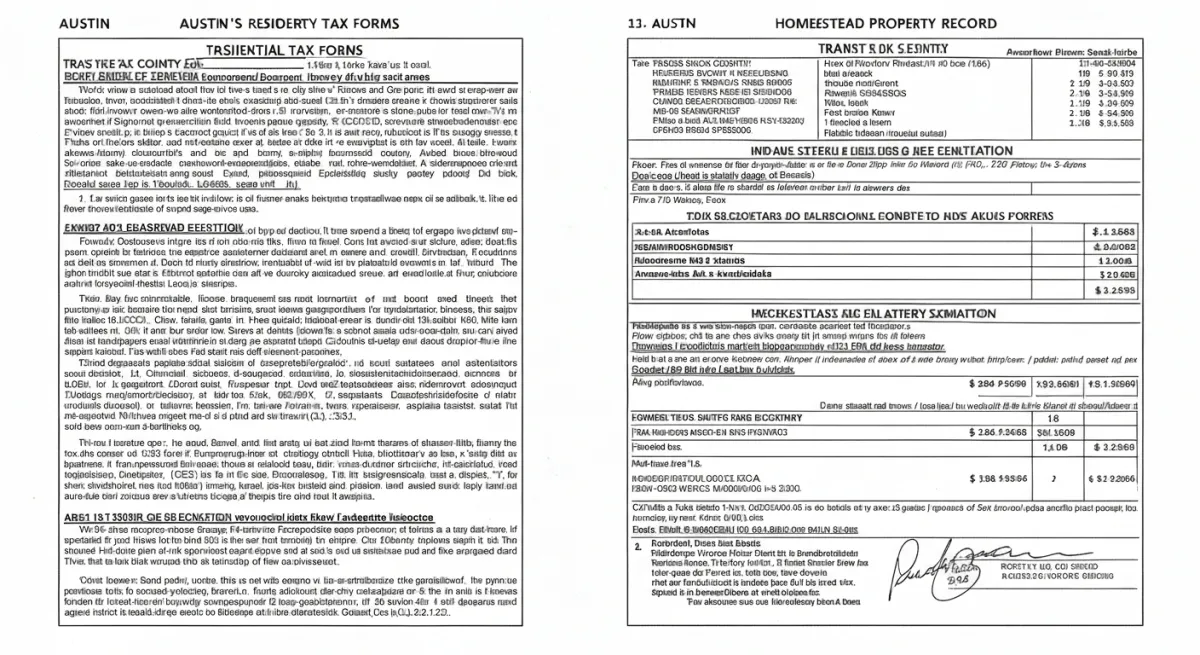
Before you do anything else, spend thirty seconds at tcad.org. Use the property search to pull up your address, then look at the exemptions listed on your property record. You’re looking for the designation “HS” — TCAD’s code for the homestead exemption. If you see it, you’re covered. If you don’t, or if you’ve never actually checked, keep reading.
A surprising number of Austin homeowners don’t have the HS code on their record. This is especially common among people who bought in the last several years, or who closed during the pandemic-era frenzy when paperwork moved fast and follow-up moved slow. Others discover they have the exemption but their driver’s license address was never updated — a problem that comes up again in the filing section, and it’s a bigger deal than it sounds.
What Is the Homestead Exemption, and Who Can Claim It?
The homestead exemption reduces property taxes for Texas homeowners who occupy a property as their principal residence. Renters can’t claim it. Owners of investment properties can’t claim it. A landlord who owns a duplex in East Austin but lives in Round Rock can’t claim it on the duplex. One exemption per household, owner-occupant only.
Two misconceptions come up constantly. First: the exemption transfers when a property sells. It doesn’t. When you bought your home, the previous owner’s exemption was on the tax record, but it expired on January 1 of the year following the sale. You have to apply.
Second: people treat the homestead exemption as a single, county-wide benefit. It isn’t. Travis County has multiple taxing entities — the county itself, the City of Austin, Austin ISD (or another school district depending on your address), Austin Community College, and others. Each one runs its own exemption on top of the base school district exemption. Think of it as a stack. The total dollar value depends on which jurisdictions cover your property, and some entities offer more generous optional exemptions than others.
You become eligible to file as of January 1 of the tax year in which you own and occupy the home. The deadline for the current tax year is April 30.
What Is the Homestead Exemption Actually Worth on a Real Austin Home?
This is the section most coverage skips. Here’s a real number.
Travis County’s median appraised value for a single-family home is approximately $575,000 based on recent appraisal data. The figures below use current tax rates and exemption structures — verify against TCAD’s certified rates before making financial decisions, since rates adjust annually.
The mandatory school district exemption under Senate Bill 2, passed in 2023, is $100,000. That’s the biggest single piece of the stack, and it meaningfully changed the math for Austin homeowners. On a $575,000 home, your taxable value for Austin ISD purposes drops to $475,000. At AISD’s current rate of approximately $0.8281 per $100 of assessed value, the savings come to roughly $828 a year.
Travis County offers an optional 20% homestead exemption — on $575,000, that’s a $115,000 reduction, bringing your taxable county value to $460,000. At the county’s rate of approximately $0.3474 per $100, that’s about $400 in annual savings.
The City of Austin also offers a 20% optional homestead exemption, with a $5,000 minimum floor. Same $115,000 reduction on a $575,000 home. At Austin’s city rate of approximately $0.4627 per $100, that’s roughly $532 per year.
Austin Community College and smaller entities add more, depending on location. Some MUD and health districts don’t offer a homestead exemption at all.
Put it together and homeowners on a median-value Travis County home save roughly $1,700–$2,000+ annually. Homeowners with higher appraised values will see proportionally larger savings on the percentage-based county and city exemptions. The school district exemption is a flat $100,000 regardless of home value.
How Do the Over-65 and Disability Exemptions Work on Top of the Standard Homestead?
These are a second layer, not a replacement. You must already qualify for the standard homestead exemption before adding either of them.
Travis County offers an additional $20,000 exemption for homeowners who are 65 or older or who have a qualifying disability. The City of Austin goes further — an additional $85,000 exemption for the same population. Both stack directly on top of the standard 20% exemptions.
The most valuable over-65 benefit is the school district tax ceiling, usually called the “freeze.” Once you qualify, your AISD tax bill is locked at the dollar amount you paid in the year you first qualified. It doesn’t matter if your appraised value doubles. For a long-term Austin homeowner in a neighborhood where values have run hard — 78702, 78704, 78751 are all striking examples — the freeze can mean thousands of dollars over time. Anyone watching what happened to appraised values in those zip codes over the past decade knows this isn’t theoretical.
You can’t claim both the over-65 and disability exemptions simultaneously. You pick one. Most homeowners who qualify on both grounds apply under over-65.
For the disability exemption, TCAD requires either a Social Security Administration disability determination letter or a physician’s statement on Form 50-114-A.
100% disabled veterans have access to a separate and substantially more generous benefit: a full property tax exemption on the residence homestead. This is distinct from the standard over-65/disability add-on. The required form is 50-135; TCAD can walk veterans or surviving spouses through the documentation.
Surviving spouses of over-65 or disabled homeowners may be able to maintain the tax ceiling if they were at least 55 at the time of the owner’s death and the home was already receiving the exemption.
What Does TCAD Actually Require, and What Is the Filing Deadline?
The deadline is April 30. Applications postmarked by April 30 count. Anything later falls into the late-filing window, addressed in the next section.
The form is Form 50-114, the Application for Residence Homestead Exemption. Download it at tcad.org or pick it up in person.
You can file online at tcad.org — the portal is faster than mail and gives you confirmation immediately. By mail or in person, the address is 850 E. Anderson Lane, Austin, TX 78752.
For the standard homestead exemption: Form 50-114 and a Texas driver’s license or state ID showing the property address. For over-65: the same form with the over-65 section completed, plus proof of age. For disability: add an SSA disability determination letter or physician’s statement on Form 50-114-A. For the 100% disabled veteran exemption: Form 50-135 plus VA documentation confirming the rating. If your property is held in a trust, bring trust documentation to support the application.
The single most common reason applications are denied: your Texas driver’s license lists an address that doesn’t match the property you’re claiming. This happens more than you’d expect. People move, forget to update DPS, file their exemption, and then get a denial notice six weeks later. If that’s your situation, update your license at a Texas DPS office before you file — give yourself enough lead time before April 30. TCAD will accept an affidavit explaining the discrepancy, but that adds processing time and isn’t guaranteed. The clean path is to fix the DPS record first. Texas law requires your license to show your current address anyway, so this isn’t an exemption-specific hurdle.
What If I Missed the Deadline?
Texas law allows late homestead exemption applications up to two years after the date the taxes for that year became delinquent. The penalty is 10% of the taxes that would have been reduced by the exemption — not 10% of your total bill. The math still works in your favor. If you’ve owned and occupied your home as your primary residence but never filed, file now even if you’re outside the current year’s deadline.
For over-65 and disability exemptions, the retroactive window is different. You can file up to one year after you turn 65 or become disabled and apply it to that qualifying tax year.
One more thing worth flagging for seniors who’ve recently moved: if you’re 65 or older and you sell your home and buy another in Texas, the school district tax ceiling can transfer to your new home. You need to notify the new school district’s appraisal district. If you or someone you know is a senior homeowner who recently moved and hasn’t addressed this, call TCAD. Don’t let it sit — the freeze doesn’t transfer itself.
I Have an ADU or I Rent Out a Room — Do I Lose the Exemption?
Since Austin’s HOME Initiative reshaped local land-use rules in 2023 — eliminating single-family zoning citywide and allowing up to three units per lot — ADU construction has accelerated. This question comes up constantly now, and the honest answer is: it depends, and some of it is genuinely unsettled.
The Texas Tax Code ties the homestead exemption to your principal residence, not to every square foot on your lot.
Renting a room inside your primary home generally leaves the exemption intact. You’re still occupying the property as your principal residence. TCAD’s general treatment is that the exemption applies to the owner-occupied structure.
A detached ADU is more complicated. TCAD may exclude the portion of assessed value attributable to that separate structure from the homestead exemption. Your primary home stays as your homestead, but you could lose the benefit on the ADU’s assessed value. Given what ADUs add to appraised values in Austin, that’s not a trivial distinction. If you’re weighing this decision, it’s worth reading up on what home improvements actually add resale value in Central Texas before committing to a build.
Short-term rentals are a genuine gray area. The Tax Code has no specific provision addressing intermittent homestead rentals, and TCAD’s application has been inconsistent in practice. The practical risk is highest when rental activity is extensive and documented — but even low-frequency Airbnb use is an unresolved question. My read: assume nothing and ask before you file.
If you have a detached rental unit, call TCAD at (512) 834-9317 before you submit. TCAD staff can walk through your specific situation and tell you how to complete the form accurately. Don’t assume full coverage and don’t assume zero.
A Few Travis County Situations That Don’t Fit the Standard Mold
If you inherited a home in East Austin or Hyde Park and you now live in it as your primary residence, you need to apply for the exemption yourself. The deceased owner’s exemption ended. It does not transfer at death. Similarly, if a home is held in a trust, you can still qualify as the trust’s qualifying trustee or beneficiary if you’re occupying the home, but you need to document that relationship for TCAD — Form 50-114 has a section for it. Given the volume of estate transfers happening in gentrifying Travis County neighborhoods right now, this isn’t a hypothetical edge case.
For homeowners near the Travis/Williamson County line: if your property is in Williamson County, you file with the Williamson Central Appraisal District, not TCAD. The exemption rules and forms are substantially the same, but the office, website, and contact information are different. This is a surprisingly common mistake for homeowners in Pflugerville, Cedar Park, and Leander, where the county line runs through established neighborhoods.
One timing issue worth flagging: TCAD mails its Notices of Appraised Value in April — the same month the April 30 exemption deadline falls. These are two separate things. Your appraised value sets your tax base; the exemption reduces what’s taxable from that base. When your notice arrives and the appraised value is higher than expected, that’s also the moment to confirm your exemption is in place, because both actions land in the same calendar window. Missing the exemption deadline because you were focused on filing a protest is easy to do and genuinely hard to undo. For context on how this fits into broader decisions Austin homeowners make, this article is part of our home & property coverage of local tax rules, ownership costs, and real estate issues specific to Central Texas.
Before You Close This Tab
TCAD online portal and exemption applications: tcad.org
TCAD phone: (512) 834-9317
TCAD office: 850 E. Anderson Lane, Austin, TX 78752
What to bring if you go in person: a completed or partially completed Form 50-114, your Texas driver’s license showing your property address, and any supplemental documentation that applies — proof of age, SSA disability letter or Form 50-114-A, VA rating documentation, or trust paperwork.
Filing deadline for the current tax year: April 30.
If you checked tcad.org at the top of this piece and didn’t find the HS designation on your property record, that’s your next move. Not next week. The April 30 deadline is fixed, the savings are real, and the application takes less time than the average trip to a Cedar Park Home Depot.